.svg)
.png)


.avif)
Global spending on AI keeps rising. Research shows that many companies invested $10 million or more in new AI systems in 2025, and the numbers continue to climb. Yet there is no single price tag for AI. A simple AI chatbot can cost about $5,000, while a top-tier model like Gemini Ultra can reach hundreds of millions. This wide range shows how artificial intelligence costs work in 2026: every project lands in a different place depending on scope, data readiness, and team structure.
At Azumo, we see this firsthand. The question "how much will this cost?" comes up in nearly every discovery engagement we run. To answer it properly, we compiled data from real AI projects: our own work across 100+ client engagements, including Meta, Discovery Channel, and Omnicom, as well as public cost disclosures, vendor pricing, and industry reports. We analyzed patterns across sectors, reviewed common pitfalls, and cross-checked our findings with expert insights, so this cost spectrum reflects real-world AI development rather than theoretical estimates.
Before you choose a direction, you need a clear view of the cost of AI and the main factors that drive it. This guide breaks that down.
How Do AI Project Budgets Vary Across Different Complexity Levels?
AI development cost works like the cost of a car. You can buy a small used car for a low price, or you can order a custom luxury model for a very high price. Both options move you from point A to point B, but they solve different problems.
In preparing this section, we reviewed AI project budgets across different complexity levels to map how costs scale with functionality and risk, which is why artificial intelligence costs vary so widely.
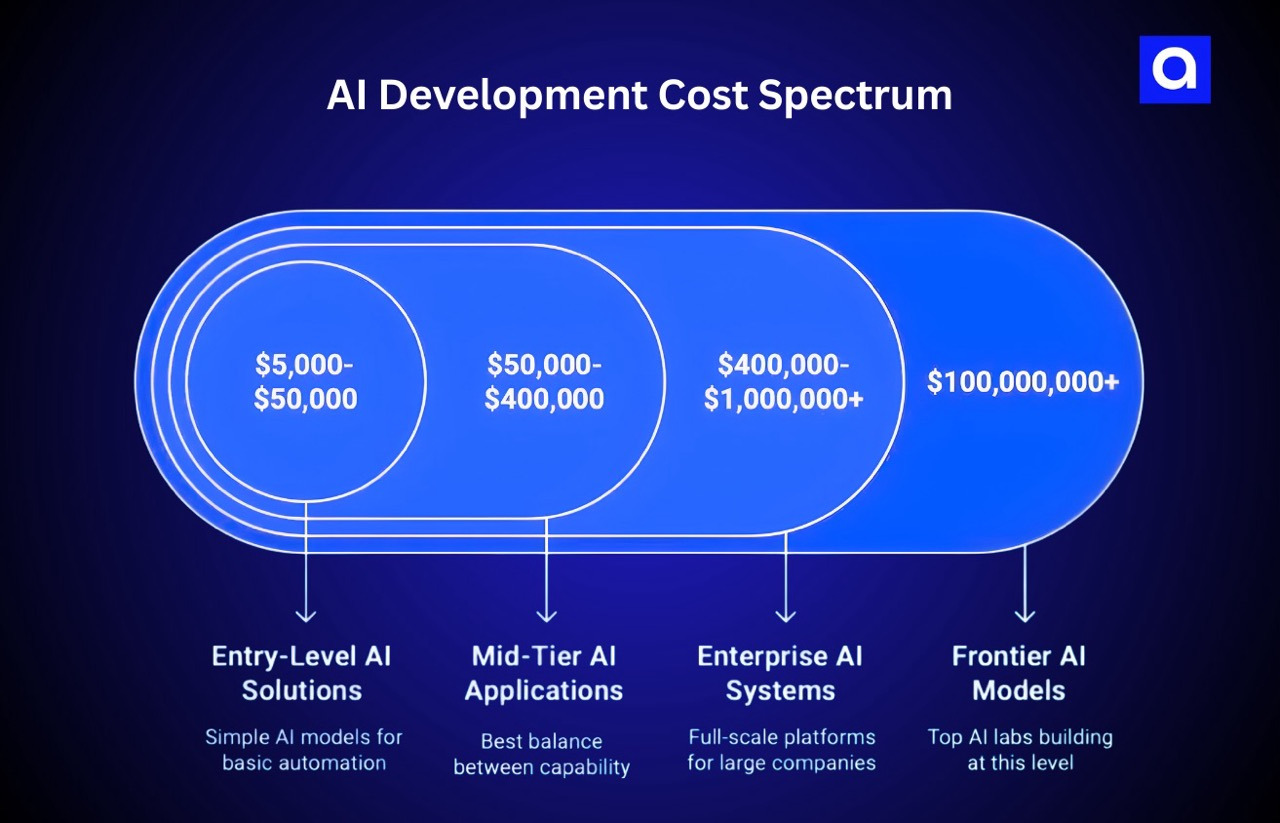
Entry-Level AI Solutions ($5,000-$50,000)
If you're looking at basic automation or simple AI features, you're probably in this range. According to Time, simple AI models typically fall between $5,000 and $50,000. This includes things like rule-based chatbots, basic recommendation systems, or simple image classification tools.
Our review of early-stage AI deployments shows that teams in this range prioritize speed and low risk over deep customization, which keeps initial AI development costs manageable.
Mid-Tier AI Applications ($50,000-$400,000)
This is where most serious business applications live. Medium-complexity projects typically range from $50,000 to $150,000, with more sophisticated implementations pushing toward $400,000.
AI chatbots with natural language processing cost $5,000 to $80,000. Medical chatbots cost $120,000 to $350,000 because the team must add domain knowledge and compliance. Recommendation systems can range from $10,000 to $200,000.
Based on our experience delivering mid-market AI implementations at Azumo, this tier delivers the best balance between capability, scalability, and artificial intelligence cost estimation accuracy, especially for teams adopting LLM models for real production use. This is where most of our AI development services engagements land.
Enterprise AI Systems ($400,000-$1,000,000+)
Large companies enter this range when they want full-scale platforms. AI development cost grows because the team builds complex systems that touch many parts of the business. In our research into enterprise AI programs, integration depth and long-term ownership consistently drove costs higher than model development itself, making this tier as much an operational investment as a technical one.
Predictive maintenance systems cost $200,000 to $2 million. Advanced computer vision for real-time work costs $200,000 to $700,000. Enterprise virtual assistants often sit between $25,000 and $100,000+, depending on the number of systems they connect to.
Here, we notice that the cost of AI grows fast because the platform touches many teams and systems. AI implementation costs also rise because the company needs long-term updates.
Frontier AI Models ($100 Million+)
Only top AI labs build at this level. AI development costs here start at $100 million and can reach $1 billion or more. To understand this tier, we reviewed public training cost disclosures and infrastructure estimates from leading AI labs, which show how extreme artificial intelligence costs become at the frontier level.
GPT-4 costs about $78 million in hardware. Llama 3.1-405B cost $170 million. Gemini Ultra costs $191 million. Some experts expect next-generation systems to hit $1 billion, and the next wave may reach $10 billion. A planned supercomputer for future models may reach $100 billion.
What are the 5 Major Cost Components of AI Development?
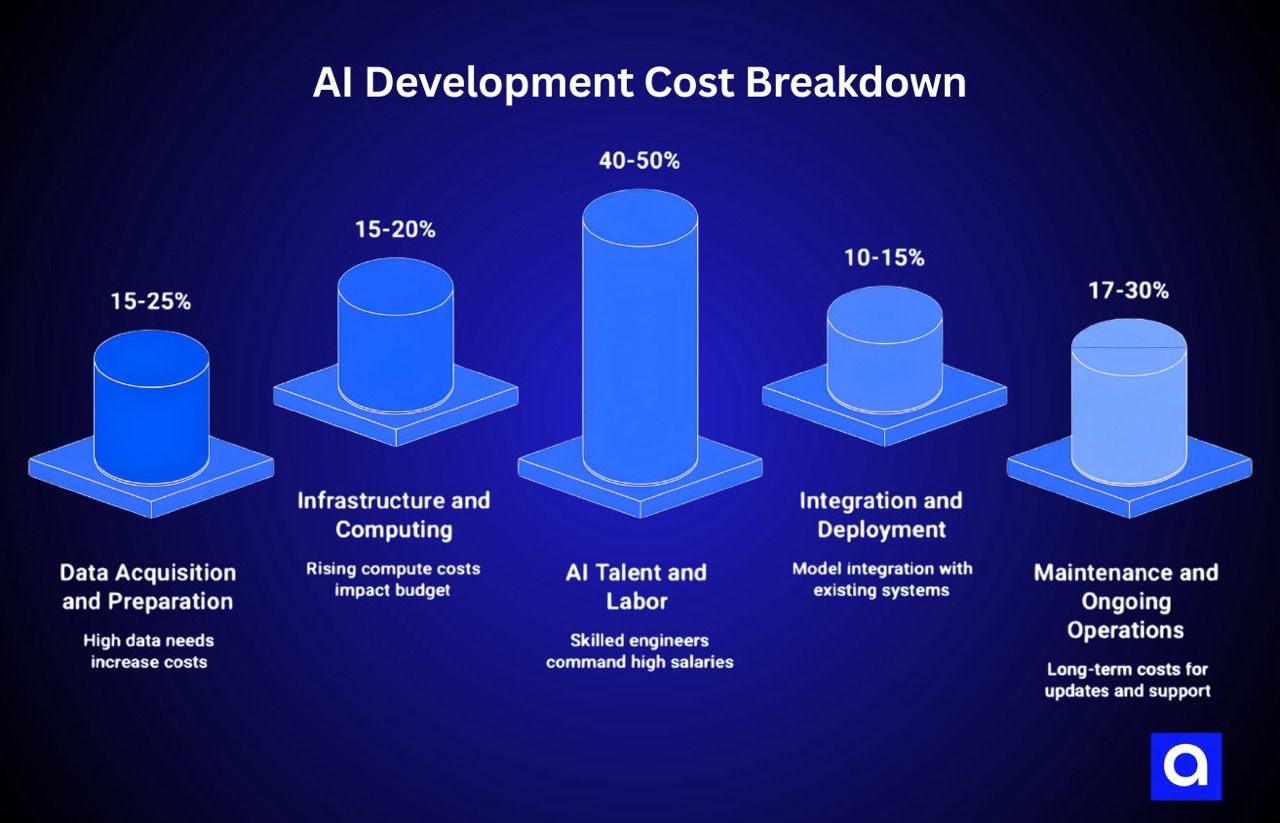
AI development companies create costs according to five main areas. Every area affects your total budget. When you understand these parts, you get a clear view of artificial intelligence costs and a more accurate artificial intelligence cost estimation.
Let us break it down for you.
1. Data Acquisition and Preparation (15-25% of Total Cost)
Data work creates one of the highest AI development costs. Most companies do not start with enough training data, and this problem increases the cost of AI quickly.
A complex project often needs 100,000 data samples. Data collection and preparation usually take 15% to 25% of the full AI development cost. The time commitment also grows at this stage because data scientists spend 60% of their work on cleanup and 19% on data collection. This means they spend almost 80% of their time on data instead of models.
If you buy 100,000 samples through Amazon’s data tools, you pay about $70,000. Cleanup takes 80 to 160 hours when errors or bias appear in the dataset. Many companies face this issue because 66% of datasets contain flaws.
Poor data creates heavy losses. Bad data forces companies to lose $12.9 million per year on average. When you invest in this step, you lower AI implementation costs later.
2. Infrastructure and Computing (15-20% of Total Cost)
Another thing that we didn’t leave unnoticed is that Infrastructure creates another large slice of AI development cost. Prices keep rising, and companies pay more each year for training and deployment.
Compute spending grew 89% between 2023 and 2025. GPU usage pushed cloud costs up 40% in one year. The average monthly AI infrastructure cost reached $85,521 in 2025 from $62,964 in 2024.
GPU prices vary:
- L40S: from $0.32/hour
- A100: from $0.40/hour
- H100: $0.99 to $8.00/hour
- H200: $2.14 to $2.50/hour
- 8x H100 cluster: $20 to $40/hour
Annual cloud costs for retraining and inference reach $50,000 to $500,000.
Idle compute creates even more artificial intelligence costs. 83% of container spend often comes from idle resources. This makes the cost of AI climb without delivering value.
3. AI Talent and Labor (40-50% of Total Cost)
Labor creates the highest AI development cost. Skilled engineers now hold some of the highest salaries in tech.
AI engineers in the U.S. earn $100,000 to $300,000 per year. Machine learning engineers average $175,000. Top AI talent earns $450,000 to $800,000 per year.
Hiring costs also rise because companies pay 28% more when a role includes AI skills. Some companies now pay 15% to 20% more because they waited too long to hire.
You can lower AI implementation costs by hiring worldwide:
- Eastern Europe: $30,000 to $70,000
- India: $20,000 to $50,000
- Mexico: about $58,075
A full U.S. team may cost $400,000+ per year, while offshore teams cost 50% to 70% less.
This is exactly the model Azumo uses: our nearshore AI engineers across 20+ Latin American countries work in your time zone at a fraction of U.S. rates, without sacrificing quality or communication.
4. Integration and Deployment (10-15% of Total Cost)
Integration drives a major part of AI development cost because the model must work with your current systems. Integration increases costs by 20% to 40%. Complex API connections or middleware add $30,000 to $100,000. Advanced deployment methods add $10,000 to $50,000.
Proper integration often takes 3 to 6 months, which increases your AI implementation costs. Security adds more cost. Strong security measures add 15% to 25%. Security audits cost $5,000 to $20,000 each.
At Azumo, all AI projects are delivered under SOC 2 compliance, with HIPAA and GDPR readiness built into engagements that require it, so security costs are accounted for from day one rather than surfacing as surprises later.
5. Maintenance and Ongoing Operations (17-30% Annually)
We’ll die on this hill: maintenance creates long-term artificial intelligence costs. Companies often underestimate this part of the AI development cost.
Annual maintenance usually costs 17% to 30%, but heavy regulatory work pushes this to 50%. Small applications cost $50,000 to $200,000 per year. Large enterprise models cost millions because they need constant updates.
Companies must keep 25% to 75% of their original build resources for ongoing support.
Ongoing costs include:
- Training systems: about $150,000/year
- Cloud retraining: $50,000 to $500,000/year
- Model tuning: $20,000 to $100,000/year
- Compliance updates: $10,000 to $50,000/year
These numbers show how much AI costs after launch, not just before it.
How Much Does AI Development Cost in Your Industry?
AI development costs change a lot from one industry to another. Each field deals with different rules, data types, and use cases. This creates big differences in artificial intelligence costs and AI implementation costs.
Healthcare AI Implementation
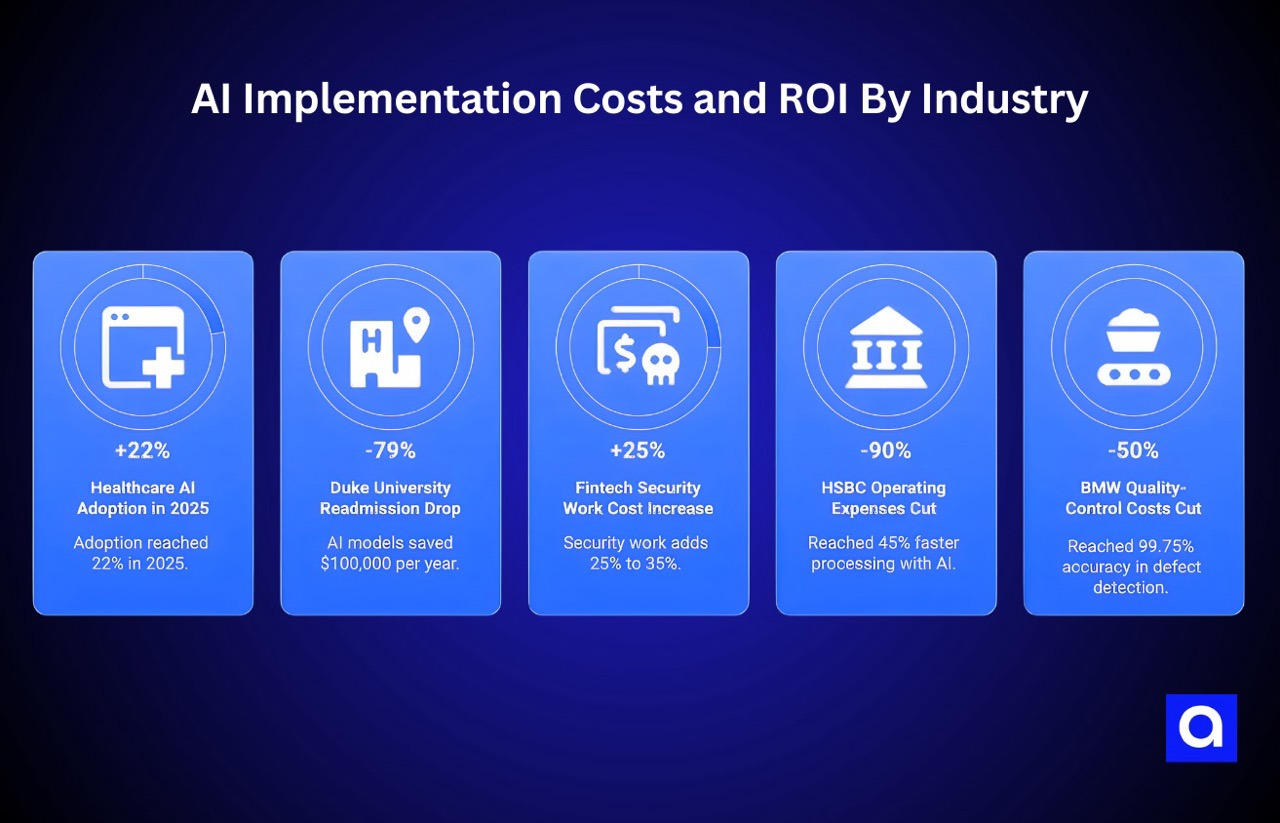
Healthcare faces some of the highest artificial intelligence costs because the industry deals with strict rules and sensitive data. AI spending in healthcare reached $1.4 billion in 2025, up from less than $500 million in 2024. Many organizations now use domain-specific AI, and adoption reached 22% in 2025.
Typical cost of AI in healthcare:
- Basic healthcare tools: $20,000 to $50,000
- Diagnostic tools and patient prediction models: $100,000 to $1 million+
- Medical chatbots: $120,000 to $350,000
Healthcare systems often gain huge returns. Duke University used AI models for chest radiographs and saw a 79% drop in readmissions, which saved $100,000 per year. Strong ROI helps justify the AI development cost in this field.
Financial Services AI
It’s no news for us that financial services deal with high artificial intelligence costs because of strict security rules. Fintech projects usually cost $50,000 to $150,000, but security work adds 25% to 35%.
Fraud detection cost of AI:
- Basic system: $30,000+
- Mid-level system: $100,000+
- Advanced system: $300,000+
Banks often recover these AI implementation costs fast. HSBC cut operating expenses by up to 90% in some back-office tasks and reached 45% faster processing with AI systems. These savings make the AI development cost worth it.
Retail and E-commerce
Retail and e-commerce usually deal with lower AI development costs. The data is easier to manage, and the use cases fit pre-built frameworks.
Typical cost of AI in retail:
- Recommendation engines: $10,000 to $200,000
- E-commerce chatbots: $20,000 to $100,000
The lower artificial intelligence costs help retailers adopt AI faster. This sector often sees quick results because teams can run simple models without heavy domain rules.
Manufacturing
Manufacturing deals with high AI development costs due to complex systems, large datasets, and automation needs. This industry often shows some of the highest AI implementation costs.
Common ranges:
- Predictive maintenance systems: $200,000 to $2 million
- Process automation: $500,000 to $5 million
The ROI often outweighs the artificial intelligence costs. GE cut downtime by 20% with predictive AI and saved millions each year. BMW used AI-based image tools and cut quality-control costs by 50% while reaching 99.75% accuracy in defect detection.
What Are the Hidden Costs That Derail AI Budgets?
AI development cost often looks clear at the start, but hidden expenses can push budgets far past the original plan. Many teams miss these numbers. Hidden costs can reach 35% to 50% of total spending. This creates a big gap between artificial intelligence cost estimation and real-world AI implementation costs. We always build contingency plans to avoid surprises and protect budgets.
The Data Surprise
Data problems create some of the biggest jumps in AI development cost. Companies often misjudge data needs and underestimate data acquisition. Many teams miscalculate the cost of AI data by up to 40%.
About 66% of companies face errors or bias in training data. Cleaning 100,000 samples needs 80 to 160 hours, which drives artificial intelligence costs up fast.
Bad data creates deeper losses. Picsellia reports that poor data quality costs companies $12.9 million each year. Good data protects your budget and cuts future AI implementation costs.
This is why Azumo's process starts with a paid 2–3 week discovery engagement that includes a thorough data assessment, so you understand your data readiness before committing to a full build.
Infrastructure Scaling
You also need to plan for compute expansion. This part often changes the AI development cost more than expected. Coherent Solutions states that many teams deal with 25% to 30% higher cloud expenses when models grow.
Tangoe’s report shows cloud costs rose 30% in 2024. Datadog adds another warning. 83% of container spending comes from idle systems. If you don’t watch usage, you pay for compute power you don’t use. This is one mistake that we think makes the cost of AI much higher.
The Integration Gap
Integration creates another sharp rise in AI development costs. When teams connect new AI systems to older tools, the work adds 20% to 40% to the total cost of AI. Custom APIs and middleware raise this number even more. These tasks can cost $30,000 to $100,000.
Most companies need 3 to 6 months to complete this stage. That time affects the final artificial intelligence costs and often becomes the biggest delay.
At Azumo, we have deep experience integrating AI into existing systems, including Salesforce, SAP, ServiceNow, and custom internal platforms, which helps compress this timeline and keep costs predictable.
Security and Compliance Costs
Security work increases the AI development cost in every industry. Strong safeguards add 15% to 25% to budgets. Regular security audits cost $5,000 to $20,000.
The risk of skipping this part is huge. AgentiveAIQ reports that the average data breach costs $4.45 million. GDPR violations can take up to 4% of global revenue. These numbers show why security remains a major part of artificial intelligence costs.
What to Expect From AI Investment Returns?
AI investments deliver strong returns for many companies. A Microsoft study (via Coherent Solutions) reports an average return of 3.5X, and 5% of companies even reach 8X. A Microsoft–IDC report says GenAI delivers 3.7X value for each dollar. Top performers create $10.30 for each dollar they invest.
EY reports that 97% of senior leaders who invest in AI see positive ROI. Snowflake also reports that 92% of early adopters see ROI.
But the full picture looks different when we look at long-term results. IBM research, says only 25% of AI projects met ROI expectations in the last three years. V7 Labs reports that the average ROI across enterprise AI sits at only 5.9%. Fullview notes that most companies reach solid returns only after 2-4 years, which is much slower than the usual 7-12 month payback period for other tech investments.
If you expect quick wins, you may feel disappointed.
Where Organizations See the Biggest Gains
EY shows that leaders who invest at least 5% of their budgets in AI gain the strongest results:
- Employee productivity: 76% see positive ROI (vs. 62% for lower budgets)
- Cybersecurity: 74% vs. 58%
- Product innovation: 78% positive results
- Competitive advantage: 73% vs. 47%
Fullview reports that workers who use AI feel 40% more productive. A Harvard Business School study shows that workers finish tasks 25.1% faster with more than 40% quality improvement. Developers who use tools like GitHub Copilot code up to 55% faster.
AI also cuts costs. Companies that use AI tools report 54% lower operational costs. Fullview notes that AI adoption can reduce total operations spending by up to 20%.
The Challenges Worth Knowing
EY reports that 67% of leaders face negative effects from AI projects. 66% believe these issues will grow. AI talent remains the biggest barrier. 57% of leaders struggle to scale AI because they cannot hire enough experts. 40% of leaders also raise concerns about ethics, privacy, or governance.
These points do not mean you should avoid AI. They simply show that strong planning, strong oversight, and clear expectations will lead to better outcomes.
Build vs. Buy: Making the Right Choice for Your Budget
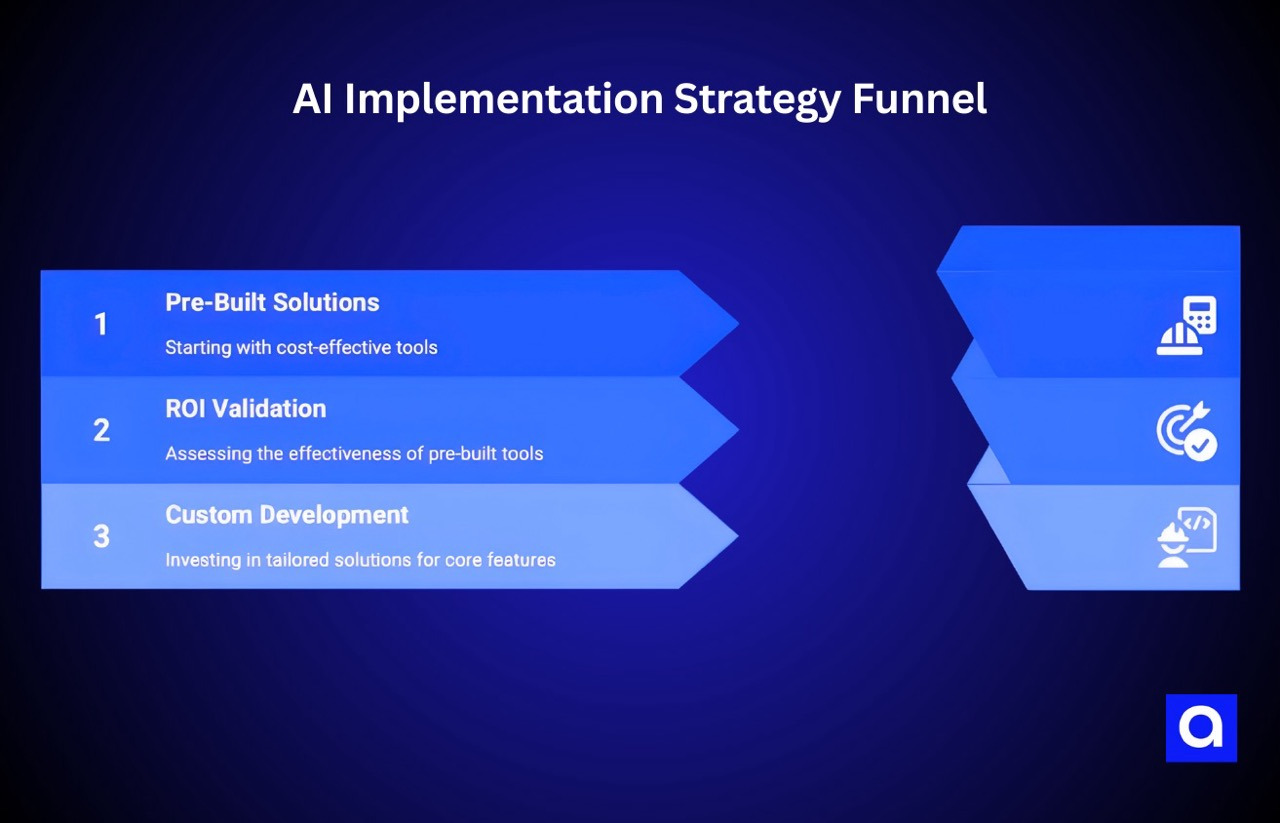
You face one major decision when you plan your AI strategy. You must choose to build a custom system or buy a pre-built one. This choice affects your AI development cost, your timeline, and your results. It also shapes your artificial intelligence costs and the total cost of AI inside your business.
When Pre-Built Solutions Make Sense
Pre-built tools offer the lowest AI development costs. Prices start at $20 to $100 per month according to Future Processing. AI-as-a-Service platforms cost $500 to $5,000+ per month, which stays far below the cost of custom systems. You can also use open-source LLMs to get advanced AI features without paying for full commercial licenses. This approach keeps AI implementation costs low while still accessing high-quality language models.
Pre-built tools fit best for:
- Standard use cases like customer support
- Simple automation
- Quick wins and proof-of-concept work
- Teams with limited technical talent
- E-commerce recommendation engines
The benefits are simple. You spend less upfront, you lower your artificial intelligence costs, and you get to market faster. You also reduce your AI implementation costs because vendors include updates and support. You trade deep control for speed and convenience.
When Custom Development Is Worth It
Custom development creates a higher AI development cost, but it unlocks more power. Prices range from $50,000 to $1,000,000+. These numbers show the true cost of AI when you aim for unique features or full control.
Custom development works best when you need:
- Unique algorithms or proprietary data models
- Deep links to complex internal systems
- Industry-specific needs like medical diagnostics or fraud detection
- Strategic advantages that no competitor has
- Full ownership of your data
Custom systems help you scale, integrate, and control outcomes. You pay more upfront, and you face higher AI implementation costs, but you gain long-term value and strong control over artificial intelligence cost estimation.
The Hybrid Approach
Many companies choose a mix. They start with pre-built tools for quick validation. This stage usually costs $5,000 to $20,000. After they prove ROI, they invest in custom development for core features that drive revenue. These custom builds often start at $100,000+.
This path helps you control your total AI development costs and avoid overspending before you understand what works. You reduce early artificial intelligence costs while you plan a realistic artificial intelligence cost estimation for long-term growth.
This method gives you clarity, protects your budget, and answers the question “how much does AI cost?” with real data from your own workflows.
We guide clients through hybrid approaches, starting with pre-built tools for validation, then moving to custom solutions for core revenue-driving features.
How to Budget for Your AI Initiative
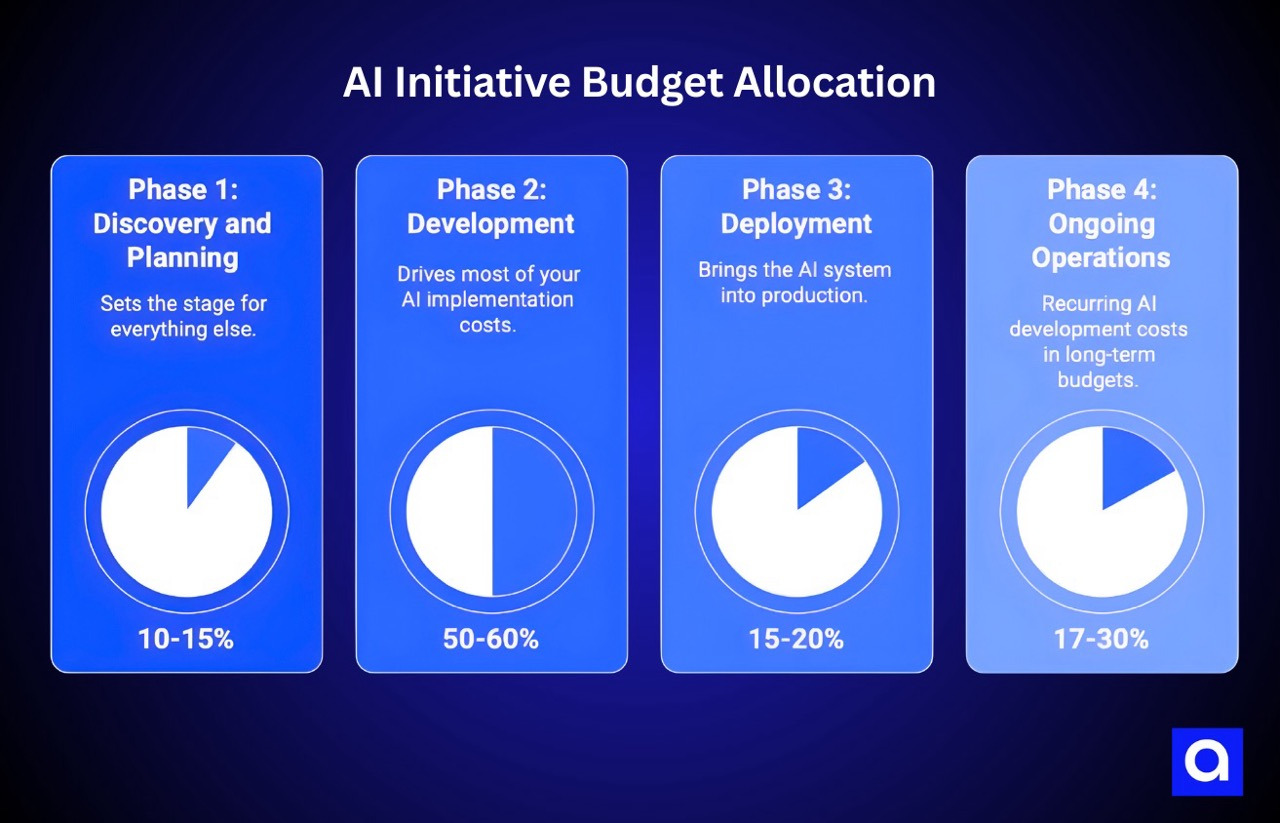
A realistic AI budget starts with understanding each phase of development and the typical costs involved. Planning carefully helps control AI development costs and prevents surprises.
Phase 1: Discovery and Planning (10-15% of Total Budget)
Discovery sets the stage for everything else. This phase includes:
- Requirements gathering: $10,000-$30,000
- Feasibility studies: $15,000-$50,000
- Data assessment: $5,000-$20,000
- Vendor evaluation: $5,000-$15,000
Timeline: 1-2 months.
Skipping planning might save money upfront, but poor planning usually increases your artificial intelligence costs later.
Phase 2: Development (50-60% of Total Budget)
Development drives most of your AI implementation costs. Typical allocations are:
- Data acquisition and preparation: 15-25% of phase budget
- Model development: 30-40%
- Infrastructure setup: 15-20%
- Integration: 10-15%
- Testing and validation: 10-15%
Timeline: 6-12 months for medium-complexity projects. This phase determines most of your AI development cost.
Phase 3: Deployment (15-20% of Total Budget)
Deployment brings the AI system into production. Costs include:
- Production infrastructure: $20,000-$100,000
- User training: $10,000-$50,000
- Documentation: $5,000-$20,000
- Initial monitoring setup: $10,000-$30,000
Timeline: 1-3 months. Proper deployment makes sure your AI works reliably and reduces long-term artificial intelligence costs.
Phase 4: Ongoing Operations (17-30% of Initial Cost Annually)
AI requires ongoing attention. Plan for:
- Maintenance: $50,000-$200,000/year
- Model retraining: $20,000-$100,000/year
- Infrastructure: $50,000-$500,000/year
- Support and updates: $10,000-$50,000/year
These are part of your recurring AI development costs and should be included in long-term budgets.
Sample Budget Ranges by Project Complexity
Simple AI Project:
- Development: $20,000-$75,000
- First-year total: $30,000-$100,000
- Annual ongoing: $10,000-$30,000
Medium Complexity:
- Development: $100,000-$400,000
- First-year total: $150,000-$550,000
- Annual ongoing: $50,000-$150,000
Enterprise System:
- Development: $500,000-$2,000,000
- First-year total: $750,000-$2,500,000
- Annual ongoing: $150,000-$600,000
Contingency Planning
Unexpected costs are common. You can always add 20-30% buffer as a standard practice. For your first AI project, consider a 40-50% contingency.
Most overruns happen in:
- Data preparation: 40%
- Infrastructure scaling: 25-30%
- Integration: 20%
Hidden costs can account for 35-50% of total AI expenses. Including a buffer isn’t pessimism; it’s smart planning for a successful AI initiative.
What are the Trends of AI Development Costs for 2025-2027
Now, after reading our article, you know how much AI development costs, and you can plan the right budget and decide when to invest.
The Rising Tide of AI Investment
AI investment is growing fast. GMI Cloud projects the AI infrastructure market to expand 35% annually through 2027. DDI Development estimates that the global AI market could reach $1.8 trillion by 2030.
Training costs for frontier models are rising at a 2.4x annual rate. TIME reports that the computational power required to train large AI models doubles roughly every nine months. If you plan major AI projects, expect significant increases in artificial intelligence costs.
Computing Costs: Prepare for Increases
Computing costs jumped 89% between 2023 and 2025. They are likely to keep rising. AI infrastructure could take up more of your AI development cost.
There is some good news. Pre-trained models reduce the need for training from scratch. Better tools and frameworks make development faster. Cloud competition is also lowering some infrastructure prices. These changes help reduce AI implementation costs.
Talent Market: Still Hot
Demand for AI talent doubled in 2024. Salaries are high and stay that way. Companies now hire mid-senior and principal engineers, not just senior staff.
Global talent pools in Eastern Europe, Latin America, and Asia are growing. Using these markets can lower artificial intelligence cost estimation without hurting quality.
Azumo's nearshore model, with senior AI engineers across 20+ Latin American countries, is built specifically to give enterprises access to this talent advantage while maintaining real-time collaboration and SOC 2 compliance.
Strategic Planning for the Future
Planning for AI development costs to be 10-25% of total IT budgets by 2027. That is a big share and needs careful planning.
Successful companies do not always spend the most. They start small with pilot projects ($50,000-$200,000) before costs rise. They build internal AI skills, invest in data infrastructure early, and focus on projects with clear ROI.
Following these steps helps control the cost of AI and prepares your business for future AI growth.
How to Make Smart AI Investment Decisions?
AI development costs in 2025 can be very different. Simple tools start around $5,000, while the most advanced models can cost billions. The average enterprise project takes 13 months and costs about $2.7 million. Hidden costs can add 35-50% to your budget.
Returns on AI can be strong, but they take time. Early adopters see $3.70 to $10.30 for every dollar spent. Employees using AI report 40% higher productivity, and companies see up to 54% lower operational costs. That ROI shows up against a backdrop of fast-rising usage: adoption data behind that ROI math puts 88% of organizations using AI in at least one function in 2025, though only 9% have reached full AI maturity. That 40% productivity figure lines up with usage data on how many employees now use AI daily: 91% of employees say their organization uses at least one AI technology, though only 31% use AI tools weekly or daily.
The real question is not whether you can afford AI. It is whether you can afford not to invest.
- Assess your needs: Choose your use cases. Decide whether to build or buy. A simple recommendation engine is very different from a diagnostic AI for healthcare.
- Set a realistic budget: Use the cost ranges in this guide. Add a 30-50% buffer for surprises, especially on first projects. Plan for 3 years of costs, including maintenance at 17-30% per year.
- Start small: Launch pilot projects ($50,000-$200,000) first. Test results before scaling. Optimize costs as you grow.
- Build your skills: Invest in data infrastructure early. Train your team. Use open-source tools. Work with experienced AI development partners.
The companies that succeed with AI are not always the ones with the biggest budgets. They are the ones who understand costs, plan carefully, and focus on real business value.
If you want to explore AI development and understand both technical and budget needs, start by clearly defining your goals. This is the first step to AI solutions that deliver real ROI.
Conclusion
AI development costs can seem high and unpredictable. They can range from a few thousand dollars to millions, depending on your goals and the complexity of your project. But with careful planning, realistic budgets, and smart choices, you can control costs and get real value from AI.
The organizations that succeed are the ones that understand where their money goes, plan for the long term, and focus on clear, measurable business outcomes. Working with an experienced AI development company also helps you avoid common mistakes, choose the right approach, and build solutions that scale.
Since 2016, Azumo has delivered 100+ AI projects for clients, spanning custom chatbots, computer vision, NLP, generative AI, and the data pipelines that power them. All delivered under SOC 2 compliance with nearshore engineering teams that work in your time zone.
If you're exploring AI and want a partner who can guide you through the technical and budget decisions, get in touch with us. We'll help you plan, build, and launch AI solutions that create real results for your business.
Frequently Asked Questions

About the Author:
Founder & CEO | Azumo
Chike Agbai, Founder & CEO of Azumo, leads a nearshore software development firm that builds intelligent applications using top-tier Latin American talent.


.avif)