.svg)
.png)


Most Companies Build Internal Agents First, and the Data Explains Why
Despite customer service being the most visible AI agent use case, less than 10% of organizations have scaled AI agents in any individual function. Forty percent of agentic AI projects fail due to inadequate foundations and infrastructure. The sequencing decision, customer-facing first or internal operations first, is the single most important architectural choice engineering leaders face in 2026. It determines whether your organization builds the integration layer, governance muscle, and data quality that every subsequent agent deployment depends on.
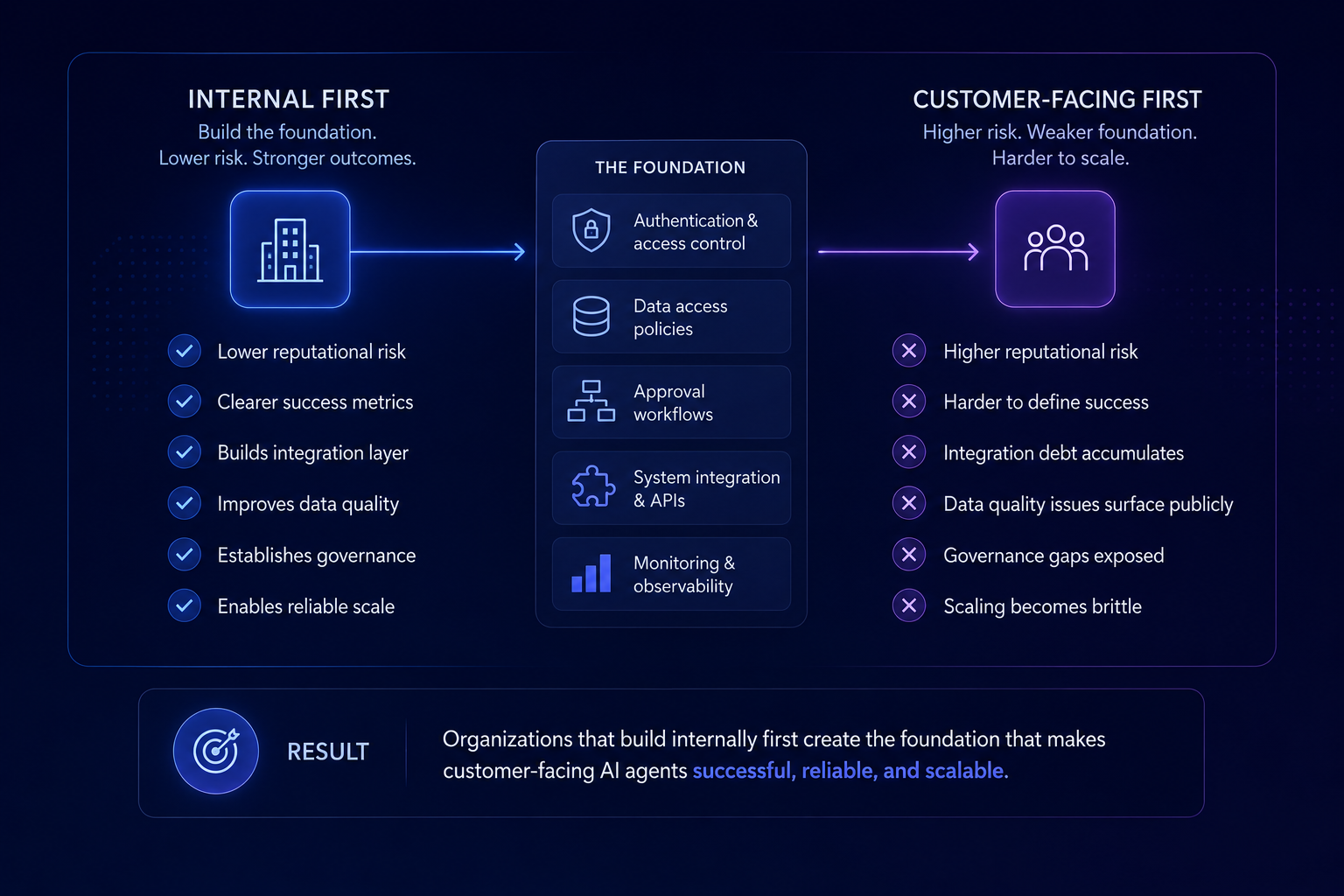
Organizations are more likely to deploy their first production AI agent on internal back-office workflow automation than on customer-facing operations. The reason is structural, not cultural. Internal deployments carry lower reputational risk, offer clearer success metrics, and build the enterprise integration foundation that customer-facing agents require.
The failure rate tells the story. That 40% failure rate follows a consistent pattern: teams that skip the integration and governance groundwork fail publicly. Internal deployments force you to solve authentication, data access policies, approval workflows, and system-of-record integration before you touch a customer channel. Customer-facing deployments let you defer those problems until they become production incidents.
Moveworks built its production AI agent business on internal IT and HR support automation. They automated password resets, device enrollment, software request triage, and policy questions before expanding to broader enterprise workflows. This internal-first approach let them refine natural language understanding accuracy, build integration patterns with ServiceNow and ITSM tools, and demonstrate measurable ticket deflection rates in low-risk environments before touching customer-facing channels.
The governance gap explains why so few organizations scale agents beyond pilot stage. Only 17% of enterprises have formal governance for AI, but those that do tend to scale agent deployments with greater frequency. Internal operations force governance decisions early: who approves an agent's ability to provision software licenses, reset credentials, or modify employee records? Customer service agents can operate without those answers until something breaks.
Customer service agents do deliver faster, more visible ROI. They directly reduce support costs and improve CSAT scores that executives already track, making budget approval easier. But visible ROI means nothing if the agent fails publicly. The 40% project failure rate is disproportionately concentrated in teams that skipped the integration and governance groundwork that internal deployments naturally force you to build.
When comparing ai agents customer service vs internal operations, the question is not which delivers more value. It is which builds the foundation that makes the other one work.
Back-Office Automation Builds the Integration Layer Customer Agents Need
Internal agents require connections to systems that customer-facing agents eventually need: identity providers, approval systems, knowledge bases, CRM platforms, and ticketing tools. The difference is consequence. When an internal agent misroutes a software request, your IT team catches it. When a customer-facing agent misroutes a refund, your brand takes the hit.
Back-office automation builds three capabilities that customer agents inherit. First, authentication and authorization patterns that work across multiple systems. Second, data quality standards that prevent agents from acting on stale or conflicting information. Third, human-in-the-loop workflows that define when agents escalate and to whom.
These capabilities are not theoretical. They are the difference between a pilot that handles 100 requests per day in a controlled environment and a production system that handles 10,000 requests per day with acceptable error rates. Internal deployments let you discover your organization's actual data quality, your actual integration complexity, and your actual appetite for autonomous decision-making before those discoveries happen in front of customers.
Each agent deployment teaches your organization how to operate AI in production. Internal deployments teach those lessons at lower cost and lower risk. Customer-facing deployments teach the same lessons with your brand reputation as tuition.
Customer Service Agents Deliver Faster Metrics but Carry Compounding Risk
Internal agents build the foundation. So what exactly do customer-facing agents demand on top of it, and what happens when that foundation is missing?
Customer service automation produces measurable cost reductions and CSAT improvements within weeks. But a failed customer-facing agent deployment creates reputational damage and organizational distrust that can stall an entire AI program for quarters. Businesses achieved 25% reduction in customer service costs through AI-driven automation and efficiency, and 54% of customers have a more positive view of brands that use AI agents for customer service. Those numbers explain why customer service remains the most attractive first deployment target for executive teams chasing visible ROI.
The metrics are real. The risk is also real, and it compounds.
When a customer service agent fails, it fails in front of the people who determine whether your company gets their next purchase, their renewal, or their referral. When an internal agent fails, it fails in front of employees who understand that software breaks and who have escalation paths built into their daily workflow. The difference is not just reputational. It is organizational. A public failure in customer service creates executive skepticism that spreads to every other AI initiative on your roadmap.
Salesforce Agentforce illustrates the pattern. It is designed to automate complex customer service tasks, provide personalized experiences, and continuously self-improve. But Salesforce's own architecture requires deep enterprise integration with CRM data, knowledge bases, and order management systems before the agent can reliably resolve tickets. Organizations that deploy Agentforce without first establishing clean data pipelines and governance policies experience hallucinated responses and incorrect case routing: exactly the kind of customer-facing failure that erodes the ticket deflection rate gains the platform promises.
The pattern repeats across platforms. Vendor solutions reduce time to first deployment, but they do not eliminate the integration and governance work that determines whether an agent scales beyond pilot stage. Organizations with mature AI governance show a 68% success rate for AI projects; those without governance see just 32%. That gap exists because governance is not a policy document. It is the operational muscle that defines data access boundaries, approval thresholds, escalation triggers, and error handling before an agent touches production traffic.
Some will argue that modern customer service platforms come with pre-built integrations and guardrails that eliminate most of the infrastructure risk, making customer-facing deployment safe even as a first agent. That claim is half true. Pre-built connectors handle the easy 60% of cases: password resets, order status lookups, FAQ responses, and basic account updates. The remaining 40%, edge cases, policy exceptions, cross-system lookups, require the same custom integration work that internal deployments force you to build first. Most organizations struggle to scale beyond early use cases due to a lack of enterprise context, and that context is not something a vendor can package.
Ticket Deflection Gains Collapse Without Enterprise Integration
Ticket deflection rate is the metric that sells customer service agents to executives. If an agent can resolve 30% of inbound tickets without human intervention, the cost savings are immediate and the ROI calculation is simple.
But deflection rate is a lagging indicator. It measures what happened, not whether what happened was correct.
An agent that deflects 30% of tickets by providing incorrect refund amounts, outdated policy information, or misrouted escalations is not reducing costs. It is deferring them. Customers who receive wrong answers either call back, increasing handle time and cost per ticket, or leave, increasing churn. Both outcomes are worse than the baseline you started with, but both take weeks or months to appear in the metrics that justified the deployment.
Picture this: a customer asks about a promotional discount that exists in the marketing database but not in the CRM. The agent hallucinates an answer based on similar past promotions. The customer receives incorrect information, escalates to a supervisor, and the ticket that should have been deflected now requires two human touches instead of one. Multiply that scenario across thousands of interactions per day and the 25% cost reduction becomes a cost increase. I've seen this exact pattern play out at a mid-market e-commerce company that launched its support agent before reconciling data across three separate product catalogs. Within six weeks, their escalation rate was higher than before the agent existed.
Enterprise integration prevents this collapse by ensuring the agent has access to the same systems, the same data freshness, and the same business logic that human agents use. That integration work is identical whether you build it for an internal agent or a customer-facing agent. The difference is consequence. Internal agents let you discover integration gaps when an employee receives a delayed software approval. Customer-facing agents let you discover those gaps when a customer posts about your broken chatbot on social media.
The debate over ai agents customer service vs internal operations is not about which use case delivers more value. It is about which use case lets you build the integration and governance foundation at acceptable risk. Internal operations force you to solve authentication, data quality, and approval workflows before you deploy. Customer service lets you defer those problems until they become public failures. Organizations that choose internal-first are not avoiding customer service. They are building the foundation that makes customer service agents work at scale.
Back-Office Agents in Finance, HR, and IT Create the Governance Muscle You Cannot Skip
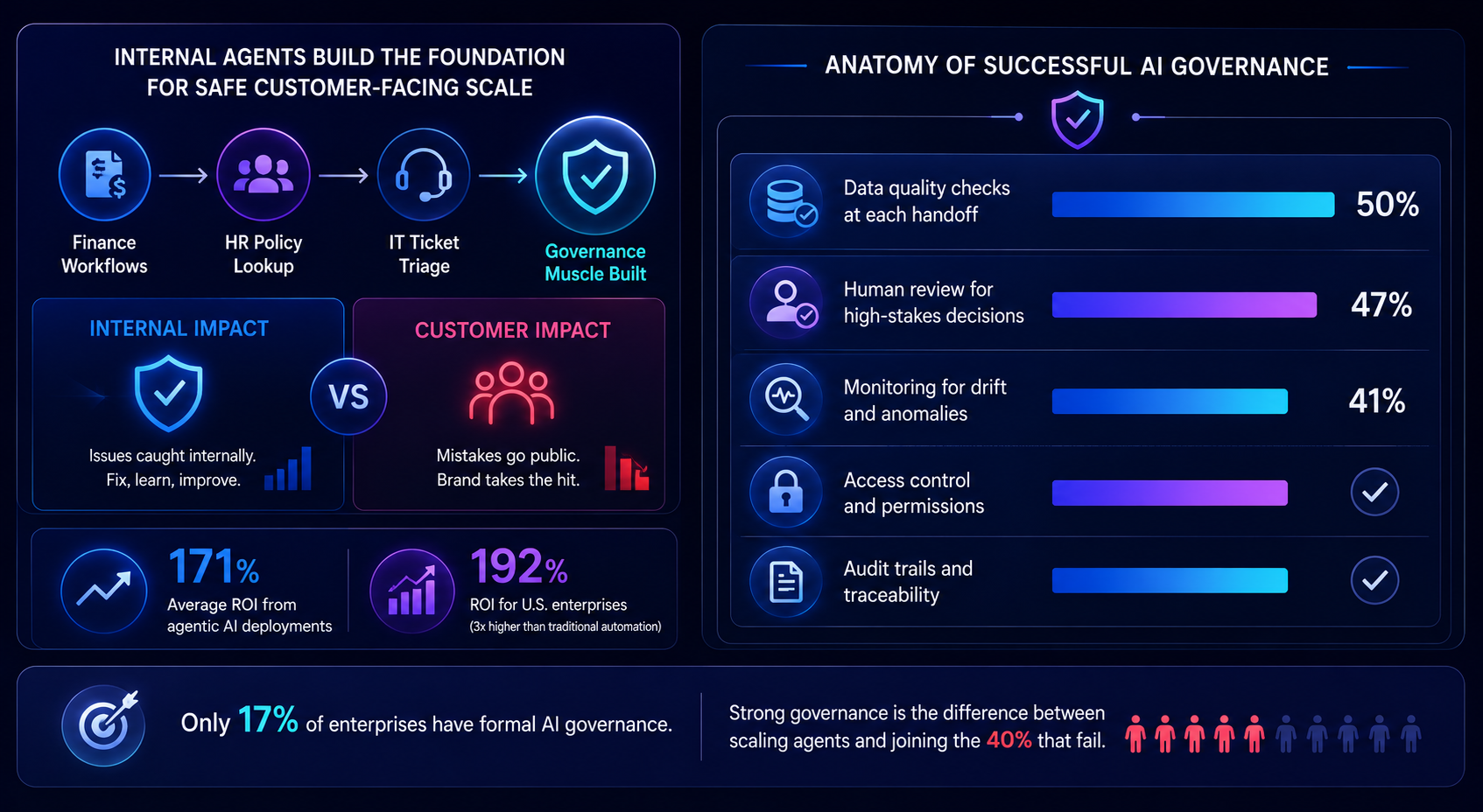
Deploying AI agents on internal operations, finance workflows, HR policy lookup, IT ticket triage, forces organizations to build the formal governance, data quality checks, and access control patterns that are prerequisites for safe customer-facing deployment. The difference is not complexity. It is consequence. When a finance agent miscategorizes an expense, your accounting team catches it in the next reconciliation cycle. When a customer service agent miscalculates a refund, your brand takes the hit on social media.
Companies report average 171% ROI from agentic AI deployments, and U.S. enterprises specifically report 192% ROI, characterized by Landbase as three times higher than traditional automation. Those returns come from organizations that built governance infrastructure before they scaled agent deployments. Internal operations are where that infrastructure gets built under controlled conditions.
The governance gap is structural. Only 17% of enterprises have formal AI governance, but successful implementations share common patterns: data quality checks at each handoff (50% of deployments), human review for high-stakes decisions (47%), and monitoring for drift and anomalies (41%). These patterns are not optional features. They are the operational muscle that determines whether an agent scales beyond pilot stage or becomes another failed project in the 40% that never reach production.
Internal operations force you to answer governance questions that customer-facing deployments let you defer. Who approves an agent's ability to modify employee records? What data quality threshold triggers human review? Which systems can an agent read from versus write to? When does an agent escalate, and to whom?
These questions have answers in finance, HR, and IT because those functions already operate under regulatory and audit requirements that predate AI. GDPR, SOX, HIPAA, and internal audit frameworks define data access boundaries, approval workflows, and audit trail requirements that map directly to agent governance needs. Building agents in these environments means building governance that already has executive buy-in, legal review, and operational precedent.
Workday's agentic AI capabilities target HR and finance back-office workflows: automating expense approvals, benefits inquiries, and workforce planning tasks. Finance teams catch errors internally before they affect customers. Intuit embedded AI agents into QuickBooks and TurboTax to automate accounting, tax prep, and payment handling for SMBs. Both companies chose internal and operational workflows first because these domains have structured data, clear success criteria, and contained blast radius.
The governance patterns they built, role-based access, audit trails, human escalation for high-stakes decisions, became reusable infrastructure for any subsequent customer-facing agent. Workday did not build separate governance for HR agents and then rebuild it for customer-facing agents. They built it once in an environment where regulatory requirements forced rigor, then extended it to other use cases.
This is the pattern that separates organizations with 192% ROI from those contributing to the 40% failure rate. Internal deployments create governance under regulatory pressure, which ensures it actually gets built rather than deferred. Customer-facing deployments create governance under reputational pressure, which means it gets built after something breaks publicly.
The compliance burden is real. Back-office processes in finance and HR are often the most heavily regulated and compliance-sensitive areas of an enterprise, making them harder, not easier, to automate with AI agents than customer service. But this is precisely the point. The governance rigor required by finance and HR automation (audit trails, approval workflows, data quality gates) is the same rigor that customer-facing agents need but that teams skip when they start with support chatbots. Building governance under regulatory pressure ensures it gets built. Building it under reputational pressure ensures it gets built too late.
Intuit's approach demonstrates the compounding value of internal-first deployment. Their agents handle tax calculations and accounting categorization: tasks where errors have legal and financial consequences for customers. The data quality checks, validation rules, and human review thresholds they built for internal accounting workflows became the foundation for customer-facing tax prep agents. They did not build governance twice. They built it once in an environment that forced rigor, then reused it.
The integration layer follows the same pattern. Finance agents require connections to ERP systems, payment processors, approval workflows, and audit logging. HR agents require connections to HRIS platforms, identity providers, benefits systems, and compliance databases. IT agents require connections to ticketing systems, asset management, identity providers, and knowledge bases. These are the same systems that customer-facing agents eventually need to access to resolve tickets, process refunds, or update account information.
Internal deployments force you to build those integrations with clear success criteria and contained blast radius. Customer-facing deployments force you to build them under time pressure with your brand reputation as the cost of failure. The technical work is identical. The risk profile is not.
Organizations that start with AI finance automation are not avoiding customer service. They are building the governance and integration foundation that makes customer service agents work at scale. The 171% average ROI comes from organizations that built that foundation deliberately, not from those that deferred it until a customer-facing failure forced the issue.
Match Your First Agent to Your Integration Maturity
Both paths lead to production AI agents. The question is which path your organization can walk without tripping.
The correct sequencing decision depends not on which domain offers higher ROI in isolation, but on whether your organization has already built the enterprise integration layer, data governance, and agent observability infrastructure that both paths require. Gartner projects that by 2028, 33% of enterprise software applications will include agentic AI, up from less than 1% in 2024. That 33-fold increase means most organizations are making this sequencing decision for the first time, without the integration maturity to safely start with customer-facing deployment.
The decision matrix is simpler than most frameworks suggest. It has three inputs: API maturity, governance readiness, and acceptable blast radius.
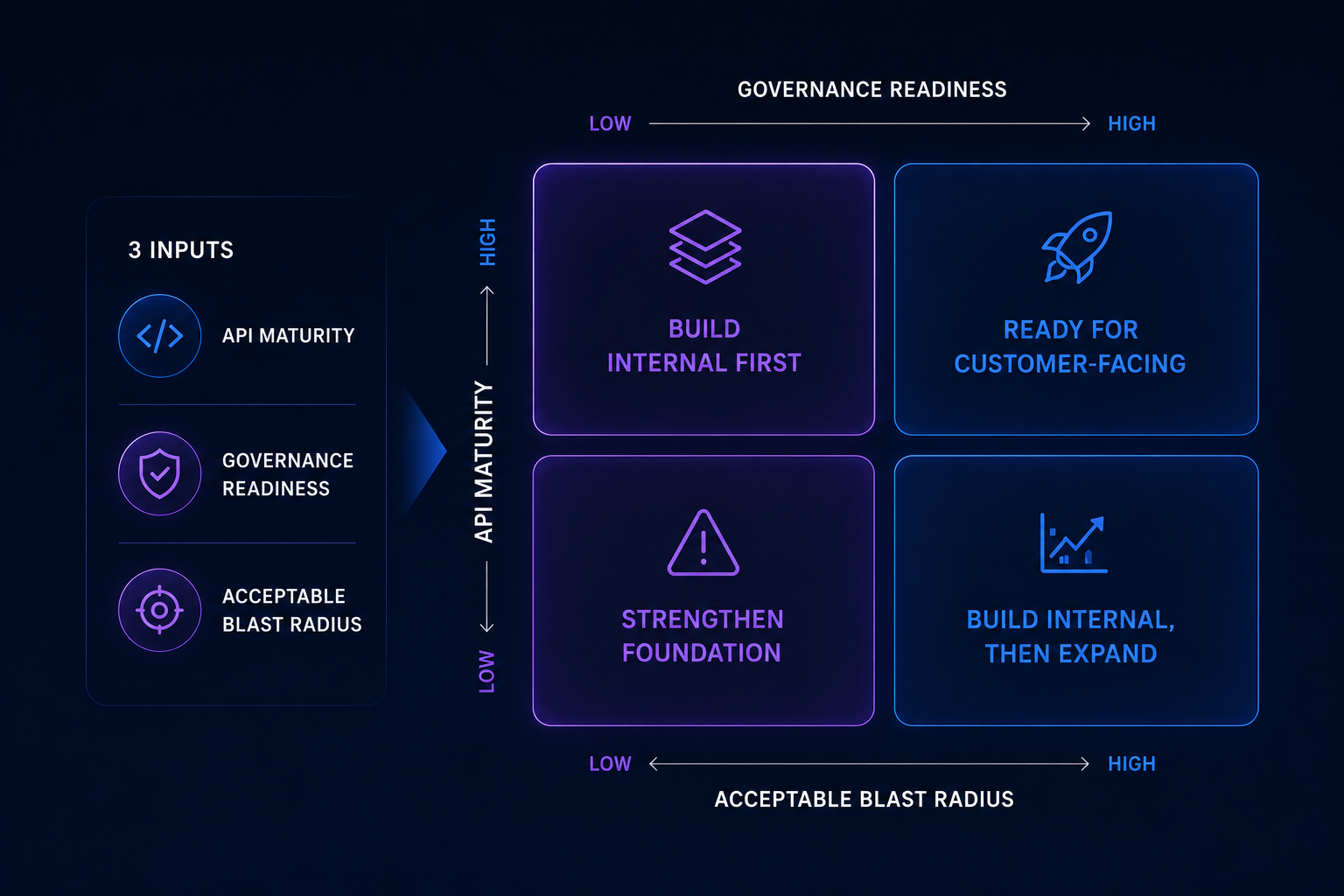
API maturity means your systems already expose the data and actions agents need through documented, versioned interfaces with authentication and rate limiting. If your CRM, ERP, HRIS, and ticketing systems require custom screen-scraping or database queries to extract information, your API maturity is low. If they expose REST or GraphQL APIs with OAuth2 and role-based access control, your API maturity is high. Customer-facing agents require high API maturity because they need real-time access to order status, account balances, inventory levels, and policy rules. Internal agents can tolerate lower API maturity because humans can fill gaps when integrations fail.
Governance readiness means your organization has already defined data access policies, approval thresholds, escalation triggers, and audit requirements for automated systems. If you have formal processes for approving service accounts, reviewing system access logs, and defining data retention policies, your governance readiness is high. If those decisions happen ad hoc or get deferred until after deployment, your governance readiness is low. Customer-facing agents require high governance readiness because errors become public failures. Internal agents force governance decisions but tolerate learning as you build.
Blast radius is the scope of damage when an agent fails. Customer-facing failures affect brand reputation, customer retention, and revenue. Internal failures affect employee productivity and process efficiency. Organizations with low tolerance for public failure should start with internal operations regardless of API maturity or governance readiness.
Neurons Lab deployed its ARKEN multi-agent accelerator for a wealth management firm, connecting agents to client portfolios, live market data, and the firm's product catalog. The deployment increased relationship manager capacity by 30%. This was a back-office augmentation use case: surfacing actionable insights to internal RMs rather than directly facing end customers. That sequencing allowed the firm to validate integration patterns, data quality, and agent accuracy before any client-facing exposure. The 30% capacity gain came from enterprise integration maturity, not from the agent's conversational ability. Connecting agents to custodial feeds and portfolio systems is the same integration surface we handle in our investment software development services.
The wealth management example demonstrates the compounding advantage of internal-first deployment. The firm built integrations to portfolio management systems, market data feeds, and product catalogs under controlled conditions. When they eventually deploy customer-facing agents, those integrations already exist. The governance policies they established for internal agent access to client data become the foundation for customer-facing agent policies. The observability infrastructure they built to monitor agent accuracy and escalation rates transfers directly to customer service monitoring.
The counterargument is valid for a minority: organizations with modern cloud-native stacks and strong API layers can safely start with customer-facing agents because their integration maturity is already high. If your systems already expose APIs with proper authentication, if your data quality is high enough that agents rarely encounter conflicting information, and if your governance policies already define automated system access, then customer service automation is a reasonable first deployment.
The problem is that most organizations overestimate their integration maturity. They have APIs, but those APIs were built for human-driven applications with different latency, consistency, and error handling requirements than agents need. They have data quality processes, but those processes tolerate inconsistencies that humans resolve contextually and that agents cannot. They have governance policies, but those policies assume human judgment at decision points that agents must automate.
By 2026, 40% of enterprise applications will feature task-specific AI agents. The ai agents customer service vs internal operations decision is not academic. Organizations that start with internal operations build the integration patterns, governance playbook, and organizational trust that customer-facing agents inherit. Organizations that start with customer service either already have that foundation or they build it under time pressure with their brand reputation as the cost of mistakes.
For the 17% with full AI adoption across workflows, the sequencing decision is already behind them. For everyone else, it is the difference between building a foundation that compounds and building a pilot that fails publicly.
The 90-Day Sequence That Compounds
Here is the concrete path. Run a 30-day back-office workflow automation pilot on a single internal process: invoice routing, IT ticket triage, or HR policy lookup. Set two KPIs: accuracy at or above 95% and task completion at or above 90%. Measure both weekly.
That pilot will force your team to solve authentication across systems, define data quality thresholds, build escalation workflows, and establish agent observability. Those are not pilot artifacts. They are production infrastructure.

Use the integration patterns, governance playbook, and organizational trust earned from that pilot to launch a customer-facing agent within 60 days. The compounding advantage is not in the agent itself. It is in the reusable enterprise integration layer you build along the way.
The organizations reporting 192% ROI from agentic AI did not start with the highest-visibility use case. They started with the use case that built the foundation every other agent stands on. In the ai agents customer service vs internal operations debate, the answer for most organizations is not "either/or." It is "internal first, customer-facing fast."
Ninety days. One internal pilot. One customer-facing launch. That is the sequence that compounds.

About the Author:
Head of Customer Success | Account Manager & Account Executive
Matias Margossian, Account Executive and Customer Success Manager with a finance background and tech expertise, blending business strategy, analytics, and client success.

.avif)