.svg)
.png)


.avif)
AI is already used in hospitals and clinics for diagnosing diseases, supporting doctors, and helping patients through chatbots and virtual assistants. It is no longer just a future idea; it’s a part of everyday healthcare. Healthcare's AI curve tracks other high-stakes, regulated fields, with contact centers reporting AI handling 65% of support queries without a human. Legal teams have moved even faster, with 79% of legal professionals now using AI daily, up from just 19% in 2023.
In this article, we look at 60 AI in healthcare statistics covering market size, adoption, spending, benefits, and challenges.
Key AI in Healthcare Statistics for 2026
AI is changing healthcare faster than ever, from diagnostics and virtual assistants to hospital operations and patient care. These numbers show how quickly adoption is growing and where the biggest investments are happening.
- The global AI in healthcare market is projected to reach $50.70 billion in 2026, up from $36.67 billion in 2025. - Source
- 75% of U.S. health systems now use at least one AI application, up from 59% in 2025. - Source
- 66% of physicians used health AI in 2024, a 78% increase from 38% in 2023. - Source
- 32% of U.S. adults now use AI chatbots for health information, double the rate from one year prior. - Source
- The average ROI for AI in healthcare is $3.20 for every $1 invested, with returns realized within 14 months. - Source
- The FDA has approved 1,247 AI and ML-enabled medical devices as of May 2025. - Source
- 85% of healthcare organizations plan to increase AI budgets in 2026. - Source
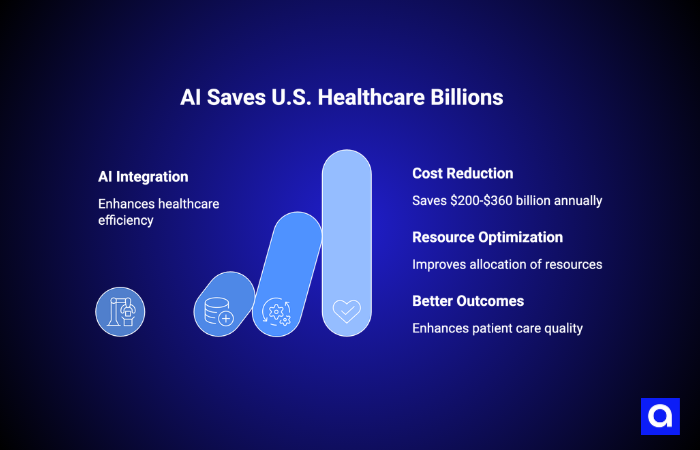
- AI could save U.S. healthcare $200 to $360 billion annually, representing 5 to 10% of total spending. - Source
AI in Healthcare Market Overview: Size and Growth Trends
The AI in healthcare market is growing rapidly as hospitals, clinics, and health tech companies invest more in automation, diagnostics, and patient care tools. Generative AI is also becoming a major driver of this growth, especially in areas like medical documentation, virtual assistants, and clinical decision support.
- The U.S. AI in healthcare market alone is set to grow from $11.57 billion in 2025 to $194.88 billion by 2034 at a 36.97% CAGR. - Source
- The generative AI in healthcare market is projected to grow from $3.3 billion in 2025 to $4.7 billion in 2026 and $39.8 billion by 2035 at a 26.7% CAGR. - Source
- Generative AI platforms represent the fastest-growing technology sub-segment at ~45.76% CAGR between 2026 and 2031. - Source
- Hospitals and clinics account for 42.44% of global AI in healthcare revenue in 2026. - Source
- By 2034, the AI in healthcare market is projected to reach $613.81 billion. - Source
Adoption of AI in Healthcare: Industry Overview
AI is becoming a standard part of healthcare operations, especially in diagnosis, treatment planning, and clinical workflows. Hospitals are using it to improve speed, accuracy, and decision-making across multiple departments.
AI in Diagnostics and Treatment Statistics
This is where AI is making its most measurable clinical impact. Radiology leads the pack, and the numbers show why.
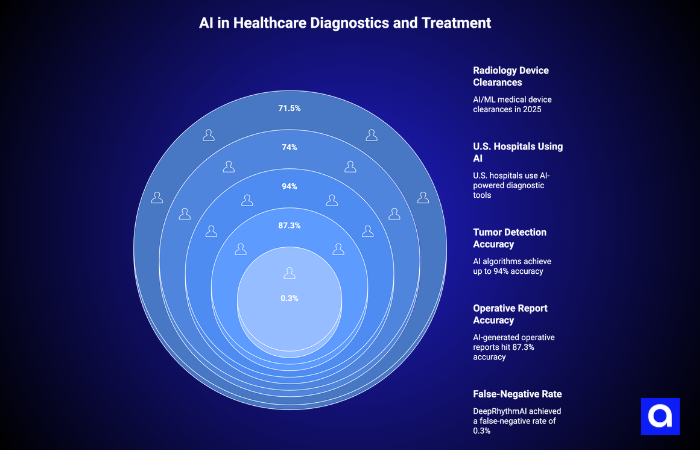
- Radiology accounts for 71.5% of all AI/ML medical device clearances in 2025. - Source
- 74% of U.S. hospitals use AI-powered diagnostic tools in their radiology departments. - Source
- AI algorithms achieve up to 94% accuracy in tumor detection, exceeding human performance in controlled settings. - Source
- A meta-analysis of 83 studies found that generative AI models achieved 52.1% overall diagnostic accuracy, comparable to non-expert physicians but lower than expert specialists. - Source
- AI-generated operative reports hit 87.3% accuracy across 158 cases, outperforming surgeon-written reports at 72.8% accuracy. - Source
- In a study of 14,606 patients, DeepRhythmAI achieved a false-negative rate of 0.3% versus 4.4% for human technician analysis. - Source
- AI-supported hospitals report a 42% reduction in diagnostic errors compared to non-AI facilities. - Source
- Radiologists detect lesions 26% faster and identify 30% more cases with AI assistance. - Source
- The robot-assisted surgery segment holds 22.94% market share in 2026. - Source
AI Medical Assistants, Virtual Care, and AI Doctors
While diagnostics grabs the headlines, virtual care AI quietly generates some of the strongest ROI numbers in the AI in healthcare industry.
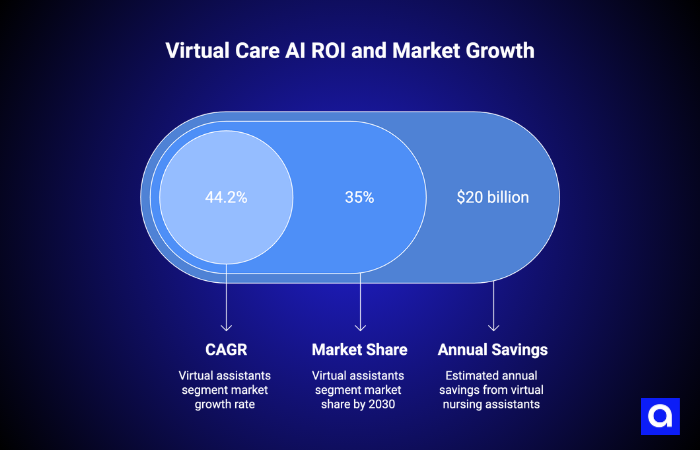
- Virtual nursing assistants powered by AI save the healthcare industry an estimated $20 billion annually. - Source
- The virtual assistants segment in AI healthcare is expected to grow at a 44.2% CAGR from 2024 to 2030, capturing 35% of the market. - Source
- 37% of respondents in NVIDIA's 2026 survey named virtual health assistants and chatbots as the top ROI use case for digital healthcare. - Source
- AI chatbots reduce patient wait times by up to 50% and cut administrative workload by 30 to 40%. - Source
- Natural Language Processing (NLP) leads telehealth AI with a 32% technology market share. - Source
- The global healthcare chatbot market is growing at a 21.5% CAGR and is projected to reach $543.65 million by 2030. - Source
AI Adoption Among Healthcare Providers and Organizations
Here's how the provider landscape looks right now:
- 71% of U.S. non-federal acute-care hospitals reported using predictive AI integrated with their EHRs in 2024, up from 66% in 2023. - Source
- Ambient clinical documentation is the most universally adopted AI use case, with 100% of major health systems reporting some usage. - Source
- Clinical note-taking reached 68% adoption with 62% year-over-year growth between 2025 and 2026. - Source
- AI physician adoption rose to 63% by January 2026, with 69% of users reporting daily use and 36% using AI multiple times per day. - Source
- Neurology reported the highest AI adoption rate among specialties at 64%, followed by gastroenterology at 61% and internal medicine at 60%. - Source
- 68% of physicians recognize at least some advantage of AI in patient care, up from 63% in 2023. - Source
- 79% of healthcare organizations are actively using some form of AI technology. - Source
AI in Healthcare from Patients' Perspective: Consumer Trends
Patients aren't waiting for their doctors to bring them AI. They're finding it themselves. The consumer side of AI use in healthcare statistics tells a story of rapid, self-directed adoption that's outpacing institutional rollouts.
Consumer Adoption and Trust in AI Healthcare Solutions
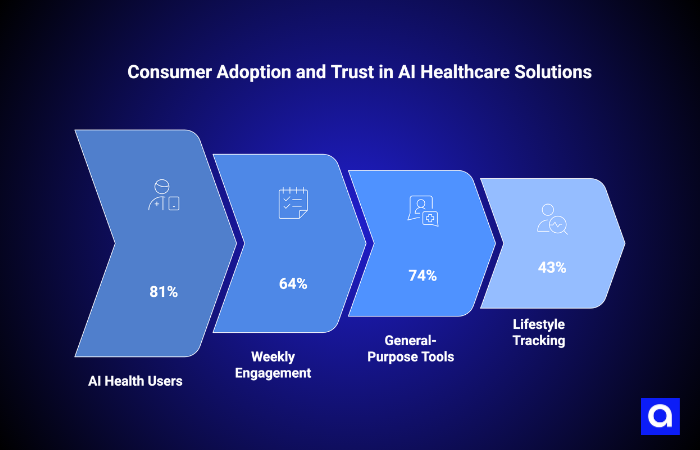
- 64% of AI healthcare users engage with health AI on a weekly basis or more. - Source
- 81% of AI health users report taking a concrete action after an AI query, from seeking more information to changing a health behavior to scheduling a provider visit. - Source
- 74% of health AI users turn to general-purpose tools like ChatGPT, while only 5% use provider-offered bots and 4% use payer-offered bots. - Source
- AI health users are more likely to track lifestyle indicators: sleep (43% vs. 28%), physical activity (41% vs. 32%), diet (40% vs. 28%), and stress (35% vs. 22%) compared to non-AI users. - Source
- Consumer AI health use shows no meaningful differences across income or education levels, unlike wearables or telehealth, where adoption was historically tied to wealth. - Source
- Consumers who engage with AI-enabled healthcare tools report higher satisfaction with the healthcare industry compared to non-users. - Source
Demographics of AI Healthcare Users
- Men (34%) reported slightly higher AI health adoption compared to women (30%). - Source
- More than 61% of physicians aged 30 and under use AI in their practice, compared to 57% in their 30s and 40s and 55% in their 50s. - Source
AI in Healthcare: Spending and Budget Allocation
Here's where the money is going:
- 85% of healthcare organizations plan to increase AI budgets in 2026, with 46% planning increases of more than 10%. - Source
- Digital health funding hit $7.4 billion in Q1 2026, up from $5.9 billion the previous quarter, with 60% concentrated in 19 mega-rounds of $100M+. - Source
- Global healthcare AI investment reached $22.4 billion in 2025, with clinical AI attracting 60% of venture capital and operational AI attracting 40%. - Source
Benefits and Impact of AI in Healthcare
The AI in healthcare benefits statistics tell a compelling story for any organization still on the fence about investment. The returns are real, they're measurable, and they're showing up faster than expected.
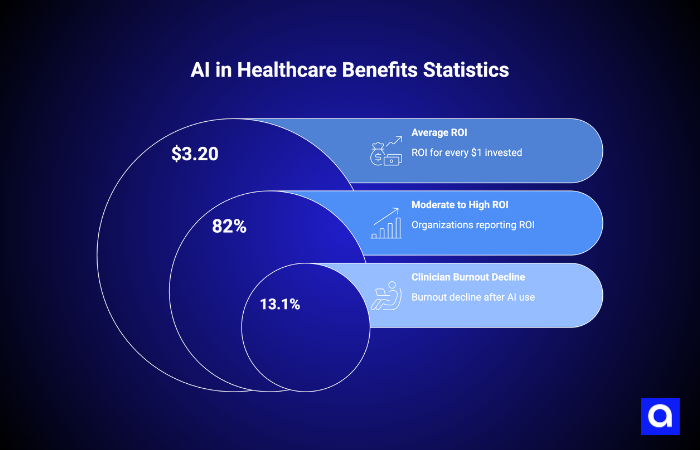
- The average ROI for AI in healthcare is $3.20 for every $1 invested, with typical returns realized within 14 months. - Source
- 82% of organizations using AI report moderate to high ROI, with 52% reporting moderate ROI and 30% reporting high or very high ROI. - Source
- AI could save U.S. healthcare $200 to $360 billion annually, representing 5 to 10% of total healthcare spending. - Source
- AI is projected to reduce administrative costs by $20 billion annually in the U.S. - Source
- Clinician burnout declined from 51.9% to 38.8% after short-term use of AI-assisted documentation tools. - Source
- 81% of healthcare organizations that deployed AI report increased revenue; 73% achieved reduced operational costs; 41% experience faster R&D cycles. - Source
Challenges, Risks, and Limitations of Implementing AI in Healthcare
Here's the part that most AI healthcare statistics roundups skip or minimize. But if you're actually building or buying AI for a health system, these are the numbers you need to take seriously.
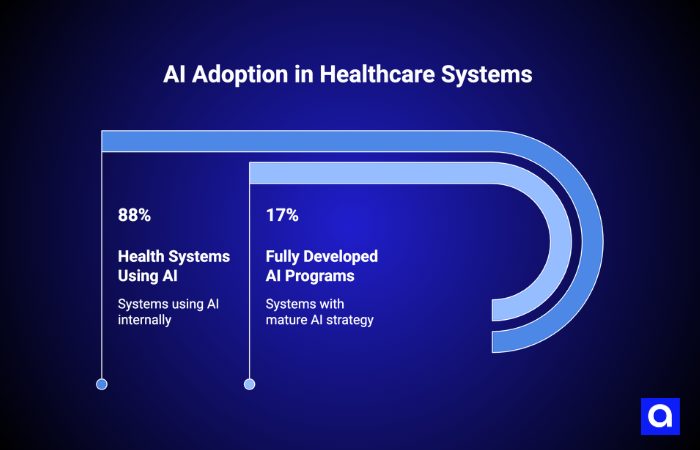
- A 2025 survey of 233 health systems found 88% use AI internally, yet more than 80% don't have fully developed AI programs, and only 17% have a mature AI strategy. - Source
- The top barriers to AI adoption cited by 2,041 healthcare leaders across 90 countries are workflow integration (72%), unclear leadership direction (68%), and limited staff capacity and training (61%). - Source
- 57% of healthcare professionals have used unauthorized AI tools (shadow AI), and 40% of hospitals have been affected, adding an average of $670,000 to data breach costs. - Source
- The average healthcare data breach cost $7.42 million in 2025, making healthcare the most expensive industry for data breaches for 14 consecutive years. - Source
- 66% of physicians reported they used AI. There was a dramatic drop in the number of physicians who reported being nonusers - Source
The gap between "using AI" and "using AI well" is enormous. Most organizations sit somewhere in between, running tools without governance frameworks, mature strategies, or clear accountability structures.
Future of AI in Healthcare Statistics
The AI healthcare future points toward a market that could exceed $1 trillion by 2034, according to Fortune Business Insights. But the more practical question isn't "how big will the market get?" It's "What will AI actually change?"
- AI-powered drug discovery reduces development timelines from 10 years to 2 to 3 years, cutting lead development time by up to 70%. - Source
- The AI in the drug discovery market is projected to reach $4 billion by 2028 at a 40.2% CAGR. - Source
- The surgical robot market is projected to grow from $5.16 billion in 2021 to $20.98 billion by 2030. - Source
Organizations that invest now in the right AI infrastructure, governance, and talent will compound their advantages over the next decade. Those who wait risk falling behind a curve that's already steep and accelerating.
How Azumo Helps Healthcare Organizations Build AI Solutions
The statistics in this article paint a clear picture: AI in healthcare is growing fast, delivering real ROI, and reshaping how care gets delivered. But the challenges section tells an equally important story. 80% of health systems lack a mature AI strategy. Shadow AI is creating security risks. Workflow integration remains the number one barrier.
That's exactly where Azumo comes in. As a custom software development partner with deep domain expertise in AI and machine learning, Azumo helps healthcare organizations move from scattered AI experiments to production-grade solutions.
What that looks like in practice:
- Custom AI for diagnostics, documentation, and patient engagement built to fit your clinical workflows, not the other way around
- HIPAA-compliant architecture designed from the ground up for healthcare's regulatory requirements
- EHR/EMR integration so AI tools work inside the systems your teams already use
- Staff training and change management alignment to close the adoption gap that stalls most AI programs
Generic, off-the-shelf AI tools struggle in healthcare's complex, regulated environment. That's why organizations like hospitals and health systems choose to build custom solutions with partners who understand both the technology and the clinical context.
If you're looking to move from pilot to production with AI in healthcare, let's talk. Azumo's AI development teams can help you build solutions that deliver measurable outcomes.
References
AI In Healthcare Market Size & Share | Industry Report, 2033: https://www.grandviewresearch.com/industry-analysis/artificial-intelligence-ai-healthcare-market
Artificial Intelligence in Healthcare Market: https://www.marketsandmarkets.com/report-search-page.asp?rpt=artificial-intelligence-healthcare-market
AI in Healthcare Market Size, Share, Growth Report, 2034: https://www.fortunebusinessinsights.com/industry-reports/artificial-intelligence-in-healthcare-market-100534
AI in Healthcare Market Rises 37.66% Healthy CAGR by 2035: https://www.towardshealthcare.com/insights/ai-in-healthcare-market
Artificial Intelligence in Healthcare Market Size & Share Analysis 2031: https://www.mordorintelligence.com/industry-reports/artificial-intelligence-in-healthcare-market
Artificial Intelligence in Healthcare Market Size, Growth & Forecast 2035: https://www.researchnester.com/reports/artificial-intelligence-in-healthcare-market/1429
Generative AI in Healthcare Market Size, Share & Growth: https://www.rootsanalysis.com/reports/generative-ai-in-healthcare-market.html
AI In Healthcare Statistics (2026) - Adoption & Market Size: https://www.demandsage.com/ai-in-healthcare-stats/
Doximity 2026 State of AI in Medicine Report: https://www.doximity.com/reports/state-of-ai-medicine-report/2026
2 in 3 physicians are using health AI—up 78% from 2023 | American Medical Association: https://www.ama-assn.org/practice-management/digital-health/2-3-physicians-are-using-health-ai-78-2023
75% of US health systems use, plan to use an AI in 2026: survey: https://www.fiercehealthcare.com/ai-and-machine-learning/75-us-healthcare-systems-use-plan-use-ai-platform-2026
Hospital Trends in the Use, Evaluation, and Governance of Predictive AI, 2023-2024 - ONC Health IT Research & Analysis: https://healthit.gov/data/data-briefs/hospital-trends-use-evaluation-and-governance-predictive-ai-2023-2024
2025 Year in Review: AI/ML Medical Device 510(k) Clearances: https://innolitics.com/articles/year-in-review-ai-ml-medical-device-k-clearances/
The tortoise and the hare of care: Health AI insights from Rock Health’s 2025 Consumer Adoption Survey | Rock Health: https://rockhealth.com/insights/the-tortoise-and-the-hare-of-care-health-ai-insights-from-rock-healths-2025-consumer-adoption-survey/
Improving consumer trust and experience in healthcare | McKinsey: https://www.mckinsey.com/industries/healthcare/our-insights/healing-consumer-confidence-through-ai-powered-human-centered-healthcare
Survey Reveals AI Is Delivering Clear Return on Investment in Healthcare | NVIDIA Blog: https://blogs.nvidia.com/blog/ai-in-healthcare-survey-2026/
2025: The State of AI in Healthcare | Menlo Ventures: https://menlovc.com/perspective/2025-the-state-of-ai-in-healthcare/
Digital Health Funding Hits $7.4B in Q1 2026 Driven by AI Drug Discovery and M&A: https://hitconsultant.net/2026/04/20/digital-health-funding-q1-2026-ai-ma-rebound/
Healthcare Analytics Statistics 2026: Market Size, AI, Breach Costs - Knowi: https://www.knowi.com/blog/healthcare-analytics-statistics-2026/
AI in healthcare Statistics and Facts 2026 | Futurism: https://vocal.media/futurism/ai-in-healthcare-statistics-and-facts-2026
3 Key Insights for the 2026 Health AI Horizon: https://dimesociety.org/newsroom/blog/3-key-insights-for-the-2026-health-ai-horizon/
AI in Healthcare — Complete 2026 Guide | The Thinking Company: https://thinking.inc/en/industry-service/ai-in-healthcare/
$1T healthcare shift is coming, driven by virtual care, AI: PwC: https://www.fiercehealthcare.com/health-tech/2035-1t-healthcare-spend-will-shift-digital-first-ai-driven-healthcare-system-pwc
The Future of AI in Healthcare: 7 Key Innovations for 2026: https://dashtechinc.com/blog/7-breakthroughs-shaping-the-future-of-ai-in-healthcare-for-2026/
AI in Healthcare Statistics and Facts (2026):
https://scoop.market.us/ai-in-healthcare-statistics/
AI Trends in Healthcare 2026 - Refine the Health Future: https://www.voiceoc.com/blogs/ai-healthcare-trends-for-future
The Future of Medical AI: What's Coming in 2026 and Beyond: https://www.offcall.com/learn/articles/the-future-of-medical-ai-what-s-coming-in-2026-and-beyond
The Biggest Challenges for AI in Healthcare in 2026 - Bing Info: https://binginfo.in/ai-in-healthcare/
27 AI in Healthcare Statistics in 2025: https://www.openandaffordable.com/post/ai-in-healthcare-statistics-and-trends
https://www.philips.com/a-w/about/news/archive/features/2025/ai-in-radiology-three-keys-to-real-world-impact.html

About the Author:
Founder & CEO | Azumo
Chike Agbai, Founder & CEO of Azumo, leads a nearshore software development firm that builds intelligent applications using top-tier Latin American talent.



.avif)