.svg)
.png)


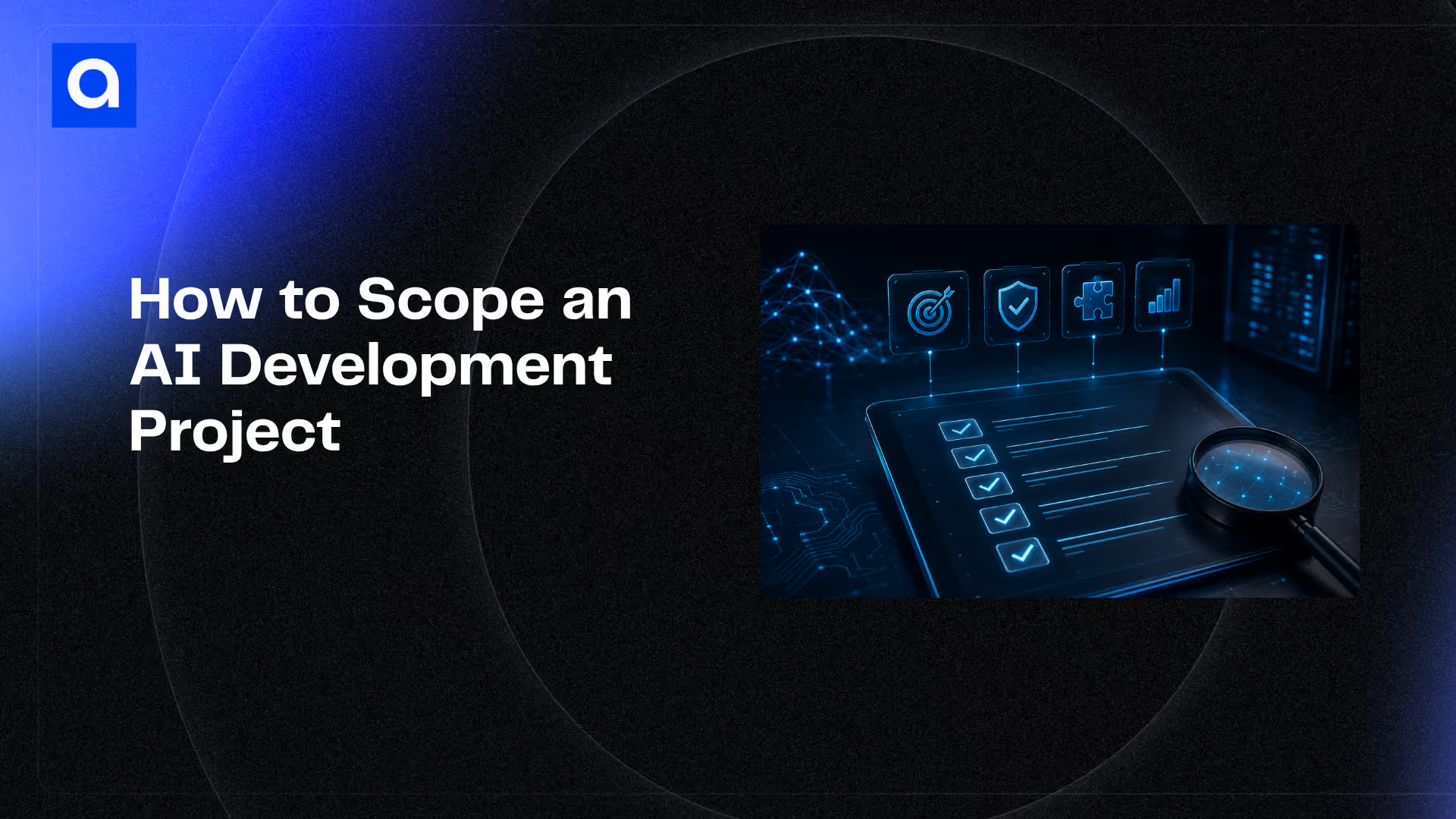
How to Scope an AI Development Project
Scoping an AI development project is hard because not all AI projects behave the same way.
A simple RAG application connected to a clean knowledge base can be scoped, built, and tested in weeks. A digital twin for an asset-heavy infrastructure business may take months or years of data engineering, simulation logic, system integration, domain modeling, and operational rollout. Both are "AI projects." They are not remotely the same kind of work.
That is why AI project scope should not start with the model. It should start with the business workflow, the data readiness, the integration surface, the risk profile, and how close to production the system actually has to get.
The question is not "What AI model should we use?" The better question is: "What does this system have to do in the real business, with real data, real users, real constraints, and real consequences?"
The Short Answer
To scope an AI development project, you need to define ten things:
- The business problem
- The user and the workflow
- The desired output or action
- The data required
- The quality bar
- The integration points
- The security and compliance requirements
- The delivery path
- The team required
- The production and maintenance plan
The model is one part of the scope. Often, it is not even the hard part. The hard work is usually getting the right data, designing the workflow, integrating with existing systems, evaluating output quality, and making the system reliable enough for actual use.
Start by Defining the Business Problem
A clear AI scope starts with a clear problem. Not a technology idea. Not a model choice. Not "we need AI." A real business problem.
Examples:
- We need to reduce support ticket handling time.
- We need to help sales teams answer RFPs faster.
- We need to classify documents more accurately.
- We need to give field teams better access to technical knowledge.
- We need to forecast equipment failure risk.
- We need to automate repetitive operations workflows.
- We need to summarize large volumes of customer conversations.
- We need to prioritize maintenance or operational decisions using real-time data.
A weak scope sounds like: "Build an AI assistant for our company."
A better scope sounds like: "Build an internal AI assistant that helps customer support managers answer policy and product questions from approved documentation, with source citations, role-based access, and escalation when confidence is low."
The second version tells you who, where, what, and how. The first version tells you nothing a vendor can bid against.
Identify the User and Workflow
AI projects often fail when they are scoped around a feature instead of a workflow. A feature is something the system does. A workflow is how a person gets work done. For scoping, the workflow matters more.
Ask:
- Who will use the AI system?
- What are they trying to accomplish?
- Where does the workflow start?
- What input does the user provide?
- What output do they need?
- What happens after the AI system responds?
- Does a human approve the result?
- Does the system take action automatically?
- How often does the workflow happen?
- What tools does the user already use?
Answers to those questions usually determine more about scope than the choice of model does.
Separate the Use Case From the AI Technique
A common scoping mistake is locking in the AI technique too early.
Most real systems combine more than one of the above. A vendor that names the technique before they understand the use case is scoping backwards.
Define the Output
Every AI project needs a clear output. The output may be an answer, a summary, a recommendation, a classification, a prediction, a generated document, a completed workflow, a ranked list, a risk score, a decision support interface, an automated action, or a human-reviewed draft.
The output drives the scope. Ask:
- What does the system produce?
- Who uses the output?
- How accurate does it need to be?
- Does the output need citations or source links?
- Does the user need to edit it?
- Does the output trigger a workflow?
- What happens if the output is wrong?
A scope that does not name the output usually has not yet decided what the system is.
Evaluate Data Readiness
Data readiness is one of the biggest drivers of AI project scope. Many failed AI projects are really failed data projects.
Before estimating scope, answer:
- What data does the system need?
- Where does the data live?
- Who owns it?
- Is it structured, unstructured, or both?
- Is it clean?
- Is it complete?
- How often does it change?
- Are there duplicates or conflicts?
- Does it contain sensitive information?
- Do users have different access rights to it?
- Does the system need real-time data?
- Does the data need labeling, cleaning, chunking, embedding, enrichment, or transformation before it can be used?
Most of those questions sound mundane. They control more of the timeline and budget than any model choice.
Map the Integration Points
Most valuable AI systems have to connect to existing systems. Integration is where scope expands quietly.
Possible integration points include CRMs, ERPs, data warehouses, internal databases, APIs, authentication systems, document repositories, ticketing systems, support platforms, communication tools, monitoring tools, custom applications, cloud infrastructure, and BI systems.
For each integration, ask whether the connection is read-only, read-write, real-time or batched, single-tenant or multi-tenant, and how authentication and permissions flow through.
Define the Quality Bar
AI quality is not binary. With normal software, a feature works or it does not. With AI, the system can be useful most of the time, wrong some of the time, and confidently wrong in ways that are hard to detect. The scope has to declare what acceptable looks like.
Ask:
- What does "good" mean for this system?
- How accurate does it need to be?
- Does the answer need a source?
- Can the system say "I don't know"?
- What confidence level is acceptable?
- What edge cases matter?
- How will we test outputs?
- Who reviews bad outputs?
- How will users provide feedback?
- What needs to improve over time?
Decide How Close to Production the Project Needs to Get
A proof of concept is scoped very differently from a production system.
A proof of concept answers: "Can this work?" A production system answers: "Can this work reliably, securely, affordably, and repeatedly for real users?"
The most expensive AI mistakes happen at the boundary between Prototype and Production, when a working demo is treated as a finished product. For more on that gap, see our blog post on moving AI prototypes into production.
Assess Security, Privacy, and Compliance Requirements
Security can change scope dramatically.
Ask:
- What sensitive data will the system touch?
- Will data be sent to third-party model providers, and which ones?
- Will the system use customer data?
- Will the system use employee data?
- What permissions are required?
- Do different users see different data?
- Does the system need audit logs?
- Does the system need human approval steps?
- Are there regulatory requirements (HIPAA, SOC 2, GDPR, financial)?
- What outputs should be blocked or escalated?
A vendor that treats these as items to "figure out later" is scoping a system that is going to need to be re-scoped later, often after a security review derails the timeline.
Estimate the Team Required
AI projects often require multiple skill sets: product strategy, solution architecture, AI engineering, ML engineering, data engineering, backend and frontend development, cloud infrastructure, MLOps, QA, UX, project management, security, and client-side domain expertise.
The right move is not to overstaff early. Start with the smallest team that can reduce uncertainty, then scale once the project is clearer. A senior AI architect plus a senior engineer can usually de-risk a use case in weeks. Adding a full team to a fuzzy scope wastes everyone's time.
Identify the Biggest Unknowns
Good AI scoping is not about pretending everything is known upfront. It is about identifying the unknowns that matter most and reducing them deliberately.
Common unknowns include data quality, retrieval accuracy, user trust, hallucination risk, latency, API and infrastructure cost, legacy system behavior, deployment environment, security review timing, compliance requirements, human review workflow, and ongoing improvement cadence.
Name the unknowns in the scope document. A scope that pretends nothing is unknown is a scope that is going to be wrong.
Use Scope Ranges, Not False Precision
A good AI estimate avoids false precision early. Three rough buckets cover most projects.
Small scope
A narrow tool with clean data, limited integrations, and low risk. Often a focused internal tool or a single-purpose assistant connected to a tidy data source.
Medium scope
A business application with real users, real integrations, security requirements, and clear quality expectations. Most useful AI applications inside a real company sit here.
Large scope
A production system with complex data, multiple integrations, domain-specific logic, governance, monitoring, and high operational importance. Often mission-critical.
The size determines the team, the timeline, the discovery shape, and the cost structure. Underestimating size is the most common scoping error. Overestimating it is the second most common.
Scoping Matrix
A useful exercise: score each driver as Simple, Moderate, or Complex for your project. The mix tells you the shape of the work, the team you need, and which engagement model fits. (For the engagement-model question, see our comparison of AI consulting vs AI development company vs staff augmentation.)
What to Include in an AI Project Scope
A useful AI project scope document includes:
- The business objective
- The users and workflows
- The data sources, with readiness assessment
- The technical approach and the alternatives considered
- The integrations
- The security and compliance requirements
- The evaluation plan
- The delivery stages
- The team model
- The assumptions
- The risks and unknowns
- The maintenance plan
If a vendor's proposed scope is missing two or more of these, the proposal is incomplete, and the budget that goes with it will be wrong.
Common Scoping Mistakes
- Scoping around the model instead of the workflow.
- Treating a prototype like a product.
- Ignoring data quality.
- Underestimating integration work.
- Skipping the evaluation plan.
- Ignoring human review and escalation paths.
- Forgetting maintenance cost in year two.
- Pretending the unknowns do not exist.
How Azumo Helps Scope AI Development Projects
Azumo helps companies scope AI projects by connecting the business goal to the technical work required to build useful software. Scoping is something we have done across a wide range of AI surface area, including RAG, LLM fine-tuning, AI agents, generative AI, traditional ML, NLP, computer vision, and real-time voice.
That breadth matters during scoping because it lets us recognize patterns across very different projects. We have shipped semantic search for Meta on a 3.5 million record supplier database, a YOLO and OCR computer vision pipeline for CENTEGIX's school safety check-in product, equity prediction and borrow-rate forecasting for Stovell AI, GPT-powered document extraction for Angle Health's RFP-to-quote pipeline in regulated health insurance, multi-phase generative AI integration for Omnicom's Sparks & Honey on its Q cultural intelligence platform, and a multilingual NLP voice skill for Discovery Channel on Alexa and Google Assistant. We also operate Hello, our own AI receptionist, on a custom voice pipeline.
A typical scoping engagement covers the use case, the workflow, data readiness, the AI approach, the integration points, the security model, the evaluation plan, the delivery path, the team, the budget drivers, and the support model. The goal is to help companies avoid the two most common scoping errors: under-scoping serious work, and overbuilding when a simpler approach would have served.
For our broader offering, see our AI development services. When you are ready to evaluate vendors, our guide on how to choose an AI development company and our AI development company evaluation checklist are the natural next steps.
Final Takeaway
AI project scope depends on more than the model. It depends on the workflow, the data, the integrations, the security, the quality bar, the production requirements, and the long-term support plan.
The best way to scope an AI development project is to define the real business problem first, then work backward into the data, the architecture, the team, the timeline, and the delivery plan.
Scope the work, not the wishful thinking.
Need help scoping an AI project?
Azumo helps companies define, scope, build, and deploy practical AI applications that connect to real business systems. We have shipped production AI for clients including Meta, Omnicom, CENTEGIX, Stovell AI, Discovery Channel, and Angle Health, and we operate our own production AI products on a custom voice pipeline.
Frequently Asked Questions

About the Author:
Head of Customer Success | Account Manager & Account Executive
Matias Margossian, Account Executive and Customer Success Manager with a finance background and tech expertise, blending business strategy, analytics, and client success.

.avif)