.svg)
.png)


.avif)
AI orchestration is growing as companies move from small AI experiments to full systems that connect tools, teams, and data across the business. The market is expected to grow from $13.99 billion in 2026 to over $60 billion by 2034.
The main challenge is that most organizations still use many disconnected apps, which makes automation harder than it should be. At the same time, more enterprises are starting to build multi-agent AI systems, which increases the need for better orchestration tools.
In this guide, we look at the best AI orchestration tools for enterprise workflows in 2026, including open-source frameworks, cloud platforms, and no-code solutions to help you choose the right setup for production use.
What Is AI Orchestration in Enterprise Workflows?
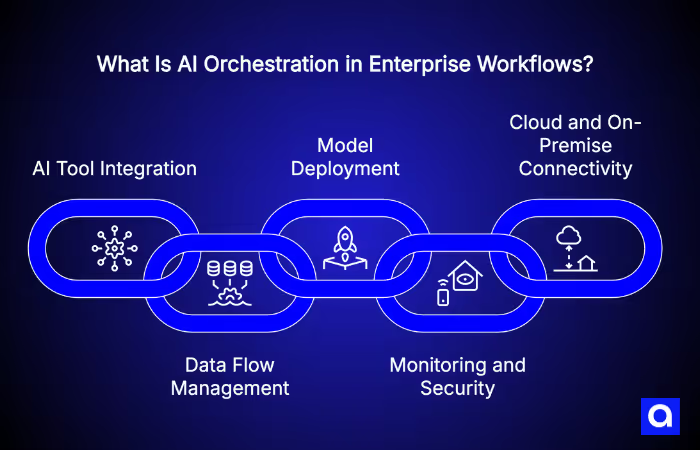
AI orchestration is the system that helps different AI tools, models, and data sources work together to complete complex business tasks. Instead of one AI doing everything, orchestration makes sure each part of the system works in the right order and shares information properly. It is more like a control system for AI than a single chatbot.
For example, if a supply chain system detects a delivery delay, one AI agent can notify the customer, another can reroute the shipment, and another can estimate the financial impact. All of this happens automatically, and humans only step in when a decision is actually needed.
AI orchestration also manages the full process behind AI systems, including data flow, model deployment, monitoring, and security. It often works across both cloud and on-premise environments to keep everything connected and running smoothly.
Why Enterprises Need AI Orchestration Tools
As companies adopt more AI tools, managing them becomes harder. Different systems, agents, and data sources often end up working separately instead of together, which reduces the value of automation.
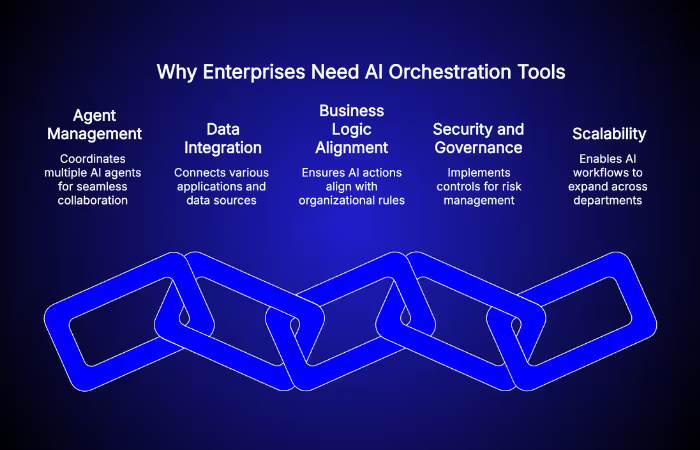
Managing Multiple AI Agents Across Systems
Many companies are no longer using just one AI tool. Instead, they are running several specialized agents for different tasks. Without coordination, these agents end up working separately, which creates confusion and limits value. Orchestration helps them work together in a structured way.
Coordinating Data, APIs, and Business Logic
Most enterprises use hundreds of applications, and many of them do not connect properly. AI orchestration helps bridge this gap by linking systems like CRMs, ERPs, and data warehouses. This allows AI to access real-time data, trigger actions, and follow business rules across tools.
Ensuring Reliability, Security, and Governance
As AI use grows, governance becomes more important. Businesses need visibility into how AI systems make decisions and act on data. Orchestration tools help with this by adding controls like access rules, approval steps, and audit logs so teams can manage risk more effectively.
Scaling AI Workflows Across Departments
Many AI projects work in testing but fail when scaled across departments. Orchestration helps turn small experiments into reliable, production-ready systems by reducing duplication, improving coordination, and making workflows easier to manage across the organization.
How Azumo Helps Enterprises Orchestrate AI Agents and Workflows
Choosing the right AI orchestration tools depends on your existing systems, compliance needs, and how complex your workflows are. For many enterprises, the challenge is not picking a tool, but designing an architecture that actually works in production.
At Azumo, we specialize in custom AI development and help companies build and deploy production-ready AI orchestration systems using frameworks like LangGraph, CrewAI, and AutoGen, as well as cloud platforms such as Vertex AI and AWS Step Functions.
We focus on building systems that are ready for real enterprise use, including proper governance, audit trails, role-based access control, and human-in-the-loop checkpoints from the start. Beyond orchestration, our teams also work with technologies such as computer vision for clients building more advanced AI-powered products.
Let's connect and discuss your AI orchestration roadmap and identify the right architecture for your business.
How We Reviewed and Handpicked the Top 10 AI Orchestration Tools
We selected these tools based on real-world factors that matter once AI systems move from demos into production.
We focused on:
- Production readiness and real enterprise usage
- Support for multi-agent systems and orchestration depth
- Integration options with APIs, CRMs, ERPs, and data platforms
- Security features, including role-based access control and governance
- Community strength and ongoing development activity
- Deployment options like cloud, self-hosted, on-premise, or hybrid setups
- Pricing and overall cost at scale
- Human-in-the-loop support for approvals and oversight
- Monitoring, logging, and system visibility
This list includes developer tools, cloud platforms, and no-code solutions because enterprise teams have very different needs depending on their size and technical setup.
Best AI Orchestration Tools for Enterprise Workflows
LangChain – Best AI Orchestration Framework for Building Applications Around LLM
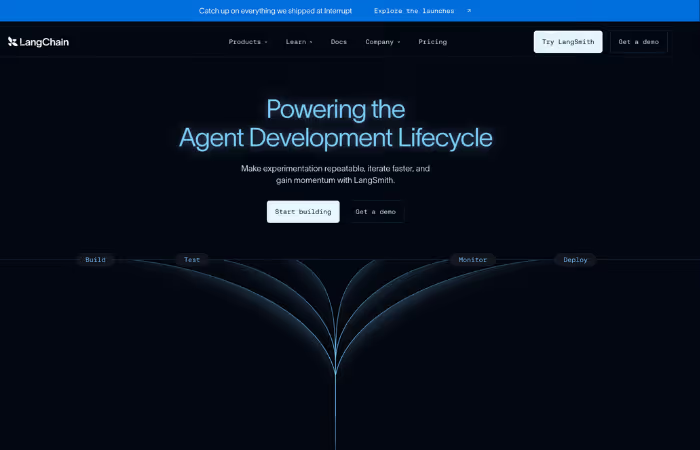
LangChain is one of the most widely used frameworks for building AI workflows with large language models. It is designed for creating modular, multi-step AI systems rather than simple single prompts.
Its graph-based extension, LangGraph, represents workflows as connected nodes and steps. This makes it easier to build complex flows with loops, branching logic, retries, and human-in-the-loop approvals. It is used in production environments, including large-scale enterprise systems.
LangChain also provides a flexible ecosystem of tools for working with models, memory, data connectors, and output parsing. With LangSmith, teams can also track, debug, and monitor AI workflows in production.
- Strengths: Highly flexible, large ecosystem, strong support for complex workflows, and good observability with LangSmith.
- Limitations: Frequent updates can break compatibility, setup can be complex, and it may be too heavy for simple use cases.
- Best for: Enterprise teams building advanced LLM workflows, RAG development services, and multi-step AI agents.
- Pricing: Open-source core, paid observability, and enterprise features via LangSmith.
Temporal – Best AI Orchestration Tool for Durable Enterprise Workflows
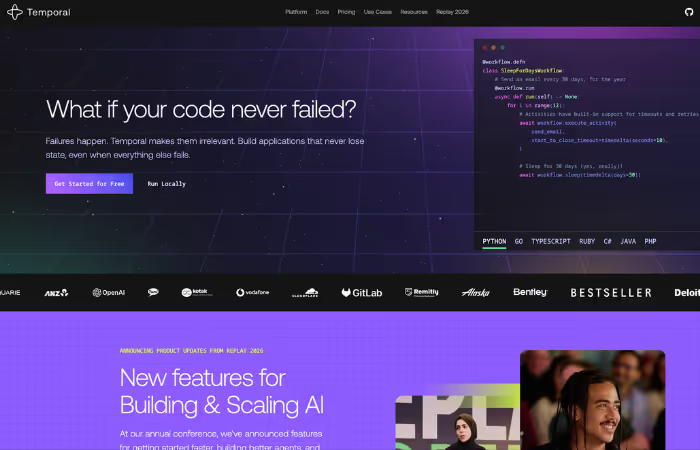
Temporal is a workflow orchestration engine designed for building reliable, long-running business processes. It focuses on "durable execution," which means workflows can pause, recover, and continue even if systems fail or restart.
It is widely used in production systems where reliability matters more than speed or simplicity. Instead of just triggering tasks, Temporal tracks the full state of a workflow and ensures every step is completed correctly, even across distributed systems.
- Strengths: Highly reliable workflow execution, strong fault tolerance, built for complex distributed systems.
- Limitations: Requires engineering effort, is not beginner-friendly, and has a steeper learning curve.
- Best for: Enterprise teams building mission-critical workflows that must not fail, such as payments, logistics, or backend automation systems.
- Pricing: Open source with paid enterprise options.
Microsoft AutoGen – Best Framework for Orchestrating Multiple AI Agents
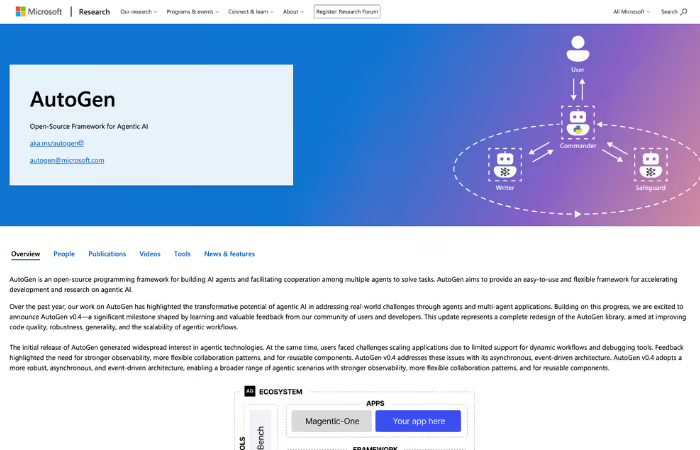
Microsoft AutoGen is a framework designed for building systems where multiple AI agents work together to solve tasks. It is especially focused on conversational coordination between agents rather than single-step automation.
It supports different multi-agent patterns such as two-agent chats, group discussions, and hierarchical agent setups. It also includes tools for safe code execution, event-driven workflows, and integration with Azure services for enterprise environments.
In 2025, Microsoft introduced the Agent Framework as a successor direction, combining ideas from AutoGen and Semantic Kernel, while the open-source community continues development under AG2.
- Strengths: Strong multi-agent design, good human-in-the-loop support, flexible for research and coding workflows.
- Limitations: Recent breaking changes, higher token usage for simple tasks, and a smaller ecosystem compared to more mature frameworks.
- Best for: Teams building multi-agent AI systems, research environments, and Microsoft/Azure-based enterprise solutions.
- Pricing: Open source.
CrewAI – Best AI Orchestration Tool for Lightweight Multi-Agent Workflows
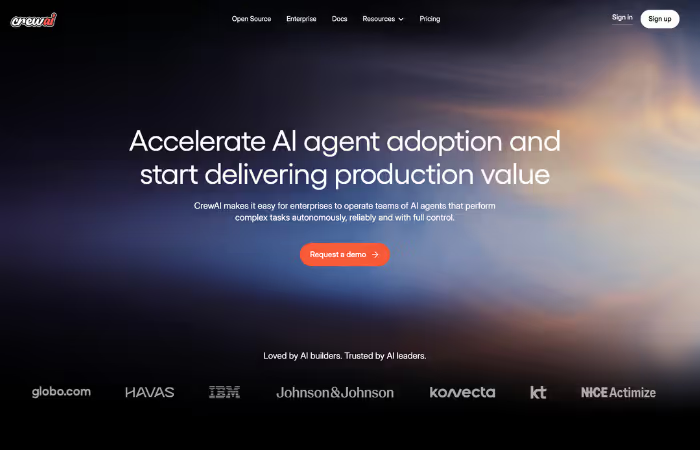
CrewAI is a framework for building simple multi-agent systems where each AI agent has a clear role, goal, and set of responsibilities. It is designed to make multi-agent orchestration easy to understand and quick to set up.
It uses a "crew" structure where agents work together on tasks, either in sequence or through hierarchical coordination. The system is split into two main parts: Crews, which handle role-based collaboration, and Flows, which manage structured, event-driven workflows. This makes it flexible for both simple and more structured automation needs.
CrewAI is popular for fast prototyping because it combines a simple setup with a readable configuration using Python and YAML. Teams can quickly build and test working AI workflows without heavy engineering overhead.
- Strengths: Easy to understand, fast to build prototypes, strong community growth, and good for role-based workflows.
- Limitations: Can become inefficient for very large or complex systems, and multi-agent setups may increase token usage.
- Best for: Product teams, startups, and developers building lightweight multi-agent systems or quickly testing AI workflow ideas.
- Pricing: Open source core with optional paid enterprise features.
Vertex AI Pipelines – Best AI Orchestration Tool for Enterprise Cloud AI Pipelines
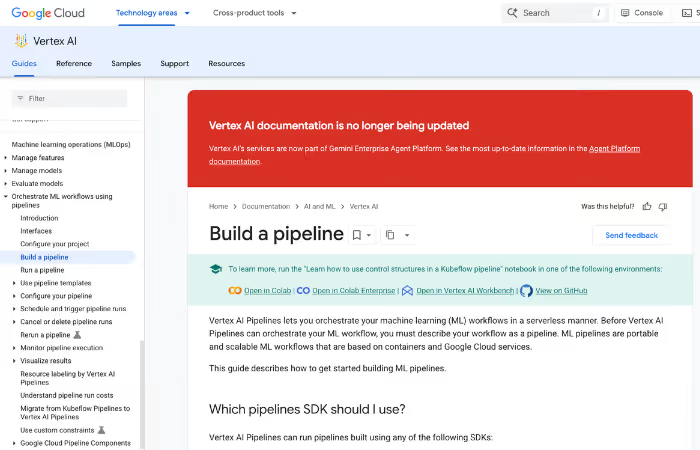
Vertex AI Pipelines is Google Cloud's managed orchestration system for building and running machine learning and AI workflows at scale. It helps teams automate the full lifecycle of AI systems, from data processing to model training and deployment.
It runs on top of Kubeflow Pipelines and integrates closely with the wider Google Cloud ecosystem. This allows teams to connect data from tools like BigQuery and Spanner, while also using Gemini models and other third-party LLMs inside the same workflow.
More recently, Google has expanded Vertex AI with agent-building capabilities, making it easier to create AI systems that follow defined goals and connect to enterprise data sources. This turns it into both a pipeline orchestration tool and a foundation for agentic AI development services.
- Strengths: Fully managed service, strong integration with Google Cloud, built-in governance and security, and support for multiple models.
- Limitations: Works best inside Google Cloud, and cross-cloud setups require extra configuration.
- Best for: Enterprises using Google Cloud that need scalable, secure, and production-ready AI and ML pipelines.
- Pricing: Pay-as-you-go based on GCP usage.
AWS Step Functions – Best AI Orchestration Tool for Serverless Enterprise Workflows
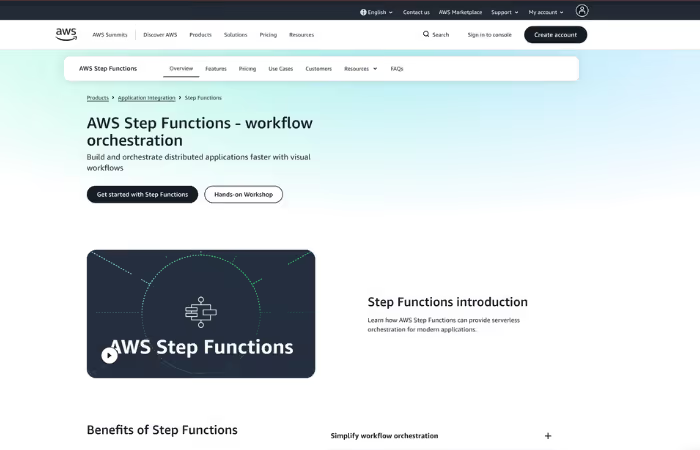
AWS Step Functions is a serverless workflow orchestration service from Amazon Web Services that helps teams coordinate applications and services across AWS. It is designed for building reliable, step-by-step workflows that can run at scale without managing servers.
It works by using "state machines" to define each step in a process. These steps can connect to more than 200 AWS services, which makes it useful for building complex backend systems and AI-powered workflows. It is also commonly used with Amazon Bedrock Agents for multi-step AI tasks.
Step Functions is built for enterprise environments where reliability, security, and compliance are critical. It supports features like automatic retries, workflow tracking, and execution history, while keeping everything inside the AWS ecosystem and a customer's private cloud.
- Strengths: Deep AWS integration, strong reliability, built-in retry and monitoring, and serverless scalability.
- Limitations: Steep learning curve, best value only inside AWS, and pricing can become complex at high volume.
- Best for: Enterprises fully or heavily invested in AWS that need secure, scalable, and auditable workflow orchestration.
- Pricing: Pay-per-state-transition model.
Zapier AI – Best AI Orchestration Tool for No-Code Business Automation
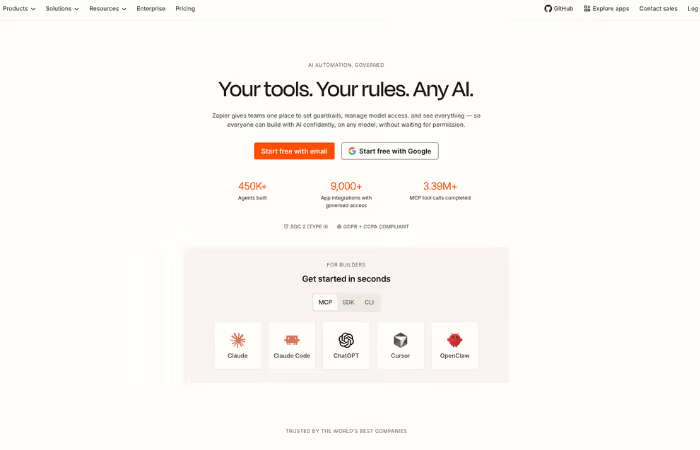
Zapier is a no-code automation platform that helps teams connect different apps and automate repetitive work. It is widely used by non-technical teams to build workflows without writing any code.
It supports thousands of app integrations, which allows users to move data between tools like CRMs, email platforms, and project management systems. With newer AI features added in recent years, Zapier now also helps users add simple AI steps into these automated workflows.
Zapier is mainly designed for ease of use, so teams can quickly set up automations and keep them running without engineering support.
- Strengths: Huge integration library, very easy to use, and fast setup with minimal learning curve.
- Limitations: Not designed for complex AI orchestration or multi-agent workflows.
- Best for: Operations, marketing, and AI solutions for sales teams automating everyday business tasks across SaaS tools.
- Pricing: Free plan available; paid plans start around $19.99/month.
Make (Integromat) – Best AI Orchestration Tool for Visual Workflow Automation
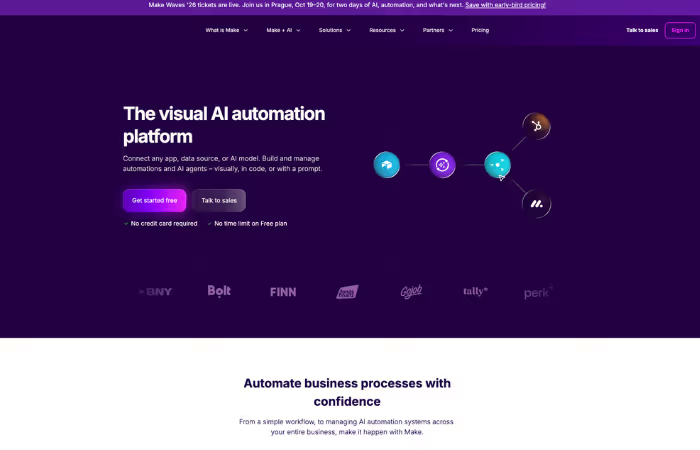
Make is a visual automation platform that lets users build workflows using a drag-and-drop canvas. It is designed for teams that prefer a clear visual structure when designing automation flows.
It supports thousands of app integrations and allows users to connect tools, transform data, and build multi-step workflows in a structured visual format. This makes it especially useful for teams that want more control than simple no-code tools but still want a visual builder.
Make focuses on flexibility and cost efficiency, making it popular among mid-market teams and agencies managing multiple client workflows.
- Strengths: Visual workflow builder, affordable pricing, flexible automation design, and good for structured processes.
- Limitations: Smaller integration library than Zapier and limited support for advanced AI-native orchestration.
- Best for: Mid-market companies and agencies building structured, visual automation workflows.
- Pricing: Free plan available; paid plans start around $10.59/month.
Apache Airflow – Best AI Orchestration Tool for Data and ML Pipelines
Apache Airflow is a workflow orchestration platform mainly used for scheduling and managing data pipelines. It is widely adopted in data engineering and machine learning operations, often used alongside MLOps development to automate model training and deployment pipelines.
Airflow lets teams define workflows as code and automate complex data processes such as ETL jobs, model training pipelines, and reporting systems. It runs tasks in a structured order and ensures dependencies are handled correctly.
- Strengths: Mature ecosystem, strong scheduling capabilities, widely adopted in data engineering.
- Limitations: Not real-time focused, requires coding knowledge, and can be heavy to manage at scale.
- Best for: Data teams and enterprises running scheduled workflows, analytics pipelines, or ML training processes.
- Pricing: Open source (managed versions available via cloud providers).
Microsoft Semantic Kernel – Best AI Orchestration Tool for AI Agent Applications
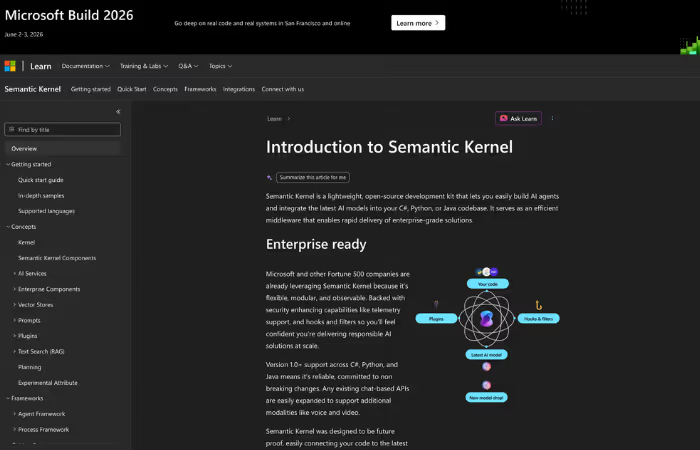
Microsoft Semantic Kernel is a framework for building AI applications that combine large language models with tools, memory, and structured planning.
It helps developers create AI agents that can plan tasks, call functions, and interact with external systems in a controlled way. It relies heavily on NLP development to interpret user intent and generate contextually relevant responses. It is often used to build enterprise AI assistants and multi-step agent workflows.
- Strengths: Strong integration with the Microsoft ecosystem, flexible agent design, and good support for tool use and planning.
- Limitations: Still evolving, requires development effort, and has less community adoption than LangChain.
- Best for: Teams building enterprise AI agents, copilots, or structured LLM-based applications.
- Pricing: Open source.
What Are the Key Capabilities of AI Orchestration Platforms?
AI orchestration platforms are not just about running AI tools. They are designed to connect systems, manage workflows, and make sure AI behaves reliably in real business environments.
Multi-Agent Coordination
Modern orchestration platforms can manage multiple AI agents working together. Instead of one general-purpose AI, you can have different agents for specific roles like research, analysis, coding, or customer support. A central coordinator assigns tasks and keeps everything aligned so the system works as one unit.
Workflow Memory and State Management
Enterprise workflows need to remember what happened in previous steps. Good orchestration platforms can pause, retry failed steps, branch based on conditions, and continue where they left off. This is important for long-running processes that cannot fail halfway through.
API and Enterprise System Integration
Orchestration tools connect AI systems to real business software like CRMs, ERPs, data warehouses, and support systems. Some platforms focus on wide integration coverage, while others focus on deep enterprise connections with specific systems. This is what allows AI to actually act on business data instead of working in isolation.
Human-in-the-Loop Control
Most business processes still require human approval at key points. Modern orchestration platforms include review steps where humans can approve or reject important actions. This helps reduce risk and ensures AI decisions stay aligned with business rules.
Monitoring, Logging, and Governance
To run AI in production, companies need visibility and control. Orchestration platforms track workflows, log actions, monitor performance, and enforce access rules. This helps teams understand what AI is doing and ensures systems stay compliant and reliable over time.
Industries with strict regulatory requirements benefit most from these governance capabilities. Healthcare teams often need software development services for healthcare to manage patient data securely, while fintech companies rely on stronger controls, audit trails, and integration support from software development for fintech. Legal teams face similar pressure around confidential data and case-specific workflows, making legal software development services important when standard AI tools cannot provide enough control.
Frequently Asked Questions

About the Author:
VP of Technology | Software Engineer | Expert in Scalable Systems & Leadership | React, Node.js & Cloud Architect
Gonzalo Buszmicz, VP of Technology at Azumo, specializes in scalable systems, full-stack development, and cloud architecture, with over 15 years of experience leading teams.



.avif)