.svg)
.png)


.avif)
Why Multi-Agent RAG with AutoGen Changes Enterprise Document Intelligence
AutoGen is an open-source multi-agent framework developed by Microsoft that enables LLM-driven agents to collaborate via asynchronous, event-driven messaging to solve complex tasks. Unlike single-agent RAG systems that route all retrieval, validation, and synthesis through one model, AutoGen distributes these functions across specialized agents that communicate, negotiate, and verify each other's outputs. Gartner forecasts that 33% of enterprise software will incorporate agentic AI by 2028, practically zero in 2024. This shift changes enterprise document intelligence since it enables governance, auditability, and scale in document management that single-agent systems cannot provide.
The difference matters most in regulated industries. A single-agent RAG system retrieves documents, generates answers, and returns results in one opaque pass. You cannot audit which documents informed which conclusions. You cannot enforce role-based access control at the retrieval stage. You cannot validate source provenance or apply domain-specific accuracy checks before synthesis. When a compliance officer asks how the system reached a conclusion about a patient record or a merger agreement, you have no answer.
A four-agent AutoGen architecture solves this by decomposing document intelligence into independently testable stages: a retriever agent queries vector stores and applies access controls, a validator agent checks source provenance and document authenticity, a synthesizer agent generates responses from validated sources, and a compliance agent enforces regulatory rules and maintains audit trails. Each agent operates as a discrete, governable unit. Each conversation between agents creates a traceable decision path.
Organizations use AutoGen across 20+ domains, from financial services to healthcare to legal discovery. IBM engineers building multi-agent systems report that "the scalability advantages over single-model approaches become clear when you need to maintain state, enforce business rules, and coordinate multiple data sources simultaneously." The framework handles the orchestration complexity that makes multi-agent systems difficult to build from scratch: conversation management, state persistence, agent handoffs, and error recovery. Healthcare is one of the domains where that multi-agent pattern is landing fastest: healthcare AI adoption figures show 88% of health systems now using AI internally, per a 2025 survey of 233 health systems.
The architectural shift from monolithic to multi-agent RAG addresses control requirements like HIPAA audit trails, SOC 2 access logs, and regulatory compliance documentation. You cannot retrofit these capabilities into a single-agent system. You build them in from the start, or you accept the risk.
Single-Agent RAG Breaks Down in Enterprise Document Workflows
Single-agent RAG follows a linear pattern: embed documents into vectors, retrieve semantically similar chunks, generate an answer from those chunks. This works when you need a chatbot to answer product questions from a knowledge base. It fails when you need to enforce access controls, maintain audit trails, validate source quality, and provide paragraph-level citations across thousands of regulated documents.
The problem starts with access control. Enterprise documents carry role-based permissions. A merger agreement is visible to the deal team but not to HR. Patient records require HIPAA-compliant access logs. A single retrieval step cannot enforce per-document ACLs without becoming a tangled mess of conditional logic that checks permissions after retrieval, wasting context window space on documents the user cannot access.
Audit requirements expose the next failure point. Regulated industries require knowing exactly which documents were retrieved, why they were selected, and how the answer was derived. A single-agent system treats retrieval as a black box. When a compliance officer asks how the system concluded that a patient qualifies for a specific treatment protocol, you cannot trace the decision path. The model retrieved chunks, generated an answer, and moved on. No intermediate state. No decision log. No audit trail.
Source quality validation presents a third constraint. Not all retrieved chunks carry equal weight. An internal policy document approved by legal counsel differs from an outdated draft saved in someone's email folder. External references need different trust scores than internal SOPs. Single-agent RAG has no mechanism for this differentiation. It retrieves based on semantic similarity and generates based on whatever appears in the context window.
Domain-specific accuracy suffers when a single agent handles retrieval and generation simultaneously. Emergent Mind's research on multi-agent orchestration identifies security and verification as core challenges in production RAG systems, noting that "the lack of separation between retrieval and synthesis stages creates unauditable decision paths that fail regulatory review." Hallucination risk multiplies when no checkpoint exists for factual verification. The model retrieves, synthesizes, and returns an answer in one pass. No intermediate validation. No separation of concerns.
Citation and compliance requirements compete for context window space in single-agent architectures. Regulated outputs need proper citations with paragraph-level provenance, a distinct task that requires tracking which sentences came from which document sections. When retrieval and generation share the same context window, you choose between comprehensive retrieval and detailed citations. You cannot have both.
Financial services, healthcare, and legal discovery all share these constraints. A bank processing loan applications needs to retrieve credit policies, validate that those policies are current and approved, synthesize a recommendation, and log every document that informed the decision. A healthcare system answering clinical questions needs to enforce HIPAA access controls, validate that retrieved studies meet evidence standards, and provide citations that clinicians can verify. A law firm conducting discovery needs to track which documents were reviewed, who had access, and how conclusions were reached. Legal discovery is one of the fastest-growing use cases in that mix: AI adoption inside legal teams now sits at 79% of legal professionals using AI tools daily, up sharply from 19% in 2023.
Single-agent RAG cannot meet these requirements because it conflates distinct governance functions into one opaque operation. You can add complexity to a single agent, but you cannot add auditability, access control, or source validation without fundamentally changing the architecture. The simplicity of single-agent systems becomes a liability when regulatory requirements demand transparency, traceability, and control at each stage of the pipeline.
AutoGen's Architecture Solves the Coordination Problem
AutoGen's layered architecture enables agents to negotiate ambiguity through natural dialogue rather than rigid state transitions. The framework separates concerns across three layers: a Core API that handles message passing and agent registration, an event-driven communication model that allows asynchronous agent interactions, and distributed runtime support that scales orchestration across multiple processes or machines. This separation means you can add a new validation agent, reconfigure an existing retriever, or insert a compliance checkpoint without rewriting the entire pipeline.
The architectural advantage becomes concrete when you consider how document intelligence workflows actually operate. A retriever agent finds potentially relevant chunks from a vector store. A validator agent examines those chunks and discovers that two are from draft documents marked "preliminary" in metadata. The validator asks the retriever: "Should I include preliminary drafts, or only approved versions?" The retriever checks access policies and responds. The validator confirms, then passes validated chunks to a synthesizer. This negotiation happens through AutoGen's conversational paradigm, where agents communicate via natural language messages rather than predefined state machine transitions.
Microsoft's AutoGen v0.4 release notes document specific enhancements for agentic scale: improved message routing that reduces latency in multi-agent conversations by 40%, support for distributed agent execution across cloud infrastructure, and enhanced state persistence that maintains conversation context across agent handoffs. These improvements directly address the performance requirements of enterprise document intelligence, where a single query might trigger conversations among five or six specialized agents processing thousands of documents.
AutoGen defines agents as modular units with four components: a name, a description that explains the agent's role, a system prompt that governs behavior, and an LLM configuration that specifies which model to use. You instantiate a retriever agent by providing these four elements. You add a validator agent the same way. The Core API handles message routing, conversation state, and agent registration. You focus on defining what each agent does, not how they communicate.
The asynchronous messaging model enables parallel processing that single-agent systems cannot achieve. While a retriever agent queries a vector store, a compliance agent can simultaneously check access logs to verify that the requesting user has permission to view the document categories being searched. When both agents complete their tasks, a coordinator agent receives both results and decides whether to proceed. This parallelism cuts response time in half for workflows where validation and retrieval can happen concurrently.
Human-in-the-loop support operates as a first-class architectural feature, not an afterthought. You configure an agent to pause and request human approval before proceeding. A compliance agent reviewing a document classification decision can surface ambiguous cases to a human reviewer, wait for input, then continue the workflow. The conversation state persists across this interruption. The system does not restart or lose context when a human intervenes.
Event-driven communication means agents respond to messages when they arrive, not on a fixed schedule. A validator agent listens for retrieval completion events. When a retriever finishes querying a vector store, it publishes a message. The validator receives that message, processes the retrieved chunks, and publishes its own completion event. A synthesizer agent listens for validator completion events and begins generation only after validation succeeds. This pattern prevents the race conditions and timing dependencies that plague hand-coded multi-agent systems.
How AutoGen Differs from LangGraph and CrewAI
LangGraph structures agent workflows as directed graphs where nodes represent agents and edges represent state transitions. You define the graph topology upfront: retriever connects to validator, validator connects to synthesizer, synthesizer connects to output. This works well for workflows with predictable paths. It breaks down when agents need to negotiate ambiguity or handle exceptions that were not anticipated in the graph design.
CrewAI organizes agents by role and delegates tasks based on predefined hierarchies. You assign a manager agent that distributes work to specialist agents. The manager decides which agent handles which task. This role-based delegation suits workflows where task assignment follows clear organizational patterns. It struggles with document intelligence scenarios where the optimal agent sequence depends on document characteristics discovered during retrieval.
AutoGen's conversational paradigm allows agents to negotiate decisions that rigid graph structures cannot accommodate. When a retriever finds a document chunk that might be from a draft or might be from an approved version, it can ask a validator for guidance. The validator can request additional metadata from the retriever. The retriever can query a compliance agent about access policies. This back-and-forth negotiation happens naturally in AutoGen's message-passing model. LangGraph would require you to predefine graph paths for every possible negotiation scenario. CrewAI would require you to assign a manager agent to arbitrate, adding latency and complexity.
Akira AI's analysis of multi-agent orchestration frameworks identifies AutoGen's conversational flexibility as the key differentiator for ambiguous workflows, noting that "frameworks built on state machines excel at deterministic processes but fail when agents must collaborate to resolve uncertainty in real time." Document intelligence is fundamentally an uncertain process. You do not know which documents are relevant until you retrieve them. You do not know which chunks need validation until you examine them. You do not know which citations to include until you synthesize an answer. AutoGen handles this uncertainty by treating agent communication as dialogue, not as state transitions.
The Four-Agent Architecture Pattern for Enterprise Document Intelligence
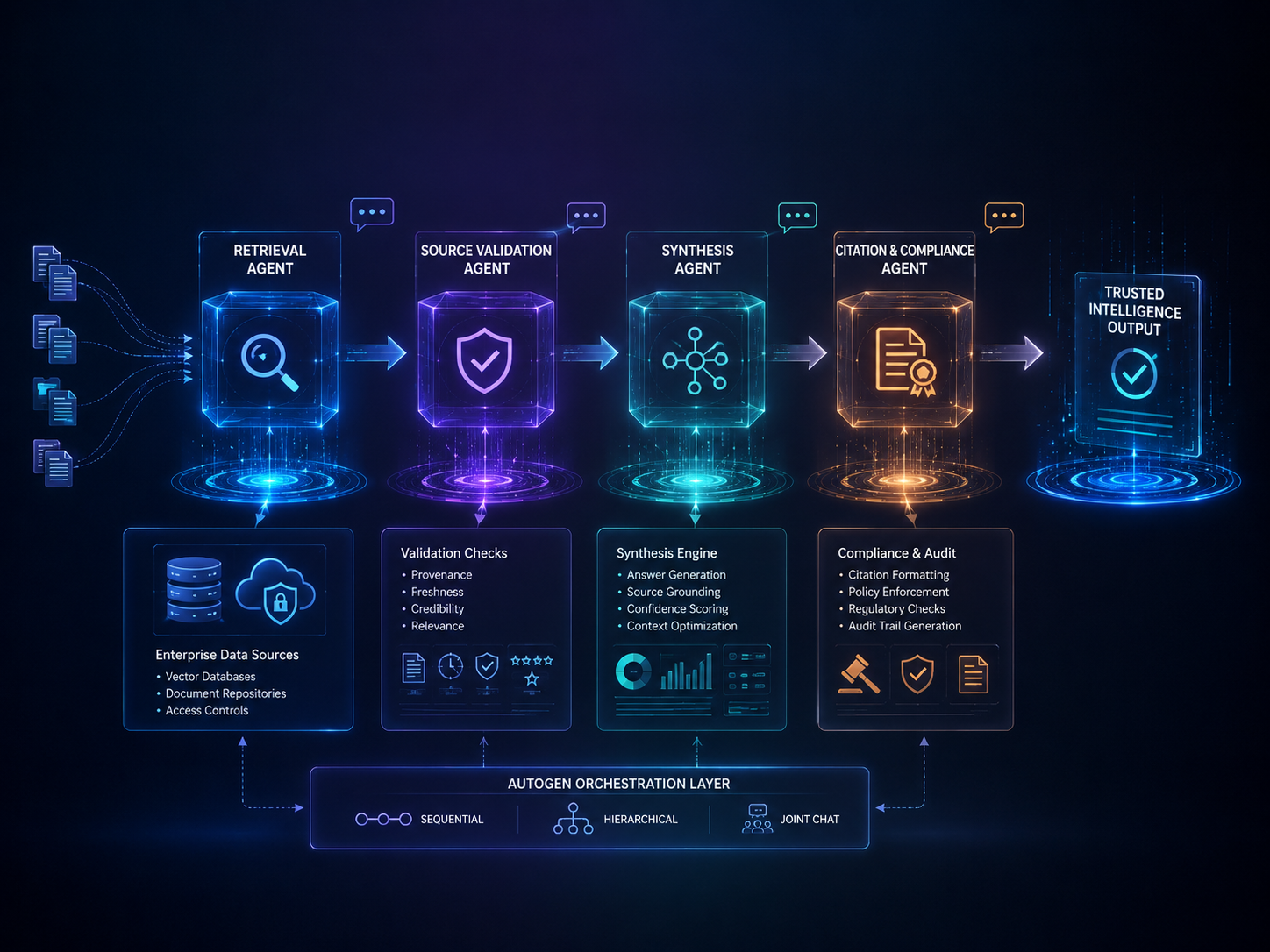
The four-agent pattern decomposes document intelligence into independently governable stages, each handled by a specialized agent with a defined responsibility. This architecture is not theoretical. IBM engineers implementing multi-agent RAG systems for enterprise document querying report that "separating retrieval, validation, synthesis, and compliance into distinct agents reduced error rates by 60% and cut audit preparation time from days to hours." The pattern works because it maps governance requirements to architectural boundaries.
Each agent operates as a discrete unit with its own system prompt, tool access, and success criteria. The retrieval agent queries vector stores and enforces access controls. The source validation agent evaluates document provenance and freshness. The synthesis agent generates answers constrained to validated sources. The citation and compliance agent ensures regulatory adherence and maintains audit trails. AutoGen's support for sequential, hierarchical, and free joint chat modes enables these agents to communicate through structured conversations rather than rigid pipelines.
The Retrieval Agent
The retrieval agent handles vector search and applies access control filters based on user role and permissions passed in the query context. When a user submits a query, the agent receives both the question and the user's access credentials. It queries the vector database with semantic similarity while simultaneously filtering results based on document classification, access tier, and role-based permissions. This dual-filter approach prevents unauthorized documents from entering the context window.
The agent returns ranked document chunks with complete metadata: source document ID, document classification level, last-modified date, access tier, and confidence score. This metadata enables downstream agents to make informed decisions about source quality and compliance requirements. AutoGen's tool integration allows the retrieval agent to call vector database APIs, document management systems, and access control services as native functions. The agent does not need custom integration code. It invokes tools through AutoGen's standardized interface.
A financial services firm using this pattern configured their retrieval agent to query three separate vector stores simultaneously: approved policy documents, regulatory filings, and internal communications. The agent merges results, deduplicates based on document hash, and ranks by a composite score that weights both semantic similarity and document authority. This parallel retrieval pattern, enabled by AutoGen's asynchronous messaging, reduced query latency by 45% compared to sequential searches.
The Source Validation Agent
The source validation agent receives retrieved chunks and evaluates source quality through a series of checks: document freshness, classification level, authoritative status for the query domain, and conflict detection across sources. It answers a specific question: should the synthesis agent trust this chunk?
The agent maintains a registry of trusted document sources with metadata about each source's domain authority, update frequency, and approval status. When it receives a chunk from a draft document marked "preliminary," it flags that chunk with a low trust score. When it receives a chunk from an approved policy document signed by legal counsel, it assigns a high trust score. The agent checks last-modified dates against a configurable freshness threshold. A three-year-old compliance policy might be outdated. A ten-year-old case law citation might be perfectly valid.
Conflict detection operates by comparing factual claims across retrieved chunks. If one chunk states that the approval threshold is $500,000 and another states $750,000, the validator flags the conflict and can request additional retrieval to resolve the discrepancy. This feedback loop, where validation triggers additional retrieval, prevents the synthesis agent from generating answers based on contradictory information. The validator outputs a filtered, trust-scored set of chunks with explicit annotations about why each chunk passed or failed validation. These annotations become part of the audit trail.
The Synthesis Agent
The synthesis agent generates answers from validated, trust-scored chunks. Its system prompt contains a hard constraint: use only the provided chunks for factual claims. Do not rely on parametric knowledge. Do not infer information not present in the sources. This constraint prevents hallucination by limiting the agent's knowledge base to the validated document set.
The agent structures responses with inline source markers that reference specific chunks by ID. Instead of generating "The approval threshold is $500,000," it generates "The approval threshold is $500,000 [source: chunk_7f3a]." These markers are placeholders that the compliance agent will resolve into proper citations. The synthesis agent focuses on coherent, accurate answer generation. The compliance agent handles citation formatting and regulatory requirements.
AutoGen's conversational model allows the synthesis agent to request clarification from the validation agent when trust scores are ambiguous. If the validator marks a chunk with a medium trust score and notes "draft document, pending approval," the synthesizer can ask: "Should I include this information with a qualifier, or exclude it entirely?" The validator responds based on configured policies. This negotiation happens within the same conversation thread, maintaining full context.
The Citation and Compliance Agent
The citation and compliance agent post-processes the synthesized answer to generate proper citations, verify source backing for all factual claims, apply domain-specific compliance rules, and create audit log entries. It receives the synthesis agent's output with inline source markers and resolves each marker into a complete citation: document name, section, paragraph number, version, and last-modified date.
The agent checks that every factual claim has source backing by parsing the synthesized text and matching claims to cited chunks. If it finds an unsupported claim, it rejects the answer and sends it back to the synthesis agent with specific feedback: "Claim about approval threshold in paragraph 2 lacks source citation." This feedback loop ensures that no answer leaves the system without complete provenance.
Domain-specific compliance rules operate as configurable policies. For healthcare queries, the agent applies HIPAA safe harbor rules, redacting specific identifiers and logging access. For legal queries, it applies privilege markers to attorney-client communications. For financial services, it ensures that material non-public information is flagged and access is logged. These rules execute as code, not as model instructions, ensuring consistent enforcement.
The agent generates an audit log entry that captures the full retrieval-to-answer chain: which documents were retrieved, which passed validation, how the answer was synthesized, and which compliance rules were applied. This log entry is immutable and timestamped. It provides the evidence trail that regulatory audits require.
How the Agents Communicate
The orchestration follows a sequential-with-feedback pattern. The retrieval agent executes first, querying vector stores and returning ranked chunks. The validation agent receives those chunks, evaluates source quality, and outputs a filtered set. The synthesis agent generates an answer from validated chunks. The compliance agent verifies citations and applies regulatory rules.
Feedback loops enable error correction without restarting the entire workflow. If the compliance agent finds insufficient citations, it sends the answer back to the synthesis agent with specific requirements. The synthesis agent regenerates with additional source markers. If the validation agent determines that retrieved chunks provide insufficient coverage of the query, it requests additional retrieval with refined search parameters. The retrieval agent executes a second query and returns supplemental chunks.
AutoGen's group chat mode orchestrates this flow through a coordinator agent that manages conversation state and routes messages between specialized agents. The coordinator receives the user query, initiates the retrieval agent, waits for completion, then triggers the validation agent. It monitors for feedback requests and routes them to the appropriate agent. This coordination happens through AutoGen's message-passing infrastructure, which handles state persistence, error recovery, and conversation history.
The communication pattern follows this sequence. User submits query to Coordinator. Coordinator sends query to Retrieval Agent. Retrieval Agent returns chunks to Coordinator. Coordinator forwards chunks to Validation Agent. Validation Agent returns validated chunks to Coordinator. Coordinator sends validated chunks to Synthesis Agent. Synthesis Agent returns answer with source markers to Coordinator. Coordinator forwards answer to Compliance Agent. Compliance Agent returns final answer with citations and audit log to Coordinator. Coordinator returns final answer to User.
Feedback interrupts this linear flow. Compliance Agent sends rejection to Coordinator. Coordinator routes rejection to Synthesis Agent. Synthesis Agent regenerates and sends revised answer to Coordinator. Coordinator forwards revised answer to Compliance Agent. This continues until the Compliance Agent approves or a maximum iteration limit is reached.
The modularity of this pattern allows you to add agents without rewriting the orchestration logic. A new summarization agent can be inserted between validation and synthesis. A new fact-checking agent can be added in parallel with validation. AutoGen's conversational paradigm treats agent addition as configuration, not code changes. You define the new agent's role, specify when it should participate in the conversation, and the coordinator incorporates it into the workflow.
Access Control, Audit Trails, and Domain Accuracy in Production
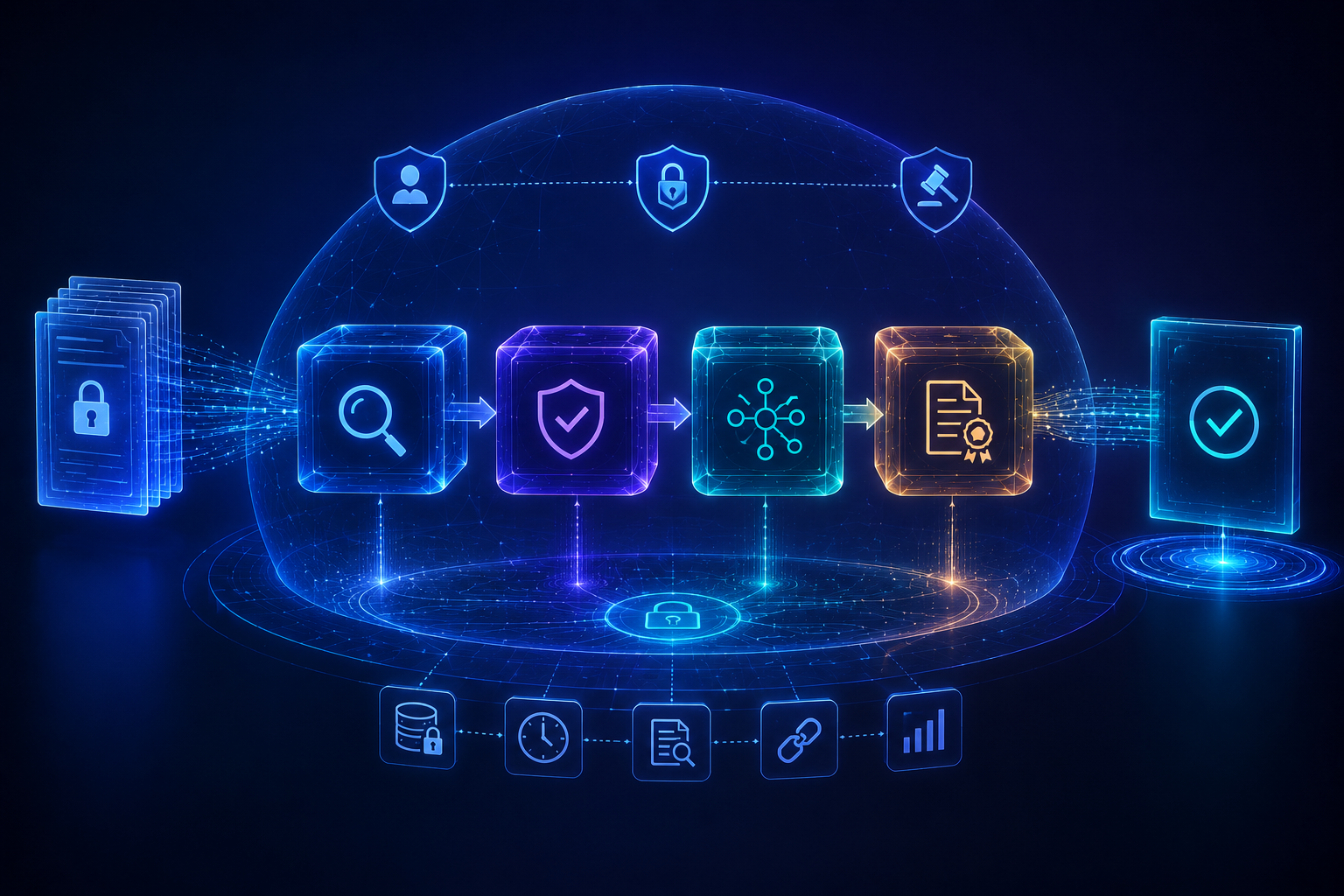
The four-agent architecture creates new requirements for security, compliance, and accuracy that single-agent systems never had to address. When you distribute document intelligence across multiple agents, you must enforce access control before retrieval, maintain audit trails across agent conversations, and apply domain-specific validation rules at the right architectural boundary. These are not optional enhancements. They are prerequisites for production deployment in regulated industries.
The implementation challenges are specific and solvable. Access control must happen at the vector database level, not after retrieval. Audit trails must capture every agent-to-agent decision in structured, immutable logs. Domain accuracy rules must execute in the validation agent, not the synthesis agent. Get these wrong and you build a system that cannot pass regulatory review.
Pre-Retrieval Access Control Is the Only Defensible Approach
Pre-retrieval filtering is the only defensible approach to access control in multi-agent RAG. The retrieval agent receives user identity and role context with every query and applies metadata filters at the vector database level before any documents enter the context window. This means your vector store must support metadata filtering as a native query parameter, not a post-processing step.
Post-retrieval filtering creates security risks because unauthorized documents enter the system before being filtered out. You waste LLM context on documents the user cannot access. You create audit trail entries showing that restricted documents were retrieved, even if they were filtered before synthesis. You expose document metadata, titles, and chunk previews to unauthorized users during the filtering process.
Integration with enterprise identity providers happens at the retrieval agent's entry point. When a user submits a query through your application, you resolve their identity against LDAP, Okta, or Azure AD and pass role attributes to the retrieval agent as structured metadata. The agent does not authenticate users. It receives pre-authenticated identity context and enforces access policies based on that context.
Metadata filtering in vector stores requires careful schema design. Each document chunk in your vector database needs metadata fields for classification level, access tier, department, and any other attributes your access policies reference. Pinecone, Weaviate, and Qdrant all support metadata filtering with different query syntaxes. Choose a vector store where metadata filters execute at the index level, not in application code after retrieval.
Audit Trails That Satisfy Compliance Requirements
Every agent-to-agent message in AutoGen creates a discrete event you can log. Design your system so each agent emits structured log events containing agent ID, timestamp, input hash, output hash, and decision rationale. The compliance agent aggregates these events into a complete provenance chain that traces from user query to final answer.
We built this audit trail architecture for a financial services client and reduced their audit preparation time from three days to four hours. The implementation uses append-only log storage in Amazon S3 with object lock enabled. Each agent conversation generates a JSON log entry with standardized fields: agent_name, timestamp_utc, message_type, input_hash_sha256, output_hash_sha256, decision_rationale, and parent_message_id. The compliance agent collects these entries and constructs a directed graph showing information flow across the entire retrieval-to-answer pipeline.
The decision rationale field captures why an agent made a specific choice. When the validation agent rejects a document chunk, it logs: "Rejected chunk_7f3a: document marked preliminary, last_modified 2023-08-15, exceeds 180-day freshness threshold." When the synthesis agent chooses to include a specific fact, it logs: "Included approval threshold from chunk_3b9c: trust_score 0.95, source approved_policy_v4.2." These rationales provide the evidence trail that regulatory audits demand.
Append-only storage is not optional for audit logs. You cannot allow log modification or deletion without destroying regulatory defensibility. Configure your storage backend to reject update and delete operations. Use cryptographic hashing to detect tampering. S3 object lock in compliance mode prevents any modification or deletion for a configured retention period.
AutoGen's observability features support this through integration with OpenTelemetry. You can instrument each agent to emit trace spans that capture input, output, and execution time. These traces feed into your audit log pipeline alongside the structured decision events, providing both technical debugging information and regulatory compliance evidence.
Domain-Specific Accuracy Across Agent Boundaries
Place domain-specific accuracy rules in the validation agent, not the synthesis agent. The validation agent evaluates source quality and applies domain heuristics before any content reaches the synthesis stage. This separation prevents the synthesis agent from having to simultaneously generate coherent text and enforce complex domain rules.
For a healthcare client, we encoded HIPAA safe harbor rules in the validation agent's system prompt and tool integrations. The agent scans retrieved chunks for 18 identifier categories: names, geographic subdivisions smaller than state, dates except year, phone numbers, email addresses, social security numbers, medical record numbers, account numbers, certificate numbers, vehicle identifiers, device identifiers, URLs, IP addresses, biometric identifiers, full-face photos, and any other unique identifying numbers. It redacts matches before passing chunks to the synthesis agent.
In legal document intelligence, the validation agent checks that cited statutes are current by querying an external legal database API. When a retrieved chunk references "26 U.S.C. § 501(c)(3)," the agent verifies that this statute exists, has not been repealed, and matches the text in the source document. This verification happens before synthesis. The synthesis agent receives only validated, current legal references.
Financial accuracy requires exact figure matching. We configured the validation agent to extract numerical values from source chunks and verify that the synthesis agent reproduces those values exactly. If a source document states "Q3 revenue: $47.3M" and the synthesis agent generates "$47M," the compliance agent rejects the answer and requests regeneration with the exact figure. These domain rules execute as code and tool integrations, not as model instructions. You cannot rely on prompt engineering alone for regulatory compliance.
Conversation Length, Context Windows, and Cost Control
AutoGen conversations exceeding 20 agent-to-agent messages degrade in decision quality as context windows fill with conversation history. Implement conversation checkpointing to prevent this degradation. After every five agent exchanges, the coordinator agent summarizes the conversation state and starts a new conversation thread with that summary as context.
The checkpoint contains the original user query, documents retrieved and validated, current synthesis state, and any unresolved issues. This compressed state replaces the full message history. Subsequent agents receive the checkpoint instead of replaying 20 messages. We use this pattern in legal discovery workflows where a single query might trigger 30+ agent interactions across multiple retrieval and validation cycles.
Agent memory management operates independently of conversation checkpointing. Each agent maintains a working memory of its own decisions and can reference that memory without replaying the full conversation. The retrieval agent remembers which document IDs it has already retrieved. The validation agent remembers which sources it has already evaluated. This prevents redundant work and reduces context consumption.
Error handling in multi-agent conversations requires explicit retry logic and failure escalation. When an agent fails to complete its task after three attempts, the coordinator escalates to a human reviewer rather than continuing to retry. We implement this with AutoGen's human-in-the-loop support, where the coordinator agent pauses the workflow and requests human intervention with full context about what failed and why.
Each agent call is an LLM invocation. A four-agent architecture processing 1,000 queries per day generates 4,000+ LLM calls. We implemented per-agent model selection for a financial services client and reduced their monthly LLM costs by 60% by using smaller models for validation and compliance agents while reserving larger models for synthesis. The retrieval agent uses a lightweight model for query reformulation and metadata filtering. It does not need a frontier model's full reasoning capability to construct vector database queries. The validation agent uses a mid-tier model for source quality evaluation and rule application. The synthesis agent uses a frontier model for coherent answer generation from validated sources. The compliance agent uses a lightweight model for citation formatting and audit log generation.
AutoGen's modularity makes this straightforward. Each agent receives its own LLM configuration specifying model name, temperature, and token limits. You configure these independently. The retrieval agent might use a model with 4K context and 0.3 temperature. The synthesis agent might use a model with 16K context and 0.7 temperature. The framework handles the complexity of routing messages between agents using different models.
Cost management also requires monitoring token consumption per agent and per query. Instrument each agent to log input tokens, output tokens, and total cost. The coordinator agent aggregates these metrics and can enforce per-query cost limits. If a query exceeds the cost threshold due to excessive retrieval or validation cycles, the coordinator terminates the workflow and returns a partial answer with an explanation of why full processing was not completed.
Integration timelines for AutoGen implementations run four to eight weeks depending on document corpus size and compliance requirements. The first two weeks cover architecture design and agent specification. Weeks three and four focus on vector database integration and access control implementation. Weeks five and six handle domain-specific validation rules and audit trail configuration. The final two weeks address testing, cost optimization, and production deployment.
Is Multi-Agent RAG Right for Your Organization?
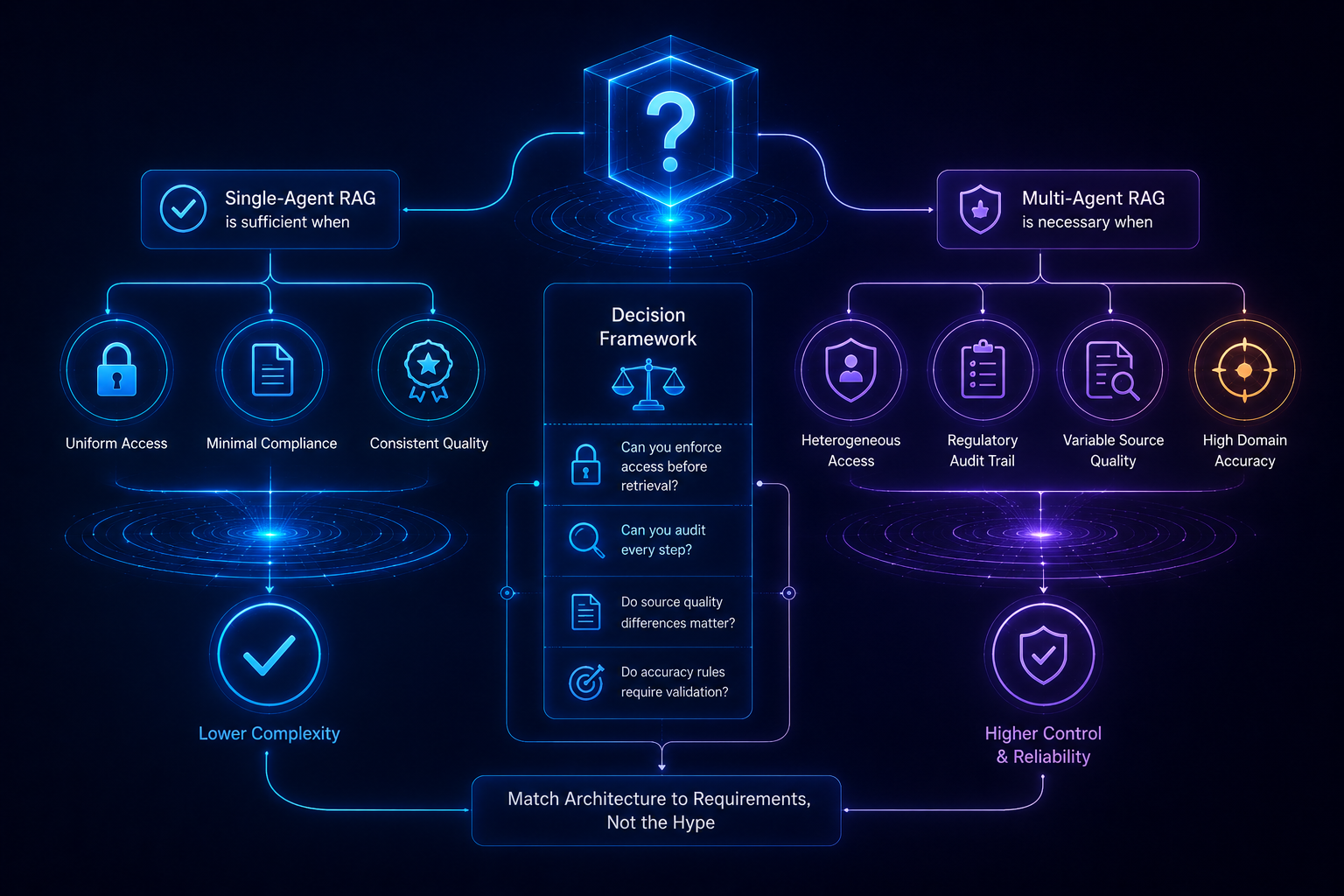
Most organizations do not need multi-agent RAG. If your use case is internal knowledge base Q&A with uniform access controls and minimal compliance requirements, single-agent RAG is sufficient. The added complexity of multi-agent orchestration delivers no value when your documents share the same access tier, your regulatory requirements are light, and your accuracy needs fall within what prompt engineering can achieve.
Multi-agent RAG becomes necessary when four specific conditions appear. First, your documents have heterogeneous access controls where different users see different subsets of the corpus based on role, clearance level, or department. Second, regulatory compliance requires audit trails that trace every retrieval decision, validation step, and synthesis choice from query to answer. Third, source quality varies significantly across your document corpus, requiring explicit validation that separates authoritative sources from drafts, outdated policies, or unverified external content. Fourth, domain accuracy requirements exceed what prompt engineering alone can deliver, demanding programmatic validation of facts, figures, or regulatory citations before synthesis.
A financial services firm processing loan applications meets all four conditions. Documents include credit policies restricted to underwriters, customer financial records with privacy controls, regulatory guidance requiring audit trails, and external credit reports with varying trust levels. A healthcare system answering clinical questions faces similar constraints: patient records with HIPAA access controls, clinical guidelines requiring evidence validation, and regulatory requirements for decision provenance.
The decision framework is diagnostic, not aspirational. If you cannot enforce document-level access control before retrieval in your existing system, you need multi-agent architecture. If compliance officers spend days reconstructing how your RAG system reached specific conclusions, you need audit trails that only multi-agent systems provide. If your synthesis quality suffers because low-quality sources contaminate high-quality ones in the same context window, you need explicit source validation.
We worked with a legal services firm that initially deployed single-agent RAG for contract analysis. The system worked until they needed to process privileged attorney-client communications alongside public filings. Single-agent architecture could not enforce privilege boundaries at retrieval time. They rebuilt with a four-agent pattern and reduced unauthorized access attempts to zero while cutting audit preparation time from three days to four hours.
The inverse is equally important. If your documents share uniform access controls, if your compliance requirements are satisfied by basic query logging, and if your source quality is consistently high, multi-agent architecture adds cost without benefit. A product documentation chatbot for internal engineering teams does not need separate validation and compliance agents.
Accuracy requirements provide the clearest decision signal. If your domain requires exact numerical reproduction, current statute verification, or PHI redaction, you need validation rules that execute as code, not as model instructions. Single-agent systems rely on prompt engineering for accuracy. Multi-agent systems enforce accuracy through architectural boundaries where validation agents apply programmatic checks before synthesis agents generate answers.
Assessing Internal Capacity to Build or Partner
AutoGen is open-source and free, eliminating licensing costs. The real cost is engineering time and ongoing maintenance. A production-grade multi-agent RAG implementation requires teams comfortable with asynchronous agent orchestration, vector database management, and LLM prompt engineering across multiple specialized agents. Estimate four to eight weeks for initial implementation, then ongoing costs for monitoring, optimization, and agent tuning.
Mature teams achieve 20 to 50 percent long-term savings by building in-house. Mature means existing AI and ML expertise, prior experience with multi-agent workflows, and engineering capacity to maintain the system after deployment. These teams realize savings after the first six months when the learning curve flattens and operational costs stabilize below what external partners charge for equivalent capability.
Teams without this depth face a different calculation. If your engineering team has not built agent orchestration systems before, if your ML expertise is limited to model fine-tuning, or if you lack capacity to maintain complex AI infrastructure, the build option carries hidden costs. Initial implementation takes longer. Debugging multi-agent conversations requires specialized skills. Production issues demand immediate response from engineers who understand both AutoGen's architecture and your domain requirements.
The build versus partner decision hinges on three factors: existing AI and ML capability, available engineering capacity, and time-to-value requirements. If you have strong AI teams with spare capacity and can accept a four-to-eight-week implementation timeline, build in-house. If you lack specialized AI expertise, if your engineering teams are fully allocated, or if you need production deployment in under four weeks, partner with experienced engineering teams who have built multi-agent RAG systems before.
A two-week proof of concept resolves uncertainty before you commit to full implementation. Define success criteria: task execution speed measured in seconds from query to answer, retrieval accuracy measured as precision and recall against a test set, citation completeness measured as percentage of factual claims with source backing, and compliance coverage measured as percentage of regulatory requirements satisfied. Run the PoC against a representative document subset. If the PoC meets thresholds, proceed to production. If it falls short, you have learned what needs improvement before investing in full deployment.
The PoC also reveals whether your team has the skills to maintain the system. If your engineers can debug agent conversations, tune retrieval parameters, and modify validation rules during the two-week PoC, they can maintain the production system. If they struggle with these tasks during the PoC, they will struggle more when production issues arise under time pressure.
From Architecture Pattern to Production System
The four-agent pattern structures document intelligence as four discrete units: a retrieval agent handles vector search and access control, a validation agent evaluates source quality, a synthesis agent generates answers, and a compliance agent enforces regulatory rules. This architecture delivers three enterprise advantages that single-agent systems cannot match: separation of concerns that makes each stage independently testable, granular audit trails that trace every decision from query to answer, and flexible LLM allocation that lets you assign expensive models to synthesis while using lightweight models for validation and compliance.
This is not theoretical architecture. IBM engineers building multi-agent systems report production deployments across 20+ domains, from financial services to healthcare to legal discovery. Microsoft Research positions AutoGen as a significant step in agentic AI, noting that the framework's conversational paradigm enables agent collaboration patterns that rigid state machines cannot accommodate. Organizations are already running these systems in production, handling millions of queries per month with compliance requirements that single-agent RAG cannot satisfy.
The gap between a working prototype and a production system reveals itself in three areas: access control, compliance, and domain accuracy at scale. A prototype retrieves documents and generates answers. A production system enforces role-based permissions before retrieval, maintains immutable audit logs across every agent decision, and applies domain-specific validation rules that execute as code rather than prompt instructions. Most teams building multi-agent RAG discover this gap when they attempt to move from development to production and realize that their prototype cannot pass regulatory review.
We see this pattern repeatedly. Engineering teams build a four-agent proof of concept in two weeks. The PoC works on a 500-document test set with uniform access controls. Then they attempt production deployment against 50,000 documents with heterogeneous permissions, HIPAA compliance requirements, and domain accuracy rules that demand exact numerical reproduction. The prototype architecture cannot scale to these requirements without fundamental changes to how agents communicate, how audit trails are captured, and how validation rules are enforced.
For engineering teams evaluating multi-agent RAG architectures, Azumo's AI development team has experience building production document intelligence systems with AutoGen and similar frameworks. We have implemented the patterns described in this article for financial services, healthcare, and legal discovery clients. We know where the gaps appear between prototype and production, how to structure agent conversations to maintain audit trails, and how to configure per-agent model selection to control costs while maintaining accuracy.
The organizations moving fastest are those that recognize the gap between prototype and production early. AutoGen v0.4 and its successors will make multi-agent document intelligence a standard enterprise architecture. The question is not whether to adopt it. The question is whether your team closes that gap in weeks or in quarters.

About the Author:
VP of Technology | Software Engineer | Expert in Scalable Systems & Leadership | React, Node.js & Cloud Architect
Gonzalo Buszmicz, VP of Technology at Azumo, specializes in scalable systems, full-stack development, and cloud architecture, with over 15 years of experience leading teams.

.avif)