.svg)
.png)


Businesses are using AI voice agents more than ever to handle customer calls, sales conversations, and operational tasks.
What started as simple phone automation has evolved into AI systems that can hold natural conversations, answer questions, qualify leads, and support customers at scale.
In this guide, we review the best AI voice agent platforms for sales, customer support, and business operations. We also explain when a SaaS tool is enough and when a custom AI voice solution may be a better fit for your business.
What Are AI Voice Agents?
AI voice agents are software tools that can hold real phone conversations with people. They use speech-to-text to understand what someone is saying, AI models to process the request, and text-to-speech technology to respond naturally in real time.
They are very different from older IVR systems with "press 1 for support" menus. Instead of forcing callers through fixed options, AI voice agents can understand what a person wants, answer questions, book appointments, access CRM data, and transfer the call to a human when needed.
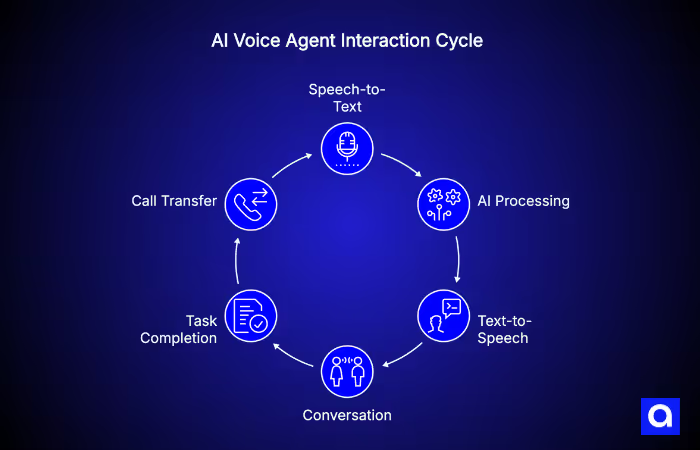
Modern AI voice agents rely on technologies like NLP and agentic AI to handle many real business conversations reliably. They are commonly used for tasks like customer support, appointment booking, lead qualification, and call routing at scale.
How Can Businesses Benefit from AI Voice Agents?
AI voice agents help businesses reduce costs, respond faster, and handle more calls without growing support teams. Many companies use them to automate repetitive conversations that would normally require human agents.
- One of the biggest benefits is 24/7 availability. AI voice agents can answer calls at any time without staffing limitations, making sure businesses do not miss leads or customer inquiries outside working hours.
- They also improve response speed. Businesses can respond to inbound leads within seconds, qualify callers automatically, and keep CRM systems updated in real time. This makes AI in sales teams more effective by helping reps follow up faster and focus on qualified leads, while AI for customer support improves response consistency and reduces repetitive work for support agents.
- Another advantage is reducing the workload for human teams. AI handles repetitive, high-volume calls, which allows employees to focus on more important or complex conversations.
However, AI voice agents still have limitations. They can struggle with strong accents, background noise, or emotionally sensitive conversations. Businesses with highly customized workflows may also find that off-the-shelf tools are not flexible enough, which is why some choose custom-built AI agent solutions instead.
How We Chose the Best AI Voice Agents
We selected these AI voice agents based on hands-on research, platform reviews, feature comparisons, and real business use cases. Instead of ranking every tool against each other, we grouped them by where they work best, because the right solution for a small business is very different from what a large enterprise may need.
To build this list, we looked at factors like voice quality, response speed, CRM and workflow integrations, multilingual support, security and compliance standards, human handoff capabilities, pricing transparency, and overall ease of use.
We also reviewed feedback and research from industry sources to better understand how these platforms perform in real-world environments.
The result is a list of AI voice agents that stand out across sales, customer support, operations, and enterprise automation use cases.
Best AI Voice Agents for Customer Support
These platforms are built for inbound support, ticket resolution, and customer experience. They handle high call volumes without sacrificing quality.
CharliBot by Azumo
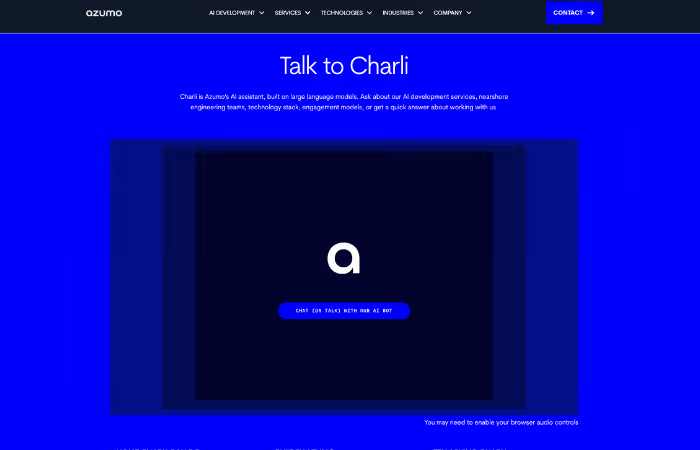
CharliBot by Azumo is a customizable AI chatbot and voice agent platform built by Azumo. It can be trained on existing business content like PDFs, websites, and internal documents, then deployed across channels such as Slack, SMS, WhatsApp, and Facebook Messenger.
CharliBot helps businesses handle customer questions, automate support, route conversations, and escalate complex issues to human agents with full conversation history included. Unlike generic chatbot tools, each deployment is customized around the company's workflows, CRM systems, and brand voice.
Best for: Businesses that want a branded AI support agent with deeper customization and integrations.
PolyAI
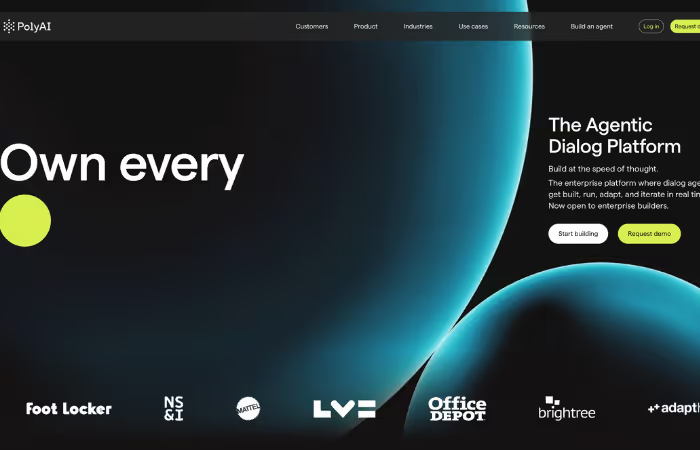
PolyAI is an enterprise AI voice platform designed for large contact centers handling high call volumes. It focuses on automating customer conversations while keeping interactions natural and efficient.
The platform is commonly used in industries like banking, healthcare, and hospitality, where businesses want to reduce support workload while maintaining customer experience quality. It also offers strong performance for fully automated call resolution and enterprise-scale deployments.
Best for: Large enterprises that need scalable AI voice automation for customer support operations.
Sierra AI

Sierra AI is an enterprise AI platform focused on customer experience automation. It was designed to work alongside existing customer service infrastructure while helping companies maintain consistent communication and brand tone across channels.
The platform uses multiple AI models together to improve reliability and reduce incorrect responses. It is mainly adopted by large brands that prioritize customer experience quality and enterprise-level AI operations.
Best for: Enterprises focused on brand consistency and large-scale customer experience management.
Zendesk AI Voice Solutions
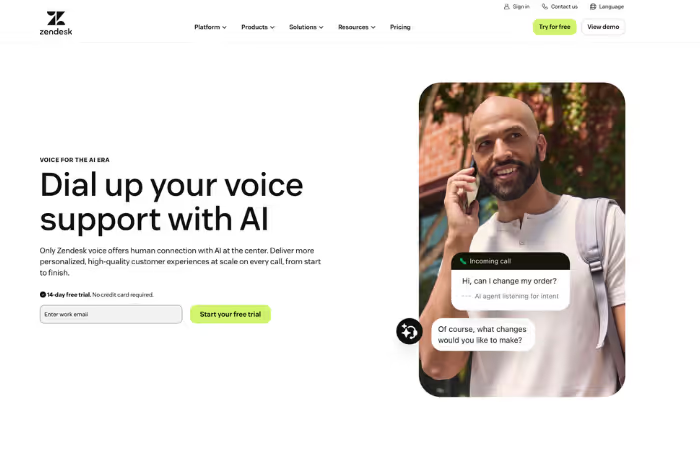
Zendesk AI Voice Solutions adds AI-powered voice automation directly into the Zendesk support platform. It can manage customer calls from the initial greeting through issue resolution while passing full context to human agents when escalation is needed.
Because it is built into Zendesk, it is especially useful for businesses already using Zendesk for customer support. Teams can add voice AI without introducing a separate vendor or support system.
Best for: Zendesk users who want built-in AI voice support and automation.
Spitch
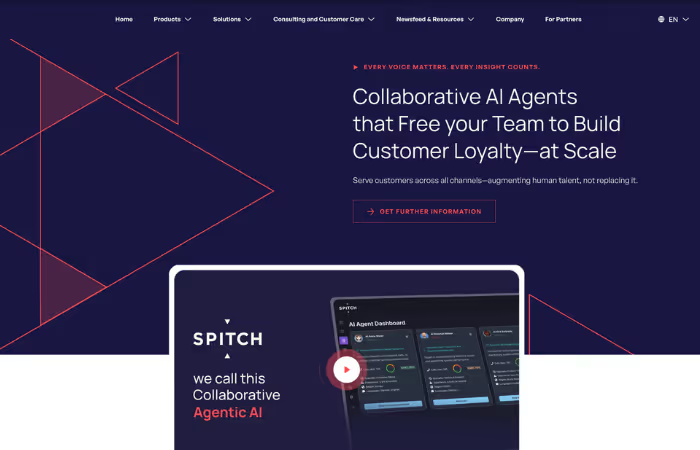
Spitch is a conversational AI platform focused on secure voice and customer communication. One of its main features is voice biometrics, which allows customers to verify their identity using their voice instead of passwords or PINs.
The platform supports both voice and text conversations across channels while keeping conversation context connected. It is widely used in regulated industries where security and compliance are critical.
Best for: Financial services, government, and regulated industries that need secure customer authentication.
Best AI Voice Agents for Sales Teams
Sales-focused voice AI agents handle outbound prospecting, inbound lead qualification, appointment booking, and CRM sync. Many businesses also use AI agent development services to build custom sales workflows around these tasks.
The best AI voice agents for sales teams free reps to focus on closing instead of dialing. Teams evaluating these tools may also want to explore the best AI SDR tools to complement their voice automation stack.
CloudTalk
CloudTalk combines a cloud phone system with built-in AI voice automation through its AI Voice Agent, CeTe. It helps businesses automate tasks like missed call follow-ups, lead qualification, CRM updates, and after-hours call handling.
The platform supports more than 60 languages, making it useful for international sales and support teams. Because the AI features are built directly into the phone system, teams can start using voice automation without needing separate tools or a complex setup.
Best for: Growing sales and support teams that want AI voice features built directly into their calling platform.
Bland AI
Bland AI is a developer-focused AI voice platform designed for large-scale calling operations. It supports custom prompts, voice cloning, and multilingual conversations across many languages.
The platform is built for flexibility and scale, making it popular with engineering-led teams running outbound campaigns or highly customized workflows. It also includes features that make conversations sound more natural, such as background audio simulation.
Best for: Technical teams managing high-volume outbound voice automation.
Retell AI
Retell AI is an API-first AI voice platform that gives developers full control over speech recognition, language models, voice generation, and telephony systems.
It is designed for businesses that want to build custom AI calling experiences while maintaining performance and compliance standards. The platform also includes HIPAA support and SOC 2 certification, making it suitable for regulated industries.
Best for: Businesses that need customizable AI voice infrastructure with built-in compliance support.
Synthflow AI
Synthflow AI is a no-code AI voice platform designed for teams that want to launch voice automation quickly without developer support. It allows users to build AI voice agents through a visual interface and supports more than 50 languages.
The platform focuses on fast deployment, reliability, and enterprise-grade compliance. It is commonly used by sales teams, agencies, and businesses looking for simple voice automation without managing technical infrastructure.
Best for: Non-technical teams that want easy-to-launch AI voice automation.
Best AI Voice Agents for Enterprise-Scale Automation
Enterprise platforms handle complex multi-department workflows, deep CCaaS integrations, and compliance-heavy environments at the scale of thousands of simultaneous calls. The best AI voice agents for enterprise plug into existing infrastructure instead of replacing it.
Cognigy
Cognigy is an enterprise conversational AI platform built for large customer support operations. It integrates directly with existing contact center systems like Genesys, Avaya, Amazon Connect, and 8x8, allowing companies to add AI automation without replacing their current setup.
The platform supports conversations across phone, chat, SMS, and messaging apps while keeping context connected across channels. It also includes AI tools that assist live agents during calls by suggesting responses and surfacing customer information in real time.
Best for: Large enterprises that want AI voice automation without changing their existing contact center infrastructure.
Vapi AI
Vapi AI is a developer-focused voice AI platform that gives teams full control over the voice technology stack. Developers can choose their own speech recognition, voice generation, AI models, and telephony providers instead of being locked into one system.
The platform is designed for teams building custom voice products or branded AI calling experiences. It is highly flexible but usually requires engineering resources to set up and manage effectively.
Best for: Engineering teams building fully custom AI voice systems with maximum flexibility.
Voiceflow
Voiceflow is a collaborative platform for designing AI voice and chat experiences. It provides a visual workspace where designers, product teams, and developers can build conversational flows together.
The platform focuses heavily on conversation design and workflow collaboration rather than telephony itself, so teams often connect it with platforms like Vapi or Retell for phone support. It is popular with companies building multi-channel AI assistants and customer experiences.
Best for: Cross-functional teams creating voice and chat agents with a strong focus on design and collaboration.
Ringly.io
Ringly.io is an AI voice support platform built specifically for Shopify and e-commerce businesses. Its AI agents can answer questions about orders, shipping, returns, and products using live store data.
The platform supports multiple languages and is designed for businesses that want automated phone support without needing developers or custom integrations. It is especially useful for high-volume online stores that receive repetitive customer inquiries.
Best for: Shopify and e-commerce brands that want fully automated customer phone support.
Best AI Voice Agent Platforms for Developers and Custom AI Builds
For teams that need granular control, proprietary models, or fully custom voice experiences, these options offer the flexibility that out-of-the-box tools cannot.
Bland AI (Advanced Use Cases)
On a larger scale, Bland AI supports much more than simple outbound calling. Businesses can use it for inbound calls, outbound campaigns, SMS workflows, and complex multi-step automation flows across channels.
The platform also includes security and governance features that make it suitable for regulated industries and enterprise deployments. Its predictable usage-based pricing is another reason large organizations use it for high-volume operations.
Best for: Enterprises that need scalable voice automation with strong security and workflow flexibility.
Vapi AI (API-First Voice Infrastructure)
Vapi AI is widely used as a flexible infrastructure layer for teams building custom AI voice products. Developers can combine different providers for speech recognition, voice generation, and AI models to create fully customized voice experiences.
The platform is often paired with tools like Voiceflow for conversation design while keeping full backend control over the voice stack.
Best for: Teams building fully custom and branded AI voice agents without relying on closed platforms.
Open Voice AI Stack for Custom Builds
Open-source voice AI tools like Rasa, LiveKit, and Deepgram give engineering teams full control over infrastructure and customization while reducing dependence on SaaS vendors.
These tools are often used by companies building long-term proprietary AI systems that require flexibility, scalability, and deeper infrastructure ownership. They usually require strong internal engineering and DevOps capabilities to deploy and maintain successfully.
Best for: Engineering teams building custom long-term voice AI infrastructure with full technical control.
Key Features to Look for in AI Voice Agent Platforms
Not all AI voice platforms offer the same quality or capabilities, so it is important to evaluate a few core features before choosing a solution.
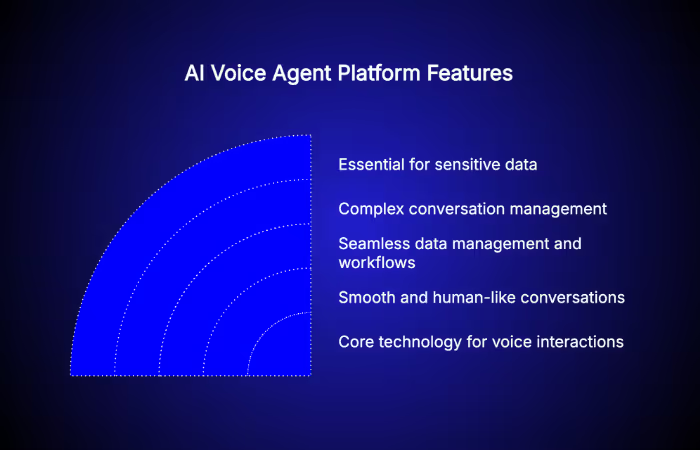
- Natural voice quality and fast responses: Conversations should feel smooth and human-like, with minimal delays between responses. Good speech recognition and accent handling are also important for customer trust and call accuracy.
- CRM and workflow integrations: Strong integrations with tools like Salesforce, HubSpot, or Zendesk help automatically log calls, update customer data, and trigger workflows in real time.
- Multi-step conversation handling: The best AI voice agents can manage full conversations, not just simple questions. They should be able to qualify leads, book appointments, answer follow-up questions, and keep context throughout the call. Platforms that use RAG can also pull from internal knowledge bases to give more accurate, grounded responses.
- Smooth human handoff: When a call needs escalation, the platform should transfer the conversation to a human agent with the full call history included so customers do not need to repeat themselves.
- Analytics and reporting: Good platforms provide insights like call resolution rates, escalation frequency, customer sentiment, and call duration to help businesses improve performance over time.
- Security and compliance: For healthcare, finance, or enterprise use cases, features like HIPAA, SOC 2, and GDPR compliance are often essential.
When Businesses Need Custom AI Voice Agent Development
SaaS AI voice platforms work well for many standard use cases, but some businesses eventually reach their limits.
This usually happens when companies have strict compliance requirements, such as HIPAA in healthcare or regulations in fintech and financial services, where off-the-shelf tools may not provide sufficient control or guarantees. Teams looking for software development for healthcare or software development services for fintech often face this challenge because their systems require stronger data protection, auditability, and workflow-specific logic. Legal services businesses face similar challenges, as their workflows often require strict data handling and highly specific conversation logic.
It also becomes necessary when workflows are too complex or unique to fit into a standard drag-and-drop builder. Some businesses also need tighter control over brand voice, deeper integration with legacy systems like ERPs, or a larger scale than SaaS platforms can support.
Because of this, many companies start with a ready-made platform and move to custom AI development as their needs grow. At Azumo, we help teams make that transition and build custom AI solutions around your specific workflows and systems.
How Azumo Builds Custom AI Voice Agent Solutions
At Azumo, we have been building custom AI development solutions since 2016. We work as a nearshore development partner and handle the full process, from choosing the right models to building, deploying, and improving the system over time.
That includes complex logic, multi-system orchestration, and highly specific business rules that require deeper customization than typical no-code tools allow. Beyond voice, our teams also work with technologies like computer vision and AI image segmentation for clients building more advanced AI-powered products.
Instead of forcing teams into fixed templates, we design voice agents around how your business actually operates, including data flows, internal tools, and customer experience requirements.
If you need something beyond off-the-shelf voice automation, we can help design and build a solution specific to your environment. Contact us to discuss your AI voice agent project and explore the right solution for your business.
Frequently Asked Questions

About the Author:
Head of Customer Success | Account Manager & Account Executive
Matias Margossian, Account Executive and Customer Success Manager with a finance background and tech expertise, blending business strategy, analytics, and client success.

.avif)