.svg)
.png)


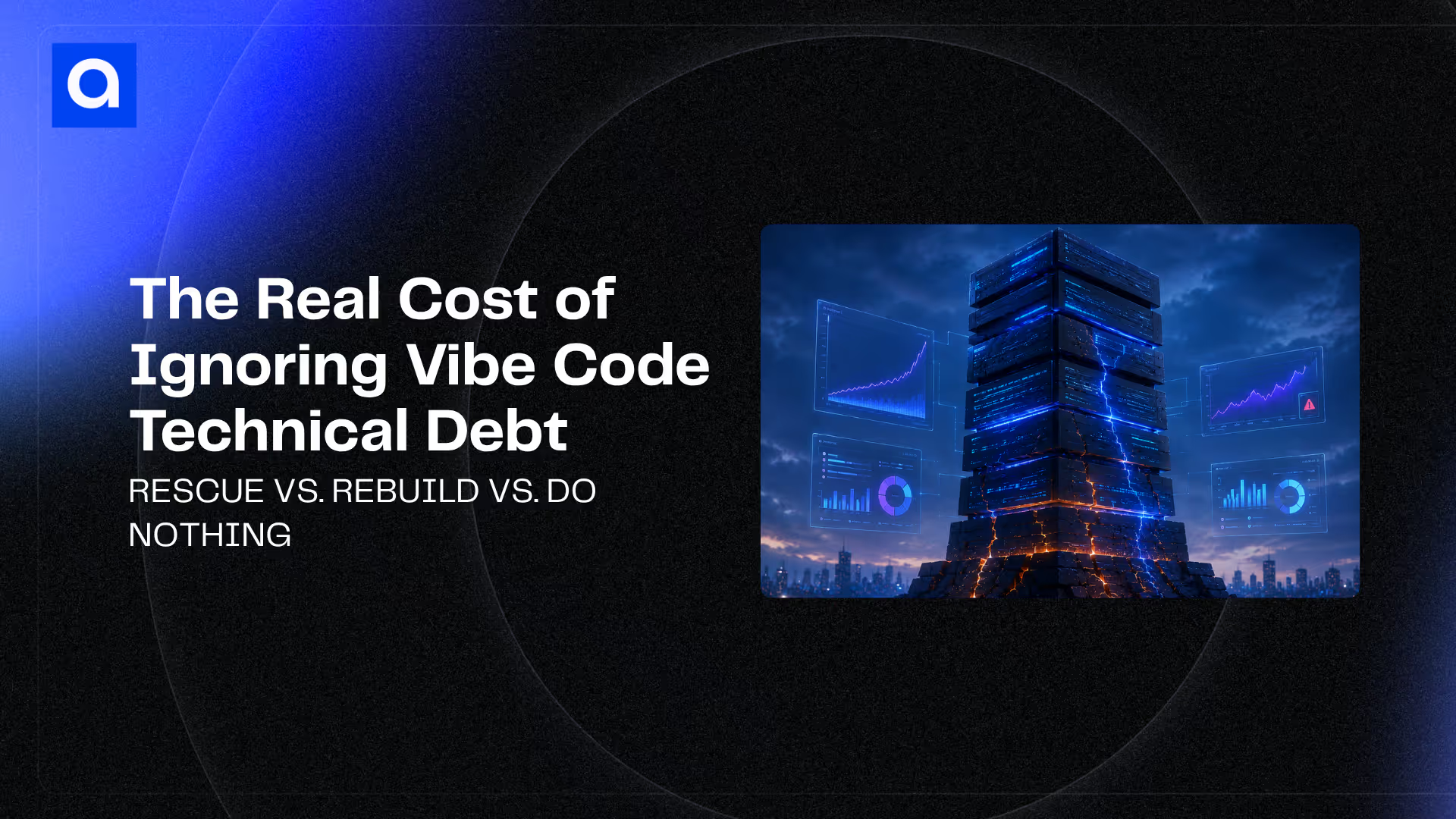
Doing nothing is not free: it is a deferred liability with a measurable price tag
CodeRabbit's December 2025 analysis of 470 open-source GitHub pull requests found AI-co-authored code shipped 1.7× more major issues, 2.74× more security vulnerabilities, and 75% more misconfigurations than human-only code. Twenty-five percent of Y Combinator's Winter 2025 batch reported codebases that were 95% AI-generated.
The question for technical leaders is no longer whether vibe-coded MVPs carry hidden cost. It is which of three paths, rescue, rebuild, or do nothing, carries the lowest total cost of ownership once the MVP gains traction.
Continuing to patch a vibe-coded MVP without structural intervention compounds three quantifiable costs: security debt, SDLC process debt, and maintainability debt. Together, these exceed the cost of a professional rescue within 12 to 18 months of production traction. The math is not subtle. It just requires making implicit assumptions explicit.
Start with security debt. The CodeRabbit 2.74× vulnerability multiplier gives you a concrete input for incident modeling. Veracode research cited in the State of Vibe Coding 2026 found 45% of examined AI-generated code contained security vulnerabilities. The Cloud Security Alliance reports AI-assisted commits expose secrets at 3.2% compared to 1.5% for human-only commits: more than 2× the rate. Secrets leakage is not a theoretical risk. It is a leading indicator that shows up in commit logs before it shows up in incident reports.
Now apply these numbers to a real scenario. Take the Y Combinator Winter 2025 batch as a population sample. A typical SaaS in that cohort hitting $2M ARR runs on a codebase that is 95% AI-generated. Apply the 2.74× vulnerability multiplier to your industry's baseline breach probability. Multiply by the average breach cost in your sector. Then factor in the CSA's 2× secret exposure rate as a compounding variable, not a one-time event, because every sprint ships new commits with new credential leakage risk.
On a probability-weighted basis, the expected annual loss from doing nothing materially exceeds the cost of a 12-week rescue engagement. The "do nothing" path is the most expensive option. It just does not feel that way because the cost arrives as a lump sum on a random Tuesday rather than a line item in this quarter's budget.
The common objection here is fair: "Our MVP has been running fine for months without incident. These statistics are about averages, not our specific app."
That objection treats the absence of a detected incident as evidence of safety. It is not. Every budget decision implicitly assigns a probability to future incidents. The question is whether you make that probability explicit and defensible or leave it implicit and arbitrary. Your codebase may sit above or below the mean. But the 2× secret-exposure rate from the Cloud Security Alliance is not a lagging indicator based on past breaches. It is a leading indicator measured in commit-level data right now. If your AI-assisted commits expose secrets at twice the human rate, the vulnerability surface is growing with every deploy, whether or not an attacker has found it yet. The security risks specific to vibe coding compound faster than most teams track.
Three categories of debt compound at different rates. Security debt compounds with each new commit. SDLC process debt, the absence of peer review, threat modeling, and code ownership, compounds with each new team member who inherits undocumented decisions. Maintainability debt compounds with each patch layered on top of code no one fully understands. Lumping all three into a single "tech debt" line item masks the urgency of the security component, which carries the highest expected loss per unit of time.
Doing nothing is a deferred liability that grows faster than your revenue, priced by probability rather than certainty, and payable in full when the first real incident hits.
Rebuild costs 3 to 5× more than rescue and loses the validation you already paid for
If doing nothing carries a hidden actuarial cost, the next question is whether to spend the rescue budget or commit to a full rebuild.
The instinct toward a clean rewrite is understandable. Vibe-coded MVPs produce code that looks alien to experienced engineers: tangled dependencies, no separation of concerns, authentication logic scattered across files. The impulse is to torch it and start fresh.
But full rebuild is the wrong default for any vibe-coded MVP that has achieved product-market fit. It discards the user-facing behavior that validated the business while incurring the full cost of greenfield architecture. Rescue takes the opposite approach: preserve the validated frontend and surgically replace the unstable backend. The vibe coding rescue cost vs rebuild ROI calculation consistently favors rescue when you account for timeline, opportunity cost, and behavioral regression. In our experience modernizing vibe-coded platforms, rebuild engagements run 3 to 5× the cost of a targeted rescue.
That multiplier deserves unpacking. A rebuild means re-specifying every interaction, every edge case, every micro-decision baked into the current UX. Those decisions were not documented. They were discovered through user behavior, iterated on through dozens of deploys, and encoded in code that no one wrote a spec for. Rebuilding from scratch forces your team to rediscover all of them, and they will miss some. The result is behavioral regression: the new system works differently in small ways that drove adoption in the first place. Industry rescue practice reflects this reality. The standard approach keeps the existing frontend and completely rebuilds the backend, because that is where scalability and data-integrity risks concentrate. Practitioners describe this as "emergency surgery on the architecture itself" rather than a rewrite. The frontend earned its place. The backend did not.
The Sparks & Honey Q™ AI platform illustrates the phased alternative. Rather than rebuild from scratch, we modernized Q™ with a fully decoupled architecture and generative AI capabilities across three phases. The result: 24/7 platform availability and a decoupled frontend/backend that preserved the validated product surface while replacing the unstable foundation. The phased approach delivered production stability without the 12-to-18-month dark period a full rebuild would have required.
That dark period is the hidden cost rebuild advocates rarely model. During a rebuild, your product freezes. Competitors ship. Users churn. Revenue growth stalls while engineering burns budget on a system that produces zero customer value until launch day.
Scale makes the rebuild option even less realistic. The vibe coding market reached $4.7 billion in 2026 and is projected to hit $12.3 billion by 2027 at 38% CAGR. The population of MVPs requiring a rescue-or-rebuild decision is growing faster than engineering talent supply. Staffing a full rebuild team for 12 to 18 months is not just expensive. For most startups, it is operationally impossible given current hiring timelines.
The counterargument engineers raise most often: "The vibe-coded codebase is so messy that a rebuild will actually be faster than untangling it." This is sometimes true. For codebases under 5,000 lines where the original UX has not been validated by real users, rebuilding can be the right call. But for any MVP with active users and measurable retention, the cost of behavioral regression, losing the specific UX details that drove adoption, usually exceeds the cost of refactoring. The rescue-vs-rebuild decision should be driven by whether the frontend has earned its keep, not by how ugly the codebase looks in a code review.
Ugly code with validated user behavior is an asset wrapped in a liability. A rebuild throws away the asset to eliminate the liability. A rescue separates the two. That distinction is the difference between a 12-week engagement and a 12-month odyssey that delivers a product your users no longer recognize. For teams preparing a vibe-coded app for production, the question is not "how bad is this code?" It is "how much of this product's value lives in behavior we cannot easily re-specify?"
How to model the three paths as a defensible business case
Once the relative cost of the three paths is clear, the remaining work is presenting the case to the people who control the budget.
A credible vibe coding rescue cost vs rebuild ROI business case requires three numbers your finance team can defend: expected annual incident cost under do-nothing, rescue cost over 12 weeks plus ongoing maintenance, and rebuild cost plus the opportunity cost of feature freeze. Most leaders skip the third because it is the hardest to admit. Admitting that a rebuild freezes feature delivery for 12 to 18 months means admitting the company will ship nothing new during that window. Finance teams will model that revenue impact if you give them the inputs. Most engineering leaders never do.
The first number, expected incident cost, is where teams stall. The common objection: "Modeling incident probability for a specific codebase is too speculative to put in a budget request."
Reframe this. Every budget decision implicitly assigns probabilities. Choosing not to fund a rescue is choosing to bet that the current codebase will not produce a material incident during the planning window. The question is whether you make that bet explicit and defensible or leave it implicit and arbitrary. Published multipliers give you defensible anchors. The 2.74× security vulnerability multiplier from CodeRabbit's December 2025 analysis provides a concrete incident-probability input: take your industry's baseline breach probability, multiply by 2.74, multiply by the average breach cost in your sector. That produces an expected-loss figure finance teams can evaluate against the rescue line item. It is not a guess. It is a probability-weighted estimate grounded in third-party data.
Vibe-coded systems accumulate three distinct debt categories that compound at different rates: maintainability debt, security debt, and SDLC process debt. Each must be modeled separately rather than lumped into a single "tech debt" line item. Security debt compounds per commit. Process debt compounds per hire. Maintainability debt compounds per patch. A single budget line obscures which category is driving the most expected loss per quarter, and it is almost always security.
On rescue engagements we have run, we begin with a 2-week diagnostic that produces three artifacts: a secrets-and-vulnerability scan quantifying current security debt, an SDLC gap analysis showing which controls are missing (peer review, threat modeling, code ownership), and a maintainability score on the top 10 critical files. Those three artifacts let the buyer's CFO compare rescue cost against a probability-weighted incident model rather than a gut call. The diagnostic converts an engineering opinion into a finance-ready comparison across all three paths, with inputs an auditor or board member can trace back to source data.
The decision window is shorter than the budget cycle
Your next board meeting will arrive before your next budget cycle closes. Run the 2-week diagnostic before that meeting, not after.
Inventory secrets exposure across your AI-generated commits. Count the untested critical paths in your application: authentication flows, payment processing, data export endpoints. Price the three options against a real incident probability using the CodeRabbit 2.74× multiplier and the CSA 2× secret-exposure rate as your anchoring inputs.
Bring three artifacts to the budget conversation. First, the secrets-and-vulnerability scan with a count of exposed credentials and unpatched CVEs. Second, the SDLC gap analysis naming each missing control: no peer review, no threat model, no ownership map. Third, a one-page comparison pricing do-nothing expected loss, 12-week rescue cost, and rebuild cost inclusive of feature-freeze revenue impact. That one page is the entire vibe coding rescue cost vs rebuild ROI argument in a form finance can sign off on.
The decision is not technical. It is financial. The cost of waiting another quarter is not zero. It is the probability of an incident multiplied by its cost, accruing silently with every deploy. Your codebase is not getting safer while you schedule the next planning session. Run the structured diagnostic of an AI-built codebase now. The artifacts will make the decision for you.

About the Author:
Head of Customer Success | Account Manager & Account Executive
Matias Margossian, Account Executive and Customer Success Manager with a finance background and tech expertise, blending business strategy, analytics, and client success.


.avif)