.svg)
.png)


.avif)
Why Feature-Checklist Comparisons Mislead Buyers
PwC's 2025 AI Agent Survey puts organizational adoption of AI agents at 79%. The LangChain State of AI Agents survey puts unreliable performance as the top production blocker, cited by 32% of teams. Those two numbers belong in the same sentence because they describe the same problem: most organizations have shipped an AI agent framework, and most of those deployments are struggling in production.
The gap is a framework architecture problem.
Every top-ranking AI agent frameworks comparison scores on capability checklists: multi-agent support, tool integrations, memory primitives, supported model providers. Those checklists fail to predict whether a framework survives production, because the actual cause of deployment failure is not missing features. It is unhandled failure modes.
The Checklist Trap
The AIMultiple benchmark makes this concrete. AIMultiple ran four identical data analysis tasks 100 times each across LangGraph, LangChain, CrewAI, and OpenAI Swarm. LangGraph won on latency and token consumption across all 100 runs. That is a meaningful finding. But the benchmark could not measure how each framework handles context window overflow mid-workflow, how each one routes a decision to a human when the agent hits an ambiguous edge case, or how each one behaves when a coordination loop between agents drives cost up without producing output. Checklist comparisons inherit this same blind spot: they score what frameworks say they support, not what happens when that support is stressed.
Practitioner postmortems from MindStudio, ElixirData, Langflow, and Genezio converge on the same failure categories: context window overflow with silent information loss, tool overload on single-agent designs, weak fact-checking, multi-agent coordination loops, and missing decision boundaries for human escalation. None of these appear as line items on a feature matrix. That is the structural problem with the comparison format.
What 32% Unreliable Performance Actually Means
The LangChain State of AI Agents data is worth reading carefully. Unreliable performance ranks as the top blocker for 32% of teams. Framework choice does not appear in the top four blockers at all. Teams are not failing because they picked the wrong framework on a checklist. They are failing because the framework they picked, whichever one it was, hit a production condition it was not designed to handle, and the team had no mitigation in place.
The objection worth taking seriously: feature checklists are not useless. A buyer needs to confirm multi-agent support exists before evaluating coordination-loop behavior. You cannot have a coordination loop in a framework that does not support multi-agent orchestration. That argument is correct at the shortlist stage.
The problem is that checklist parity is now table stakes across the eight frameworks this article scores. Every serious framework supports multi-agent. Every serious framework has memory primitives and tool integration. The differentiator is no longer whether a framework supports a capability. It is how the framework fails when that capability is pushed past its design limits at production load. That is the question the rest of this ranking is built to answer, and it is the reason 2026's top AI agent frameworks compared on capability alone keep producing misleading shortlists. PwC's number sits above McKinsey's more conservative read on how many organizations actually run agents in production: 62% of organizations are at least experimenting with AI agents, but only 23% are actively scaling agentic AI in any business function.
How We Scored Each Framework: The Seven Failure Modes
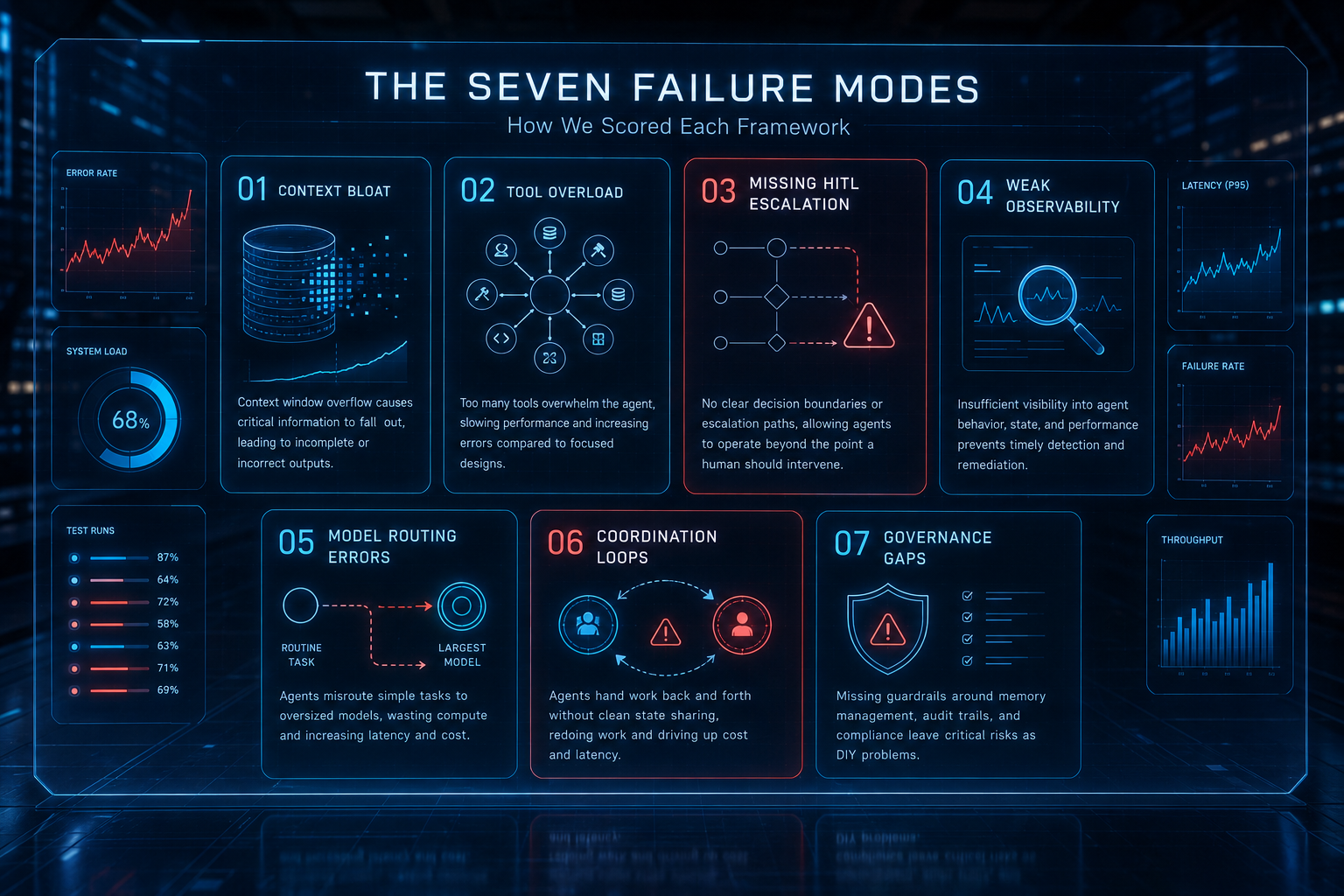
If feature checklists mislead, what should buyers score against instead? The seven failure modes below are drawn from the practitioner postmortems that checklist comparisons ignore.
Each framework in this ranking is scored on seven production failure modes: context bloat, tool overload, missing human-in-the-loop (HITL) escalation, weak observability, model routing errors, coordination loops, and governance gaps. These are not invented categories. They are the failure modes that practitioner postmortems, benchmark data, and enterprise survey blockers independently converge on.
The Seven Failure Modes, Defined
The convergence across independent sources is striking. MindStudio identifies model misrouting as the most expensive mistake teams make, responsible for 70 to 80% of compute costs when agents send routine classification tasks to the largest available model. ElixirData documents context window overflow as a silent killer: at step 5 of an 8-step workflow, the context fills, older evidence falls out without any error signal, and the agent finishes with missing facts it does not know are missing.
Langflow describes tool overload collapsing single-agent designs: one super-agent given too many tools becomes slower and more error-prone than a focused one. Genezio flags stale data and weak fact-checking as a distinct failure mode from context loss. ElixirData and IBM both name missing decision boundaries and escalation paths as the structural gap that leaves agents running past the point where a human should have taken over.
That accounts for five. The remaining two, coordination loops and governance gaps, come from the multi-agent layer. MindStudio and Artiquare independently describe the coordination loop failure: agents hand work back and forth without clean state sharing, redoing work the other agent already completed, driving cost and latency up without producing output. Governance gaps sit one level above all of these. ElixirData's analysis identifies a consistent pattern where frameworks address orchestration but leave memory management, audit trails, and compliance boundaries as DIY problems for the team that deploys them.
Seven modes. Each one sourced.
Why These Seven and Not Others
AWS's Prescriptive Guidance scores frameworks across eight axes: AWS integration, autonomous multi-agent support, workflow complexity, multimodal capability, model selection, LLM API integration, production deployment maturity, and learning curve. It is a useful starting point. AWS rates LangChain and LangGraph as "strongest" on workflow complexity, rates both with "steep" learning curves and "DIY" production deployment, and says nothing more specific about what "DIY" means operationally.
Our seven failure modes are what that "DIY" label actually contains. When AWS says a framework requires DIY production deployment, it means the team is responsible for building observability, escalation paths, and governance controls that the framework does not ship. Naming the seven modes turns that qualitative score into something a buyer can act on. The same logic applies upstream to AI agent architecture decisions that determine production reliability: the framework's gaps become architectural obligations the moment the team commits.
A skeptic will push back on the count. Why seven and not five, or twelve? The answer is that seven is the union of independent failure-mode taxonomies, not an invented structure. Remove any one and you lose a documented cause of production failure. Add categories beyond these seven and they collapse into subdivisions of an existing mode.
One methodological standard worth stating clearly: we follow the AIMultiple benchmark's approach of requiring failure modes to appear repeatably under load. AIMultiple ran each of its four tasks 100 times to measure consistency under realistic workloads. A failure mode that shows up in a one-shot demo but not under sustained load does not belong in a production scoring framework. The seven modes above all meet that bar.
Failure Modes Are Not Equally Lethal: The Severity Hierarchy
With the methodology defined, the next question is which failure modes punish buyers hardest, because the ranking that follows weighs frameworks against the modes most likely to break their deployment.
Context window overflow and coordination loops are the most lethal failure modes in production. Both fail silently, producing confident wrong answers with no error signal. Observability and HITL gaps are the most operationally expensive, because they compound every other failure mode on the list.
Silent Failures vs Visible Failures
ElixirData's documentation of context window overflow is worth reading precisely. At step 5 of an 8-step workflow, the context fills. Older evidence falls out without triggering any error. The agent finishes the workflow with missing facts it does not know are missing, and it reports a confident answer. There is no exception to catch, no log entry to chase. The output looks correct until someone downstream acts on it. That is the most dangerous class of failure in this taxonomy: no error to debug.
Coordination loops fail the same way. MindStudio describes a three-agent setup where Agent A researches, Agent B drafts, and Agent C verifies. Because state is not shared cleanly between A and B, Agent B redrafts research Agent A already completed. Agent A and Agent B hand the task back and forth repeatedly, each pass consuming tokens and adding latency, without a termination condition firing. The workflow appears to be running normally. The cost signal arrives later, on the bill.
Model routing failures occupy the opposite end of the severity spectrum. They are expensive but visible. MindStudio identifies compute as 70 to 80% of total AI expenses. Routing routine classification tasks to Claude or ChatGPT's largest models instead of a lightweight classifier can raise costs by 10x or more. That number surfaces in week one. A finance team will flag it. Someone corrects the routing configuration, and the problem resolves without a production incident.
Visible failures are recoverable. Silent ones compound. For long-running stateful workflows, this is also where agentic RAG patterns mitigate context window overflow earn their keep, by bounding what enters the model's window in the first place.
Why Observability Is a Force Multiplier
Artiquare's critique of the framework category names the structural problem directly: frameworks "often prioritize abstraction and demos over robust contracts, testability, and state handling." The consequence is that observability gaps do not produce failures on their own. They make every other failure mode harder to detect and longer to resolve.
Without tracing, a context overflow failure looks like a quality problem. Without structured logs, a coordination loop looks like normal latency variation. Without span-level telemetry, model routing errors are invisible until cost spikes.
Observability does not sit at the top of the severity hierarchy because it fails loudest. It sits there because its absence multiplies the damage from every failure below it.
A sophisticated reader will push back here: severity is contextual. A fintech KYC workflow weighs governance and HITL gaps highest. A marketing automation team weighs model routing costs highest. A single universal severity hierarchy oversimplifies.
That objection holds partial force, and the concession is worth making directly. The hierarchy is not universal. It is predictable by workload type. Regulated workflows should weight governance and HITL escalation highest. Cost-sensitive deployments should weight model routing highest. Long-running stateful workflows, the kind most likely to hit production at scale, should weight context bloat and coordination loops highest, because those are the failure modes that produce wrong answers before anyone notices something is wrong.
The next section evaluates frameworks against severity weights calibrated to the most common production workload types, not a single fixed hierarchy.
The 8 AI Agent Frameworks Ranked by Production Failure Mode

With severity weights and methodology in place, here is how the eight leading frameworks actually score against the seven failure modes.
A single rank order is journalistic malpractice here, and the AIMultiple benchmark is the reason why. AIMultiple's 100-run data analysis benchmark shows LangGraph winning on latency and token consumption consistently. That result says nothing about HITL-heavy regulated workflows where AutoGen's conversational pattern is a better structural fit. Producing one rank order requires pretending the seven failure modes weigh equally for every buyer. They do not. So the list below groups by orchestration paradigm, then names the failure-mode profile for each framework. The buyer's job is to match their workload's severity weights to the framework whose worst score falls in a mode they can mitigate.
Orchestration-First Frameworks
LangGraph. Best for engineering teams running long-running stateful workflows that need explicit control over context flow and coordination logic. LangGraph's directed acyclic graph (DAG) predetermines tool calls rather than letting the LLM decide at each step which tool to invoke. AIMultiple's benchmark explains LangGraph's consistent win on latency in structural terms: fewer LLM decision points means fewer compounding latency gaps and fewer coordination loops. LangGraph v1.0 ships with built-in human-in-the-loop checkpointing and LangSmith observability, which directly address the two failure modes that compound silently. It also carries the most mature MCP integration in this comparison, per recent evaluations from Atlan and Channel, which reduces tool overload risk by standardizing tool and function calling across providers. The trade-off: steep learning curve and rigid upfront design cost. Teams that skip the architecture work before writing code will hit governance gaps they cannot patch without a rewrite.
LangChain. Best for teams that need broad tool integration surface area and an established ecosystem for rapid prototyping. The AIMultiple benchmark showed LangChain lagging significantly behind LangGraph on both latency and token consumption across 100-run tasks. That delta is not random. LangChain's chain-first design has the LLM decide at each step which tool to use, compounding both latency and context bloat risk over multi-step workflows. Treat LangChain as a prototyping layer and LangGraph as the production runtime, which is now AWS's explicit guidance.
CrewAI. Best for teams building role-based multi-agent pipelines where coordination clarity matters more than fine-grained state control. CrewAI shipped native MCP support in v1.10, which reduces tool overload risk by externalizing the tool catalog. OSSInsight's 28-day GitHub star growth data puts CrewAI at 23.7%, second only to the OpenAI Agents SDK, meaning governance and reliability features are shipping at speed. The coordination model is explicit and readable, which makes the coordination-loop failure mode easier to detect and debug than in frameworks that abstract agent interaction. The trade-off: less precise control over context flow than LangGraph, so context bloat in long-running workflows requires more deliberate management by the implementing team.
AutoGen. Best for HITL-heavy workflows where human escalation is a first-class requirement rather than an add-on. AutoGen's conversational agent pattern makes escalation paths explicit in the workflow definition rather than bolted on after the fact. It scores highest in this group on the HITL failure mode. The trade-off: ecosystem momentum is the slowest of the four orchestration-first frameworks. OSSInsight's data shows Microsoft's AutoGen at 3.9% 28-day star growth versus CrewAI's 23.7%. Slower momentum means governance and MCP features ship later, which matters for teams on active production roadmaps.
Provider-Native and Specialist Frameworks
OpenAI Agents SDK. Best for teams already committed to OpenAI's model stack who want tight native integration and fast ecosystem momentum. OSSInsight puts the openai/openai-agents-python repo at 32.5% 28-day star growth, the fastest of any framework in this comparison. The governance and HITL features are maturing quickly. The trade-off: MCP support remains community and indirect rather than native, which means the tool-overload failure mode requires more custom wiring than LangGraph or CrewAI. Fast-moving frameworks also break API contracts more often, so teams running stable production workflows absorb more migration cost.
Microsoft Agent Framework. Best for enterprises that need built-in governance, HITL, and observability without building those layers from scratch. The framework ships native MCP, graph-based multi-agent coordination, checkpointing, native HITL, and OpenTelemetry observability as defaults. On the observability and governance failure modes, this is the strongest out-of-the-box profile in the comparison. The trade-off: deep integration with Azure and Microsoft's ecosystem is both its strength and its constraint. Teams not already on Azure accept meaningful ecosystem lock-in.
LlamaIndex. Best for teams whose primary production challenge is retrieval-augmented generation at scale, where context bloat is the dominant failure mode. LlamaIndex's data indexing and retrieval architecture is purpose-built to manage what enters the context window, making it the strongest framework for that specific failure mode. The trade-off: it is a specialist framework. Teams that need robust multi-agent coordination or HITL escalation will build those layers themselves, or combine LlamaIndex with an orchestration-first framework.
Agno. Best for teams that want a lightweight, model-agnostic foundation with minimal framework overhead. Agno's minimal abstraction layer keeps the attack surface small, which reduces the coordination-loop failure mode in simple single-agent or small multi-agent designs. The trade-off: the team must build more of the observability and escalation stack from scratch. For regulated workflows or long-running stateful deployments, that build cost often exceeds the cost of a more opinionated framework's learning curve.
No framework wins all seven failure modes. The relevant question is not which framework scores highest overall. It is which framework's worst failure-mode score lands in a category your team can mitigate through engineering investment. For a broader view of the best AI agents and platforms in 2026, the competitive picture extends well beyond frameworks into managed platforms and provider-native tooling.
The MCP and Observability Inflection: What Changed in the Last Six Months
The rankings above reflect the state of the frameworks today, but two recent shifts have moved fast enough that older comparisons mis-rank the field. Native Model Context Protocol (MCP) support has become a headline feature, and observability has moved from optional to enforced. Any buyer evaluation written before Q4 2024 now under-scores the frameworks that shipped MCP and OpenTelemetry (OTEL) integration first.
Why Native MCP Support Changes the Tool-Overload Score
MCP standardizes tool and function calling across model providers, which means the tool catalog lives outside the framework rather than inside it. That architectural shift directly mitigates the tool-overload failure mode: when tools are defined and versioned externally, a single agent is less likely to accumulate a sprawling, redundant set of tool definitions that slow inference and produce unpredictable routing.
The MCP adoption gap across the eight frameworks is meaningful. CrewAI shipped native MCP in v1.10. LangGraph and LangChain carry what recent evaluations from Atlan and Channel describe as the most mature MCP integration in the category. Vercel AI SDK 6 and Mastra ship native MCP by default. The OpenAI Agents SDK remains community and indirect on MCP, which means teams using it must wire their own adapters.
That last point is where the counterargument deserves a direct answer. A technically accurate objection holds that MCP is a protocol, not a framework feature. Any framework can integrate it via adapters. So "native MCP" is over-weighted as a differentiator.
The objection is accurate at the protocol level. But adapter-based MCP is precisely where the tool-overload failure mode resurfaces. Every adapter introduces a boundary where tool descriptions, schema validation, and authentication can drift. A tool definition in the adapter layer and a tool definition in the model's reasoning chain can fall out of sync without any error signal. Native MCP reduces the surface area of that failure mode. An adapter reintroduces it. The distinction is not whether MCP is supported. It is how many places in the stack can silently diverge. For a deeper explanation of Model Context Protocol (MCP) and how it changes agent tool design, the protocol's design choices map directly onto the failure-mode scoring above.
LangGraph's path to v1.0 illustrates the inflection clearly. LangGraph reached v1.0 in late 2024 and became the default runtime for LangChain agents. The reason stated explicitly by the LangChain team: built-in human-in-the-loop checkpointing and LangSmith observability. The framework that won the inflection is the one that made these capabilities default rather than optional add-ons.
Observability Is No Longer Optional
McKinsey's 2025 data puts 62% of organizations experimenting with AI agents and 23% scaling in at least one function. The 23% that successfully scaled share a consistent operational requirement: observability. Not as a nice-to-have. As the prerequisite that made scaling possible.
IBM highlights frameworks that provide tracing, debugging, and clean separation between the low-level agent network and the higher-level conversational layer. Langfuse frames the distinction sharply: OTEL-style observability determines whether a framework can be debugged in production at all, not merely whether debugging is convenient. Without span-level tracing, a context overflow failure looks like a quality problem. A coordination loop looks like normal latency variation. Model routing errors are invisible until the cost spike arrives.
The frameworks that treat observability as a default are measurably easier to operate under load. LangGraph ships with LangSmith integration. Microsoft Agent Framework ships native OpenTelemetry. Strands Agents is built around OTEL as a foundational design choice, not a plugin.
Teams evaluating frameworks on comparisons written before Q4 2024 are scoring against criteria where MCP and OTEL were differentiators. They are now table stakes for any deployment expected to survive past the first production incident. A framework that requires teams to build observability from scratch is not cheaper to operate. It is more expensive, because every failure mode in the seven-mode taxonomy takes longer to diagnose without instrumentation already in place.
When You Need a Framework Decision Plus the Engineering to Survive Its Failure Modes
The ranking and the inflection both raise the same question for a buyer: who builds the layers the framework doesn't ship? That is the engagement we take.
We are the right partner for teams that have already decided AI agents are core to their roadmap and need engineers who can both pick the framework and build the observability, escalation, and governance layers that frameworks do not ship. We are not the right partner for teams that need an off-the-shelf agent product or a pure no-code platform.
Where We Fit in the Framework-Decision Lifecycle
Our production AI track record starts in 2017 with MyNLU, runs through the ACE chatbot engine (2018-19), Healthyscreen (2020 SMS COVID screening, more than 1 million worker days processed), and Valkyrie, our REST gateway to LLMs. We select frameworks based on what we have shipped, not vendor marketing. That history informs every framework recommendation we make, and it means we have hit each of the seven failure modes in production, not in a sandbox.
Two client outcomes illustrate where that experience applies.
For Angle Health, we designed and built an automated RFP intake-to-quote-generation system using LLMs. The system cut processing time from 45 minutes to 5 minutes, a 90% cycle time reduction. It survived the context-bloat and tool-overload failure modes because we scoped it to a narrow workflow with explicit document parsing and Zendesk integration. A general-purpose agent would have failed on both modes. Narrow scoping, enforced at the architecture stage, is what prevented it.
Our own AI Receptionist, Hello by Azumo, achieved a 1.7-second median response time with 76% of turns completing under 2 seconds across 512 measured conversation turns, and has run with zero downtime since deployment in early 2026. The architecture uses lightweight models for intent classification and larger models for synthesis. That is the model routing problem MindStudio identifies as responsible for 70 to 80% of compute costs when mishandled. We handled it by design, not by accident.
We also sit inside the Anthropic Claude Partner Network, with approximately 30% of our team Claude-trained. That gives us early access to model behavior changes before they reach general availability, which matters for frameworks built on Claude as a primary reasoning layer.
Where We Are the Wrong Choice
A sophisticated buyer will ask this directly, so we will answer it first.
If your problem is "I need a no-code workflow tool to ship a marketing chatbot," we are the wrong call. Buy StackAI, Gumloop, or n8n. Those products exist for that use case and will deliver faster at lower cost than a custom engineering engagement.
Single-vendor managed agent platforms also win when ecosystem lock-in is acceptable and the workload fits the platform's design envelope. Our value is precisely the opposite case: production AI where the envelope is defined by the client's workload, not the vendor's product.
We fit when the framework decision is non-trivial, the deployment is stateful or regulated, and the team needs engineers who can build the observability and governance layers that no framework in this ranking ships as a complete solution. We also fit when ecosystem lock-in is unacceptable, because our work is portable by design.
The Stovell AI engagement captures this profile exactly. We built a scalable cloud-based AI platform with production-ready predictive models and SaaS infrastructure for equity signal generation. Those models have been live for more than eight years, delivering a 5-day predictive window that consistently outperformed S&P 500 benchmarks. That is the deployment duration where framework-level failure modes (state management, observability, and model selection trade-offs) compound from inconvenience into structural problems. Solving them once at architecture is the only option.
For how Azumo approaches AI agent development as a partner, the engagement model follows the same diagnostic logic the failure-mode audit uses.
The Buyer Mistakes That Make Framework Choice Irrelevant
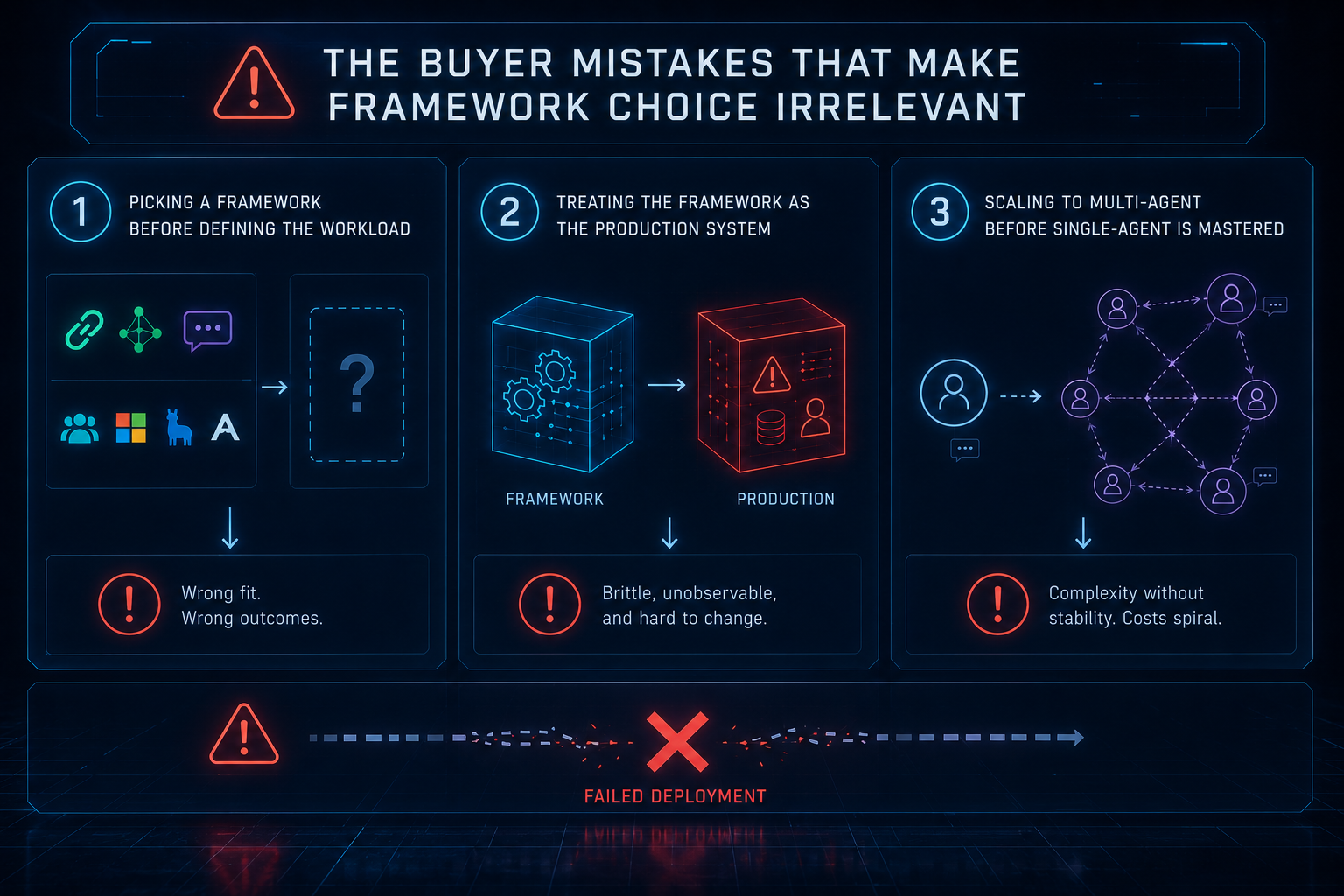
The framework rankings and the brand-fit section both presume the buyer makes good operational decisions around them. Most do not, and three specific mistakes make even the best framework choice moot: picking a framework before defining the workload, treating the framework as the production system, and scaling to multi-agent before single-agent is mastered. Any of these three mistakes will produce a failed deployment regardless of which framework sits underneath it.
Mistake One: Framework Before Workload
Artiquare's critique names the structural problem directly: frameworks like LangGraph and AutoGen "often prioritize abstraction and demos over robust contracts, testability, and state handling." ElixirData's production analysis reinforces the point from a different angle: current frameworks address orchestration but leave governance, memory management, and feedback loops as open problems for the implementing team.
The buyer mistake is confusing a developer framework with a production runtime.
A framework gives you an orchestration layer. It does not give you a production system. The observability stack, the escalation paths, the governance controls, the memory architecture: all of that is built by the engineering team on top of the framework, after the framework is chosen. Teams that pick a framework first and define the workload second discover this gap only after they have committed to an architecture that makes certain failure modes structurally hard to address. The AWS and Moxo guidance converges on the same corrective: start with workflow requirements, match architecture to use case, then select the framework that fits that architecture. The buyer mistake is reversing that order.
Agent Sprawl Before Single-Agent Mastery
A pattern we see consistently on engagements we run: a team builds a single agent, hits a tool-overload wall at around fifteen to twenty tools, and treats the problem as a scaling issue. The fix they reach for is decomposition. One agent becomes three. Three becomes six. Each new agent gets a narrower tool set and a defined role.
The coordination layer is what they did not build first.
MindStudio and independent practitioner analyses document the outcome from the outside, and it matches what we observe directly: latency rises because every agent handoff adds context and round-trips. Reliability falls because every new agent introduces its own failure modes at the boundary. What was a working RAG copilot becomes a multi-agent architecture that cannot reach production. The framework was never the problem. The failure-mode response was wrong.
MindStudio is explicit on the cost dimension: compute represents 70 to 80% of total AI expenses, and agent sprawl compounds that cost without compounding output quality. Adding agents does not improve outcomes. It multiplies the surface area where things break.
The right sequence is to make a single agent reliable, observable, and correctly scoped before splitting it. Decompose along workflow boundaries, not tool-count boundaries. And build the state-sharing contract between agents before the first handoff, not after coordination loops appear in production logs.
A reader who has tracked the argument this far will push back here with a fair objection: if buyer mistakes dominate outcomes this heavily, why does the framework ranking matter at all? The article's own evidence seems to undercut itself.
The answer is that framework choice determines whether a buyer mistake is fixable in place. A team that picks LangGraph, over-builds multi-agent, and hits coordination-loop failures can refactor to single-agent within the same framework. LangGraph's DAG structure and built-in checkpointing support that refactor without a migration. A team that picks a no-code platform, ships a stateful workflow, and then hits its governance ceiling has one option: migrate to a framework that supports the governance layer they need. That migration cost is not recoverable.
The ranking matters because it identifies which failure modes are recoverable through engineering investment and which are structural to the framework's design. Buyer mistakes are the primary variable. Framework choice is not the override. But it determines the cost of correcting course. For a step-by-step approach to building AI agents that survive production, the sequencing guidance above translates directly into an engineering workflow.
Run the Failure Mode Audit Before You Pick the Framework
Before shortlisting any framework from this AI agent frameworks comparison, score your intended workload against the seven failure modes. Which one is most likely to kill your deployment? That answer should drive the shortlist, not the benchmark leaderboard.
LangGraph wins AIMultiple's 100-run data analysis benchmark on latency and token consumption. That result is real. It is also irrelevant to a HITL-heavy regulated workflow where AutoGen's conversational escalation pattern fits the workload better than a DAG-first architecture. The wrong framework is not the one with the lowest benchmark score. It is the one whose strongest failure mode aligns with your weakest mitigation capability.
The practical audit has three steps. First, map your workload to the failure modes: is it long-running and stateful (context bloat and coordination loops dominate), cost-sensitive and high-volume (model routing dominates), or regulated and human-supervised (governance and HITL dominate)? Second, identify which of those failure modes your team can mitigate operationally through instrumentation, scoping, and architecture discipline, and which ones you would need the framework itself to handle. Third, pick the framework whose worst score falls in the mode you can mitigate, not the mode you cannot.
The category will keep producing feature checklists and benchmark tables. They are useful for confirming a framework supports the capabilities your workload requires. They are not useful for predicting whether the framework survives production.
Production survival is an operational question. Answer it before the first line of code, against the failure modes that actually break deployments at scale.

About the Author:
Chief Technology Officer | Software Architect | Builder of AI, Products, and Teams
Juan Pablo Lorandi is the CTO at Azumo, with 20+ years of experience in software architecture, product development, and engineering leadership.

.avif)