.svg)
.png)


.avif)
Training a traditional image classifier takes a lot of work. You need thousands of labeled images for every category you want the model to recognize. For example, classifying 500 product types could require hundreds of thousands of tagged images before you even start training.
Zero-shot image classification changes that. It lets AI recognize new categories using only text descriptions, without needing any labeled images.
At Azumo, we use zero-shot classification in real AI systems for clients in healthcare, e-commerce, media, and other industries. In this article, we explain how it works, why it matters, and what the future holds.
What is Zero-Shot Image Classification?

Zero-shot image classification is a way for AI to recognize image categories it has never seen before. Instead of needing labeled examples for every new class, the model uses text descriptions or other semantic information to understand what to look for.
Think of it this way. Traditional image classification needs N labeled examples per category. If N is 100, you need 100 images for each class. Zero-shot learning is the extreme case where N is zero. The model learns to classify without any labeled examples.
The most famous model for this is OpenAI’s CLIP. It was trained on 400 million image-text pairs from the internet and can match images to text descriptions. CLIP reached 76.2% zero-shot top-1 on ImageNet in 2021, matching a supervised ResNet-50. Since then, contrastive successors have pushed zero-shot ImageNet accuracy to roughly 85–86%, LiT at 85.2%, and CoCa at 86.3%, narrowing the gap to fully supervised models.
If you want to see how Azumo’s computer vision services put this into practice, we will get to that shortly.
Why is Zero-Shot Image Classification Important for AI Applications?
The biggest challenge in traditional computer vision is labeling data. Every new category requires collecting images, labeling them, and retraining the model. This process is slow, expensive, and hard to scale when categories change often.
Zero-shot classification removes this problem. You can add new categories just by writing a text description instead of creating a new dataset. This makes AI faster and easier to update.
- In e-commerce, catalogs can grow quickly. New products, seasonal items, and regional variations can be classified without new labeling.
- In healthcare, rare diseases or new conditions can be detected from images without waiting for large datasets.
- For content moderation, new types of harmful content can be flagged with text prompts instead of manual labeling.
For teams looking to build AI systems that scale without constant retraining, Azumo AI Development Services can help architect the right approach.
How Does Zero-Shot Image Classification Work?

Let's break this down into two phases: how the model learns, and how it classifies new images at inference time.
The Training Phase
Models like CLIP do not train for a specific task. Instead, they learn the connection between images and text. CLIP trains on 400 million image-text pairs. It uses a vision encoder to process images and a text encoder to process text. Both create vectors in the same space. During training, the model brings matching image and text pairs closer and pushes non-matching pairs apart.
The vision encoders in these models have evolved significantly. CLIP’s original 2021 release already included both convolutional (ResNet) and Vision Transformer (ViT) image encoders, and its best model - the one reaching 76.2% on ImageNet is a ViT (ViT-L/14 at 336px resolution). Across the field since then, ViT backbones have become the default for the strongest zero-shot models because they scale well with data and compute.
ViTs use self-attention, which relates every patch to every other patch from the first layer, giving a global view immediately. CNNs also integrate information across the whole image, but they do so gradually as receptive fields grow with depth. For some long-range relationships, the ViT’s early global mixing is an advantage. This architectural shift is what enables today's foundation models to be far more adaptable.
ViT-based foundation models scale to billions of parameters and can be cheaply specialized with lightweight adapters, prompt tuning (CoOp, CoCoOp), CLIP-Adapter/Tip-Adapter, or LoRA without retraining the whole network. (Like all deep networks, they still require care to avoid catastrophic forgetting when adapted sequentially.) This is the key reason modern zero-shot classification has become so much more accurate and flexible than earlier approaches.
The Inference Phase
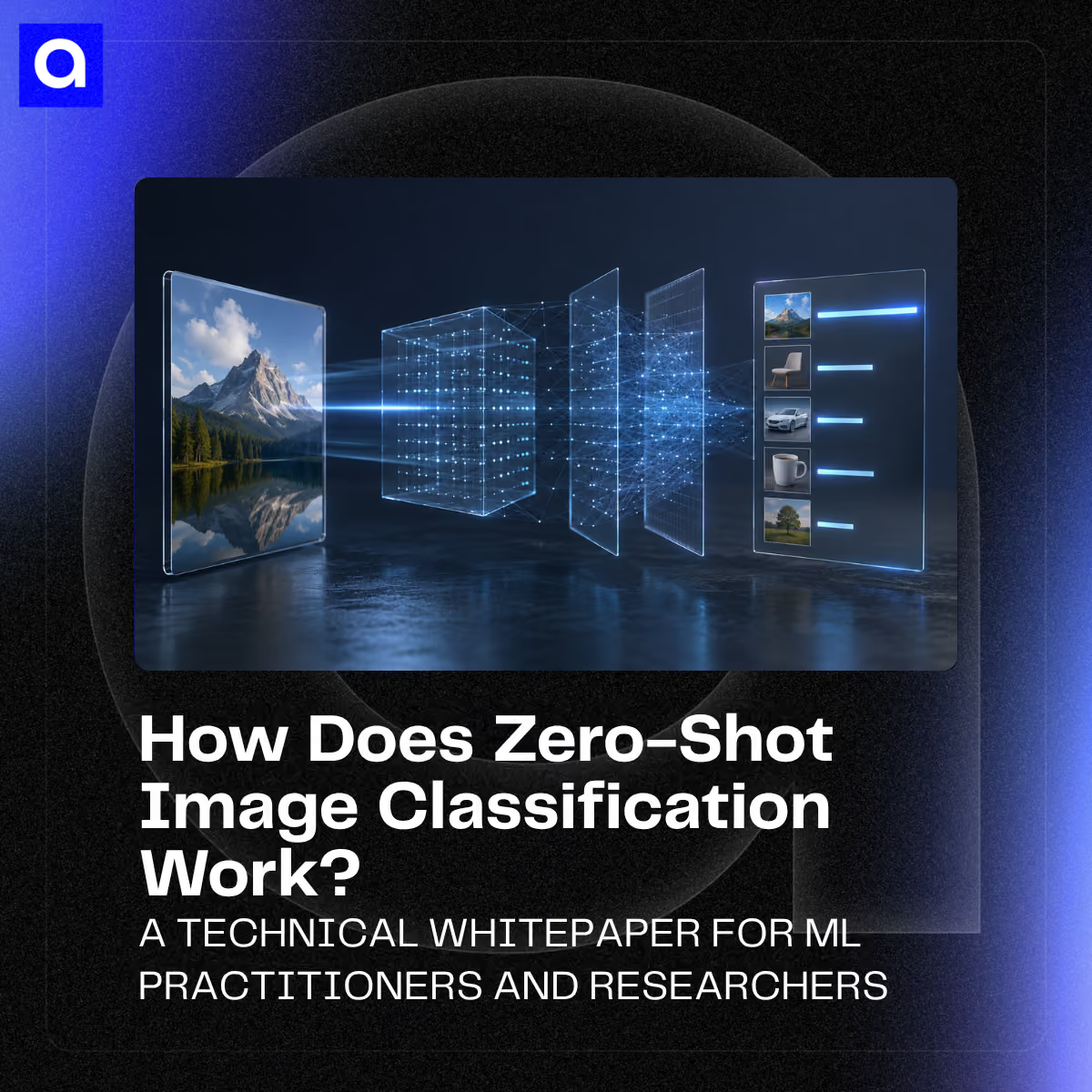
This is where zero-shot learning happens. You give the model text descriptions for the categories you want, like "a photo of a stop sign" or "a photo of a yield sign." The text encoder turns these into vectors. Your image goes through the vision encoder to become an image vector. The model compares the image vector to all the text vectors using similarity. The text that is closest to the image becomes the predicted label.
No retraining or new labeled data is needed. The model simply finds the text description that best matches the image.
Azumo builds these kinds of vision-language systems through our Multimodal AI Development practice, including visual search engines that match images to text descriptions.
Use Cases of Zero-Shot Image Classification in Various Industries
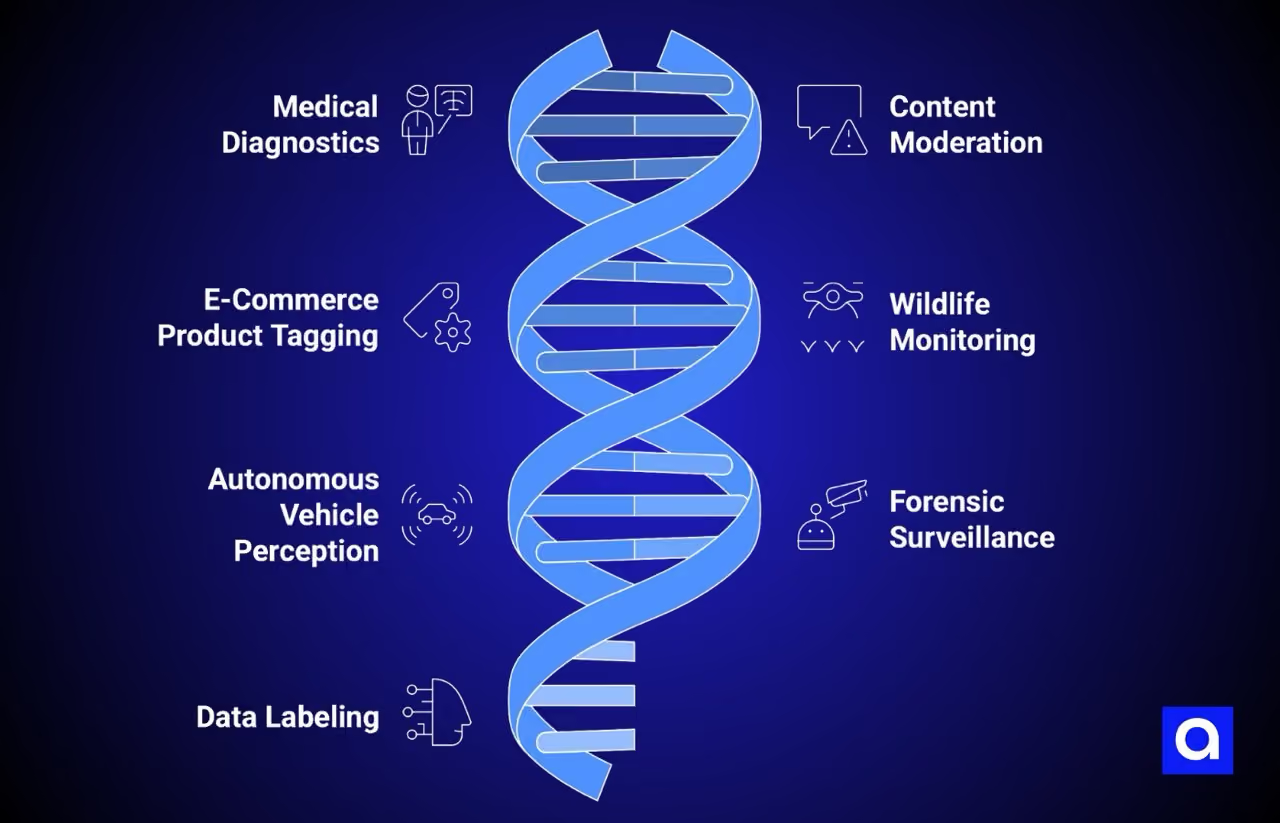
Medical Diagnostics
Zero-shot learning helps AI identify rare or new diseases from X-rays and scans without needing lots of labeled examples.
In a landmark medical example, CheXzero (Tiu et al., 2022, Nature Biomedical Engineering) performs zero-shot detection of multiple chest X-ray pathologies at a level comparable to board-certified radiologists, without using any explicitly labeled training images as it learns purely from the natural pairing of X-rays with their radiology reports, reaching a mean AUC of 0.889 on the CheXpert benchmark (just 0.042 below the best fully supervised model, with no statistically significant difference from radiologists on MCC and F1)
Content Moderation
Moderation teams can flag harmful content by writing simple text prompts like "graphic violence" or "hate symbols. Zero-shot models like CLIP can flag candidate violations from text prompts without new labeled data. Throughput depends on model size and hardware (smaller or quantized models and batching help), and because these models are vulnerable to adversarial inputs such as typographic attacks (Goh et al., 2021), production moderation keeps a human in the loop.
E-Commerce Product Tagging
New products can be classified automatically, even if there are no labeled images. Seasonal items, regional variations, and new categories get tagged right away. Zero-shot models let teams tag genuinely new products immediately by writing text descriptions of new categories, avoiding the labeling lag that hurts recommendation freshness.
The size of the accuracy benefit depends on the catalog and baseline, so we recommend measuring it per deployment rather than quoting a single industry-wide number. Azumo's Generative AI Services help e-commerce clients build these kinds of adaptive product intelligence systems.
Wildlife and Biodiversity Monitoring
Identifying rare species from camera-trap or drone images is hard because labeled data is limited. Zero-shot learning uses text descriptions of features like color, shape, or wing patterns to recognize species, making large-scale biodiversity surveys possible without manual labeling.
Autonomous Vehicle Perception
Self-driving cars and trucks need to see and understand objects on the road that they have never encountered before. This includes unusual vehicles, road signs, or unexpected obstacles. Zero-shot learning can help these systems recognize new objects without retraining on labeled images.
ZSL works for recognizing concept cars and identifying new road hazards. This approach reduces the time and effort needed to update self-driving perception systems when new objects appear on the road.
Forensic and Security Surveillance
Security systems must detect new types of threats that may only be described in text, such as a newly discovered weapon or unusual behavior patterns. Zero-shot classification allows AI to flag these threats even if there is no labeled training data available for them. This makes security AI more flexible and adaptable, helping teams respond to emerging risks quickly without waiting for new footage or manual labeling.
Data Labeling and Augmentation
AI teams can use zero-shot models to pre-label raw datasets that do not have any existing annotations. This reduces the workload for human labelers and speeds up the process of building and testing new models. Shadecoder notes that pre-labeling with ZSL can significantly shorten model prototyping timelines. For teams creating annotation pipelines, Azumo’s CVAT Developer Services can provide the tools and support needed to set up these pipelines efficiently and correctly.
What Are the Zero-Shot Image Classification Methods?
Embedding-Based Methods
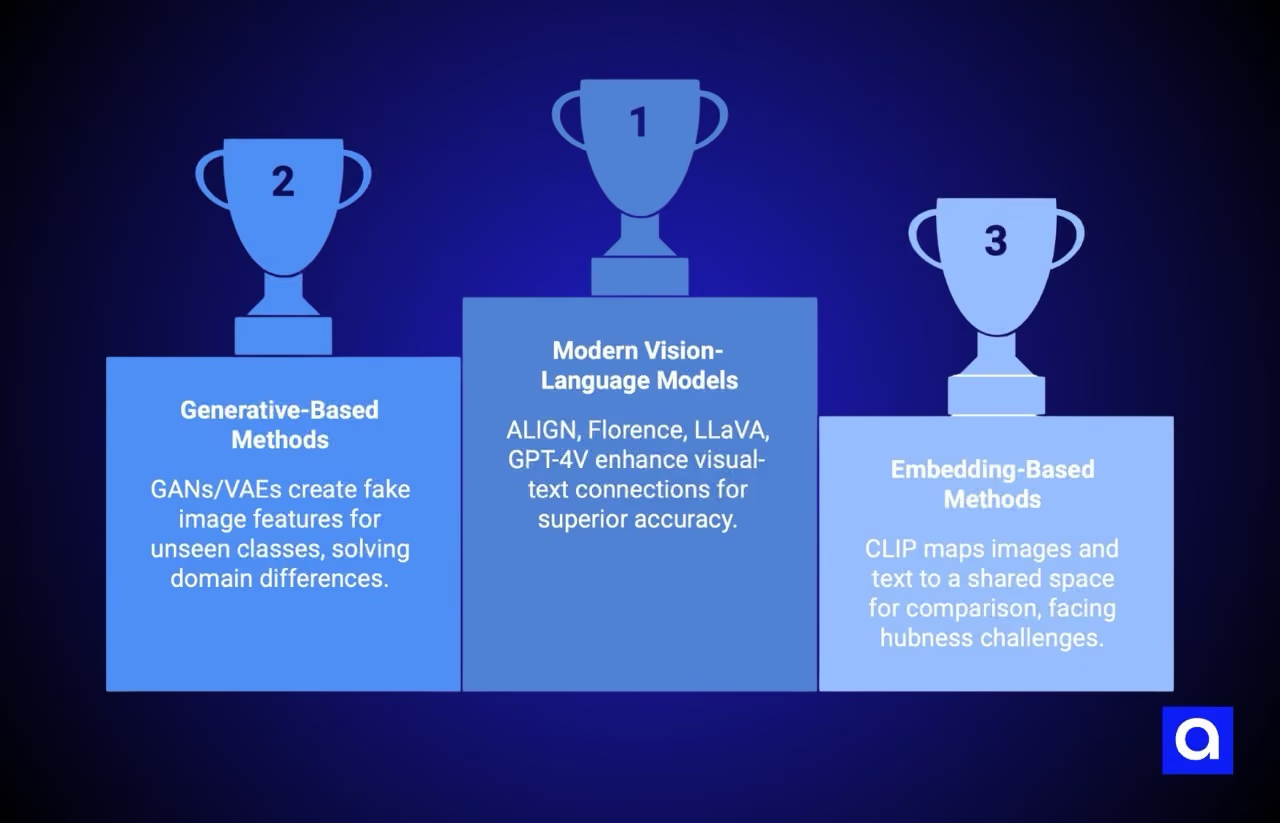
These methods put both images and class descriptions (like text labels or word vectors) into the same “space,” so the computer can compare them. At prediction time, the model finds which class is closest to the image in that space. CLIP is the most famous example of this approach. One challenge, called the “hubness” problem, happens when certain points appear as the nearest neighbor for too many images, which can make predictions less accurate.
Generative-Based Methods
These methods synthesize image features for classes the model has never seen, using generative models such as GANs or VAEs (e.g., f-CLSWGAN, Xian et al., 2018). Once these features exist, they can be added to a normal classifier so the model can handle new categories.
Generative methods can solve problems like domain differences and hubness better than pure embedding approaches. Azumo’s Generative AI team builds pipelines like this to fill gaps in client training data.
Attribute-Based Prediction
This method uses descriptive attributes such as “has stripes,” “can fly,” or “has four legs.” The model learns what these attributes look like on classes it has seen and then applies that knowledge to predict attributes for new classes.
This works well where expert attribute lists already exist (wildlife, fashion). The approach originates with Direct Attribute Prediction (Lampert et al., 2009, 2014) and the Animals-with-Attributes and CUB benchmarks.
Modern Vision-Language Models
The latest models go well beyond CLIP. Two distinct families followed CLIP. Contrastive dual-encoder models (ALIGN, Florence, and later LiT, CoCa, SigLIP, EVA-CLIP) do CLIP-style zero-shot classification and have pushed zero-shot ImageNet top-1 from CLIP’s 76.2% to roughly 85–86% (LiT 85.2%, CoCa 86.3%).
Separately, generative multimodal LLMs (LLaVA, GPT-4V) follow visual instructions and answer in open-ended text; they are powerful for reasoning about images but are not contrastive zero-shot classifiers and are not measured on the same ImageNet protocol.
On the self-supervised side, Meta's DINOv3, released in August 2025, represents a breakthrough in visual feature learning. DINOv3 is a self-supervised Vision Transformer trained on 1.7 billion images with a 7-billion-parameter ViT backbone.
Unlike CLIP, which requires image-text pairs, DINOv3 learns powerful visual representations from unlabeled images alone using a teacher-student distillation approach. Its frozen features achieve state-of-the-art performance across image classification, segmentation, depth estimation, and object detection (often without any fine-tuning).
DINOv3 is self-supervised and has no text encoder, so it does not perform zero-shot text-prompted classification on its own. Its frozen features reach state-of-the-art results when a linear classifier is trained on top of them (linear probing), but that requires labeled examples, so it is not zero-shot. To get true zero-shot classification from DINO-style features, you align them to text with a separate module, such as dino.txt, or you use a contrastive vision-language model like CLIP or SigLIP.
At Azumo, we work with both multimodal models like CLIP and self-supervised foundation models like DINOv3, selecting the right architecture based on each client's data, domain, and performance requirements. Azumo's LLM Fine-Tuning Services help clients adapt these foundational models to their specific domain needs.
What Are the Challenges of Zero-Shot Image Classification?
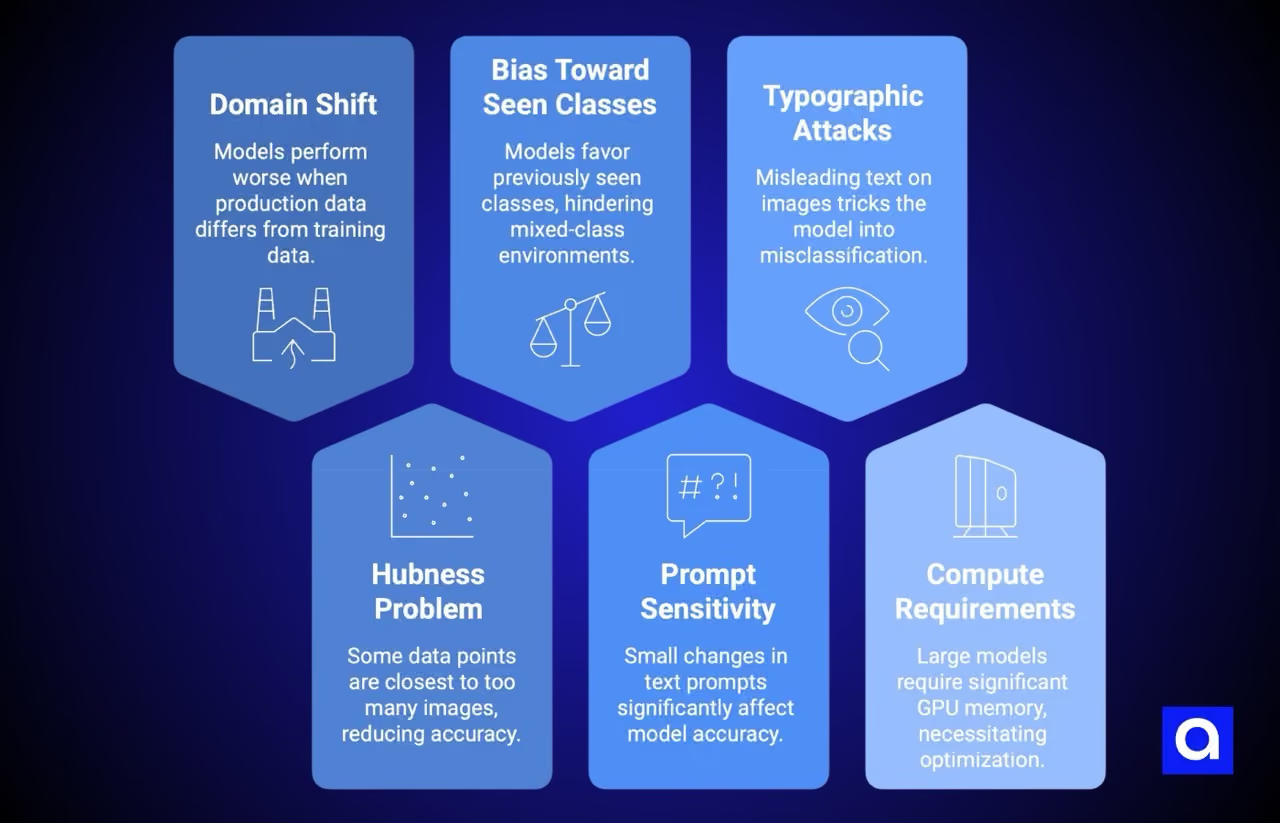
No technology is perfect, and being honest about the limitations is part of making good decisions. Here are the main challenges teams face when deploying zero-shot classification in production:
- Domain Shift: Models can perform worse when the data they see in production looks different from the data they were trained on. This is a common issue in real-world applications.
- Hubness Problem: In high-dimensional spaces, some data points appear as the closest match for too many images. This can make predictions less accurate.
- Bias Toward Seen Classes: This is the central problem of generalized zero-shot learning (GZSL), where the model must choose among both seen and unseen classes at test time and tends to over-predict seen classes.
- Prompt Sensitivity: Models like CLIP are sensitive to prompt wording. In the CLIP paper, using the template ’a photo of a {label}’ added 1.3 points of ImageNet accuracy, and ensembling 80 prompts added a further 3.5 points (Radford et al., 2021).
- Typographic Attacks: Adding misleading text on images can trick the model into misclassifying them. This is important to consider for security-sensitive uses.
- Compute Requirements: Large vision-language models need a lot of GPU memory to run. Using quantized models or cloud APIs can reduce hardware needs.
How Azumo Applies Zero-Shot Image Classification to Solve Real-World Challenges
Since 2016, Azumo has delivered over 100 AI projects for clients like Meta, Discovery Channel, Stovell AI, and many more. Our work spans computer vision, multimodal AI, NLP, and data engineering, and zero-shot image classification is a key part of what we do. Here’s how we put it into practice:
- Computer Vision Systems: We build image classification and object detection pipelines using models like CLIP, DINOv3, LLaVA, and GPT-4V. We select the right architecture for each use case: CLIP and LLaVA for multimodal tasks that match images to text, and DINOv3 for scenarios where strong visual features are needed without reliance on labeled image-text pairs. These pipelines serve clients in healthcare, e-commerce, media, and manufacturing, and our team manages everything from model selection to production deployment.
- Multimodal AI: We develop visual search engines that match images to text and content moderation systems that analyze both images and text together. These are direct applications of zero-shot classification.
- Data Pipeline Efficiency: We use zero-shot pre-labeling to reduce manual annotation costs. By combining CVAT tooling with custom workflows, we get your data ready faster for training.
- LLM Fine-Tuning: When out-of-the-box zero-shot accuracy is not sufficient for a specific domain, our team fine-tunes vision-language models on client data through our LLM Fine-Tuning Services.
- Generative AI for Data Augmentation: When labeled data is limited, we generate synthetic examples for unseen classes. This helps fill gaps that traditional data collection cannot cover quickly enough.
Our nearshore engineering teams across Latin America work in your time zone, communicate in English, and hold SOC 2 certification. If you are building an AI system that needs to classify images without the overhead of massive labeled datasets, we would love to talk. Reach out to our AI team to explore what zero-shot classification can do for your business.
Conclusion
Zero-shot image classification removes the dependency on massive labeled datasets by aligning images and text in a shared semantic space. It is already powering real applications in healthcare diagnostics, e-commerce product tagging, content moderation, security surveillance, and beyond. The technology is mature enough for production, flexible enough for fast-changing categories, and becoming more accurate as multimodal LLMs continue to advance.
Azumo helps businesses move from concept to production with zero-shot and multimodal AI systems built by experienced engineers. If you are ready to integrate this technology into your products, let's get in touch today and figure out the best path forward together.
Frequently Asked Questions

About the Author:
AI/ML Engineer
Jorge Sandoval is a Senior AI/ML Engineer with a Ph.D. in Decision Models and over a decade of experience shipping production AI systems.


.avif)