.svg)
.png)


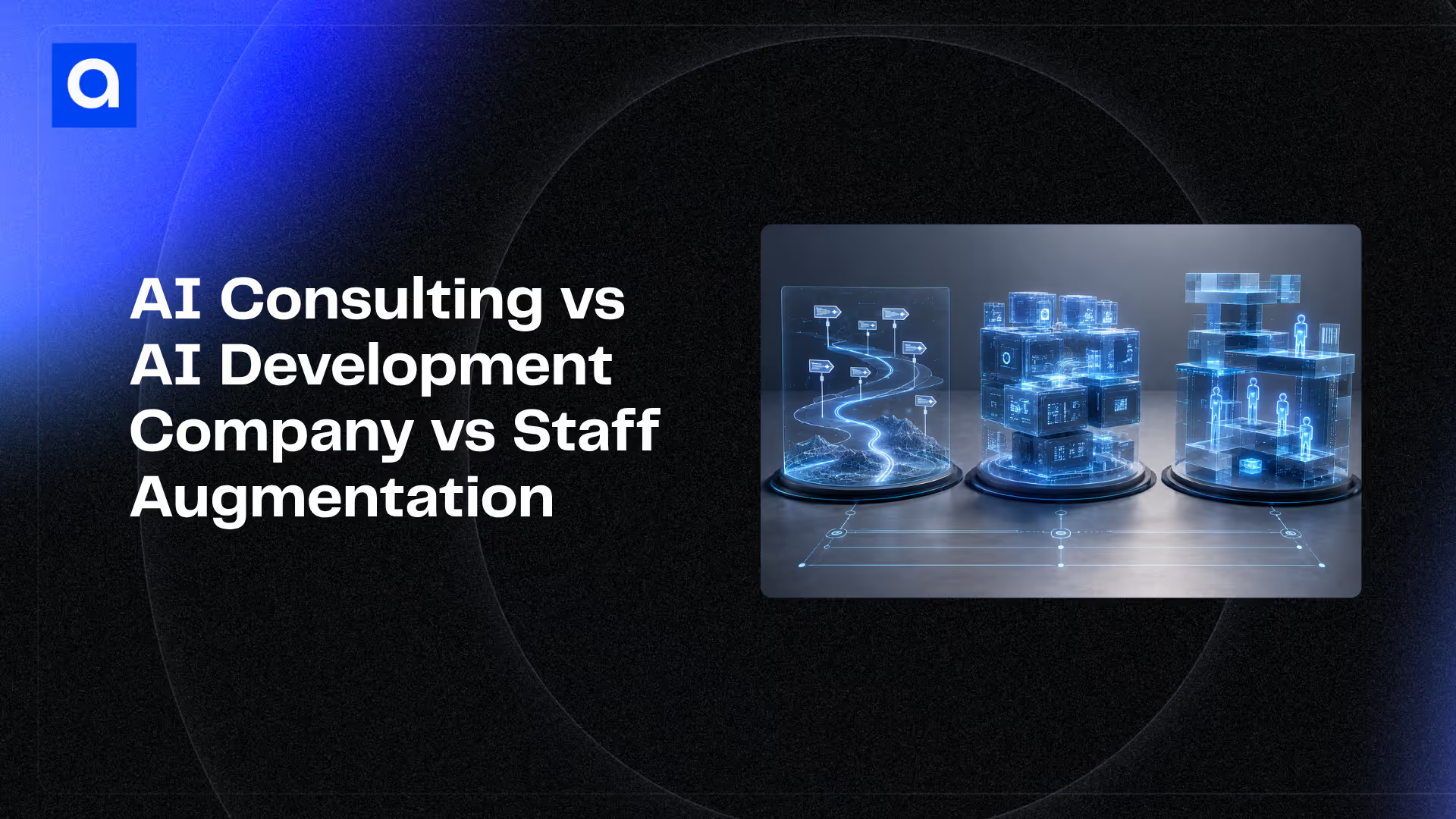
AI Consulting vs AI Development Company vs Staff Augmentation
Most companies do not start an AI project with perfect clarity. They know AI matters. They are less sure what kind of help they actually need. Strategy? Engineers? A full product team? Someone to take a working prototype the rest of the way? Skilled hands to plug into the team they already have?
That uncertainty is where the wrong choice usually gets made. Companies hire consultants when they need builders, end up with a deck instead of a system, and burn six months. Or they hire staff augmentation before the problem is clear, and then ask developers to also do the strategy work nobody owned. Or they bring in an AI development company for a job that really only needed two senior engineers added to an existing team.
The choice between AI consulting, an AI development company, and AI staff augmentation matters because each one solves a different problem. The trick is being honest about which problem you actually have.
The Short Answer
Use AI consulting when you need strategy, use-case validation, technical direction, or an executive roadmap.
Use an AI development company when you need a team to design, build, integrate, deploy, and support working AI software.
Use AI staff augmentation when you already have strong internal leadership and need to add AI, data, or software engineering talent to an existing team.
Many companies need a hybrid. They start with advisory work, move into a prototype, then scale with dedicated engineers once the path is clear. That is normal, and a good partner will tell you when to switch modes instead of stretching one model past its useful life.
What Is AI Consulting?
AI consulting helps a company understand where AI can create business value and how to approach it. The work is largely advisory: AI strategy, use-case discovery, technical feasibility, vendor selection, build-versus-buy analysis, AI roadmap development, data readiness assessment, governance and risk planning, executive education, and proof-of-concept planning.
Consulting earns its fee when the company knows AI is important but has not yet defined the right project. The output is clarity: which use case to pursue, what success looks like, what data and infrastructure you have versus what you need, and what to fund first.
When AI Consulting Is the Right Fit
AI consulting is a good fit when:
- You do not yet know which AI use case to prioritize.
- You need to educate executives or align stakeholders.
- You need a roadmap before committing engineering budget.
- You need help assessing data readiness.
- You want a neutral view on build vs buy.
- You need to define risk, governance, or compliance requirements before you build.
Where AI Consulting Falls Short
A strategy deck does not become a product by itself. A roadmap does not integrate with your CRM. A proof-of-concept plan does not solve authentication, permissions, monitoring, data pipelines, or production deployment.
Consulting can answer "What should we do?" It often cannot answer "Who is going to build, ship, and maintain this?"
That is the gap that pulls many companies into a second engagement, often with a different vendor, six months later. If you are willing to absorb that handoff, consulting alone may be fine. If you are not, the hybrid model below is usually the right call.
What Is an AI Development Company?
An AI development company helps companies build working AI software. Its job is the technical and product work needed to turn an AI idea into a usable application that lives inside the rest of the business.
That includes AI product strategy, UX and workflow design, data engineering, RAG implementation, LLM application development, AI agent development, machine learning models, model evaluation, backend and frontend development, cloud infrastructure, system integration, security and permissions, QA, deployment, monitoring, and maintenance. In other words, the same set of skills you would need on an internal team to ship a serious AI product, organized as a single delivery unit.
For a deeper look at how to evaluate one, see our blog post on how to choose an AI development company and our AI development company evaluation checklist.
When an AI Development Company Is the Right Fit
An AI development company is a good fit when:
- You have a defined business problem.
- You need to build a custom AI application.
- You need AI integrated into existing systems.
- You need help moving AI prototypes into production.
- You need product, engineering, data, and AI skills working as one team.
- You need a managed team, not just individual contributors.
- You want one partner accountable for delivery.
What Is AI Staff Augmentation?
AI staff augmentation means adding outside AI, data, or software development talent to your existing team. Instead of hiring a full project team, you bring in specific people with the skills you need. Common roles include AI engineers, ML engineers, data engineers, backend developers, frontend developers, MLOps engineers, cloud engineers, QA engineers, and technical project managers.
Staff augmentation works best when you already have strong internal product ownership, technical leadership, and delivery management. The contractors plug into your process, not the other way around. If those internal foundations are not in place, staff augmentation tends to underdeliver, because you have hired hands without anyone to direct them.
Comparison Table
How to Decide Which Model You Need
Six questions usually settle it:
- Do you know what you want to build, or are you still framing the problem?
- Do you have technical leadership in place to direct the work?
- Do you need a roadmap, or do you need a shipped product?
- Is the project technically uncertain, or well-defined?
- Does the AI system need to connect to existing systems?
- Will the system handle sensitive data?
If most of your answers point to clarity, internal leadership, and capacity gaps, staff augmentation is probably the right model. If most point to integration, deployment, and accountability, you want a development company. If most point to "we are not sure yet," start with consulting and a discovery phase.
If you are still unsure, the best first step is usually to scope an AI development project cleanly. Scope tends to reveal which model the work actually needs.
Common Scenarios
Many AI Projects Need a Hybrid Model
A typical path looks like this: a two-week discovery, a prototype, then dedicated engineers for production development, then a smaller ongoing team for monitoring and improvement. Another company might bring in staff augmentation first, then ask for architecture support when the project becomes more complex than expected. Another might begin with a consultant to scope the use case and data, then transition to a development company for the build.
A hybrid model works because AI projects move through real phases, discovery, validation, prototype, production build, scale and support. Each phase has a different center of gravity. The right partner will tell you when to switch modes instead of pretending one shape fits the whole project.
Cost Considerations
The three models price differently, and the differences matter when you budget.
AI consulting is usually scoped around strategy, assessments, workshops, or roadmap creation, often as fixed-fee engagements or short retainers.
AI staff augmentation is usually priced by role, seniority, and duration, billed monthly or hourly per engineer.
AI development company work is driven by project scope, team size, complexity, data readiness, integrations, infrastructure, and post-launch support, and is usually structured as a project or as a managed monthly engagement.
For a deeper breakdown, see our AI development cost guide.
Red Flags When Choosing a Model
- Hiring consultants when you need builders.
- Hiring developers before the problem is clear.
- Choosing staff augmentation without internal ownership in place.
- Treating AI as a one-time implementation instead of a system that needs maintenance.
- Ignoring data readiness in the pricing conversation.
- Underestimating integration as a separate cost line.
How Azumo Fits
Azumo is an AI development company. That is our center of gravity, and most of our work is designing, building, integrating, deploying, and supporting AI applications that live inside real business systems.
We have been doing this for a long time. Our work for Meta used GPT-2.0 and FastText to power semantic search across a 3.5 million record supplier database, years before generative AI became a category most vendors had heard of. More recently we have shipped a YOLO and OCR computer vision pipeline for CENTEGIX's school safety check-in product, equity prediction and borrow-rate forecasting models for Stovell AI, GPT-powered document extraction for Angle Health's RFP-to-quote pipeline in health insurance, and multi-phase generative AI integration for Omnicom's Sparks & Honey on its Q cultural intelligence platform. We also operate our own production AI products, including Hello, a real-time AI receptionist running on a custom voice pipeline you can call directly.
We extend into adjacent work when it serves the project. Some engagements start with discovery and feasibility before any code is written. Some teams need experienced AI, data, and software engineers working alongside their internal staff for a specific scope, and we do that work too. We just do not lead with it, because development is where we add the most value. The center of our work is turning AI ideas into production software, and that lens shapes every engagement, even when it starts somewhere else.
Our AI development services page lays out the offering in more detail.
Final Takeaway
AI consulting, AI development companies, and AI staff augmentation are not interchangeable. AI consulting helps you decide what to do. An AI development company helps you build and ship the solution. AI staff augmentation helps you add skilled people to a team you already manage well.
The best partner is the one who tells you which model you need before selling you the wrong one.
Need the right AI delivery model?
Azumo helps companies design, build, and deploy practical AI applications that connect to real business systems. We have shipped production AI for clients including Meta, Omnicom, CENTEGIX, Stovell AI, Discovery Channel, and Angle Health, and we operate our own production AI products on a custom voice pipeline.
Frequently Asked Questions

About the Author:
Lenin Salazar is a results-driven Project Manager with over five years of experience delivering high-quality software solutions in Agile environments. At Azumo, he leads cross-functional teams using Scrum methodologies to ensure alignment between business objectives and technology outcomes. With a background in software development and business analysis, Lenin excels at translating complex requirements into actionable product strategies, fostering collaboration, and driving projects from concept to completion. Passionate about innovation and user experience, he consistently delivers solutions that exceed client expectations and create measurable impact.
Discover Lenin Salazar, an experienced Agile Project Manager and Account Executive at Azumo with a proven track record in delivering software solutions, leading cross-functional teams, and driving business success through Scrum methodologies and stakeholder collaboration.

.avif)