
The most downloaded model on Hugging Face in 2026 is sentence-transformers/all-MiniLM-L6-v2. It ranked first on all 231 days we tracked, with about 243M downloads in the 30 days to Oct. 1, 2026. Five of the ten most downloaded models are retrieval models.
This is our own research, built from real data. We collected daily snapshots of the top 5,000 Hugging Face models by 30-day downloads from Feb. 12 to Oct. 1, 2026. The source was the Hugging Face API, the platform's public interface for model metadata and download counts. Every figure below comes from those snapshots, or from our live trends pages, which keep updating the same data daily.
According to our full Hugging Face download trends report, older retrieval and classification models keep their hold on downloads, while LLM downloads move to new releases.
Key Hugging Face Download Statistics for 2026 at a Glance
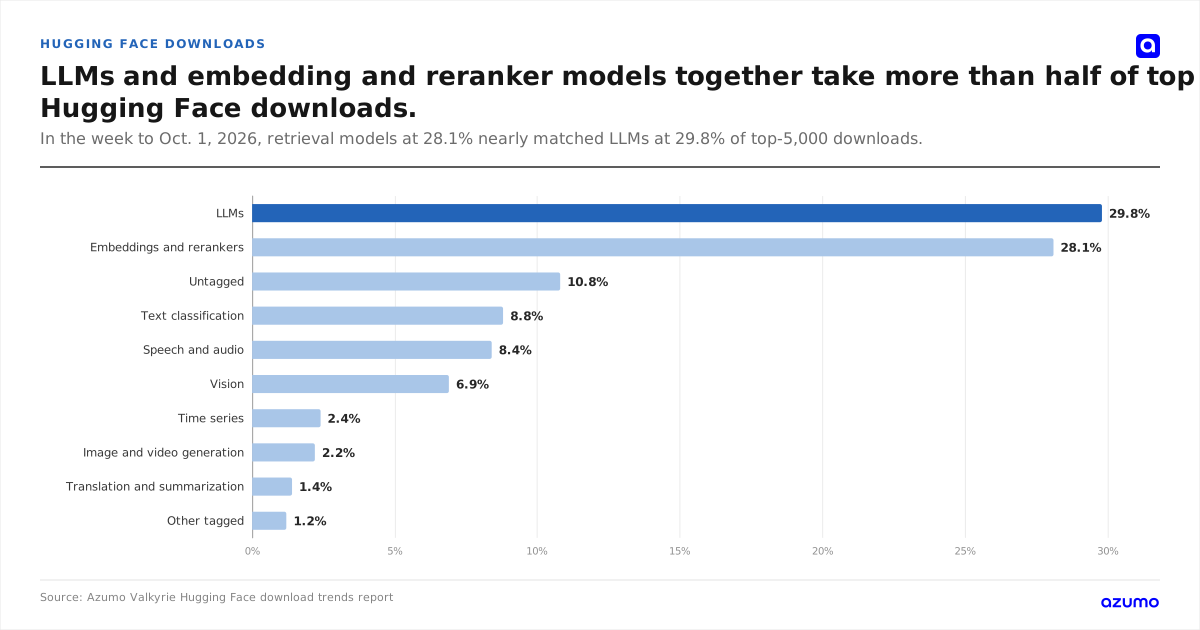
Our daily tracking produced these headline figures for the most downloaded AI models on Hugging Face in 2026. "Mid-March" means the week of March 15 to 21.
- LLMs and embedding models together went from about 45% to about 58% of top-5,000 downloads between mid-March and the week to Oct. 1, 2026.
- Vision and text classification models combined fell from about 25% to about 16% of top-5,000 downloads over the same period.
- Vision models alone fell from about 12% to about 7% of top-5,000 downloads between mid-March and the week to Oct. 1, 2026.
- Embedding and reranker models took about 28% of top-5,000 downloads in the week to Oct. 1, 2026.
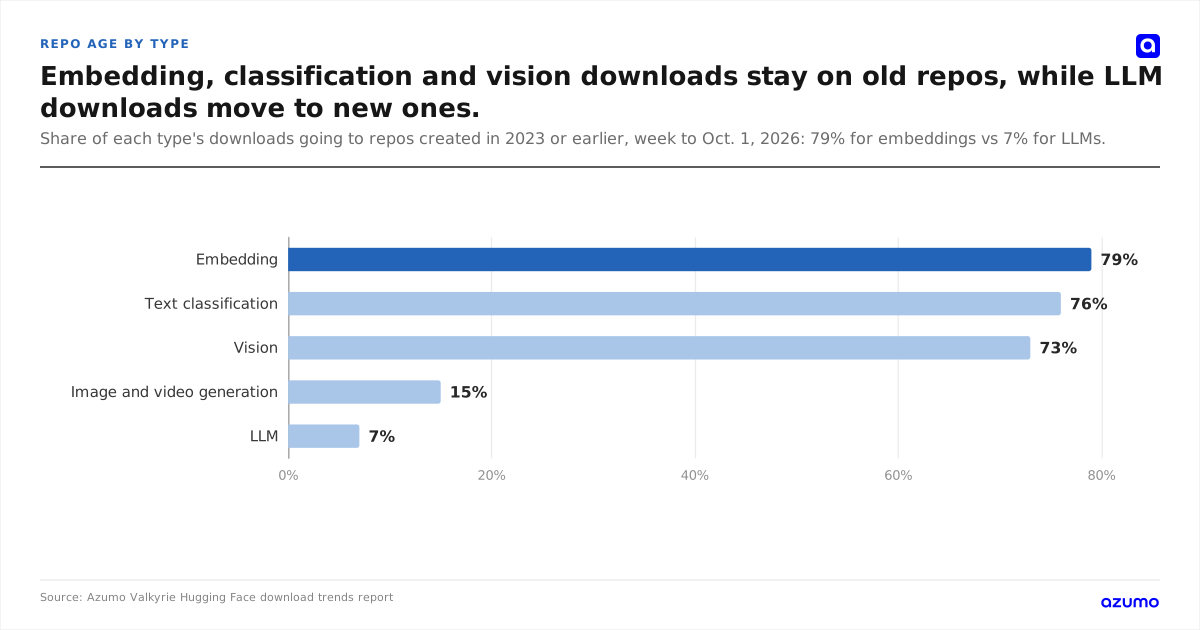
- About 79% of embedding downloads in the week to Oct. 1, 2026 went to repos created in 2023 or earlier. For LLMs, the figure is 7%.
- Qwen-based models took about 45 to 48% of open LLM downloads every month from March to September 2026.
- Rerankers rose from about 1.6% to 5.1% of all downloads between mid-March and October 2026.
- Converted copies of LLMs grew from about 5% to about 12% of all top-5,000 downloads from March to September 2026.
- Permissively licensed models went from 69% to 78% of LLM downloads between mid-March and October 2026.
- Amazon's Chronos models were about 88% of time series forecasting downloads as of the week to Oct. 1, 2026, and Chronos-2 alone was about half.
- Total 30-day downloads across the top 5,000 models rose from 2.17B on March 13, 2026 to 2.73B on Oct. 1, 2026.
What Share of Hugging Face Downloads Does Each Model Type Get?
LLMs held 29.8% of top-5,000 downloads in the week to Oct. 1, 2026. Embeddings and rerankers held 28.1%. Embeddings are models that turn text into numbers for search. Rerankers are models that re-sort search results.
Together, LLMs and embeddings grew from about 45% to about 58% of downloads since mid-March. Vision and text classification combined fell from about 25% to about 16%.
Two types now take more than half the volume. The question is how we measured it.
How We Tracked Hugging Face Downloads: Our Methodology
As set out in our Hugging Face download trends report, we recorded the top 5,000 models by 30-day download count from the Hugging Face API every day from Feb. 12 to Oct. 1, 2026. That came to 231 days, 1,053,899 rows and 13,182 distinct models.
Two gaps apply. From Feb. 14 to March 12, we kept only the top 1,000. June 22 is missing.
We recomputed every finding with independent code. Then we handed each one to reviewers whose job was to disprove it.
We compare shares because raw totals break easily. Hugging Face counts a download each time certain model files, usually the config file, are fetched. That includes automated fetches by tools and test pipelines, and nothing is deduplicated. Shares hold up better under counting faults, and we state the time window for every figure.
Our shares cover the top 5,000 models, so they do not describe the Hub's long tail. A type-level share could misstate the whole Hub, and we accept that limit.
The Most Downloaded Open-Source LLMs on Hugging Face as of October 2026
LLMs took 29.8% of top-5,000 downloads in the week to Oct. 1, 2026, the largest share of any type. The table shows the most downloaded original open LLM uploads as of Oct. 28, 2026.
Qwen models hold four of the top five places, and the smallest Qwen3 model leads. Downloads show popularity, not quality, which is why we track capability separately in our current LLM rankings.
Which Company's Open LLMs Are Downloaded Most?
Qwen-based models took about 45 to 48% of open LLM downloads every month from March to September 2026. According to our live LLM download trends, which measure this weekly by model family, the shares in the week of Oct. 26, 2026 were Qwen 47.2%, Gemma 9.3%, DeepSeek 4.1% and Llama 2.7%.
Google's share nearly tripled on Gemma 4. It rose from 3.5% in March to 10% in September, after peaking at about 14% in June. Meta's share, covering Llama and Muse, fell from 8.5% to 3.7% over the same months. Mistral is under 1%.
We credited each model to the lab whose weights it holds. On that basis, Chinese labs account for about three-fifths of open LLM downloads: between 59% and 61% from February to October 2026.
LLM Licenses and Model Sizes in 2026
Permissively licensed models, mostly Apache-2.0, went from 69% to 78% of LLM downloads between mid-March and October 2026.
Mid-size models gained ground too. Four of 2026's most downloaded new open LLM lines are 26B to 31B parameters: Qwen 3.6 and 3.8 27B, and Gemma 4 26B and 31B. They took the 10B to 35B size class from about a fifth to about a third of LLM downloads. Models of this size need significant storage and GPU memory to run, one of the issues covered in our guide to deploying open-weight models.
Converted Copies: GGUF, MLX and Compressed Versions
GGUF and MLX builds are converted copies of models for running them locally. Together with compressed lower-precision versions, converted copies of LLMs grew from about 5% to about 12% of all top-5,000 downloads from March to September 2026. Downloading a converted copy is the easy part of running a model locally. The hidden costs of self-hosting LLMs show up later, once the model has to run reliably.
New releases drive LLM volume. About 47% of LLM downloads went to repos created since Feb. 12, 2026, or 31% excluding converted copies. Embedding, text classification and vision models each get under 4% from such repos.
If you are choosing a base model, our guide on which open-source LLMs are worth fine-tuning compares the leading options, and our LLM fine-tuning services cover adapting one to your own data.
The Most Downloaded Embedding and Reranker Models on Hugging Face as of October 2026
Embedding and reranker models took about 28% of top-5,000 downloads from about 8% of the slots in the week to Oct. 1, 2026. That nearly matches LLMs at 29.8%, from far fewer models.
According to our live embedding and reranker download trends, embeddings made up 81.9% of the category's downloads on Oct. 28, 2026, and rerankers 18.1%.
Why Rerankers Tripled Their Share in 2026
Rerankers rose from about 1.6% to 5.1% of all downloads between mid-March and October 2026, or from about 7% to 18% of the embedding and reranker category. cross-encoder/ms-marco-MiniLM-L6-v2 makes up about 60% of that reranker share. Without its two biggest gainers, ms-marco-MiniLM-L6-v2 and bge-small-en-v1.5, the category's gain since mid-March is about 2 points, against 5 with them.
Who Makes the Most Downloaded Embedding Models?
On Oct. 28, 2026, sentence-transformers held 45.0% of the category, BAAI 20.8% and cross-encoder 13.0%.
Looking only at models uploaded in 2024 or earlier, with copies left out, BAAI went from about 10% to 21% of embedding and reranker downloads in our data, and sentence-transformers fell from about 62% to 46%.
Older models dominate this category. About 79% of embedding downloads in the week to Oct. 1, 2026 went to repos created in 2023 or earlier. Repos created in 2025 or 2026 hold about 7%, and the largest of them, Qwen3-Embedding-0.6B, holds about 1%.
These counts include automated pulls by tools and pipelines, which lift small models that are fetched by default. Read these shares as where Hub fetch volume goes, not as a measure of how important each model is.
Embedding models and rerankers form the retrieval layer of RAG (retrieval-augmented generation) systems. They work alongside a vector database, and we compare the main options in our guide to vector databases for RAG. Choosing an embedding model, a reranker and a database that work well together is a core part of our RAG development services.
The Most Downloaded Speech and Audio Models on Hugging Face as of October 2026
Speech and audio took 8.4% of top-5,000 downloads in the week to Oct. 1, 2026. According to our live speech and audio download trends, speech recognition made up 64.2% of the category's downloads on Oct. 28, 2026.
Whisper, Faster-Whisper and Converted Speech Models
Between mid-March and the week to Oct. 1, 2026, converted copies of speech models grew from about 6% to 20% of speech downloads. These include faster-whisper, WhisperKit, GGUF and MLX builds. Five uploaders hold about 87% of them.
OpenAI's own Whisper repos held steady over the same period, and Whisper still has about four times the downloads of converted copies of NVIDIA's speech models. pyannote, an open-source toolkit for telling speakers apart in a recording, fell from about 2.2% to 1.0% of all downloads since mid-March 2026.
Some speech volume moves in unusual ways. Speech's jump in June came from 60 to 90 older per-language wav2vec2 models rising together, and it recurred in late August and September. Our data cannot show the cause. Models that move in lockstep like this account for about 36% of speech downloads.
The Most Downloaded Computer Vision Models on Hugging Face as of October 2026
Vision models alone fell from about 12% to about 7% of top-5,000 downloads between mid-March and the week to Oct. 1, 2026. Image classification accounts for about 85% of the lost downloads. According to our live vision download trends, these were the most downloaded vision models in the 30 days to Oct. 28, 2026.
Why Vision Downloads Fell in 2026
One repo explains a large part of the drop. Falconsai's NSFW detector fell from about 42M downloads a month in mid-March 2026 to 2.4M. That repo alone accounts for about two-fifths of vision's fall.
It is part of a wider pattern. Classifiers whose names say they detect explicit content, age, gender or ethnicity fell from about 47% of image classification downloads to about 10% since mid-March 2026.
CLIP, SigLIP and Google's Rise in Vision
Zero-shot image classification was the largest vision task, at about 37% of vision downloads in the week to Oct. 1, 2026. A zero-shot model classifies images into labels it was not trained on. CLIP and SigLIP lead this task. In production, a model like CLIP is usually one stage in a longer pipeline, and our whitepaper on how computer vision systems work walks through how those stages fit together.
Google's share of vision downloads roughly doubled since mid-March 2026, from about 6% to 12-16%. Its SigLIP 2 models grew from about 4M downloads a month in mid-March to about 12M.
The Most Downloaded Text Classification Models on Hugging Face as of October 2026
Text classification fell from about 13.5% to 8.8% of downloads between mid-March and the week to Oct. 1, 2026. According to our live text classification download trends, base encoders made up 50.5% of the category's downloads on Oct. 28, 2026. A base encoder is a general text model that teams fine-tune for a specific task, such as routing support tickets or tagging names in contracts. That fine-tuning is the kind of work our NLP development services take on.
Is BERT Still the Most Downloaded Text Model?
Yes. bert-base-uncased still leads the category by a wide margin, and it also drives the decline. Since mid-March 2026, bert-base-uncased and roberta-large account for about half of the category's lost share. In the week to Oct. 1, 2026, about 76% of text classification downloads went to repos created in 2023 or earlier.
Medical NLP and Guardrail Classifiers
Growth sits in narrower niches. OpenMed, a publisher of medical NLP models, has roughly 350 models in the top 5,000, about half of all text classification models there, and about 15% of the category's downloads.
Guardrail classifiers screen prompts for attacks or unsafe content. During our tracking period, they grew from about 0.7M to 5.3M downloads a month. Meta's Prompt-Guard-86M accounts for about three-quarters of that.
The Most Downloaded Image and Video Generation Models on Hugging Face as of October 2026
Tagged image and video generation models took 2.2% of downloads in the week to Oct. 1, 2026. Counting ComfyUI repackages, the share rises to about 5.3%, and repackages take about half of the group's downloads.
According to our live image and video generation download trends, MiniMax-H3, from the model developer MiniMax, leads the category as of Oct. 28, 2026. Uploaded on July 28, 2026, it and its repackages and fine-tunes now take about a quarter of the group's downloads, while Wan models fell from about 43% to 11%. Two of the top five are LTX-2.5 repos: Lightricks' own release and a copy uploaded by comfyicu.
This is the least permissively licensed category in our data. Under half of image and video downloads carry a permissive license, against about four-fifths for LLMs, and about half carry custom licenses.
The Most Downloaded Time Series Forecasting Models on Hugging Face as of October 2026
Time series forecasting slipped from about 3.3% of downloads in March to about 2.4% in the week to Oct. 1, 2026. Amazon's Chronos models accounted for about 88% of time series forecasting downloads as of the week to Oct. 1, 2026.
Chronos-2 alone was about half of the category over the same window. It ships in two repos, Amazon's and AutoGluon's, and both make the top two. According to our live time series download trends, Apache-2.0 covers 92.9% of the most downloaded time series models.
The Most Downloaded Translation and Summarization Models on Hugging Face as of October 2026
Translation and summarization took 1.4% of top-5,000 downloads in the week to Oct. 1, 2026, and one repo drives the category. According to our live translation and summarization download trends, these were the most downloaded models in the 30 days to Oct. 28, 2026.
google-t5/t5-small went from about 1.8M downloads a month in mid-March 2026 to 24M. That one repo explains the category's rise from 0.9% to 1.4% of downloads. Without it, the category's share fell from about 0.8% to 0.55%, and tagged summarization halved.
Many general language models can also translate, but this category counts only models tagged for translation or summarization. We compare those general models in our guide to the best multilingual LLMs for 2026.
What October 2026 Hugging Face Download Data Shows Across All Categories
Three patterns repeat across the eight categories in our snapshots.
Old Models Still Dominate Most Categories
In the week to Oct. 1, 2026, about 79% of embedding downloads, 76% of text classification and 73% of vision went to repos created in 2023 or earlier. For LLMs, the figure is 7%. In those three categories, download volume stays with older repos, while LLM volume shifts to new repos with each release. Not every category follows that pattern: repos from 2023 or earlier get about 15% of image and video generation downloads and none of time series downloads.
How Fast Do New Models Reach the Top 100?
The top of the chart moves slowly. Over 231 days, 53 of the top-100 slots never changed hands, and those slots took about three-quarters of top-100 downloads. Even so, 42 of February's top 100 were out by October 2026.
New entrants rarely break in. Of about 2,900 models created in 2026 that reached the top 5,000, only 46 reached the top 100. Two-thirds of those 46 were versions of five LLM launch families: Qwen 3.5, 3.6 and 3.8, Gemma 4 and DeepSeek V4.
How Quickly Copies and Fine-Tunes Follow a Release
Unsloth, which makes an open-source fine-tuning library, released the first popular derivative for 18 of 34 major 2026 open-model releases. Compressed copies typically appear within about a week of a release, and fine-tunes follow about two weeks later. Among popular derivatives of open LLMs, 70 to 90% are compressed copies of a lab's model.
How to Read Hugging Face Download Numbers
A Hugging Face download is a file fetch, not a person. Automated tools, test pipelines and update checks all trigger fetches, and nothing is deduplicated. So a single raw total can mislead by as much as a third.
Picture an analyst pulling a May snapshot and a mid-June snapshot to report on model demand. Between June 10 and 19, 2026, almost every model's reported 30-day downloads fell by about a third. Total 30-day downloads across the top 5,000 dropped from 2.67B to 1.80B, then recovered. The fault sat on Hugging Face's side, yet that analyst would have reported a collapse that never happened.
A smaller dip followed. Total top-5,000 30-day downloads slid from 3.01B on Aug. 5, 2026 to 2.75B on Aug. 12, and were back to 3.00B by Aug. 16.
GGUF is the clearest open question. It held at about 8 to 10% of LLM downloads until mid-August 2026, then rose from about 10.6% on Aug. 12 to about 23% on Oct. 1. We cannot explain that jump, so we draw no conclusion about local deployment. If you are weighing GGUF builds for your own stack, our guide to taking open-weight models from prototype to production covers the deployment side.
Other moves happen on the same days across unrelated models, which points to bulk downloading. Repo metadata adds noise too. About 540 older repos carry Hugging Face's placeholder creation date of March 2, 2022, so they are older than their listed date. During our tracking period, 95 repos changed names and took their download counts with them. About 11% of downloads go to repos with no task tag.
Our own shares could be affected by the same faults, so we built in three controls. We compare shares, which hold up better than totals. We left days with counting faults out of our share comparisons. And we recomputed every finding with independent code, then handed it to reviewers whose job was to disprove it.
Where a move could not be explained, as with GGUF, we say so. Read these numbers as fetch volume over a stated window.
Run Open-Weight Models Like These on Your Own Data
The models in these tables are a starting point. Production value comes from adapting them to your data. Valkyrie fine-tunes open-weight models on your own data and runs them on dedicated hardware, behind the OpenAI- and Anthropic-compatible endpoints your tools already use.
See how it works at Valkyrie, then schedule a call with our team to scope your first model.
Frequently Asked Questions

About the Author:
Founder & CEO | Azumo
Chike Agbai, Founder & CEO of Azumo, leads a nearshore software development firm that builds intelligent applications using top-tier Latin American talent.