
As of Oct. 28, 2026, the most downloaded vision model on Hugging Face is openai/clip-vit-base-patch32. It recorded 17.1M downloads in the 30 days to Oct. 28, 2026. Among the most downloaded vision models on Hugging Face, timm's mobilenetv3_small_100.lamb_in1k followed with 16.0M, and Google's vit-base-patch16-224 was third with 14.9M.
This is our own research, built from real data. We tracked daily snapshots of the top 5,000 Hugging Face models by 30-day downloads from Feb. 12 to Oct. 1, 2026: 231 days, 1,053,899 rows and 13,182 models. Our live vision download trends page keeps updating the same data daily.
According to our full Hugging Face download trends report, vision fell from 14.8% of top-5,000 downloads (Feb. 12-13, 2026) to 6.9% (week to Oct. 1, 2026). YOLO and vision-language models sit outside this ranking, and a later section explains why.
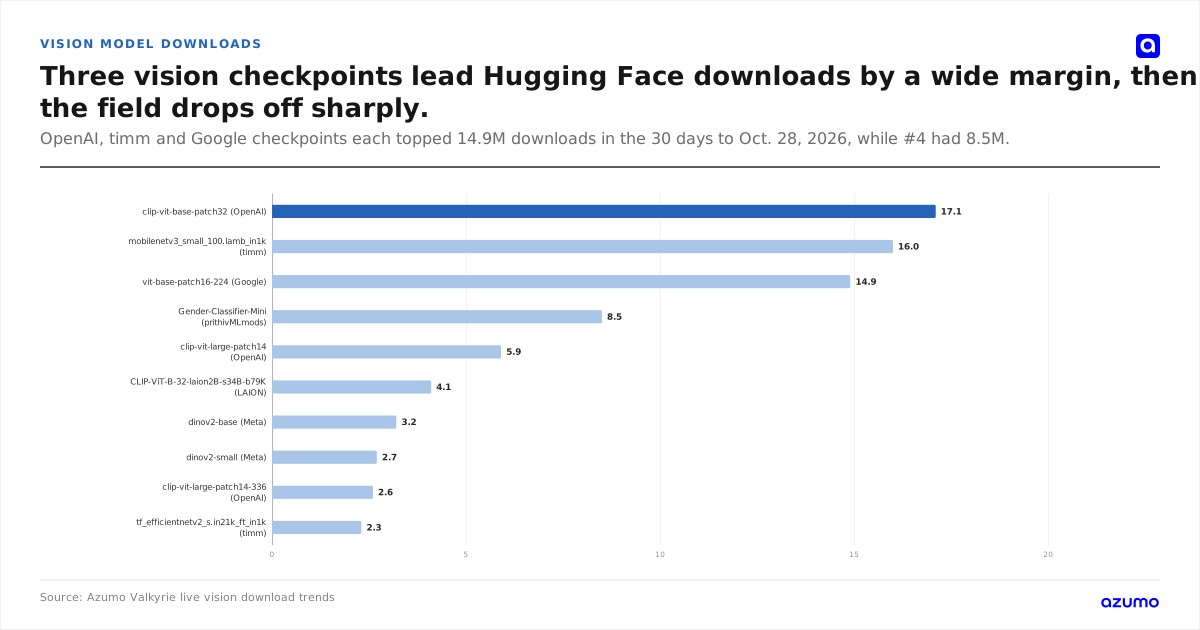
Top 25 Most Downloaded Vision Models on Hugging Face
In the 30 days to Oct. 28, 2026, image classification and zero-shot image classification held eight places each in the top 25. A zero-shot model classifies images into labels it was not trained on.
Source: our live vision download trends, 30 days to Oct. 28, 2026.
The top three sit close together, between 14.9M and 17.1M. After that, downloads fall by about 43%, from 14.9M at #3 to 8.5M at #4. OpenAI's CLIP models take four places: #1, #5, #9 and #22.
Licenses vary across the list. Of the top 25, 15 declare Apache-2.0, four declare MIT, one uses a custom license and five declare none. The custom license belongs to SAM 3. The five without a declared license are the four OpenAI CLIP models and rizvandwiki's gender-classification.
So the most downloaded model on the list, clip-vit-base-patch32, shows no declared license in our data, so check its license terms before you build on it. Building a product on one of these checkpoints is the kind of work our computer vision development services cover.
A one-month ranking is a single moment, and a burst of automated pulls can inflate a count. That is why every figure here carries its window. You can check the current order on our live vision page.
The ranking names the leaders. The next question is which jobs those downloads serve.
Most Downloaded Vision Models by Task
In the 30 days to Oct. 28, 2026, image classification took 40.0% of vision downloads and zero-shot image classification took 29.9%, together about 70%. Object detection, segmentation and depth estimation each stayed at or below 5.2%.
Source: our live vision download trends, share of vision downloads by task, 30 days to Oct. 28, 2026.
Each task does a different job. Image classification assigns a whole image to one of a fixed set of labels. Object detection finds objects in an image and draws a box around each one. Zero-shot object detection does the same for objects named in a text prompt. Image to text turns an image into words, such as reading printed text. Depth estimation predicts how far each part of a scene is from the camera. Video classification assigns a label to a whole video clip. Keypoint detection locates specific points, such as the joints of a body.
Our full report gives a different split for the week to Oct. 1, 2026: zero-shot image classification 36.8% and image classification 31.2%. The report covers the week to Oct. 1 and also leaves out test fixtures and junk repos, while our vision page shows Oct. 28. So the order of the top two tasks depends on the date and the method. The two classification tasks dominate in both.
Most Downloaded Image Classification Models: MobileNetV3, ViT and EfficientNet
In the 30 days to Oct. 28, 2026, timm's mobilenetv3_small_100 led image classification at 16.0M, ahead of Google's vit-base-patch16-224 at 14.9M and prithivMLmods' Gender-Classifier-Mini at 8.5M. Behind them come tf_efficientnetv2_s at 2.3M, resnet18 at 2.1M, nsfw_image_detection at 1.7M, resnet50 at 1.6M and gender-classification at 1.4M. Our guide to how image classification works covers the basics.
Three of those eight, Gender-Classifier-Mini, nsfw_image_detection and gender-classification, are named as gender or explicit-content classifiers.
Most Downloaded Zero-Shot Image Classification Models: CLIP and SigLIP 2
OpenAI's CLIP ViT-B/32 leads the zero-shot image classification group at 17.1M in the 30 days to Oct. 28, 2026. It is the largest single repo in the ranking. CLIP ViT-L/14 follows at 5.9M, then LAION's CLIP ViT-B/32 at 4.1M and CLIP ViT-L/14-336 at 2.6M. LAION's CLIP ConvNeXt (1.8M), Google's siglip2-giant (1.8M), siglip2-base (1.7M) and CLIP ViT-B/16 (1.5M) complete the eight.
Most Downloaded Image Feature Models: DINOv2
Image features are numeric descriptions of an image that other models build on. In the 30 days to Oct. 28, 2026, Meta's dinov2-base (3.2M), dinov2-small (2.7M) and timm's DINOv2 ViT-S/14 (2.0M) were the three image feature models in the top 25.
Most Downloaded Object Detection Models: Grounding DINO, OWLv2 and RT-DETR
Four detection repos made the top 25, each between 1.2M and 2.2M. In the 30 days to Oct. 28, 2026, IDEA-Research's grounding-dino-base (2.2M) and Google's owlv2-base-patch16-ensemble (1.6M) led as zero-shot detectors. Microsoft's table-transformer-structure-recognition (1.4M) and PekingU's rtdetr_r101vd_coco_o365 (1.2M) are tagged as object detection. In the same window, object detection took 3.7% of vision downloads and zero-shot object detection took 2.8%.
Most Downloaded Segmentation and OCR Models: SAM 3 and GLM-OCR
Segmentation outlines the exact pixels of each object. Our guide explains how image segmentation works. In the 30 days to Oct. 28, 2026, Meta's sam3 held the one segmentation place at 1.9M, under a custom license. zai-org's GLM-OCR, which reads text from images, drew 1.7M under an MIT license. No depth estimation model reaches the top 25.
The task mix describes one month. Our 231 days of daily data show how that mix, and vision's place on Hugging Face, moved during 2026.
How Vision Model Downloads Changed in 2026
Vision fell from 14.8% of top-5,000 Hugging Face downloads on Feb. 12-13, 2026 to 6.9% in the week to Oct. 1, 2026. Since mid-March, image classification accounts for about 85% of the lost downloads, and one NSFW detector alone for about two-fifths. Over the same weeks, zero-shot models and Google gained share within vision.
Vision's Share of Hugging Face Downloads Fell From 14.8% to 6.9%
"Mid-March" means the week of March 15 to 21. Vision held 11.9% of top-5,000 downloads then. Its weekly peak after that was 12.4%, in the week of April 6. Its weekly low was 6.2%, in the weeks of Aug. 17 and 24.
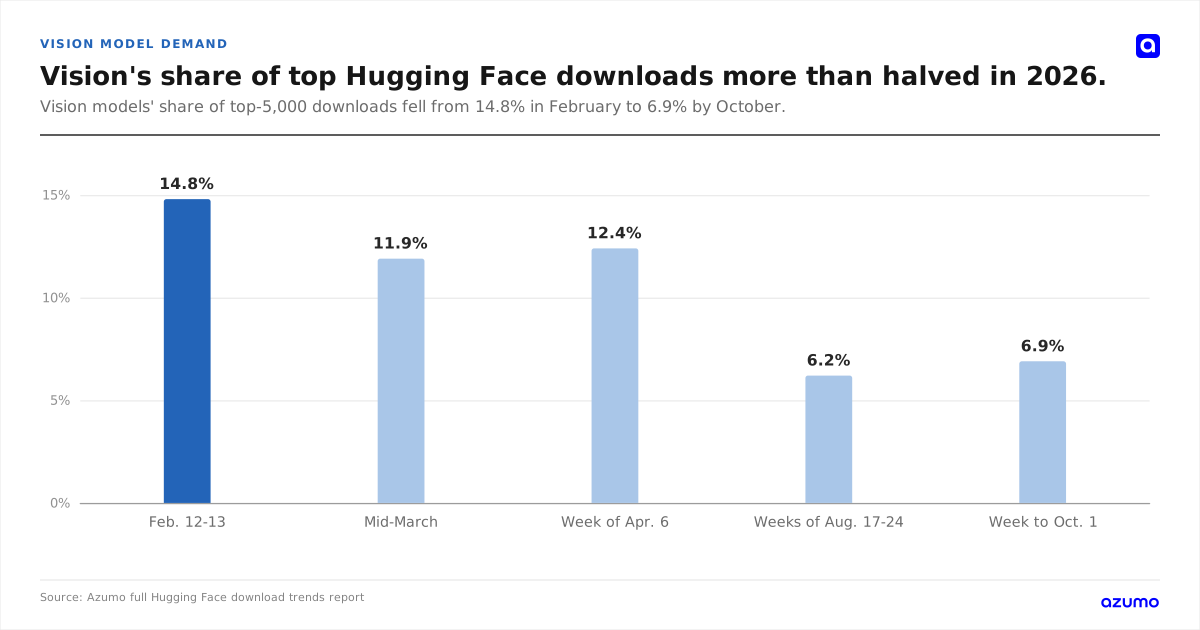
Source: our full Hugging Face download trends report, vision share of top-5,000 downloads, Feb. 12 to Oct. 1, 2026.
Vision and text classification together fell from about 25% to about 16% between mid-March and the week to Oct. 1, 2026. In the week to Oct. 1, LLMs held 29.8%, embeddings and rerankers 28.1%, text classification 8.8%, and speech and audio 8.4%.
Since mid-March, vision lost downloads outright while the top 5,000's total grew about a quarter. The fall holds on a fixed set of models.
One NSFW Detector Explains About Two-Fifths of the Drop
Image classification accounts for about 85% of vision's lost downloads between mid-March and the week to Oct. 1, 2026. Classifiers whose names say they detect explicit content, age, gender or ethnicity fell from about 47% to about 10% of image classification downloads over that period.
The largest single mover is nsfw_image_detection from Falconsai. It dropped from about 42M downloads a month in mid-March to about 2.4M in the week to Oct. 1, 2026. Most of that fall came as a drain of about 1M downloads a day from April 19, 2026. The pattern is consistent with one large consumer switching off. That cause is inferred, and our data cannot show it.
This one repo accounts for about two-fifths of vision's decline, not all of it. The twelve biggest losers lost about 83M downloads a month, while the other vision repos together grew about 11%. The market grew about a quarter over the same window, so vision lost share even where it grew.
The latest ranking adds a twist. In the 30 days to Oct. 28, 2026, our live vision page shows Gender-Classifier-Mini from prithivMLmods at #4 with 8.5M downloads. Our data cannot show why it ranks so high, so we draw no conclusion.
Zero-Shot Models Gained Share as Image Classification Shrank
Between mid-March and the week to Oct. 1, 2026, image classification fell from 46.7% to 31.2% of vision downloads, and zero-shot image classification rose from 25.7% to 36.8%.
Source: our full Hugging Face download trends report, share of vision downloads, mid-March versus the week to Oct. 1, 2026.
These figures leave out test fixtures and junk repos, and they end four weeks before our vision page's Oct. 28 snapshot. Both differences help explain why that snapshot shows image classification ahead.
Google's Share of Vision Downloads Roughly Doubled
Google's share of vision downloads roughly doubled, from about 6% in mid-March 2026 to between 12% and 16% depending on the week. The gain came from SigLIP 2 and ViT, and the shrinking vision total helped it.
Google's gain rests partly on SigLIP 2, one of the newer vision models. The next section looks at how those newer models are doing.
Newer Vision Models: SigLIP 2, DINOv3 and SAM 3
In the week to Oct. 1, 2026, the SigLIP 2 family drew about 12M downloads a month across all its repos, against about 4M in mid-March. Without a mid-September spike on one repo, the figure is about 8M.
In the same week, the DINOv3 and SAM 3 families each drew about 2M to 4M a month. These are family totals. The ranking table shows single repos, such as sam3 at 1.9M, siglip2-giant at 1.8M and siglip2-base at 1.7M in the 30 days to Oct. 28, 2026.
The older DINOv2 grew more than DINOv3. The detectors RF-DETR and D-FINE barely reach the top 5,000.
These newer families are gaining from a small base. Most vision demand still sits on older repos.
Most Vision Downloads Go to Models From 2023 or Earlier
In the week to Oct. 1, 2026, 73.1% of vision downloads went to repos created in 2023 or earlier, and 3.7% went to repos created since Feb. 12, 2026. Only three model types send a larger share to older repos: translation and summarization, embeddings and rerankers, and text classification.
Source: our full Hugging Face download trends report, share of downloads to repos created in 2023 or earlier, by model type, week to Oct. 1, 2026.
Some of these repos are older than their dates show. About 540 older repos in our data carry Hugging Face's placeholder creation date of March 2, 2022, which hides their real age.
Age explains part of the ranking. Tagging explains what is missing from it.
Why YOLO and Vision-Language Models Are Not in This Ranking
In the week to Oct. 1, 2026, about 11% of top-5,000 downloads went to repos with no Hugging Face task tag. YOLO detectors carry no task tag, so they sit in no model type and do not appear in this vision ranking.
Vision-language chat models such as Qwen3-VL are counted as LLMs in our data. For vision-language and multimodal systems, look at the LLM figures in our report.
Tags also change. GLM-OCR moved from vision to LLM and back, so a model's category can differ between two snapshots.
What the Download Data Means When Choosing a Vision Model
In the 30 days to Oct. 28, 2026, CLIP, MobileNetV3, ViT and DINOv2 models held 9 of the top 13 places. If you are choosing a model, start your shortlist with the checkpoints that hold the most demand.
Treat SigLIP 2, DINOv3 and SAM 3 as gaining but still small, at the family totals above. Check the license early: five of the top 25 declare none, and SAM 3 uses a custom license.
Treat a sudden spike as unconfirmed until you know what else moved with it. Downloads narrow a shortlist. They do not measure quality, so final selection needs testing on your own data.
If you are building a full system, our guide to how a computer vision pipeline fits together walks through the stages.
Methodology: How We Tracked and Read Vision Download Data
We took daily snapshots of the top 5,000 Hugging Face models by 30-day downloads for 231 days, from Feb. 12 to Oct. 1, 2026. Two rules matter most: compare shares, not totals, and name the window for every figure.
How Azumo Collected the Data
We pulled each snapshot from the Hugging Face API. We kept only the top 1,000 from Feb. 14 to March 12, and June 22 is missing.
Model types follow Hugging Face task tags. We identified format conversions and re-uploads by format words, converted-weights libraries and base-model tags. Our live vision page leaves most of them out. We recomputed every finding with independent code, then handed it to reviewers whose job was to disprove it. The live ranking uses 30-day rolling counts refreshed daily at 06:00 UTC.
How to Read Hugging Face Download Counts
As our report explains, Hugging Face counts a download each time certain model files, usually the config file, are fetched. That includes automated fetches by tools and test pipelines, and nothing is deduplicated. A download count cannot tell you who uses a model or how well it performs.
Picture an analyst comparing a May snapshot with a mid-June one. Between June 10 and 19, 2026, total 30-day downloads across the top 5,000 fell from 2.67B to 1.80B, then recovered by June 20. That analyst would report a collapse in demand that a counting fault created.
A smaller dip ran from 3.01B on Aug. 5 to 2.75B on Aug. 12, and back to 3.00B by Aug. 16.
From about June 20, DETR and SAM climbed on the same days as unrelated models such as t5-small. That points to automated or bulk downloading. The cause is inferred, and our data cannot confirm it. Between Feb. 12 and Oct. 1, 2026, 95 repos also changed names and took their counts with them.
The noise is real, so we read downloads only as relative demand. Shares over a fixed window, checked against what else moved on the same days, still show where demand concentrates.
Run Open-Weight Vision Models on Your Own Data
The models in this ranking are a starting point. Production value comes from adapting them to your data. Valkyrie fine-tunes open-weight models on your own data and runs them on dedicated hardware.
See how it works at Valkyrie, then schedule a call with our team to scope your first model. Our computer vision development services cover the build from there.
Frequently Asked Questions

About the Author:
Chief Technology Officer | Software Architect | Builder of AI, Products, and Teams
Juan Pablo Lorandi is the CTO at Azumo, with 20+ years of experience in software architecture, product development, and engineering leadership.