
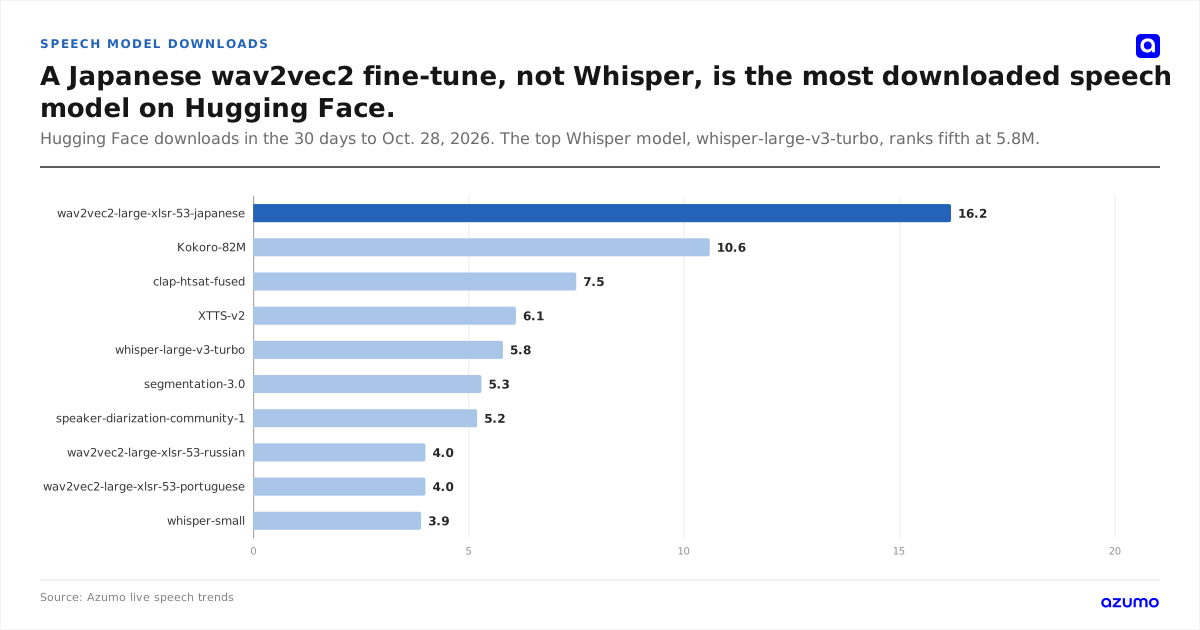
The most downloaded speech model on Hugging Face in 2026 is jonatasgrosman/wav2vec2-large-xlsr-53-japanese. It drew 16.2M downloads in the 30 days to Oct. 28, 2026. hexgrad/Kokoro-82M was second with 10.6M and was the top text-to-speech model. openai/whisper-large-v3-turbo was the top Whisper model, with 5.8M. The top spot likely reflects bulk downloading, which we explain below.
This is our own research, built from real data. We pulled the top 5,000 models from Hugging Face, the platform that hosts open AI models, every day from Feb. 12 to Oct. 1, 2026. That came to 231 days, 1,053,899 rows and 13,182 models.
According to our full Hugging Face download trends report, speech and audio models held about 8% of top-5,000 downloads. That share moved from 7.3% on Feb. 12-13 to 8.4% in the week to Oct. 1, 2026, with a dip in May.
Top 25 Most Downloaded Speech and Audio Models on Hugging Face
Speech recognition held 15 of the top 25 speech and audio places in the 30 days to Oct. 28, 2026. wav2vec2-large-xlsr-53-japanese (16.2M) led the ranking, and Kokoro-82M (10.6M) led text-to-speech.
Our live speech and audio download trends carry the same table and update it daily. The ranking leaves out most converted copies and re-uploads, which understates Whisper's footprint.
A fair objection: a single month is a snapshot, and a Japanese wav2vec2 fine-tune at the top suggests distribution quirks. We agree. The rank counts file requests, and the top spot likely reflects bulk downloading. The wav2vec2 section below explains the lockstep pulses with 231 days of data.
If you are planning a product that mixes voice, text and images, our multimodal AI services cover how these model types fit together.
Most Downloaded Speech-to-Text Models on Hugging Face
Speech-to-text models turn audio into written text. Ten of the 15 speech recognition entries are per-language wav2vec2 fine-tunes, led by the Japanese model at overall rank 1 (16.2M).
OpenAI's whisper-large-v3-turbo ranks fifth overall (5.8M). whisper-small (3.9M) and whisper-large-v3 (3.6M) follow at ranks 10 and 11. Mistral's Voxtral-Mini-4B-Realtime-2602 ranks 21st (2.0M, Apache-2.0).
One entry needs context. The mms-300m-1130-forced-aligner (2.3M) does alignment, not transcription: it matches known text to audio timestamps.
Most Downloaded Text-to-Speech Models on Hugging Face
Text-to-speech models turn written text into spoken audio. Kokoro-82M (Apache-2.0) drew 10.6M downloads in the 30 days to Oct. 28, 2026. That ranks it second overall and first in text-to-speech.
Four models follow:
- XTTS-v2: 6.1M downloads, custom license
- OmniVoice: 2.4M, no license declared
- chatterbox: 2.0M, MIT
- Qwen3-TTS-12Hz-1.7B-CustomVoice: 1.9M, Apache-2.0
Check the license column before you build on any of them. One entry declares none.
The ranking shows which models lead. The task split shows where the volume sits.
Speech Model Downloads by Task: Speech Recognition Leads With 64.2%
Speech recognition took 64.2% of speech and audio downloads in the 30 days to Oct. 28, 2026. Text to speech came second at 18.4%.
Speech recognition turns spoken audio into text. Text to speech turns written text into spoken audio. Audio classification assigns labels to a clip, such as a sound event or a speaker's age. Voice activity detection marks which parts of a recording contain speech. Speaker diarization labels who spoke when. Audio to audio transforms one audio signal into another, for example by removing noise. Text to audio generates sound or music from a text prompt.
Speech recognition's lead is large. Our report data shows which models move these numbers, and why.
Whisper, wav2vec2 and pyannote: The Speech Models Behind the Downloads
Our report data, from Feb. 12 to Oct. 1, 2026, shows three different stories behind the leaders. Converted copies, many of them Whisper builds, grew while OpenAI's own repos held steady. Old per-language wav2vec2 models pulse together, and models moving in lockstep account for about 36% of speech downloads. pyannote's downloads fell about 40%, and its newer community-1 model made up only a fraction of that.
OpenAI Whisper: Steady Downloads and a Surge in Converted Copies
OpenAI's own Whisper repos held steady between mid-March (the week of March 15 to 21) and the week to Oct. 1, 2026. Converted copies kept speech's share from falling.
A converted copy is a model repackaged for a specific runtime. They include faster-whisper, WhisperKit, audio.cpp and transcribe.cpp GGUF builds, and MLX. MLX is Apple's framework for running models on Macs.
Over the same period, converted copies of speech models grew from about 6% to 20% of speech downloads. Five uploaders hold about 87% of them.
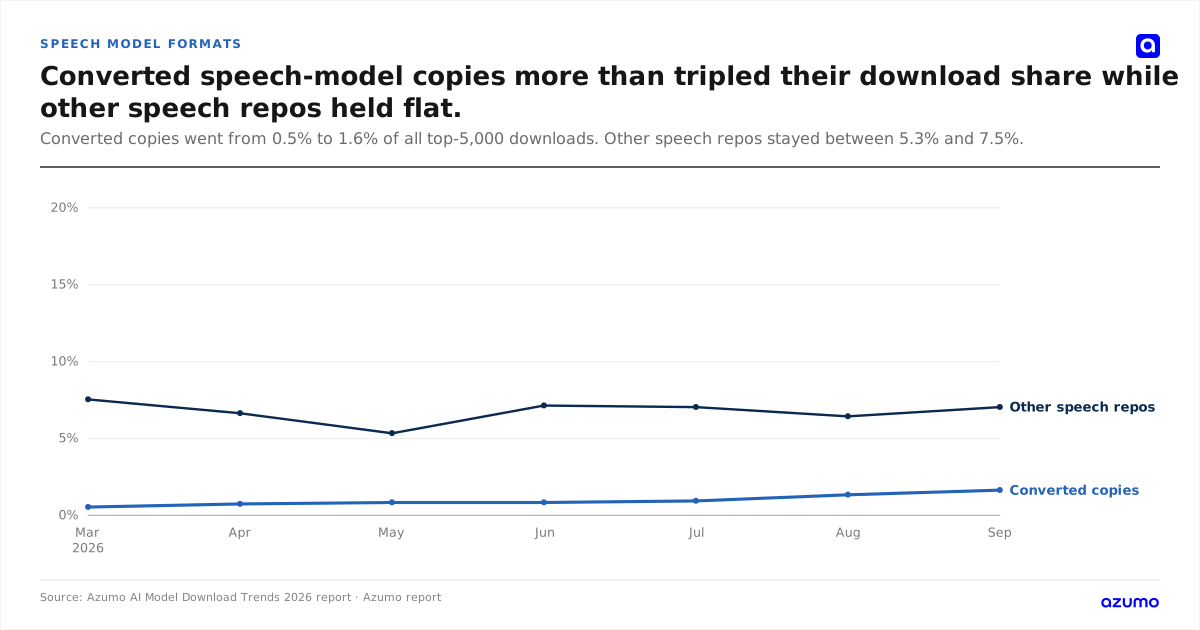
Here is the monthly share of all top-5,000 downloads, converted copies versus other speech repos, from our AI Model Download Trends 2026 report:
Month (2026)Converted copiesOther speech reposMarch0.5%7.5%April0.7%6.6%May0.8%5.3%June0.8%7.1%July0.9%7.0%August1.3%6.4%September1.6%7.0%
Copies more than tripled their share of all downloads, from 0.5% in March to 1.6% in September. Other speech repos moved between 5.3% and 7.5%. NVIDIA, the GPU maker, shows the same pattern: converted copies of its speech models more than doubled their share. Whisper still has about four times their downloads.
wav2vec2: Why Old Per-Language Models Rank So High
About 60 older per-language wav2vec2 models rose and fell together several times between February and the week to Oct. 1, 2026. Our ranking is full of this kind of model. The Japanese fine-tune, jonatasgrosman/wav2vec2-large-xlsr-53-japanese, ranks first at 16.2M, and its Russian, Portuguese, Polish, Dutch, Greek, Arabic, Hungarian and Chinese siblings hold eight more top-25 places. Our report does not identify which models pulse, so we cannot say how much of their rank the pulses explain.
Models that move in lockstep account for about 36% of speech downloads. That points to a distribution pattern rather than a wave of new adoption. Teams serving many languages face real choices here, and our guide to multilingual LLMs covers them.
Speech recognition's June jump came from 60 to 90 of these models rising on the same days. It began in the same days as a Hugging Face counting fault. Between June 10 and 19, 2026, reported 30-day downloads dipped by about a third and recovered, so comparisons across those dates need care. But the pulses recurred in late August and September without a fault.
Remove the pulses and speech's share of all downloads is flat at about 6 to 7%.
A reasonable objection: calling these pulses bulk downloading is speculation, and real teams may use per-language checkpoints in production. The cause is inferred, and we say so plainly. Hugging Face does not publish who downloads. Dozens of per-language models move together on the same days. The pattern repeats without a counting fault. And the flat 6 to 7% share appears once the pulses are removed.
Automated pulls are one form of use. Our data cannot show whether they came from pipelines, mirrors or individual teams.
pyannote: Speaker Diarization Downloads Down About 40% Since March
pyannote is an open-source toolkit for speaker diarization, which labels who spoke when. Its repos fell from about 2.2% to 1.0% of all top-5,000 downloads between mid-March and the week to Oct. 1, 2026. Their downloads dropped about 40% while the overall market grew about a quarter.
Its newer model grew. The community-1 diarization model rose from about 1.4M to 5.5M downloads a month in the report window, which ran to Oct. 1, 2026. That gain is a fraction of the older pipeline's losses. Our ranking shows 5.2M for the 30 days to Oct. 28, 2026. Each figure carries its own window, so the two do not conflict.
A maker's total can fall while its newest model gains. Model age turns out to matter across all of speech.
Most Speech Model Downloads Go to Models From 2023 or Earlier
In the week to Oct. 1, 2026, 58.8% of speech and audio downloads went to repos created in 2023 or earlier. Only 10.0% went to repos created since Feb. 12, 2026.
Other categories look different. Embeddings sit at 79.2% older repos. LLMs show 7.0% older and 46.8% new. Image and video models show 34.2% new. Speech lands between embeddings and the fast-turnover categories, with a heavy lean toward established models.
Two data notes matter here. About 540 older repos carry Hugging Face's placeholder creation date of March 2, 2022, so their real age is older than listed. And across all model types, 53 of the top-100 slots never changed hands in 231 days. Most of those are older embedding, BERT-class, speech and small Qwen and Llama models.
Old models hold the demand. The next question is how large that demand is.
How Much of Hugging Face's Downloads Go to Speech Models in 2026?
Speech and audio held about 8% of top-5,000 downloads between Feb. 12 and Oct. 1, 2026. The share moved from 7.3% on Feb. 12-13 to 8.1% in mid-March and 8.4% in the week to Oct. 1. These figures cover speech and audio as a whole.
Weekly figures swung more than the trend. We saw a low of 6.2% in late May and a high of 9.3% in the week of June 22. For comparison, in the week to Oct. 1, LLMs held 29.8% of downloads, embeddings 28.1%, text classification 8.8% and vision 6.9%. Speech and audio sits close to text classification and well behind LLMs.
Without converted copies, speech's share fell from about 7.6% to 6.7% between mid-March and the week to Oct. 1. The top 5,000 grew about a quarter over the same stretch. The wav2vec2 pulses lift the headline figure too: without them, speech's share is flat at about 6 to 7%.
A fair objection: a rise from 7.3% to 8.4% looks like growing speech demand, so new speech models should be gaining ground. The age data points the other way. Only 10.0% of speech and audio downloads went to repos created since Feb. 12, 2026.
The share is small and lifted by copies and pulses. That shapes how you should read the data when you pick a model.
What the Download Data Means When You Choose a Speech Model
About one-fifth of speech downloads in the week to Oct. 1, 2026, went to converted copies. Runtime format is part of the model choice. Teams run Whisper as faster-whisper, WhisperKit, GGUF or MLX builds. Pick the format that matches your serving hardware before you compare models.
If you run Whisper builds yourself, the hidden costs of self-hosting show up after deployment, once the model has to run reliably.
Most demand goes to established models. A 2026 release with a fraction of the downloads may still fit your task, so test it on your own audio.
Treat a spike as unconfirmed until you know what moved with it. If dozens of per-language models jump on the same days, the spike tells you about distribution. It says little about your deployment.
Download rank describes file requests. It says nothing about accuracy, latency or quality. If you are building a voice product, our review of the best AI voice agents shows how speech models fit into a full agent.
Every figure here depends on how downloads are counted and collected. The method comes next.
Methodology: How We Tracked and Read the Download Data
Our figures are shares of daily top-5,000 snapshots. They are not totals or user counts.
How We Collected the Data
We pulled Hugging Face's top 5,000 models by 30-day downloads every day through the Hugging Face API, from Feb. 12 to Oct. 1, 2026. We kept only the top 1,000 from Feb. 14 to March 12. June 22 is missing.
We placed each model in a type by its Hugging Face task tag. About 11% of downloads go to repos with no task tag. We identified converted copies and re-uploads by format words, converted-weights libraries and base-model tags. We report shares because raw totals shift with counting faults.
We recomputed every finding with independent code. Then we handed each one to reviewers whose job was to disprove it. A fair objection is that we are reporting on our own tracking data. Every collection gap, fault window and classification rule is listed here, so you can check our reading against the Hugging Face API.
What Download Counts Do and Do Not Show
Hugging Face counts a download each time certain model files are fetched, usually the config file. Its download stats documentation explains the rules. GGUF builds count per file. Counts are not deduplicated. Automated traffic from tools and test pipelines counts. Models that also ship through their own packages are undercounted.
Known faults distort trends. Between June 10 and 19, 2026, reported 30-day downloads across the top 5,000 fell from 2.67B to 1.80B, then recovered. From Aug. 5 to 16, they dipped from 3.01B to 2.75B and returned to 3.00B.
Picture an analyst comparing a May snapshot with a mid-June one. The June figure would show a collapse that never happened. We left days with counting faults out of our weekly share charts.
Other gaps add noise. Our collector froze on Feb. 14 and March 14, and about 12 more days were partly frozen on Hugging Face's side. During our tracking period, 95 repos changed names and took their download counts with them.
Download rank is not an accuracy ranking. It counts file requests.
Run Open-Weight Speech Models on Your Own Data
The models in these tables are a starting point. Valkyrie by Azumo fine-tunes open-weight models on your own data and runs them on dedicated hardware, behind the OpenAI- and Anthropic-compatible endpoints your tools already use. You pick the speech model that fits your audio. We handle the tuning and serving.
See how Valkyrie works, then talk to our team about your speech workload.
Frequently Asked Questions

About the Author:
Chief Technology Officer | Software Architect | Builder of AI, Products, and Teams
Juan Pablo Lorandi is the CTO at Azumo, with 20+ years of experience in software architecture, product development, and engineering leadership.