.svg)
.png)


Most AI projects do not fail because the model was wrong. They fail because the team building them treated AI as a demo problem instead of a software problem.
Choosing an AI development company is not about who knows the newest model, the trendiest framework, or the loudest benchmark. Those things matter, but they are not enough. The real question is whether the team can take a business problem you actually have, work with the messy data you actually own, and ship software that survives real users in production.
A good AI partner should help you answer practical questions before any code gets written:
- What should we build, and what should we not build?
- Is this even a good use of AI?
- Do we need RAG, fine-tuning, agents, traditional machine learning, or a simpler workflow?
- How will we measure whether the system works?
- How will it connect to the systems we already use?
- What happens after the first demo?
The best AI development service provider firms do more than ship prototypes. They help you build reliable, secure, maintainable systems that can survive real users, messy data, and changing business requirements.
Start With the Business Problem, Not the Model
A lot of AI projects start in the wrong place. A team gets excited about a model, framework, or library, then goes looking for a problem to apply it to. That path produces demos, not durable applications.
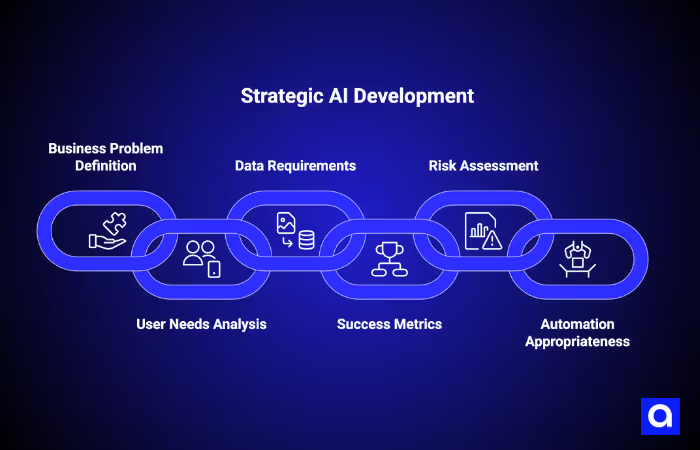
A serious AI development company will push back and force you to define the business problem first. Expect them to ask: What decision or workflow are we trying to improve? Who uses the system? What data does it need? What does success look like? What happens if the system is wrong? How much automation is actually appropriate here?
This matters because not every problem needs the same kind of AI. Some need a RAG development services approach. Some need an AI agent. Some need classic machine learning. Some need better data engineering before AI will help at all.
At Azumo, we help companies think through these choices before jumping into development. The point is to move from idea to production-ready software, not to ship an impressive demo that quietly dies after the kickoff.
Look for Production Experience, Not Just AI Fluency
Plenty of vendors can build a demo. Far fewer can build an AI system that works reliably in production.
A production AI system has to handle real data quality issues, user permissions, security requirements, latency, cost controls, monitoring, error handling, model updates, system integration, and human review workflows. This is where software engineering discipline matters as much as AI expertise.
When choosing an AI development company, ask what they have actually shipped. Ask whether they have integrated AI into existing products, internal tools, CRM systems, support workflows, knowledge bases, document pipelines, or operational software. Ask them to walk you through how they moved a specific project from discovery to production, and what broke along the way. A team that cannot answer that probably has not done it.
For a deeper look at the gap between prototype and production, see our blog post on moving AI prototypes into production.
Understand Their Approach to Data
AI projects depend heavily on data. That sounds obvious, and yet many failed AI projects are really failed data projects.
Before choosing an AI development partner, ask how they evaluate data readiness. A serious team should look at where your data lives, who owns it, how clean it is, how often it changes, whether it contains sensitive information, whether users have different permission levels, and whether the data needs to be transformed, labeled, enriched, or indexed. They should also be honest about whether the system needs real-time access or whether a daily refresh is enough.
This is especially important for RAG systems, AI agents, analytics copilots, and internal knowledge tools. These applications often depend less on the model itself and more on whether the system retrieves the right context at the right time.
Ask How They Choose Between RAG, Fine-Tuning, Agents, and Traditional ML
If the potential AI development vendor jumps straight to "we'll use agents" or "we'll fine-tune a model" before they understand the use case, treat it as a warning sign. The right choice between these is a design decision, not a default.
Evaluate Security and Risk Management Early
AI systems can introduce real risk. They may touch customer data, employee data, contracts, financial records, internal documentation, support conversations, or proprietary processes. Security cannot be an afterthought.
So, before choosing an AI development partner, ask how they handle data privacy, access controls, role-based permissions, audit logs, prompt injection risks, sensitive data exposure, model output review, human-in-the-loop workflows, compliance requirements, and infrastructure choices. You do not need every project to become a compliance exercise, but your AI partner should be able to explain the risks clearly and design around them. Vendors who deflect security questions early will deflect them later, when the stakes are higher.
Ask How They Measure Quality
AI quality is not the same as traditional software quality. With normal software, a feature usually works or it does not. With AI, the system may be useful most of the time, wrong some of the time, and confidently wrong in ways that are hard to detect.
That is why evaluation matters. Ask the vendor how they will define a good answer, what test data they will use, how they will measure accuracy and hallucination risk, how they will handle edge cases, how users will report bad outputs, and how the system will improve over time. They should also be willing to tell you what should be reviewed by a human and what should never be automated. A team that cannot describe its evaluation approach probably does not have one.
Look for Integration Experience
Most business AI systems do not live in isolation. They have to connect to CRMs, ERPs, data warehouses, internal databases, authentication systems, document repositories, support platforms, communication tools, analytics platforms, custom web applications, and third-party APIs. The integration work is often where AI projects either land or fall apart.
This is one of the biggest reasons to choose an AI development company instead of a pure AI consultant. Strategy without execution leaves you with a memo. Integration is where the value actually shows up.
Make Sure They Can Explain the Delivery Process
A good AI development company should be able to tell you what happens after the first call: how discovery works, what they need from your team, how they evaluate feasibility, how they estimate scope and cost, what the first few weeks look like, how they manage milestones, how they communicate progress, and how they handle changes. If the answer is vague, the project will be too.
Understand Pricing and Cost Drivers
AI development cost depends on scope, complexity, integrations, data readiness, infrastructure, and ongoing support.
A simple chatbot can be relatively inexpensive. A production-grade AI system connected to proprietary data, internal tools, role-based permissions, and business workflows can cost much more. When evaluating vendors, ask for transparency around discovery cost, prototype cost, production build cost, infrastructure cost, model and API usage, monitoring and maintenance, post-launch improvement, and the internal time required from your own team. For long-running workloads, also factor in self-hosting LLM costs versus paying per call.
Watch for These Red Flags When Choosing an AI Development Partner
A few patterns reliably predict trouble:
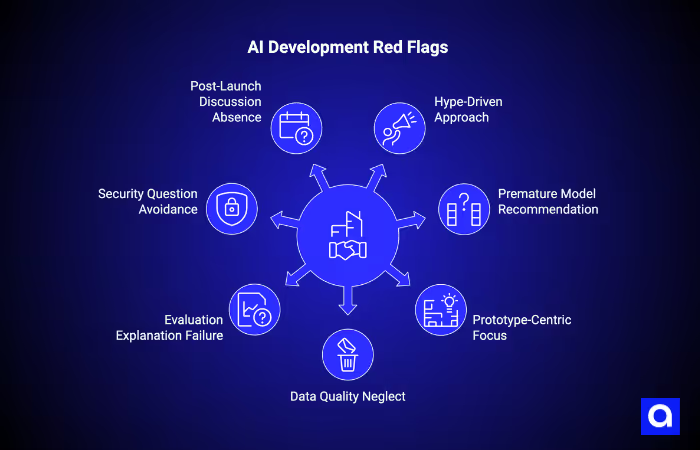
- They lead with hype.
- They recommend a model before understanding the problem.
- They only talk about prototypes.
- They ignore data quality.
- They cannot explain evaluation.
- They avoid security questions.
- They do not discuss what happens after launch.
Any one of these can be a coaching moment. A pattern of them is a no.
What a Strong AI Development Partner Should Bring
A strong AI development company should bring more than technical labor. They should help you make better decisions.
Look for a team that can provide product thinking, AI architecture, data engineering, model selection, software development, cloud infrastructure, security awareness, integration experience, QA and evaluation, project management, and ongoing support. Most of those need to live in the same team for the project to actually ship. Splitting them across vendors is how things slip through the cracks.
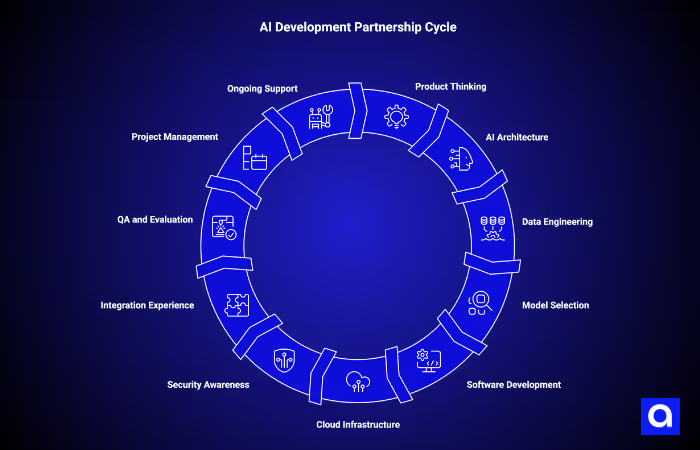
How Azumo Helps Companies Build AI Applications
Azumo helps companies design, build, and deploy AI applications that connect to real business systems. We work across AI development services, generative AI development services, RAG, AI agent development, LLM fine-tuning, MLOps, data engineering, and enterprise application development.
We have been building in this space for a long time. Our work for Meta used GPT-2.0 and FastText to power semantic search across a 3.5 million record supplier database, years before generative AI became a category most vendors had heard of. We built a multilingual NLP voice skill for Discovery Channel on Alexa and Google Assistant in the same era, and a conversational chatbot for Facebook's supplier discovery experience.
More recent AI work includes a YOLO and OCR computer vision pipeline for CENTEGIX's school safety check-in product, equity prediction and borrow-rate forecasting models for Stovell AI, GPT-powered document extraction for Angle Health's RFP-to-quote pipeline in health insurance, and multi-phase generative AI integration for Omnicom's Sparks & Honey on its Q cultural intelligence platform.
We also operate our own production AI products, including Hello, a real-time AI receptionist running on a custom voice pipeline. You can call the number on our homepage and listen to it work.
That mix matters. It means we have shipped AI into regulated industries, at enterprise scale, in consumer voice channels, and on our own infrastructure. We are not recommending architectures we have never run.
A typical engagement covers defining the use case, reviewing data readiness, selecting the right technical approach, building prototypes, integrating with existing systems, deploying production applications, and monitoring and improving them after launch.
Final Takeaway
Choosing an AI development company is not about finding the flashiest demo. It is about finding a team that can understand your business problem, work with your data, select the right technical approach, manage risk, integrate with your systems, and deliver software that works in production.
When you have two or three candidates in front of you, score them side by side using our AI development company evaluation checklist.
If a vendor cannot do all of that, they are not building you an AI system. They are building you a presentation.
Need help turning an AI idea into production software?
Azumo helps companies build practical AI applications that connect to real systems, use business data responsibly, and move beyond the prototype stage.
Frequently Asked Questions

About the Author:
Head of Customer Success | Account Manager & Account Executive
Matias Margossian, Account Executive and Customer Success Manager with a finance background and tech expertise, blending business strategy, analytics, and client success.

.avif)