.svg)
.png)


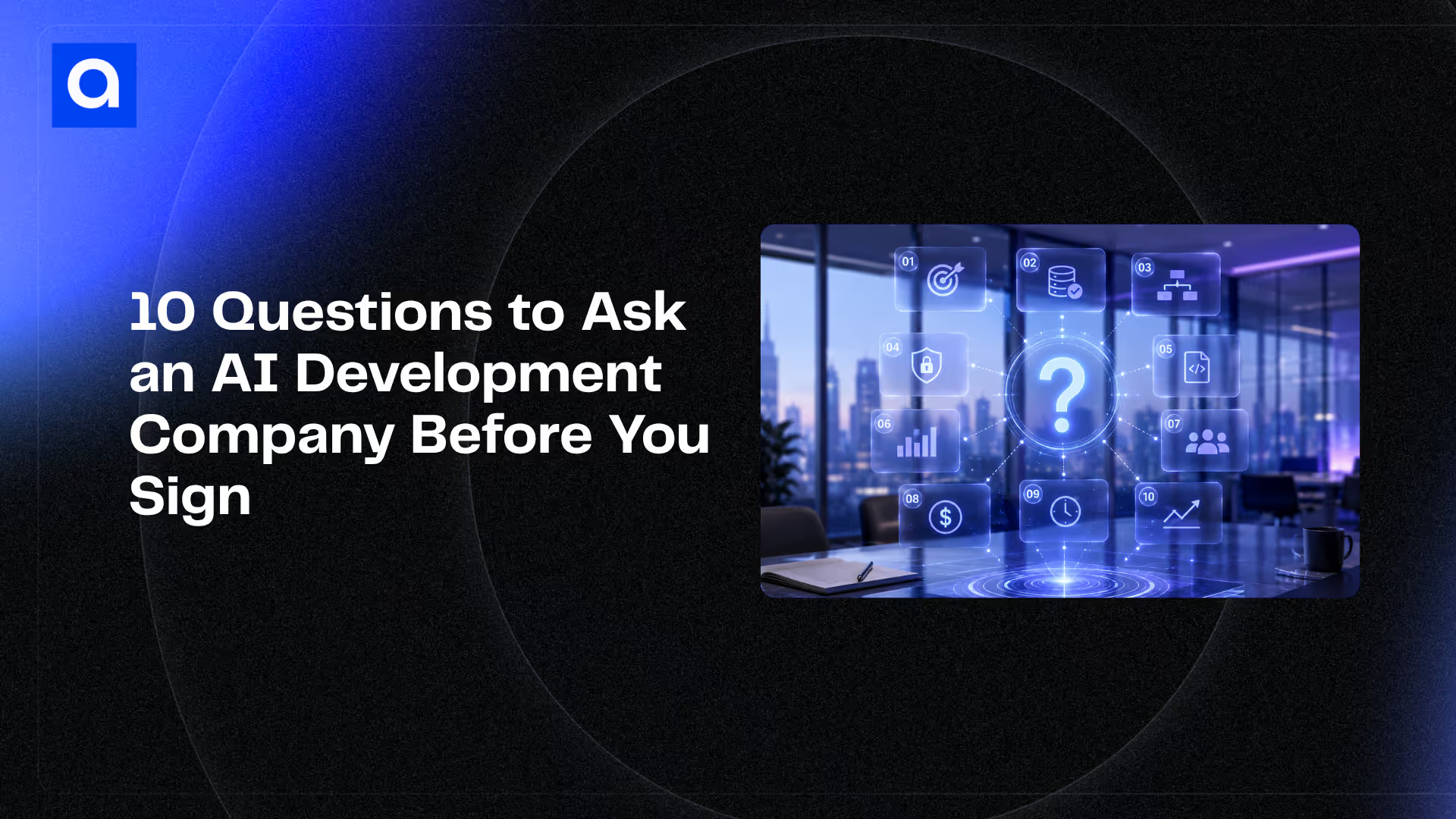
Hiring an AI development company is not the same job as hiring a traditional software vendor. You are not just asking whether the team can write code. You are asking whether they can understand a business problem, work with imperfect data, choose the right AI architecture, manage risk, integrate with existing systems, and support the application after launch.
That is a lot to evaluate in a sales process.
A polished demo does not tell you enough. A strong proposal does not always reveal the assumptions behind the scope. A vendor that sounds fluent in AI may still struggle when the work moves from prototype to production.
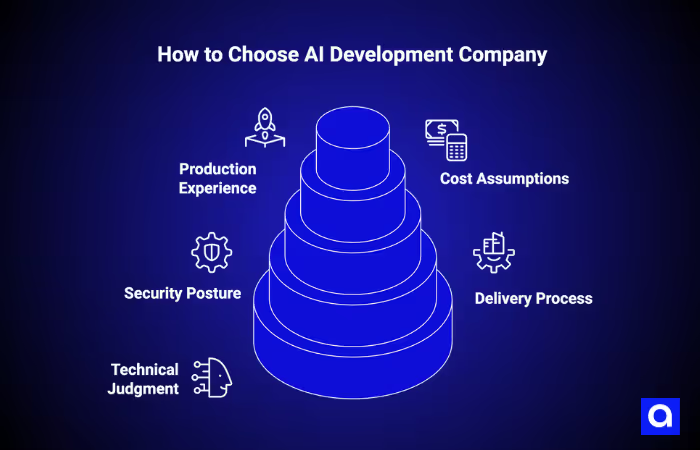
Before you sign, use the questions below to pressure-test the vendor's technical judgment, delivery process, security posture, cost assumptions, and production experience.
This article is not a scoring tool. If you want a more structured side-by-side comparison framework, use our AI development company evaluation checklist. The questions here are designed for the live vendor call, the proposal review, or the final diligence conversation before you commit.
1. What business problem do you think we are solving?
This should be the first question.
A good AI development company should be able to restate your business problem in plain language. If they cannot do that, they may be selling a generic AI capability instead of understanding what you actually need.
Listen for whether they can explain the user, the workflow, the business pain, the desired outcome, the risk of getting it wrong, and why AI is the appropriate response.
A weak answer sounds like: "We will build an AI-powered solution using the latest LLM technology."
A stronger answer sounds like: "You are trying to reduce the time your support managers spend answering policy and product questions by giving them a secure internal assistant that retrieves answers from approved documentation, cites sources, and escalates low-confidence cases."
The second answer shows the vendor understands the job to be done.
Follow-up: "What would make this project a poor fit for AI?" A credible partner should be willing to say when AI is not the best answer. Sometimes the right solution is better workflow design, better data access, traditional automation, or a simpler software tool.
2. How would you scope this project?
Scope is where many AI projects go wrong.
A vendor may quote a timeline or budget before understanding the use case, the data, the integrations, the security requirements, and the production expectations. That usually leads to problems later.
Ask the vendor to walk through how they would scope the work. They should cover use case complexity, data readiness, user workflow, required outputs, integrations, security requirements, evaluation criteria, delivery phases, team roles, and maintenance needs.
A simple AI assistant over clean documents is not the same as a production AI system connected to multiple business systems. A RAG application can be scoped quickly when the data is clean and the workflow is narrow. A digital twin for an asset-heavy business may take months of data engineering, domain modeling, simulation logic, and operational integration.
Scope should be tied to real project drivers, not a generic AI timeline. For more on this, see our blog post on how to scope an AI development project.
Follow-up: "What assumptions are you making in this estimate?" This is one of the most important questions you can ask. A proposal is only as good as the assumptions underneath it.
3. Which AI approach would you recommend, and why?
Do not let the vendor jump straight to tools. Ask them to explain the architecture.
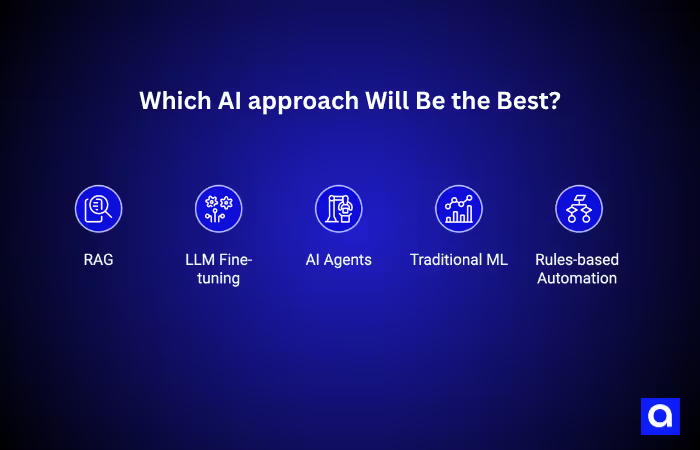
Depending on the problem, the right approach may be retrieval-augmented generation, fine-tuning, AI agents, traditional machine learning, rules-based automation, a model API, an open-source model, a custom model, or a hybrid.
The right answer depends on the use case.
RAG is often a strong fit when the system needs to answer questions using company-specific documents or changing business data. LLM fine-tuning is different: it adapts a foundation model to a narrower domain, structure, or style. AI agents are different again, useful when the system has to plan, use tools, take actions, or complete multi-step workflows. Traditional machine learning still wins for prediction, scoring, and classification tasks. Rules-based automation is sometimes the right answer when the workflow is deterministic and AI adds nothing.
A good vendor should explain why one approach fits the use case better than the alternatives.
Follow-up: "What would change your architecture recommendation?" That question reveals whether the vendor is thinking clearly or just applying a preferred pattern to every problem.
4. What data do you need, and what could go wrong with it?
AI projects depend on data.
The vendor should ask where your data lives, how clean it is, who owns it, how often it changes, and whether users have different access levels. They should also ask about sensitive data.
For many projects, the biggest scope risk is not the model. It is the data.
Expect the vendor to ask about data sources, data quality, missing data, duplicates, permissions, sensitive information, real-time needs, data cleaning, data labeling, document structure, retrieval quality, and evaluation data. If the vendor does not ask about data early, that is a warning sign.
Follow-up: "What data issue would most likely slow this project down?" A thoughtful answer might identify messy PDFs, weak metadata, unclear ownership, missing labels, inconsistent business rules, legacy databases, or permission complexity.
5. How will you evaluate whether the AI system works?
AI quality is not binary. The system may be mostly correct, sometimes wrong, occasionally outdated, or accurate but not useful. Evaluation has to be part of the project.
Ask the vendor how they will measure quality. They should explain what "good" means, what test cases they will use, how they will evaluate outputs, how they will handle edge cases, how users will flag bad responses, whether the system needs citations, whether humans need to review outputs, and how quality will improve after launch.
For AI agents, evaluation matters even more, because the system may take actions across multiple steps and the failure modes compound.
A vendor that cannot describe an evaluation process may be able to build a demo, but they may struggle to build something reliable.
Follow-up: "What should the AI system refuse to do?" This is a useful way to test whether the vendor has thought about boundaries, safety, and escalation.
6. How will you handle security, privacy, and access controls?
AI systems often touch sensitive data: customer records, employee data, financial information, contracts, support conversations, internal documents, source code, or proprietary business processes.
Security has to be part of the architecture, not added at the end.
Ask the vendor how they will handle data privacy, role-based permissions, audit logs, sensitive data exposure, prompt injection risk, human review, model provider choices, data retention, compliance requirements, and user authentication.
NIST's AI Risk Management Framework identifies trustworthy-AI characteristics, including validity and reliability, safety, security and resilience, accountability and transparency, explainability and interpretability, privacy enhancement, and fairness with harmful bias managed (NIST AI Risk Management Framework, 2023). Those principles are useful when evaluating whether a vendor is thinking beyond functionality.
Follow-up: "What data, if any, will be sent to third-party model providers?" You need a clear answer before signing.
7. What systems will this need to integrate with?
Most valuable AI systems do not live alone. They need to connect to CRMs, ERPs, data warehouses, internal databases, document repositories, authentication systems, ticketing systems, support platforms, communication tools, analytics platforms, and custom applications.
Integration is often where a simple AI concept becomes a real software project.
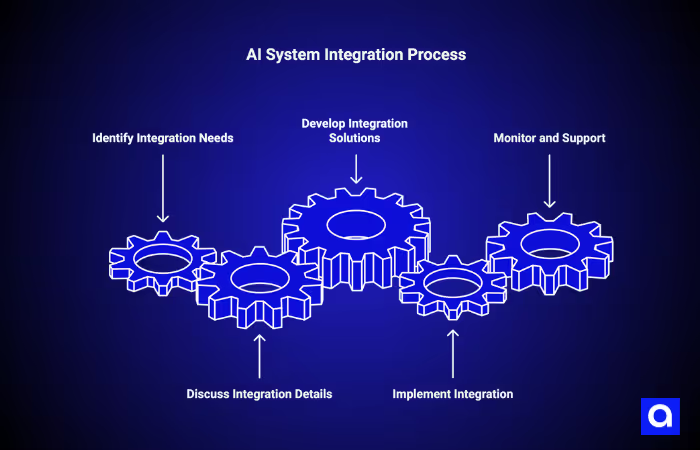
A vendor should be able to talk through APIs, data flow, authentication, permissions, error handling, monitoring, and deployment. This is one reason to work with an AI development company rather than a pure AI consultant when you need real implementation. The work is not only model selection. It is product engineering, data engineering, backend development, infrastructure, QA, and ongoing support. See our overview of AI development services for more on what this scope includes.
Follow-up: "Which integration do you think creates the most risk?" The answer will tell you whether the vendor has actually understood your operating environment.
8. What exactly is included in the proposal, and what is excluded?
AI proposals can look similar while meaning very different things.
One proposal may include discovery, data preparation, UX, backend development, frontend development, model integration, testing, deployment, monitoring, and support. Another may include only a prototype.
Before signing, ask the vendor to separate discovery, prototype, production build, data preparation, integrations, infrastructure, model and API usage, security work, testing and evaluation, documentation, project management, and post-launch support into clearly visible line items.
AI development cost varies widely depending on scope. As we cover in our AI development cost guide, serious business applications often fall in the $50,000 to $400,000 range, with hidden expenses in data preparation, infrastructure scaling, and integration adding meaningfully to initial budgets. Compare vendors on what each price actually includes, not on the headline number.
Follow-up: "What could cause the budget or timeline to change?" A good vendor should be direct about scope risks.
9. Who will be on the team, and who owns technical decisions?
AI development usually requires more than one skill set: product strategy, solution architecture, AI engineering, data engineering, backend development, frontend development, MLOps, cloud infrastructure, QA, UX, project management, security review, and client-side domain expertise.
Ask who will actually work on the project, by name and role. Then ask who owns technical decisions. You want to know who the technical lead is, who manages delivery, who handles architecture, who works with your data, who builds the application, who manages QA, who handles deployment, and who communicates status and risks.
Production AI systems sit on a layer of operational infrastructure that is rarely glamorous and always essential. Our MLOps services page describes that infrastructure: training, versioning, deployment, monitoring, and retraining. The point is that this work needs ownership, not just individual contributors.
Follow-up: "How will your team work with our internal team?" The answer helps clarify whether what you really need is consulting, staff augmentation, or a managed development team. Our comparison of AI consulting vs AI development company vs staff augmentation covers when each engagement model fits.
10. What happens after launch?
AI systems need support after launch.
Data changes. Users find edge cases. Model APIs change. Costs shift. New workflows emerge. The system may need better prompts, better retrieval, better monitoring, stronger guardrails, or new integrations.
Ask the vendor what happens after the first release. They should explain monitoring, bug fixes, model and prompt updates, retrieval improvements, cost optimization, user feedback handling, quality evaluation, security updates, infrastructure maintenance, feature enhancements, and ownership handoff.
If the vendor treats launch as the finish line, be careful.
Production AI is not a one-time implementation. It is a system that needs to be evaluated, maintained, and improved. For more on the gap between launch and durable production operation, see our blog post on moving AI prototypes into production.
Follow-up: "What support model do you recommend for the first 90 days after launch?" The answer should match the risk and importance of the system.
Bonus question: What Would You Tell us not to Build?
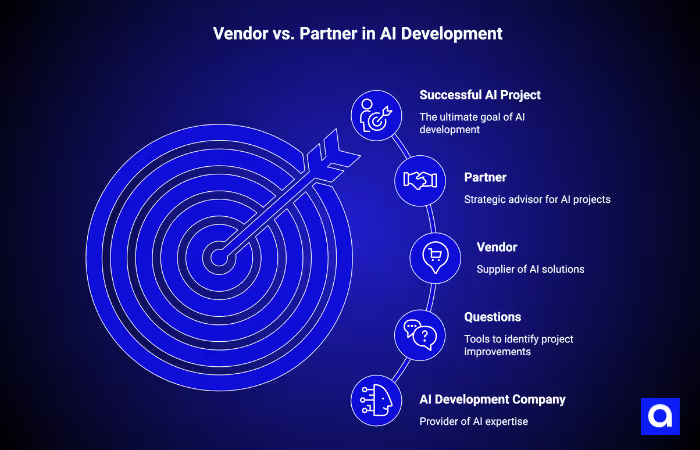
This is the question that separates a vendor from a partner.
A vendor tries to sell what you ask for. A partner helps you decide what is worth building.
Ask: "Based on what you know so far, what part of this project would you simplify, delay, or avoid?"
A strong AI development company should be able to identify overbuilt features, risky assumptions, unclear requirements, unnecessary model complexity, or areas where an existing tool may be enough.
You want a partner that can help you avoid wasted work, not just one that can build whatever you specify.
How to Use These Questions in an AI Vendor Call
You do not need to ask every question mechanically. Use them to guide the conversation.
Before the call, decide which areas matter most for your project:
- If you have messy data, focus on data readiness.
- If the system handles sensitive information, focus on security and permissions.
- If the system needs to take actions, focus on agent boundaries and human review.
- If you are comparing proposals, focus on scope, exclusions, and assumptions.
- If you already have an internal team, focus on team model and ownership.
- If the system needs to scale, focus on production, monitoring, and support.
The goal is not to trap the vendor. The goal is to make the real project visible before you sign.
Signs You are Talking to the Tight AI Development Company
You are probably talking to a serious partner if they:
- Ask clear questions about the business problem before talking about technology.
- Push to understand your data, including what is messy or incomplete.
- Explain architecture tradeoffs instead of pitching a default approach.
- Identify scope risks early in the conversation.
- Talk about evaluation and quality, not just functionality.
- Raise security and permissions without being prompted.
- Clarify what is included and what is excluded in the proposal.
- Explain who will own delivery, by name and role.
- Discuss post-launch support before you ask.
- Tell you when not to use AI.
That last point matters. AI is powerful, but it is not the answer to every business problem. The right partner will help you build where AI creates leverage and avoid building where it does not.
Final Takeaway
Before you sign with an AI development company, ask questions that reveal how they think.
Do they understand the business problem? Can they scope the project realistically? Can they explain the architecture? Do they understand your data? Can they measure quality? Will they manage security? Can they integrate with real systems? Are they clear about cost? Do they have the right team? Will they support the system after launch?
A vendor will agree to build what you ask for. A partner will help you decide what is worth building. The questions above are how you tell them apart.
For the structured side of the same evaluation, see our guide on how to choose an AI development company and our AI development company evaluation checklist.
Need help evaluating an AI development partner?
Azumo helps companies scope, build, and deploy practical AI applications that connect to real business systems. We have shipped production AI for clients including Meta, Omnicom, CENTEGIX, Stovell AI, Discovery Channel, and Angle Health, and we operate our own production AI products on a custom voice pipeline.
Frequently Asked Questions

About the Author:
Director of Partnerships at Azumo | AI Solutions | Digital Transformation | MBA
Shivam Bawa, Director of Partnerships at Azumo, leads go-to-market strategy and business development, driving digital transformation through AI solutions.

.avif)