.svg)
.png)


Missed calls can cost businesses customers and revenue, especially when people cannot quickly reach a company or get answers to simple questions. As customer inquiries grow, many businesses are turning to AI receptionist software to improve response times and handle communication more efficiently.
These tools can answer calls, qualify leads, book appointments, and route inquiries around the clock without requiring a human receptionist to be available at all times.
In this article, we cover the best AI receptionist software for 2026, the key features to look for, and how Azumo helps companies build custom AI receptionist solutions when off-the-shelf tools are not enough.
What Is an AI Receptionist and How Does It Work?
An AI receptionist is software that uses conversational AI and natural language processing (NLP) to answer phone calls or chats, understand what a customer needs, and respond automatically. It can book appointments, route calls, answer common questions, or transfer conversations to a human when needed.
The process is simple. A call or message comes in, the AI responds within seconds, understands the request, and takes the appropriate action. It can also automatically save summaries and conversation details for the business.
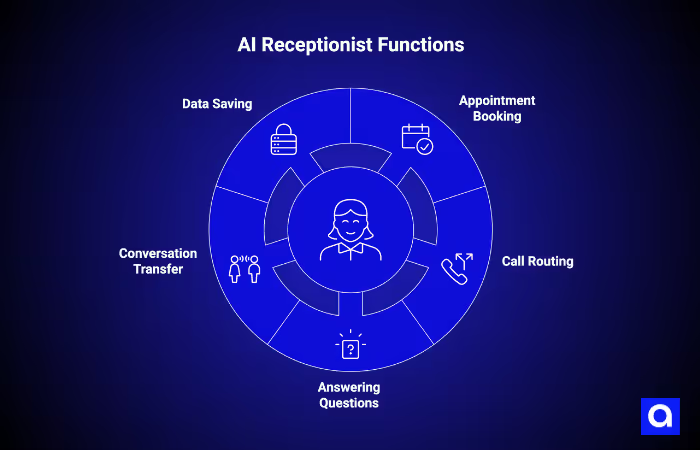
Unlike traditional IVR systems with "press 1 for billing" menus, modern AI receptionists can hold natural, back-and-forth conversations that feel much more human.
Most AI receptionist platforms fall into three categories:
- Voice AI receptionists for phone calls
- Chat AI receptionists for websites and messaging apps
- Hybrid platforms that combine AI with human agents
Modern systems are now fast enough that conversations often feel close to real-time human interaction.
Best AI Receptionist Software for Businesses in 2026
The best AI receptionist software platforms generally fall into three categories: voice-first, chat-first, and hybrid solutions. The right option depends on how your customers usually contact your business and what level of automation you need.
AI Voice Receptionist Software
1. Hello by Azumo
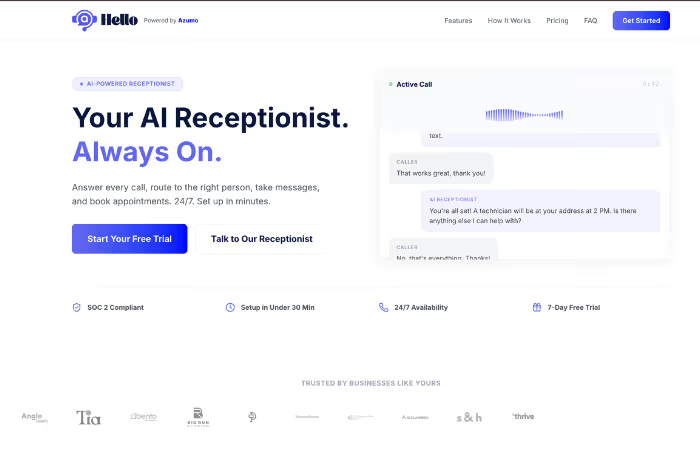
Hello by Azumo is an AI voice receptionist built for small and mid-sized businesses that want professional call handling without complicated setup. It can answer calls 24/7, route inquiries, book appointments, send SMS updates, and automatically generate call summaries.
Key features:
- Guided setup in under 30 minutes with no IT team required
- Three modes per day (Live, Message Only, Voicemail) that auto-switch by schedule
- Real-time call routing with Accept/Decline buttons delivered as Slack DMs
- Google Calendar integration that checks availability and books during the call
- CRM and Zapier webhook integrations
- Billing to the exact second with no rounding or hidden fees
- SOC 2 compliance with AES-256-GCM encryption
- Starter plan at $79/month (100 minutes), Pro plan at $149/month (200 minutes), with a 7-day free trial
It is a strong fit for professional services firms, SMBs, and startups looking for a simple but reliable AI receptionist solution.
2. Smith.ai
Smith.ai combines AI with human receptionists for call handling and lead intake. Human agents step in when conversations become more complex, and the company uses North America-based support staff. It is commonly used by law firms, financial advisors, and medical practices where client intake and customer experience are especially important.
3. Air.ai
Air.ai is a fully automated AI phone agent designed for sales and inbound call handling. It uses large language models to manage full voice conversations and supports both inbound and outbound workflows at scale. It is best suited for high-volume sales teams and customer outreach operations.
4. Bland AI
Bland AI is a developer-focused platform for building programmable AI voice agents. It includes workflow builders, branching conversation logic, and API integrations for CRM systems and automation tools. It is a strong fit for technical teams that need highly customized inbound and outbound call workflows.
5. Retell AI
Retell AI is a conversational voice AI platform built for large-scale deployments. It offers drag-and-drop workflow creation along with full API access for deeper customization. The platform is commonly used in healthcare, finance, and professional services environments that need reliable production-level voice automation.
AI Chat Receptionist Software
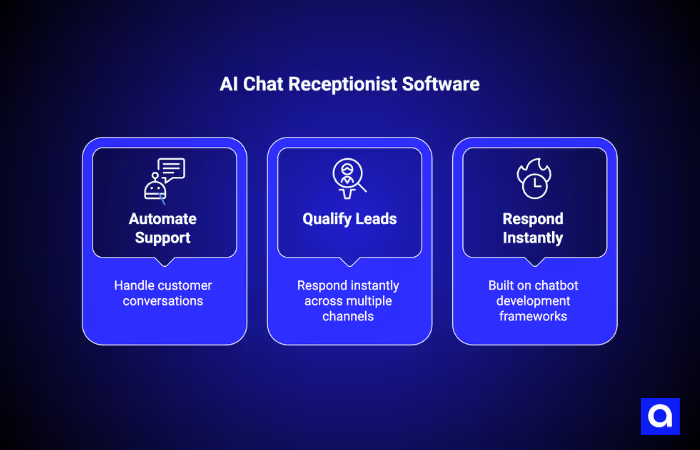
AI chat receptionist tools help businesses handle customer conversations on websites and messaging platforms. Built on chatbot development frameworks, they automate support, qualify leads, and respond instantly across multiple channels.
6. Intercom Fin
Intercom Fin is a GPT-powered AI chatbot designed for customer support and lead qualification at scale. It can understand customer questions and provide direct answers using a company's help center, documentation, or support content.
It is widely used by SaaS and enterprise companies to reduce support ticket volume and speed up response times. Fin works across multiple channels, including web, mobile, email, and social messaging, making it useful for businesses with high inbound demand. Over time, it improves accuracy by learning from existing knowledge bases and resolved conversations.
7. Tidio
Tidio is an easy-to-use AI chat receptionist built for small businesses and e-commerce stores. It helps automate customer conversations, answer common questions, and capture leads in real time through website chat widgets.
Its main advantage is simplicity, as it can be set up quickly without technical expertise. Tidio's AI assistant, Lyro, helps handle more complex queries and can reduce the workload on support teams. It also integrates with popular platforms like Shopify, Zendesk, and Freshdesk, making it a practical choice for online businesses that want fast automation.
8. Zendesk AI
Zendesk AI is an AI-powered customer support system built into the broader Zendesk platform. It helps businesses automate ticket routing, categorize customer requests, and provide instant responses to common issues.
It is especially popular among larger companies that already use Zendesk for customer service operations. The AI improves efficiency by reducing manual work for support agents and helping teams resolve issues faster. It also includes features like sentiment detection and smart triaging, which help prioritize urgent customer requests.
9. Drift
Drift is a conversational AI platform focused on sales engagement and lead generation. It helps businesses interact with website visitors in real time, qualify leads based on intent, and route high-value prospects directly to sales teams.
It is widely used in B2B marketing and account-based sales strategies where timing and personalization are critical. Drift also helps schedule meetings automatically, reducing friction in the sales process. Its AI-driven playbooks allow teams to guide conversations based on visitor behavior and company-defined rules.
Hybrid Virtual Receptionist Platforms
Hybrid receptionist tools combine AI and human agents to handle customer calls and messages. This approach helps businesses scale while still keeping a human touch when needed.
10. Ruby Receptionists
Ruby Receptionists is a live answering service that blends human receptionists with optional AI support tools. It helps businesses manage inbound calls, schedule appointments, and capture lead information professionally.
It is commonly used by service-based businesses such as law firms, medical practices, and home services companies. The human-first approach ensures callers always speak to a real person, which improves customer experience in industries where trust is important. Ruby also offers 24/7 availability, making it useful for businesses that cannot miss calls outside working hours.
11. AnswerConnect
AnswerConnect is a 24/7 live answering service enhanced with AI-powered workflows. It connects customers to trained human agents who can handle calls, take messages, and manage basic customer requests at any time of day.
It is used across industries such as legal, healthcare, and e-commerce, where continuous availability is critical. The platform is designed to ensure no call goes unanswered, helping businesses capture more leads and improve customer satisfaction. AI tools assist agents by organizing information and streamlining call handling.
Key Features to Look for in AI Receptionist Software
Before choosing an AI receptionist, it's important to understand what separates a basic tool from a high-performing one. The right features will determine how well it handles customer calls, integrates with your systems, and supports your daily operations. More advanced platforms also use AI agents that do several steps on their own, not just answer questions.
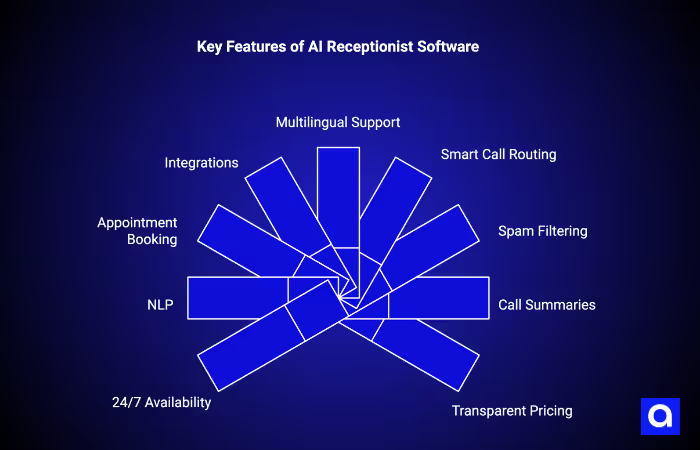
- 24/7 availability: Handles calls and messages after hours, on weekends, and during peak times without missing inquiries.
- Natural language processing (NLP): Understands real conversations instead of forcing callers through rigid IVR menus.
- Appointment booking with calendar sync: Books meetings in real time using tools like Google Calendar or other scheduling systems.
- CRM and tool integrations: Connects with platforms like Salesforce, HubSpot, Clio, and other business tools.
- Multilingual support: Communicates in multiple languages for businesses serving diverse customers.
- Smart call routing and warm transfers: Escalates complex calls smoothly to human agents when needed.
- Spam filtering and emergency detection: Filters unwanted calls and prioritizes urgent customer requests.
- Call summaries and analytics: Provides recordings, summaries, and insights to track performance and improve service.
- Transparent pricing model: Avoids unexpected costs, especially with per-minute or per-call billing structures.
Benefits of AI Receptionist Software for Businesses
AI receptionist software helps businesses avoid missed opportunities by ensuring every call is answered. With the help of generative AI, these tools can understand context, generate natural responses, and handle a wide range of inquiries without human intervention. Many callers never try again if they cannot reach a business the first time, which means a missed call often equals a lost lead.
Key benefits include:
- Fewer missed calls: Every call is answered, reducing lost leads from customers who don't call back.
- Faster response times: Calls are picked up in seconds, improving customer experience compared to long hold times.
- Lower costs: AI receptionists are significantly cheaper than hiring a full-time receptionist when you include salary and overhead.
- Easy scaling: The system can handle multiple calls at the same time without busy signals or delays.
- Consistent quality: Every caller gets the same level of service with no fatigue or human error.
- Automatic data handling: Calls are logged, summarized, and synced to CRM systems without manual work.
- Higher ROI: Even a small increase in captured leads can often offset the cost of the software.
AI Receptionist Software vs Human Receptionists: Which One is Better?
Both AI and human receptionists have clear strengths, and the better choice depends on the type of business and the kind of customer interactions you handle.
Humans are still important in areas that require emotional intelligence, judgment, and real-world experience. They can handle sensitive conversations, adapt to unexpected situations, and build personal relationships with clients in a way AI cannot fully replicate today.
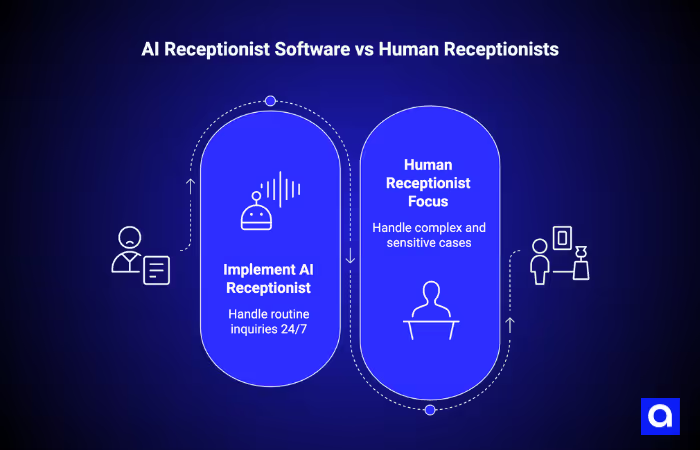
However, AI receptionists offer strong advantages in cost, availability, and scale. They are much cheaper than full-time staff, operate 24/7, and can handle multiple calls at the same time without delays or missed connections.
In most cases, the best approach is not choosing one over the other but combining both. Research suggests that hybrid models, where AI handles routine calls and humans step in for complex cases, deliver the best balance of efficiency and customer satisfaction. A practical approach is to let AI manage most standard inquiries while human receptionists focus on high-value or sensitive interactions.
How to Choose the Right AI Receptionist Solution
Start by identifying how your customers usually contact you. If most inquiries come through phone calls, a voice AI receptionist is the best fit. If customers mainly reach out through your website or messaging apps, a chat-based solution is more suitable. If you use both channels, an omnichannel or hybrid platform is usually the better option.
Next, look at how complex your interactions are. If most requests are simple, like FAQs or appointment booking, a fully AI-based tool can usually handle them well. If your business deals with sensitive or high-stakes conversations such as legal, medical, or financial intake, a hybrid model with human support is often safer.
Pricing is another key factor. Some tools offer flat-rate plans that work well for high call volumes, while others charge per call or per minute, which can be more cost-effective at lower usage. It is important to estimate your actual volume before choosing a plan.
You should also check integrations early on. The right tool should connect easily with your CRM, calendar, and communication systems so it fits into your existing workflow without extra effort.
Finally, consider compliance and scalability. Healthcare providers may need HIPAA-compliant tools, while companies operating in Europe must comply with GDPR and the EU AI Act. If your workflows are highly customized or industry-specific, off-the-shelf tools may not be enough, and a custom-built solution can offer better long-term value.
Trust Azumo to Build a Custom AI Receptionist System for Your Team
Many SaaS AI receptionist tools come with monthly fees, usage limits, and limited flexibility. At Azumo, we build custom AI systems designed around your workflows, data, and business needs.
We develop solutions that handle call answering, lead qualification, smart routing, appointment scheduling, and CRM integration using voice AI and computer vision in AI, where your workflows require it. Our team has delivered AI systems for companies like Meta, Discovery Channel, and Facebook, and we work in U.S.-aligned time zones for smooth collaboration.
We move fast, starting with a discovery phase, followed by a quick proof of concept and a production-ready build in weeks.
Whether you need a plug-and-play solution or a fully custom system, we can help you build the right AI front desk for your business. Contact us today to discuss your AI receptionist needs and get started with Azumo.
Frequently Asked Questions

About the Author:
Head of Marketing | B2B Growth & Revenue Automation Strategist | Lead Generation Expert
Margaret Genatios, Head of Marketing at Azumo, is a B2B growth strategist with 16+ years of experience in sales, marketing, and revenue operations.


.avif)