.svg)
.png)



The legal profession resisted new technology for decades, but that has changed quickly. In a short period of time, AI adoption among legal professionals grew sharply, a shift that took cloud computing nearly a decade.
Whether you are a law firm partner, in-house counsel, or legal tech builder, the trend is clear: AI is now becoming a core part of legal work.
In this article, we share 90 key AI in law statistics for 2026, based on trusted industry sources, to show where the industry stands today and where it is heading next.
Key AI in Legal Industry Statistics for 2026
Before we get into the details, here are the headline numbers that define the state of AI in law right now.
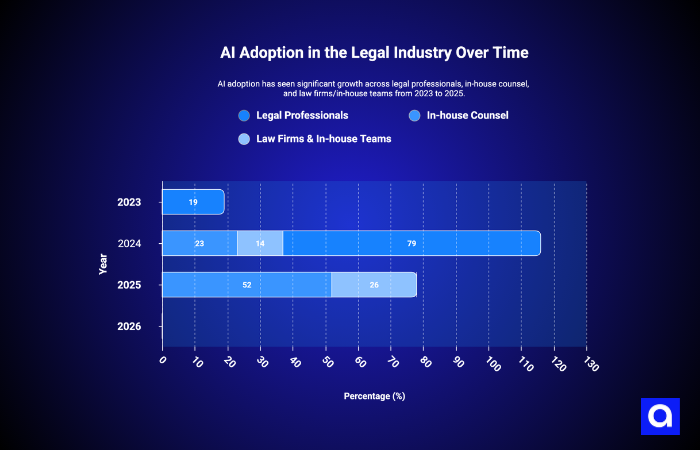
- 79% of legal professionals now use AI tools in their daily work, up from just 19% in 2023. - Source
- 52% of in-house counsel actively use GenAI, more than doubling from 23% in 2024. - Source
- AI could save the U.S. legal industry about $20 billion annually through automation of routine tasks. - Source
- 44% of legal work tasks could potentially be automated by generative AI, the second-highest rate of any U.S. industry. - Source
- The AI in the legal market is projected to grow from $4.59 billion in 2025 to $5.59 billion in 2026, a 22.3% year-over-year increase. - Source
- 80% of legal professionals expect AI to have a transformative or high impact on their work over the next five years. - Source
- 60% of lawyers now say AI is a must for their practice. - Source
- 95% believe AI will be a central component of their workflows within five years. - Source
- 26% of law firms and in-house teams were using GenAI as of early 2025, nearly double the 14% from a year prior. - Source
These numbers paint a picture in the middle of a massive shift. The adoption curve is steep, the economic stakes are real, and the window to act is narrowing fast.
AI in Legal Market Size and Growth Trends
The legal AI market is one of the fastest-growing segments in professional services software, and every major research firm agrees on the direction, even if their exact figures differ.

- The global legal AI market was valued at $1.45 billion in 2024 and is projected to reach $3.90 billion by 2030 at a 17.3% CAGR. - Source
- The global legal AI software market is projected to grow from $2.9 billion in 2025 to $34.8 billion by 2035, a CAGR of 28.21%. - Source
- North America dominates the global legal AI market with over 46% revenue share in 2024. - Source
- The Asia-Pacific legal AI market is expected to grow at a CAGR of 20% from 2025 to 2030, the fastest of any region. - Source
- The European legal AI market is expected to grow at a CAGR of 17% from 2025 to 2030. - Source
- Machine learning and deep learning accounted for over 63% of the legal AI market share by technology in 2024. - Source
- Natural language processing (NLP) is expected to contribute 35.7% of total legal AI market revenue in 2025, making it the leading technology segment. - Source
- The legal AI market is estimated at $2.1 billion in 2025, projected to reach $7.4 billion by 2035 at a 13.1% CAGR. - Source
Different research firms use different scope definitions (total legal AI market vs. legal AI software), which accounts for the variation in projections. The takeaway across all of them is the same: steep, sustained growth. That growth is not just coming from big enterprise deals, though. It is driven by the legal professionals who are actually adopting these tools every day.
AI Budget Growth Across Legal Departments
Law firms are putting real money behind AI, and the spending numbers in 2025 broke records.
- Law firm technology budgets rose 9.7% in 2025, the most rapid real growth in tech spending ever recorded in the legal sector. - Source
- Knowledge management spending increased 10.5% in 2025, the highest growth rate on record. - Source
- Law firms are boosting tech spending by 20% annually, with solo practitioners leading at a 56% increase in technology investment. - Source
- Firms with above-average productivity spend 12% more on software and 41% more on marketing, earning a 21% increase in profitability. - Source
- AI implementation in corporate legal departments jumped from 34% to 52% in a single year. - Source
This is not just a BigLaw story. Solo practitioners are increasing tech investment faster than any other firm size, and the data shows a direct link between technology spending and profitability.
AI Adoption in Law Firms and Legal Departments
Adoption is real, but it is uneven. Personal use outpaces firm-wide deployment, large firms move faster than small ones, and the gap between early adopters and laggards is widening into a strategic risk.
AI Adoption by Legal Professionals
Here is who is using AI, how often, and for what.
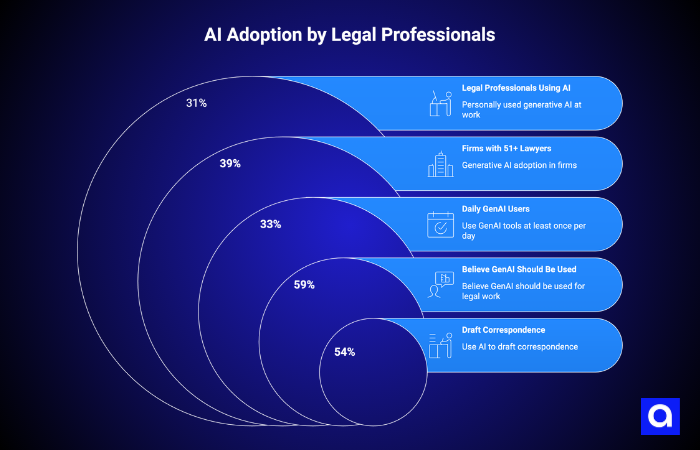
- 31% of individual legal professionals personally used generative AI at work in 2024, up from 27% in 2023. - Source
- Firms with 51+ lawyers show 39% generative AI adoption, versus about 20% at firms with 50 or fewer lawyers. - Source
- A third of law firm professionals use GenAI tools at least once per day. - Source
- 59% of legal professionals now believe GenAI should be used for legal work, up from 51% a year prior. - Source
- 54% of legal professionals use AI to draft correspondence, and 47% are interested in AI tools for financial data insights. - Source
- 53% of small firms and solo practitioners now integrate GenAI into their workflows, up from 27% in 2023. - Source
- 70% of law firm clients either prefer or are neutral toward firms that use AI. - Source
- 59% of corporate law department respondents want their law firms to use GenAI. - Source
- 8% of legal clients now formally request in official tender documents that law firms use GenAI. - Source
- 37% of legal e-discovery professionals were using AI tools by mid-2025, up from just 12% two years prior. - Source
Client expectations are shifting, too. It is not just about whether you use AI; clients are starting to ask for it by name in RFPs.
AI in Law Firm Adoption vs. Individual Lawyer Usage
There is a clear paradox in the data: individual lawyers are adopting AI faster than their firms are sanctioning it.
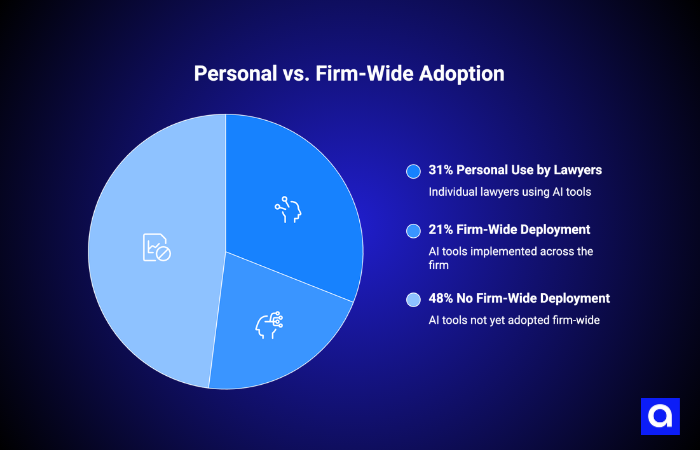
- Personal use (31%) outpaces firm-wide deployment (21%), a sign that individual lawyers are moving faster than institutional policies allow. - Source
- Only 40% of legal-specific AI solutions are being used by legal professionals in 2025, down from 58% in 2024, showing increased reliance on general-purpose tools like ChatGPT, Gemini, and Claude. - Source
- 70% of law firms are either exploring the potential of generative AI or have launched pilot projects. - Source
- Nearly a quarter of large law firms have fully implemented generative AI tools across multiple practice areas. - Source
- 21% of law firms had firm-wide AI deployment in 2024, slightly down from 24% in 2023. - Source
The shift toward general-purpose tools like ChatGPT carries real risk. These tools lack case law training, data privacy protections, and jurisdictional accuracy. Firms that do not provide approved alternatives are effectively pushing lawyers toward unvetted solutions.
AI Governance Policies and Internal Training
Most firms use AI. Most firms have not written the rules for it yet.
- 44% of law firms had not yet implemented formal AI governance policies, even as 79% of professionals used AI tools. - Source
- Only 41% of legal organizations had formal generative AI policies in 2025. - Source
- Only 40% of legal organizations provided AI training to staff in 2025. - Source
- Only 20% of legal firms were measuring the ROI of their GenAI investments in 2025. - Source
- Only 9% of businesses now impose policies against AI use in legal departments, down sharply from 29% in 2024. - Source
- 43% of respondents prioritized integration with trusted software when evaluating legal-specific AI tools. - Source
- New York State now requires at least two annual CLE credits in AI competency as of Q3 2025. - Source
The governance gap is closing, but slowly. State bars are moving from guidance to enforcement, and firms that lack clear AI policies face both regulatory and ethical exposure.
Generative AI in Legal Research, Drafting, and Review
This is where AI hits the billable hour. Generative AI legal research, document review, and contract drafting are now mainstream activities at firms that have adopted the technology.
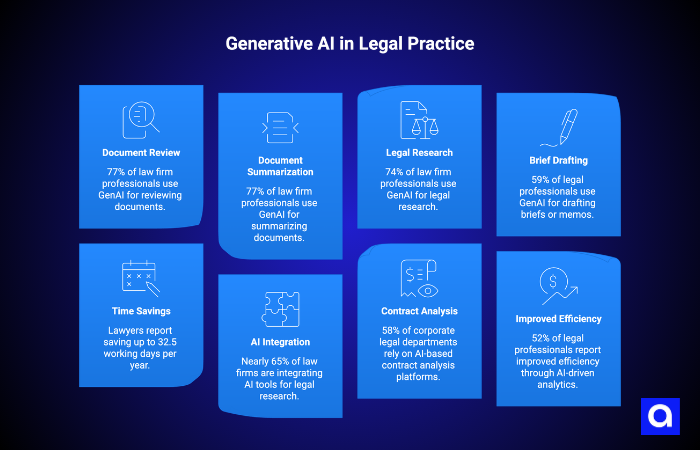
- 77% of law firm professionals use GenAI for reviewing documents, and 77% use it for summarizing documents. - Source
- 74% of law firm professionals use GenAI for legal research. - Source
- 59% of legal professionals use GenAI for drafting briefs or memos, and 58% use it for drafting contracts. - Source
- Generative AI boosts legal task completion speed by 12 to 32%, per academic research. - Source
- Lawyers report saving up to 32.5 working days per year using generative AI in their legal tasks. That is more than six weeks of time returned to strategic work. - Source
- 91% of in-house legal professionals cited efficiency as the most tangible benefit of GenAI, particularly in drafting and research. - Source
- Nearly 65% of law firms are integrating AI tools specifically for legal research and document automation. - Source
- 58% of corporate legal departments rely on AI-based contract analysis platforms. - Source
- 52% of legal professionals report improved efficiency through AI-driven analytics. - Source
- 90% of respondents believe generative AI has already altered conventional billing practices or will within the next two years. - Source
The billing disruption angle is worth paying attention to. When AI can complete in minutes what used to take hours, the hourly billing model faces an existential question. The firms figuring this out now will have a structural advantage.
Productivity and ROI of AI in Legal Work
The business case for AI in the legal industry ROI is becoming clearer by the quarter. The data separates firms with a plan from firms without one.
- More than half of legal firms are already seeing ROI from AI investments, including efficiency, cost reduction, and improved client experience. - Source
- 81% of respondents whose organizations have a visible, established AI strategy are seeing ROI, versus just 23% of those with no firm-wide AI plan. - Source
- Firms with a visible AI strategy were twice as likely to experience revenue growth and nearly four times more likely to see ROI. - Source
- 36% of legal professionals report AI has positively impacted revenues, jumping to 69% among wide AI adopters. - Source
- AI automation could reduce hourly billing per lawyer by $27,000 annually as AI accelerates task efficiency. - Source
- 54% of lawyers using AI say it saves them time and increases efficiency; 36% say it improves work quality; 36% say it helps manage caseloads. - Source
- Firms with higher technology investment are billing more than the industry average of 33% of the workday, with above-average productivity. - Source
- 30% of legal professionals believe their organization is embracing AI too slowly. - Source
- 59% of companies have seen no clear savings yet from outside counsel who use AI, with most reporting efficiency gains rather than direct cost reductions. - Source
- Only 20% of firms are measuring GenAI ROI. - Source
That stat about 81% vs. 23% ROI is probably the single most important strategic insight in this entire article. Having a plan matters more than having the fanciest tools. The firms that are deliberate about AI strategy are pulling away from everyone else.
Most Common AI Use Cases by Practice Area
AI adoption is not uniform across practice areas. Different disciplines use it in different ways, and the maturity level varies quite a bit depending on the type of legal work.
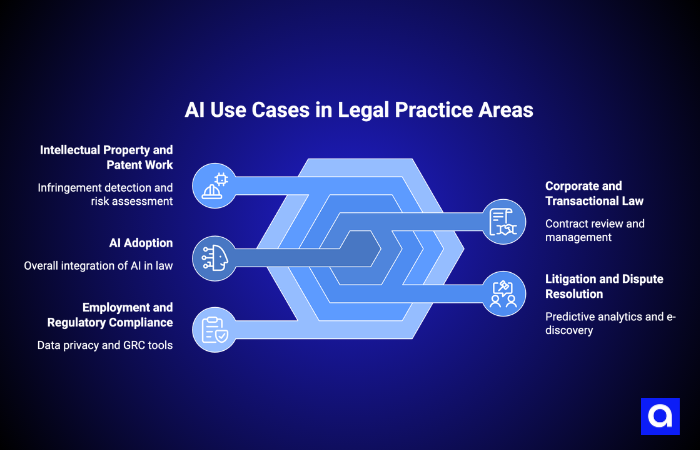
Corporate and Transactional Law
Contract review and lifecycle management are driving the biggest gains in corporate legal departments.
- AI-powered contract review is the fastest-growing application in legal AI, driven by contract lifecycle management demand in corporate departments. - Source
- 43% of U.S. law firms believe AI is having an appreciable impact on their billing practices, particularly in transactional work where efficiency gains are most measurable. - Source
Litigation and Dispute Resolution
Predictive analytics and e-discovery are transforming how litigation teams prepare and strategize.
- AI predictive analytics platforms achieve 70 to 85% accuracy in predicting case outcomes, depending on the type of prediction and available data. - Source
- One employment law firm reported that predictive analytics for case valuation increased settlement success rate by 34% and reduced time to settlement by an average of three months. - Source
- 93% of mid-sized law firms are already using AI in some capacity in litigation-related workflows, with 51% reporting widespread adoption. - Source
Intellectual Property and Patent Work
IP law saw some of the most high-profile AI-related legal battles in 2025.
- IP litigation dominated 2025 AI legal news, with class actions and corporate plaintiffs making fair-use decisions the most outcome-determinative battleground. - Source
- AI tools for patent infringement detection can scan vast document databases to identify unauthorized use of copyrighted material, trademarks, or patents, tasks that previously took weeks of human review. - Source
- AI in IP legal risk assessment can automatically review applicable legal frameworks to determine patent validity and potential infringements in M&A transactions. - Source
Employment and Regulatory Compliance
Data privacy and regulatory complexity make this area both a top challenge and a top funding target for legal AI.
- 57% of legal firms report data privacy concerns as the top AI adoption challenge, especially in HR and employment law contexts. - Source
- AI compliance tools are among the top-funded legal tech categories, with governance, risk, and compliance (GRC) companies collectively raising $27 billion in 2025 alone. - Source
Customer Support and Legal Intake Automation
This might be the area with the biggest gap between opportunity and current usage.
- Over 50% of law firms ignore client inquiries, making AI-powered intake automation one of the highest-ROI applications available today. - Source
- Legal chatbots are the fastest-growing technology segment in legal AI, projected to lead market expansion from 2025 to 2030. - Source
- One legal aid chatbot page received over 95,000 views and 20,000+ housing resource interactions within five months of launch. - Source
Global Spending on Legal AI Software
Investors see legal as one of the largest under-digitized professional sectors. The funding numbers in 2025 reflected that conviction at scale.
- Legal tech funding in the first half of 2025 surged 44% year-over-year to about $3.56 billion. - Source
- Full-year 2025 legal tech funding reached nearly $6 billion, with 14 rounds of $100 million or more. - Source
- Harvey AI raised over $800 million in 2025 alone across multiple rounds, reaching an $8 billion valuation. - Source
- Over 300 investors funded legal tech companies in H1 2025 alone. - Source
- The U.S. received $1.76 billion in legal tech investment in H1 2025. - Source
The Future of AI in the Legal Field
AI in law is shifting from experimentation to infrastructure. The question is no longer "should we adopt AI?" but "how fast can we build it into our operations?"
Ethical Considerations and AI Regulation
The regulatory environment is catching up to the technology, and the stakes for getting it wrong are rising.
- State bars have begun initiating disciplinary action for improper use of AI tools, and using public AI without human-in-the-loop verification is now a recognized ethical violation in several jurisdictions. - Source
- The top AI concern among legal professionals is overdependence on technology impeding professional skill development (24%), followed by privacy/confidentiality (15%), malicious use (14%), and data security (13%). - Source
- 48% of legal firms face AI integration barriers as a top challenge, and 44% require specialized AI expertise they currently lack. - Source

The Role of AI in Access to Justice
AI is not just a tool for corporate law departments. It is starting to address one of the legal system's deepest problems.
- More than 90% of low-income Americans lack adequate legal assistance, a gap that AI legal aid tools are specifically targeting. - Source
- The Legal Services Corporation awarded $4.2 million to 32 technology initiative projects in December 2025 to facilitate access to legal services. - Source
- At one legal aid clinic, an AI expungement tool helped the team expunge 324 charges, work that would have taken months manually. - Source
Long-Term Outlook
The long view on AI in law statistics points toward a profession that will look very different in ten years, but will still need human expertise at its core.
- AI-driven legal agents can now handle up to 23% of a lawyer's complete workload, spanning document review, compliance, research, contract lifecycle management, and billing, marking the shift from AI as a tool to AI as an autonomous co-worker. - Source
- Law school applications surged 22.9% in 2025 to their highest level in a decade, according to - Source
That is a strong signal: despite AI disruption, demand for legal expertise is rising, not falling. The firms that build their AI strategies now are securing a competitive advantage that will compound over the next several years.
How Azumo Helps Build AI Solutions for Legal Teams
The AI in law statistics above make one thing clear: legal teams that act deliberately on AI, with the right tools, governance, and custom integrations, will outperform those that do not.
At Azumo, we specialize in building custom AI solutions for professional services teams, from document automation and contract review pipelines to AI-powered client intake systems and e-discovery support.
Our nearshore engineering teams bring deep domain expertise in AI/ML, NLP, and data engineering, and we work as a direct extension of your in-house team. If your legal team is ready to move from experimentation to implementation, let's talk. Legal adoption is accelerating alongside other compliance-heavy functions: 75% of U.S. health systems now use at least one AI application. Hiring carries similar exposure, with 99% of Fortune 500 firms already using AI in recruitment.
References
- Clio Legal Trends Report 2024: https://www.clio.com/resources/legal-trends/2024-report/
- 2025 Clio Legal Trends Report: https://www.2civility.org/2025-clio-legal-trends-report/
- ACC GenAI Report: Corporate Law Departments’ AI Use: https://www.acc.com/about/newsroom/news/acc-genai-report-corporate-law-departments-ai-use-everlaw
- The Legal Industry Report 2025: https://www.fedbar.org/blog/the-legal-industry-report-2025/
- Number of Legal Professionals Using GenAI Jumps Sharply Over Past Year: https://www.globallegalpost.com/news/number-of-legal-professionals-using-gen-ai-jumps-sharply-over-past-year-study-shows-1273491086
- AI Usage Could Save U.S. Legal Industry $20 Billion Annually: https://www.2civility.org/ai-usage-could-save-us-legal-industry-20-billion-annually/
- Law Firm AI ROI: What Finally Worked and Why in 2025: https://www.bestlawfirms.com/articles/law-firm-ai-roi-what-finally-worked-and-why-in-2025/7229
- Legal AI Market Size, Share and Trends Report: https://www.grandviewresearch.com/industry-analysis/legal-ai-market-report
- AI in Legal Market Report: https://www.researchandmarkets.com/reports/6225963/ai-in-legal-market-report
- Legal AI Market: https://www.futuremarketinsights.com/reports/legal-ai-market
- Top Companies in Global Legal AI Software Market: https://www.sphericalinsights.com/blogs/top-25-companies-in-global-legal-ai-software-market-statistics-report-till-2035
- AI Automation Could Impact 300 Million Jobs: https://www.cnbc.com/2023/03/28/ai-automation-could-impact-300-million-jobs-heres-which-ones.html
- Legal Tech Funding Soars as AI Upstarts Take Over: https://www.law360.com/pulse/articles/2363506/legal-tech-funding-soars-as-ai-upstarts-take-over
- Legal Tech Raised $6B in 2025 as AI Boom Shows Divisions: https://www.artificiallawyer.com/2026/01/06/legal-tech-raised-6bn-in-2025-as-ai-boom-shows-divisions/
- AI Legal Tech Investment Hits All-Time High: https://news.crunchbase.com/venture/ai-legal-tech-investment-all-time-high-filevine/
- How AI Tools Can Analyze Judge-Specific Rulings: https://www.leanlaw.co/blog/how-ai-tools-can-analyze-judge-specific-rulings-to-improve-your-legal-arguments/
- AI Intellectual Property Disputes: The Year in Review: https://www.debevoise.com/insights/publications/2025/12/ai-intellectual-property-disputes-the-year-in
- 2025 ACC Law Department Benchmarking Report: https://www.mlaglobal.com/en/insights/research/2025-acc-law-department-benchmarking-report
- Generative AI and Legal Work Research Paper: https://papers.ssrn.com/sol3/papers.cfm?abstract_id=4733061
- AI and Technology Help Bridge Access to Justice: https://www.probonoinst.org/2026/02/06/ai-and-technology-help-bridge-access-to-justice/
- Legal AI Software Market: https://www.globalgrowthinsights.com/market-reports/legal-ai-software-market-123942
- Beyond the Ban: Why Your Law Firm Needs a Realistic AI Policy in 2026: https://www.ncbar.org/2026/01/13/beyond-the-ban-why-your-law-firm-needs-a-realistic-ai-policy-in-2026/
- 2026 AI Legal Forecast: From Innovation to Compliance: https://www.cpomagazine.com/data-protection/2026-ai-legal-forecast-from-innovation-to-compliance/
- Access to Justice: https://www.texasbarpractice.com/access-to-justice/
- The 10 Legal Tech Trends That Defined 2025: https://www.lawnext.com/2026/01/the-10-legal-tech-trends-that-defined-2025.html
- The Intersection of AI Technologies and IP Law: https://www.aicpa-cima.com/news/article/the-intersection-of-ai-technologies-and-ip-law
- AI for IP Law: https://www.spellbook.legal/learn/ai-for-ip-law
- LegalTech’s Funding Surge in 2025: https://ayta-legaltech.com/blog/from-107-million-to-2-4-billion-inside-legaltechs-6-000-funding-surge-in-2025
- LegalTech Investors: https://www.ellty.com/blog/legaltech-investors
- AI in Law Statistics: https://www.allaboutai.com/resources/ai-statistics/ai-in-law/
- Generative AI for Legal Practice: https://lawlibguides.luc.edu/GenerativeAI/LegalPractice
- Legal AI Research Paper: https://arxiv.org/pdf/2412.05090
- GenAI Adoption More Than Doubles Among U.S. In-House Counsel: https://www.globallegalpost.com/news/gen-ai-adoption-more-than-doubles-among-us-in-house-counsel-acc-study-shows-96483981

About the Author:
Founder & CEO | Azumo
Chike Agbai, Founder & CEO of Azumo, leads a nearshore software development firm that builds intelligent applications using top-tier Latin American talent.



.avif)