.svg)
.png)


In 2026, 86% of students across 16 countries already use AI in their studies. These numbers show a clear shift: AI is no longer a small test in schools. It is now a normal part of learning.
This set of 80 statistics about AI in education looks at market size, regional use, student results, teacher use, job market demand, and the challenges schools still face. It gives a clear and up-to-date view of what is happening in education today and where it is going next.
This data also shows how AI is changing education. It helps with creating learning materials, checking student work, and making lessons more personal for each student at a large scale.
Global Adoption of AI in Education Statistics
Student and institutional adoption of AI tools has moved from "early adopter" territory into mainstream territory in a single year. The numbers below show just how fast.
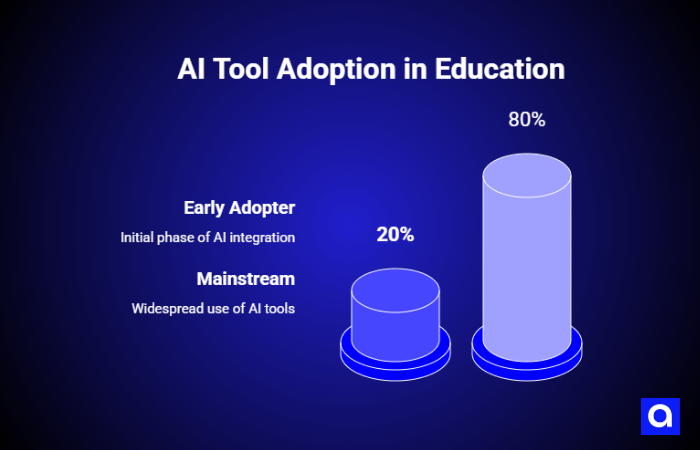
- Student AI usage jumped from 66% in 2024 to 92% in 2025, the steepest single-year increase on record among UK undergraduates. - Source
- 88% of students now use generative AI specifically for assessments (2025), up from 53% in 2024. - Source
- 86% of educational organizations have adopted generative AI, the highest adoption rate across all industries. - Source
- 60% of U.S. K-12 teachers used AI tools during the 2024-2025 school year, and 32% used them at least weekly. - Source
- Teachers who use AI tools at least weekly save an average of 5.9 hours per week, the equivalent of roughly 6 extra weeks per school year. - Source
Adoption of AI in Education Statistics by Region
AI adoption in education is not evenly distributed. North America leads in market share, Asia Pacific leads in growth rate, and significant gaps remain between the Global North and Global South.
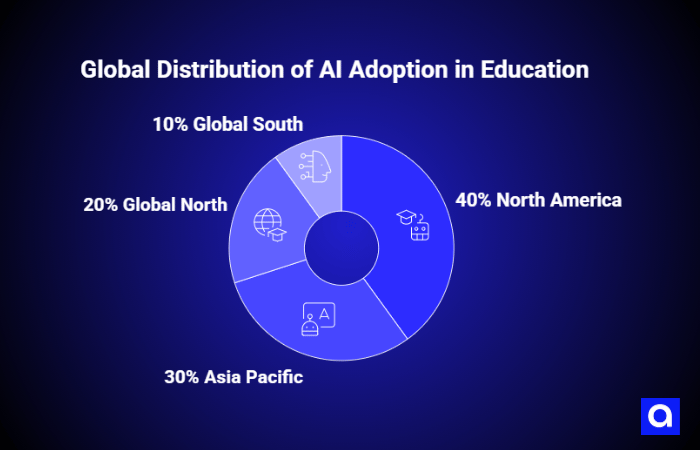
- North America holds the largest regional share of the global AI in education market at 36%, valued at $3.68 billion in 2026 and expected to reach $32 billion by 2030 (CAGR 31.1%). - Source
- Asia Pacific is the fastest-growing region with a 35.3% CAGR, its market estimated at $2.85 billion in 2026 and on track to reach $9.7 billion by 2030. - Source
- The European AI in education market is valued at $2.64 billion in 2026, forecast to grow at 31.9% CAGR to $8.0 billion by 2030, with Finland, Estonia, and the Netherlands leading in K-12 AI integration. - Source
- The Latin America AI in education market stands at $0.67 billion in 2026, growing at 33.5% CAGR to $2.1 billion by 2030. - Source
- The Middle East & Africa market sits at $0.56 billion in 2026, expected to grow at 34.3% CAGR to $1.6 billion by 2030. - Source
- China leads globally in AI education enthusiasm: 80% of students are excited about AI, compared to 35% in the U.S. and 38% in the UK. - Source
- Around 70% of institutions in Europe and North America have or are developing AI guidance, compared with just 45% in Latin America and the Caribbean. - Source
- The South Korean government invested approximately $740 million (2024-2026) to train teachers on AI tools. - Source
- The UK government invested £4 million in AI tools for lesson planning and homework marking. - Source
Market Growth and Adoption Statistics
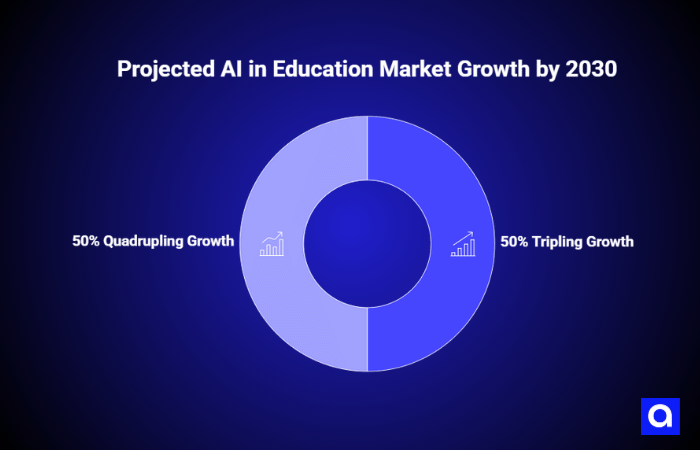
Multiple research firms project the AI in the education market to triple or quadruple by 2030. The forecasts vary in exact figures, but they all point in the same direction: steep, sustained growth.
- Long-term forecasts project that the global AI in education market will reach $136.79 billion by 2035 (CAGR 34.52%). - Source
- The AI student tools market alone is expected to reach $112.3 billion by 2034. - Source
- Generative AI could add $200 billion in value to the global education sector by reducing administrative work and improving learning outcomes. - Source
- The global e-learning market is projected to reach $365 billion by 2026, growing at 14% annually. - Source
- The global EdTech market is projected to reach $404 billion by 2025, a 16.3% CAGR and 2.5x growth from 2019. - Source
Types of Technologies Used by AI in Education Statistics
From text classification models that auto-grade essays to adaptive learning platforms that adjust lesson difficulty in real time, the types of AI now active in education span a wide range. Here is what the data shows about which technologies lead.
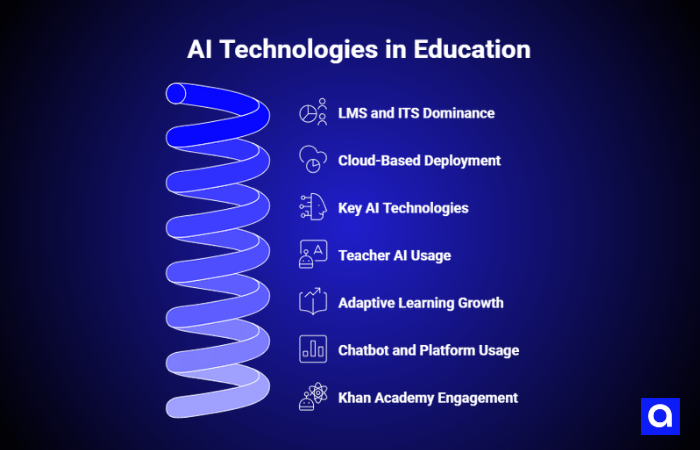
- Solutions such as learning management systems (LMS) and intelligent tutoring systems (ITS) represent the largest segment of the AI in education market, accounting for 70.3% of revenue share in 2024. - Source
- Cloud-based deployment led the market with a 60.1% revenue share in 2024. - Source
- Key AI technologies used in education include Machine Learning (ML), Natural Language Processing (NLP), generative AI/LLMs, computer vision, speech recognition, and Intelligent Tutoring Systems (ITS). Many of these rely on text classification techniques and deep learning text classification to process student inputs, sort content, and automate feedback. - Source
- 51% of teachers use AI-powered educational games; 43% use adaptive learning platforms; 41% use automated feedback/grading tools; 29% use intelligent tutoring systems. - Source
- The adaptive learning software market is projected to grow from $4.01 billion in 2024 to $4.79 billion in 2025, a 19.6% annual growth rate. - Source
- 53% of K-12 teachers use AI chatbots (such as ChatGPT and Google Bard) with students at least weekly; 80% use virtual learning platforms like Google Classroom weekly; 61% use adaptive learning systems like Khan Academy weekly. - Source
- Khan Academy's AI assistant sees daily engagement from 4.2 million unique users worldwide. - Source
AI in Higher Education vs. K-12
K-12 schools adopt AI faster than colleges and universities do. The gap between the two is worth paying attention to, especially if you are building or choosing EdTech products for a specific segment. A good text classification example of this split: K-12 teachers use AI chatbots to sort and respond to student questions, while higher education faculty still lag in regular adoption.
- K-12 schools account for 53% of all AI deployments in education globally, while higher education institutions represent 39% (as of 2025). - Source
- 63% of K-12 teachers (up 12% year-over-year) have incorporated GenAI into their teaching, compared to 49% of higher education instructors (up 5% YoY). - Source
- 83% of K-12 teachers use generative AI for personal or classroom-related purposes, compared to only 22% of higher education faculty who are regular AI users. - Source
- 54% of K-12 students used AI for school in a September 2025 RAND survey, up more than 15 percentage points in two years. - Source
- High school teachers are the most active adopters (69% use generative AI), compared to 42% of elementary teachers and just 33% of pre-K teachers. - Source
- 65% of higher education students believe they know more about AI than many of their instructors; 45% wish their instructors used AI in applicable courses. - Source
- Teaching jobs in universities are expected to grow by 24% between 2025 and 2030, with AI posing minimal replacement risk. - Source
- Only 8% of Pre-K through 3rd-grade students receive formal AI literacy training, versus 80% of high school students who receive formal AI literacy lessons. - Source
Popular AI Tools Among Students
When it comes to what text classification is in practice for students, think about every time a student asks ChatGPT a question and the model classifies the intent, generates a response, and sorts the output by relevance. These tools run on the classification of texts at their core.
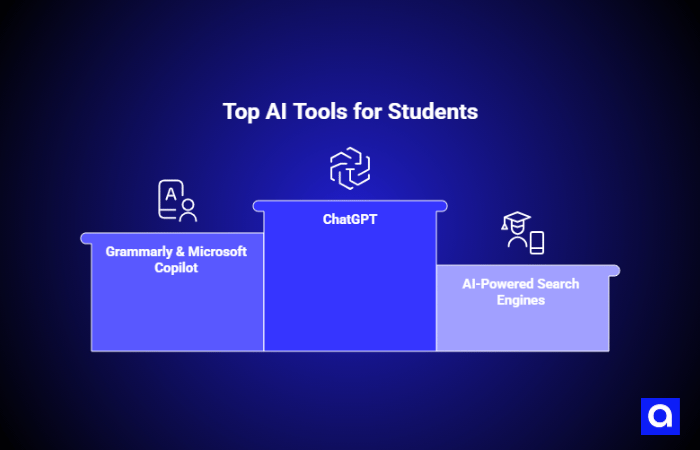
- ChatGPT is the most popular AI tool, used by 66% of students across 16 surveyed countries. - Source
- Grammarly and Microsoft Copilot are each used by 25% of students. - Source
- 60% of students added ChatGPT as a skill on LinkedIn; 38% added prompt engineering. - Source
- U.S. teens most commonly use ChatGPT for research (54%), solving math problems (29%), and writing essays (18%). - Source
- Teen use of ChatGPT for schoolwork doubled in one year, from 13% in 2023 to 26% in 2024. - Source
- AI-powered search engines are used by 1 in 5 students daily; chatbots by 51% of students; image generators by 34%; video generators by 22%. - Source
- After using Microsoft 365 Copilot Chat, students reported a 265% boost in self-learning. - Source
AI Impact on Student Performance and Learning
The performance data is where things get interesting and a bit complicated. On one hand, AI-powered tools produce measurable gains in test scores, completion rates, and retention. On the other hand, there are real concerns about what happens to critical thinking when students lean on AI too much.
- Students in AI-enhanced active learning environments achieve 54% higher test scores than peers in traditional settings. - Source
- A 2025 Harvard University physics study found that students using AI tutors learned more than twice as much in less time compared to those in traditional active-learning classrooms. - Source
- A 2025 randomized controlled trial published in Scientific Reports found that AI tutoring outperformed in-class active learning with an effect size between 0.73 and 1.3 standard deviations. - Source
- AI personalization boosts course completion rates by 70% and reduces dropout rates by 15%. - Source
- Macquarie University students using AI chatbot assistance improved exam results by up to 10% (March 2025). - Source
- 82.4% of surveyed students believe AI contributes to better academic performance; 83.5% report improved learning efficiency. - Source
- Universities using AI tools experience a 12% increase in graduation rates. - Source
- AI technology can improve student retention rates by up to 30% through personalized learning, according to McKinsey. - Source
- 70% of teachers worry that AI weakens critical thinking, and a 2025 study of 666 participants found a significant negative correlation between frequent AI use and critical thinking abilities, mediated by cognitive offloading. - Source
How Many Teachers Use AI in Education Statistics?
- 60% of U.S. K-12 public school teachers used AI tools during the 2024-2025 school year; 32% used them at least weekly. - Source
- 3 in 10 teachers use AI weekly; those who do save approximately 5.9 hours per week. - Source
- 83% of K-12 teachers use generative AI tools for personal or classroom purposes. - Source
- 47% of education leaders use AI tools every day. - Source
- 71% of K-12 teachers in the U.S. lack formal AI training; 85% feel unprepared to manage generative AI in classrooms. - Source
- Less experienced teachers are 1.8x more likely to use ChatGPT weekly than their more veteran peers. - Source
- 93% of higher education staff expect to expand their use of AI for work purposes over the next two years. - Source
Usage of AI Tools by Teachers
- According to the Cengage Group AI in Education Report (Spring 2025), higher education instructors now use GenAI to create course content (45%), assist in lesson planning (42%), support lectures (42%), and create quizzes and assessments (39%), all up significantly from 2023. Meanwhile, 74% of teachers say AI improves the quality of their administrative work. - Source
- According to an EdWeek 2025 survey, 59% of teachers said AI had enabled more personalized instruction. - Source
- And according to the Walton Family Foundation, 71% of teachers and 65% of students agree that AI should be used in schools and the workplace. - Source
What Is AI Being Used for in Education?
Here is the full picture of AI use cases, from student workflows to institutional back-office operations.
- Student use cases (according to Microsoft, cited by Resourcera): 37% use AI to brainstorm and start assignments; 33% to summarize content; 33% to find answers faster; 32% for initial feedback; 30% to personalize their study method; 28% to improve writing. - Source
Institutional use cases:
- 90% of universities use AI to automate administrative tasks like enrollment, scheduling, or plagiarism detection. - Source
- AI detection tool use in higher education jumped from 38% to 68% in one year. - Source
- An AI-powered grade prediction tool identified and helped save over 34,700 failing students from dropping out. - Source
- AI translation tools now support 87 languages, helping reduce linguistic barriers in over 42 countries. - Source
AI Skills Demand in the Job Market
The reason AI in education matters beyond classrooms? The job market now prices AI literacy into hiring decisions, salaries, and career trajectories. Deep learning text classification skills and the ability to build or use a text classification model are no longer niche resume items. They are table stakes for a growing number of roles.
- AI literacy is the #1 most in-demand skill on LinkedIn in 2026; "AI Engineer" is the fastest-growing job title, with postings rising 143% year-over-year in 2025. - Source
- Roles requiring AI skills carry a 56% wage premium over comparable non-AI positions, up from 25% one year earlier. - Source
- The number of workers in occupations explicitly requiring AI fluency grew sevenfold in two years, from roughly 1 million in 2023 to roughly 7 million in 2025. - Source
- According to the LinkedIn Work Change Report, by 2030, 70% of skills used in most jobs will change, with AI as a key catalyst. - Source
- AI has created 1.3 million new roles globally in just two years, including AI Engineers, Forward-Deployed Engineers, and Data Annotators. - Source
Challenges of AI Integration in Education
The adoption numbers are high, but the infrastructure to support responsible AI use in education is still catching up. Formal guidelines, training programs, and reliable detection tools all remain works in progress.
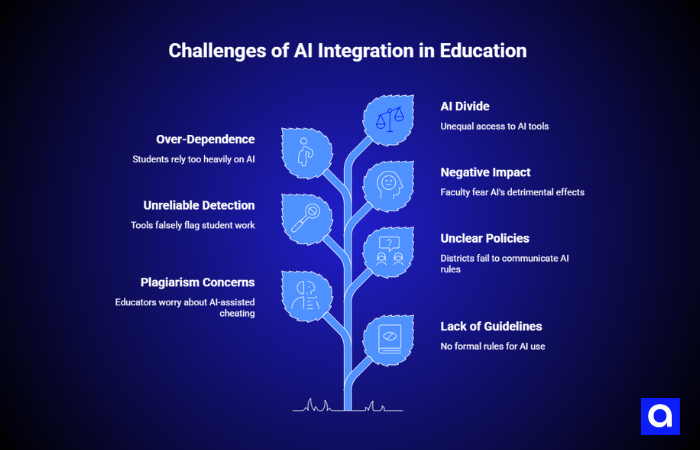
- Only 10% of schools and universities across 450+ institutions have established formal guidelines for AI use. - Source
- 72% of educators cite plagiarism as a primary concern; 93% assert that regulations on AI in education are needed. - Source
- 60% of educators report that their districts have not made AI policies clear to teachers or students. - Source
- AI detection tools prove unreliable, often producing false positives that disproportionately affect neurodivergent students and English language learners. - Source
- 47% of Harvard Faculty believe AI adoption will negatively impact higher education. - Source
- Over 30% of students can become overly dependent on AI tools, according to a Microsoft AI in Education study. - Source
- Globally, 24.7% of the working-age population in the Global North uses generative AI tools, versus only 14.1% in the Global South, indicating a growing AI divide. - Source
Future Trends for AI in Education
- The global AI in education market is projected to reach $136.79 billion by 2035 (CAGR 34.52%). - Source
- Looking ahead, 92% of business leaders plan to increase AI spending over the next three years. - Source
- According to Gartner, over 80% of enterprises will have deployed GenAI-enabled applications by 2026, which will drive downstream demand for AI-skilled graduates. - Source
- The OECD's 2026 Digital Education Outlook recommends moving beyond general-purpose AI tools toward purpose-built educational AI designed to produce durable learning gains. - Source
- The WEF 2025 report notes that less than 30% of teaching-related skills (mentoring, coaching) can be handled by AI, making teaching one of the least automatable professions. - Source
- Microsoft invested over $4 billion in AI education initiatives targeting schools, community colleges, and nonprofits (July 2025). - Source
- And in May 2025, the European Schools system established a specific framework for the educational use of generative AI, focused on ethical and human-centered principles. - Source
How Azumo Supports AI-Powered Education Tools
The statistics make one thing clear: institutions that adopt AI with purpose, not just convenience, see the strongest gains in student outcomes and operational efficiency. That is exactly where Azumo fits in.
Azumo builds custom AI solutions for educational institutions and EdTech companies, from LLM integration and adaptive learning backends to intelligent tutoring features and custom GenAI workflows. If you are looking to build or scale an AI-driven education product, Azumo's nearshore engineering teams work in your time zone with deep domain expertise in AI, ML, and NLP. Let's talk about your project. Today's AI-fluent students are headed into workplaces where 91% of employees already report organizational AI use. That's part of the same enterprise wave that has pushed AI adoption to 88% of organizations overall.
References
- Campus Technology / Digital Education Council Global AI Student Survey: https://campustechnology.com/articles/2024/08/28/survey-86-of-students-already-use-ai-in-their-studies.aspx
- HEPI/Kortext Student Generative AI Survey 2025: https://www.hepi.ac.uk/2025/02/26/hepi-kortext-ai-survey-shows-explosive-increase-in-the-use-of-generative-ai-tools-by-students/
- HEPI Student Generative AI Survey 2025: https://www.hepi.ac.uk/2025/02/26/student-generative-ai-survey-2025/
- DemandSage / Microsoft: https://www.demandsage.com/ai-in-education-statistics/
- Gallup / Walton Family Foundation (June 2025): https://news.gallup.com/poll/691967/three-teachers-weekly-saving-six-weeks-year.aspx
- Chegg Global Student Survey 2025: https://investor.chegg.com/Press-Releases/press-release-details/2025/Chegg-Global-Student-Survey-2025-80-of-Undergraduates-Worldwide-Have-Used-GenAI-to-Support-their-Studies–But-Accuracy-a-Top-Concern/default.aspx
- Grand View Research: https://www.grandviewresearch.com/industry-analysis/artificial-intelligence-ai-education-market-report
- Resourcera: https://resourcera.com/data/artificial-intelligence/ai-in-education-statistics/
- SQMagazine: https://sqmagazine.co.uk/ai-in-education-statistics/
- UNESCO 2025 Higher Education Survey: https://www.unesco.org/en/articles/unesco-survey-two-thirds-higher-education-institutions-have-or-are-developing-guidance-ai-use
- Precedence Research: https://www.precedenceresearch.com/ai-in-education-market
- Research and Markets / GlobeNewswire (April 2026): https://www.globenewswire.com/news-release/2026/04/07/3269515/0/en/Global-10-6B-AI-in-Education-Market-2026-Total-Revenue-Set-to-Quadruple-During-2026-2030-Reaching-42-48-Billion.html
- Morgan Stanley (cited by Open2Study): https://www.open2study.com/statistics/ai-in-education/
- Straits Research / IMARC Group (cited by Didask): https://www.didask.com/en/post/marche-e-learning
- HolonIQ (cited by Enrollify): https://www.enrollify.org/blog/ai-in-education-statistics
- Springer Nature / ScienceDirect: https://link.springer.com/article/10.1007/s44217-025-00908-6
- Programs.com: https://programs.com/resources/ai-education-statistics/
- NotieAI: https://www.notieai.com/ai-in-education-statistics/
- Cengage Group AI in Education Report (Spring 2025): https://www.cengagegroup.com/news/press-releases/2025/ai-in-education-report-new-cengage-group-data-shows-growing-genai-adoption-in-k12--higher-education/
- ElectroIQ: https://electroiq.com/stats/ai-in-education-statistics/
- RAND Corporation (September 2025), cited by AEI: https://www.aei.org/education/ai-has-come-for-k-12-education/
- Engageli: https://www.engageli.com/blog/ai-in-education-statistics
- Pew Research Center (cited by YSU): https://online.ysu.edu/degrees/education/msed/ai-teaching-statistics-usage-and-trends/
- Codegnan: https://codegnan.com/ai-in-education-statistics/
- Campbell Academic Technology (citing Ellucian): https://sites.campbell.edu/academictechnology/2025/03/06/ai-in-higher-education-a-summary-of-recent-surveys-of-students-and-faculty/
- ScienceDirect (2025 meta-analysis): https://www.sciencedirect.com/science/article/abs/pii/S1747938X25000740
- ArtSmart.ai: https://artsmart.ai/blog/ai-in-education-statistics-2025/
- McKinsey (cited by Enrollify): https://www.enrollify.org/blog/ai-in-education-statistics
- arXiv 2025 (Gerlich study): https://arxiv.org/html/2510.16019v1
- Microsoft News (March 2025): https://news.microsoft.com/source/asia/2025/03/24/macquarie-university-students-exam-scores-up-by-nearly-10-per-cent-thanks-to-new-ai-powered-chatbot/
- LinkedIn Jobs on the Rise 2026 / HR Leader: https://www.hrleader.com.au/business/27698-ai-engineer-tops-linkedin-s-2026-jobs-on-the-rise-list
- HeroHunt.ai: https://www.herohunt.ai/blog/fastest-growing-ai-roles-in-2026-data-and-rankings/
- McKinsey (cited by Gloat): https://gloat.com/blog/ai-skills-demand/
- PwC 2025 Global AI Jobs Barometer: https://www.pwc.com/gx/en/news-room/press-releases/2025/ai-linked-to-a-fourfold-increase-in-productivity-growth.html
- LinkedIn Work Change Report: https://economicgraph.linkedin.com/research/work-change-report
- World Economic Forum / LinkedIn (January 2026): https://www.weforum.org/stories/2026/01/ai-has-already-added-1-3-million-new-jobs-according-to-linkedin-data/
- Open2Study (citing Harvard Crimson): https://www.open2study.com/statistics/ai-in-education/
- Gallup / NPR (August 2025), cited by Engageli: https://www.engageli.com/blog/ai-in-education-statistics

About the Author:
Founder & CEO | Azumo
Chike Agbai, Founder & CEO of Azumo, leads a nearshore software development firm that builds intelligent applications using top-tier Latin American talent.



.avif)