.svg)
.png)


.avif)
AI use in companies is growing fast. In 2024, 78% of organizations reported using AI in at least one business function, rising to 88% in 2025. However, most companies are still in the early stages, with the majority experimenting or piloting AI, and only about one-third having started to scale it across the business. Enterprise AI use climbed to 88% of organizations in 2025, but adoption is uneven by function: only 23% are actively scaling AI agents in production.
As a result, AI is now part of daily business rather than an experiment. Even so, important questions remain. Where does it create real value? Which industries are ahead? And what comes next?
In this report, we bring together the latest enterprise AI statistics to give you a clear view of where enterprise AI stands today and where it is going next.
How Fast Is AI Adoption Growing Across Enterprises?
The short answer: fast, and getting faster.
- Expectations around AI’s impact on workforce size are mixed, with 43% of organizations anticipating no change, 32% expecting a decrease, and only 13% projecting an increase. - Source
- Worker access to AI rose by 50% in 2025, and the number of companies with 40% or more of projects in production is set to double within six months. - Source
- Enterprise generative AI adoption surged from $1.7B to $37B since 2023, now capturing 6% of the global SaaS market. - Source
- In 2025, 31% of AI use cases studied reached full production, double the rate from 2024. - Source
- ChatGPT Enterprise weekly messages grew roughly 8x in one year, and the average worker now sends 30% more messages. - Source
- Over 80% of organizations have explored or piloted tools like ChatGPT and Copilot, with nearly 40% reporting full deployment. - Source
- 87% of large enterprises are now implementing AI solutions. - Source
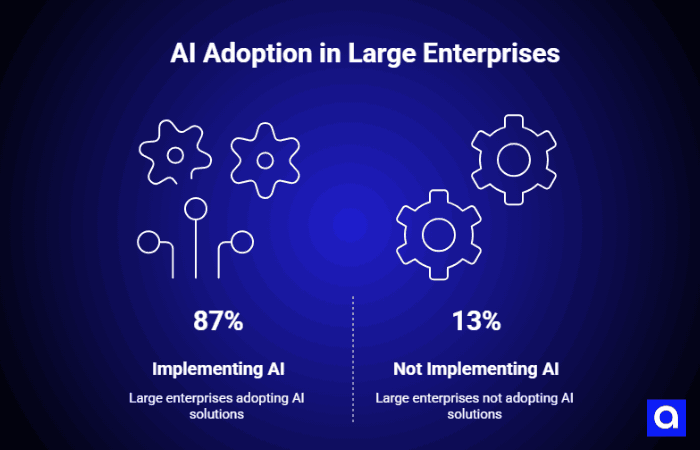
This is not a gradual shift. The pace of AI adoption in enterprises doubled in under two years, and the tools people use every day (ChatGPT, Copilot, internal AI agents) are now woven into workflows from coding to customer service. If you are building a text classification model or training a machine learning pipeline, chances are your team already uses AI-assisted tools to do it.
AI Adoption vs. AI Maturity: Which Matters More in 2026?
Here is the uncomfortable truth behind those headline enterprise AI adoption statistics: most companies have not figured out how to turn AI pilots into real business results.
- Nearly 90% of organizations use AI in operations, yet only 9% have achieved AI maturity. - Source
- Only 1% of companies view their GenAI strategies as mature. - Source
- Nearly two-thirds of organizations are still in the experiment or pilot phase; only about one-third are genuinely scaling. - Source
- 62% of organizations have not moved AI projects beyond the pilot stage. - Source
- Organizations with a formal AI strategy succeed at AI adoption 80% of the time vs. 37% for those without one. - Source
- 45% of leaders in high-AI-maturity organizations keep AI initiatives in production for three years or more; only 20% in low-maturity organizations do the same. - Source
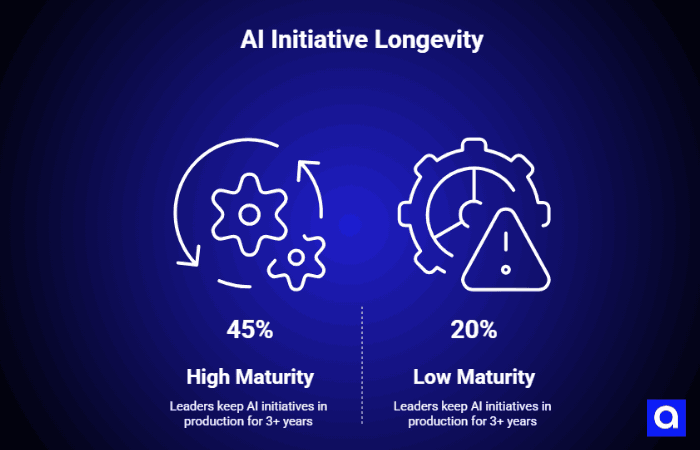
So what separates the 9% that reach maturity from the rest? It comes down to strategy, governance, and sustained investment. Adoption is a vanity metric if nothing makes it to production.
Whether you are building a deep learning text classification pipeline or deploying an NLP-based text classification model, the same principle applies: a proof of concept means nothing without a plan to scale, monitor, and maintain it over time.
AI Adoption by Industry: Statistical Breakdown of Enterprise-Level Integration
Not every industry moves at the same pace, but every single one is moving.
- The technology sector leads with roughly 94% AI adoption, near-universal at this point. - Source
- Financial services follow at 85 to 89% adoption, using AI for fraud detection, algorithmic trading, and compliance. - Source
- Manufacturing, logistics, and defense are especially advanced in physical AI, robotics, and autonomous vehicles. - Source
- Vertical AI (industry-specific AI for healthcare, legal, government) has become a $3.5B category in 2025, triple the prior year's total. - Source
- Healthcare grew AI usage 8x year-over-year; manufacturing grew 7x. - Source
- 100% of industries, including traditionally slower adopters like mining and agriculture, are now increasing AI usage. - Source
In financial services, text classification in NLP is a core capability for compliance monitoring and risk scoring. Healthcare teams apply classification of texts to sort clinical notes, insurance claims, and patient records. No matter the sector, some form of AI-driven text classification techniques or predictive models sits at the center of the operation.

What Are Enterprises Using AI For?
- Process automation leads adoption at 76% of enterprises. - Source
- Roughly 52% of enterprises use AI for research and information synthesis. - Source
- Coding is the dominant departmental AI use case at $4.0B, representing 55% of departmental AI spend, followed by IT (10%), marketing (9%), customer success (9%), design (7%), and HR (5%). - Source
- 50% of developers now use AI coding tools daily; that number rises to 65% in top-quartile organizations. - Source
- NLP is the top data science and ML application for the second year running, with 50% of specialized Python libraries devoted to NLP use cases. - Source
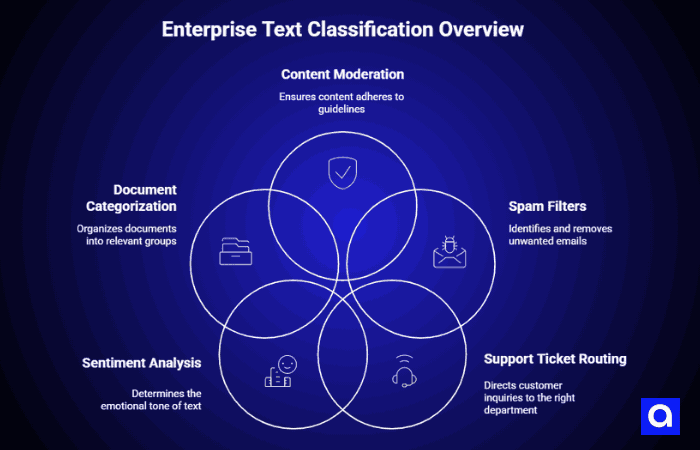
Think about what text classification is in the context of an enterprise. It powers spam filters, support ticket routing, sentiment analysis, document categorization, and content moderation. That is why NLP dominates the use case list: classification of texts is the backbone of how AI agents process, sort, and act on business data at scale.
What Jobs Are Being Automated at Enterprises?
Data Entry and Administrative Work
AI agents now process invoices, manage inventory restocking, and handle route optimization. Finance and operations teams report that AI agents accelerate close processes by 30 to 50%.
- AI agents handling refunds, escalations, and omnichannel support save small teams 40+ hours monthly. - Source
Basic Customer Service Roles
- Oscar Health deployed AI chatbots that answer 58% of benefits questions instantly and handle 39% without human escalation. - Source
- Companies using AI for marketing report a 37% reduction in costs and a 39% increase in revenue. - Source
Content Generation at Scale
Generative AI handles first drafts, marketing copy, reports, and ad content. Organizations that pair a text classification model with content generation can auto-tag, auto-route, and auto-publish at speeds that were impossible two years ago.
Repetitive Coding and Debugging Tasks
- 90% of software development professionals now use AI tools. - Source
- Over 10,000 U.S. jobs were cut in the first seven months of 2025 due to AI-driven automation, with entry-level roles hit hardest. - Source
What New Roles AI Is Creating at Enterprises
The automation story only tells half of it. AI is creating new jobs faster than it removes old ones.
- Workers with AI skills earn, on average, 56% higher wages. - Source
- The number of workers in occupations where AI fluency is explicitly required has grown sevenfold in two years, from roughly 1 million to 7 million. - Source
- Chief AI Officer roles are now present in 61% of enterprises. - Source
- New roles are appearing across every industry: AI architects, agent performance engineers, MLOps professionals, oversight specialists, and safety/governance roles. - Source
- The World Economic Forum projects 170 million new jobs will emerge by 2030, while 92 million are displaced, a net gain of 78 million positions. - Source
- By 2026, 40% of all G2000 job roles will involve working with AI agents. - Source
If you are building deep learning text classification systems, training text classification models, or applying machine learning for text classification at scale, your skill set is in high demand. These are exactly the types of roles that carry that 56% wage premium.

How Enterprises Leverage Big Data and AI for Strategic Business Intelligence
- Financial services achieved a 10-to-1 experiment-to-production ratio by 2024, nearly 3x more efficient than the 29-to-1 ratio in 2023. - Source
- Financial institutions expect 74% investment growth in data management and infrastructure through 2025, compared with 52% for other industries. - Source
- 95% of IT leaders report integration hurdles impeding AI development and implementation; organizations average roughly 897 apps, but only about 28% are connected. - Source
- McKinsey projects productivity gains from AI agents could unlock up to $2.9 trillion in economic value by 2030. - Source
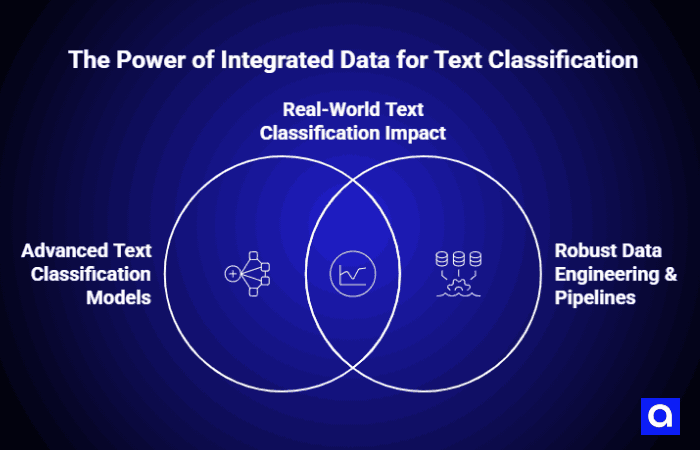
The integration challenge is real. A text classification example that works perfectly in a sandbox falls apart when the data feeding it comes from disconnected systems with inconsistent schemas. That is why data engineering and pipeline architecture matter just as much as the model itself. The best text classification techniques in the world produce nothing if they cannot access clean, connected data.
What Are the Biggest Challenges Slowing Enterprise AI Implementation
Skills and Talent Gap
- The AI skills gap is the number one barrier to integration, per Deloitte's 2026 survey of 3,235 leaders. - Source
- 46% of leaders identify skill gaps as a significant barrier to AI adoption in enterprises. - Source
- 80% of tech-focused organizations say upskilling is the most effective way to close the skills gap, yet only 28% plan to invest in upskilling programs in the next two to three years. - Source
- Only 51% of U.S. employees receive organizational support to learn AI skills vs. 84% internationally. - Source
Data and Infrastructure Issues
- 42% of organizations cannot properly customize AI models due to poor-quality data. - Source
- By 2027, companies that do not prioritize high-quality, AI-ready data will struggle to scale GenAI and agentic solutions, resulting in a 15% productivity loss. - Source
- Legacy system dependencies affect 64% of organizations, consuming 16+ hours weekly. - Source
This is where text classification methods come into play at an infrastructure level. Before you can apply machine learning for text classification on enterprise data, you need clean, labeled, well-structured datasets. That sounds simple, but for most organizations, it means retrofitting decades of legacy architecture.
Lack of Strategy and Leadership Alignment
- Less than 30% of companies report that their CEOs directly sponsor the AI agenda. - Source
- 42% of C-suite executives report that AI adoption is tearing their company apart. - Source
- 68% of executives report friction between IT and other departments around AI; 72% observe AI applications developed in silos. - Source
AI Governance and Risk Management
- Only 37% of organizations have AI governance policies in place. - Source
- Only 1 in 5 companies has a mature governance model for autonomous AI agents. - Source
- 77% of businesses express concern about AI hallucinations; 47% of enterprise AI users made at least one major business decision based on hallucinated content in 2024. - Source
- AI-associated security breaches cost organizations more than $650,000 per incident. - Source
Change Management and Employee Resistance
- 83% of AI leaders report major or extreme concern about generative AI, an eightfold increase in just two years. - Source
- Only 45% of employees (vs. 75% of the C-suite) believe their organization has successfully adopted AI. - Source
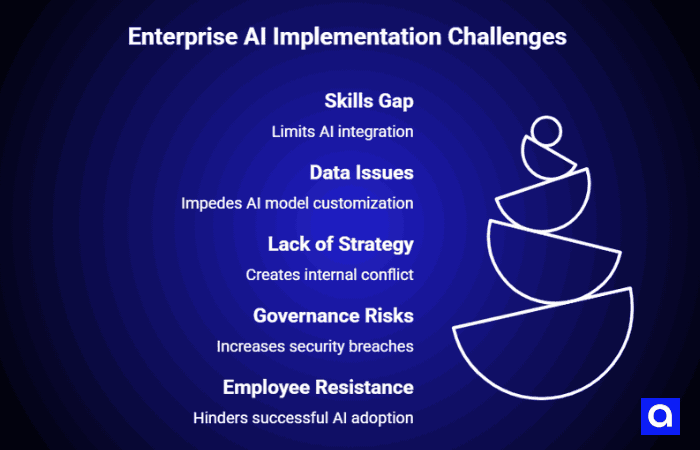
That perception gap is a problem. If leadership thinks AI adoption is going great and the rest of the team disagrees, you have a change management issue that no amount of technology spending will fix.
What Can Accelerate Enterprise AI Adoption?
Cost of Models Decreasing
- The enterprise shift from building to buying AI solutions jumped from 53% in 2024 to 76% in 2025 as model costs decline. - Source
Lower model costs mean more teams can experiment with text classification techniques, deploy a text classification model, and iterate faster without burning through massive budgets.
Tool Accessibility
- ChatGPT now serves 800+ million weekly users; workers from over 90% of companies surveyed report regular personal use of AI tools for work tasks. - Source
Competitive Pressure
- Industries most exposed to AI experience nearly 4x higher productivity growth than those least exposed; productivity in AI-exposed industries jumped from 7% to 27% since 2022. - Source
Embedded AI in Software
- By 2026, IDC expects AI copilots to be embedded in nearly 80% of enterprise workplace applications. - Source
- By the end of 2026, 40% of enterprise apps will feature integrated task-specific AI agents, up from less than 5% in 2025. - Source
The Future of AI at Enterprises: 2026 to 2030 Predictions
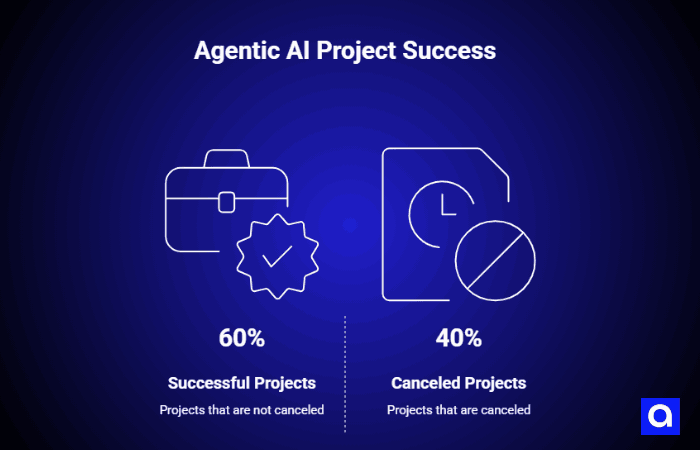
- Over 40% of agentic AI projects will be canceled by 2027 due to escalating costs, unclear business value, or inadequate risk controls. - Source
- At least 15% of day-to-day work decisions will be made autonomously through agentic AI by 2028, up from 0% in 2024. - Source
- By 2028, 33% of enterprise software applications will include agentic AI, up from less than 1% in 2024. - Source
- By 2028, 90% of B2B buying will be AI agent intermediated, pushing over $15 trillion of B2B spend through AI agent exchanges. - Source
- By 2030, 45% of organizations will orchestrate AI agents at scale, embedding them across business functions. - Source
- The AI agent market is growing at a projected CAGR of 46.3%, expanding from $7.84B in 2025 to $52.62B by 2030. - Source
- 89% of large enterprises expect to adopt generative AI by 2027. - Source
The optimism is real, but so is the caution. That stat about 40%+ of agentic AI projects getting canceled deserves as much attention as the growth forecasts. The companies that succeed will be the ones with clear strategy, strong data foundations, and teams skilled in everything from deep learning text classification to MLOps and AI governance.
If you are looking to build intelligent applications and need experienced AI development engineers who can help you move from pilot to production, Azumo works with companies from startups to Fortune 500s to do exactly that. Let's get in touch today and talk about what your AI roadmap looks like. Even as enterprise adoption climbs, the next hiring cohort is arriving more AI-fluent than the enterprises they'll join: 86% of students already use AI in their coursework.
References
- Deloitte, State of AI in the Enterprise 2026: https://www.deloitte.com/us/en/what-we-do/capabilities/applied-artificial-intelligence/content/state-of-ai-in-the-enterprise.html
- McKinsey, The State of AI in 2025: https://www.mckinsey.com/capabilities/quantumblack/our-insights/the-state-of-ai
- OpenAI, State of Enterprise AI 2025: https://openai.com/index/the-state-of-enterprise-ai-2025-report/
- Menlo Ventures, State of Generative AI in the Enterprise 2025: https://menlovc.com/perspective/2025-the-state-of-generative-ai-in-the-enterprise/
- ISG, State of Enterprise AI Adoption Report 2025: https://isg-one.com/state-of-enterprise-ai-adoption-report-2025
- Lucidworks, 2025 AI Benchmark Study: https://lucidworks.com/blog/enterprise-ai-adoption-in-2026-trends-gaps-and-strategic-insights
- Wharton / GBK Collective, 2025 AI Adoption Report: https://knowledge.wharton.upenn.edu/special-report/2025-ai-adoption-report/
- Writer / Workplace Intelligence, 2025 Enterprise AI Adoption Report: https://writer.com/blog/enterprise-ai-adoption-survey/
- Gartner (multiple reports): https://www.gartner.com/en/newsroom
- IDC FutureScape 2026: https://my.idc.com/getdoc.jsp?containerId=prUS53883425
- PwC, 2025 Global AI Jobs Barometer: https://www.pwc.com/gx/en/services/ai/ai-jobs-barometer.html
- MIT NANDA, The GenAI Divide: State of AI in Business 2025: https://mlq.ai/media/quarterly_decks/v0.1_State_of_AI_in_Business_2025_Report.pdf
- Second Talent, AI Adoption in Enterprise Statistics 2025: https://www.secondtalent.com/resources/ai-adoption-in-enterprise-statistics/
- Databricks, State of AI: Enterprise Adoption & Growth Trends: https://www.databricks.com/blog/state-ai-enterprise-adoption-growth-trends
- Fullview, 200+ AI Statistics & Trends for 2025: https://www.fullview.io/blog/ai-statistics
- IBM, AI Skills Gap: https://www.ibm.com/think/insights/ai-skills-gap
- Gloat, AI Skills Demand 2026: https://gloat.com/blog/ai-skills-demand/
- Findem, AI Now (September 2025): https://www.findem.ai/blog/ai-now-september-17-2025
- 1BusinessWorld, The Great AI ROI Reckoning (2026): https://1businessworld.com/2026/03/1artificialintelligence/the-great-ai-roi-reckoning-what-separates-the-5-of-enterprises-achieving-transformational-returns-from-the-95-that-dont/
- Integrate.io, Data Integration Adoption Rates in Enterprises 2026: https://www.integrate.io/blog/data-integration-adoption-rates-enterprises/
Frequently Asked Questions
.avif)
About the Author:
Founder & CEO | Azumo
Chike Agbai, Founder & CEO of Azumo, leads a nearshore software development firm that builds intelligent applications using top-tier Latin American talent.



.avif)