.svg)
.png)


.avif)
Nearly 9 in 10 companies now use AI in the hiring process in some capacity. If you are an HR leader, recruiter, or business executive, these AI recruitment statistics will give you a clear picture of what to expect in 2026. AI hiring tools draw the same compliance scrutiny as legal AI, where 79% of professionals now use it daily. Once candidates are hired, they join a workforce where 91% of employees already report organizational AI use.
We gathered 77 data points covering market size, adoption rates, screening accuracy, cost savings, candidate sentiment, bias risks, and future trends.
Now, let's dive into the numbers.
What Is the Market Size of AI in Recruitment?
The AI in the recruiting market has grown fast, and every major research firm projects it will nearly double within the next decade. Software solutions dominate spend, cloud deployment leads infrastructure choices, and North America captures the biggest slice of the pie.
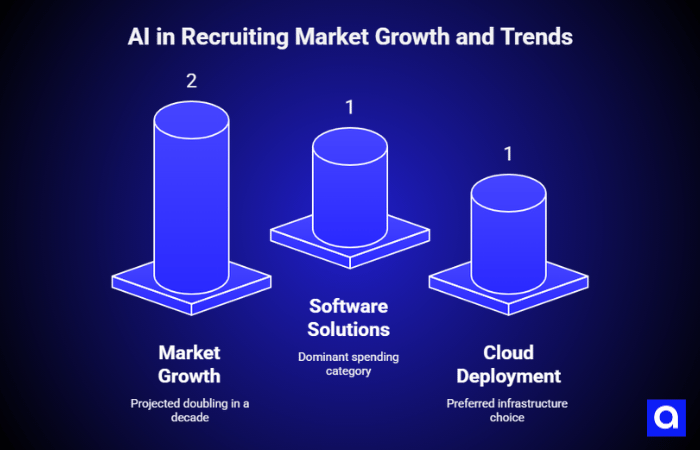
- The AI recruitment market is projected to grow from $660.23 million in 2025 to $1,289.13 million by 2035, at a CAGR of 6.92%. - Source
- In 2026, the AI recruitment industry size is assessed at $752.09 million, and it is anticipated to cross $1.39 billion by 2035 at more than 7% CAGR. - Source
- The AI recruitment market stood at $596.16 million in 2025 and is forecast to reach $860.96 million by 2030 at a 7.63% CAGR, with software holding 64.81% of the market share and cloud deployment capturing 78.51%. - Source
- The broader global artificial intelligence in HR market was estimated at $6.25 billion in 2026, projected to grow at a CAGR of 24.8% from 2026 to 2030. - Source
- North America commands a 38.6% share of the AI recruitment market, while Asia-Pacific is the fastest-growing region with a 19.60% CAGR to 2030. - Source
- By application, candidate screening and assessment represented 32.33% of the market in 2024, and services are projected to expand at an 11.80% CAGR to 2030, outpacing software growth. - Source
The Adoption Rate of AI in Recruitment
AI in talent acquisition has moved from "early experiment" to "standard practice" in just a few years. The jump from 2023 to 2025 is striking, and the trajectory for 2026 points straight up.
- 87% of companies that use AI for hiring do so throughout their recruitment process, and 99% of Fortune 500 firms use AI in hiring. - Source
- AI adoption among HR professionals surged from 58% in 2024 to 72% in 2025. - Source
- 93% of recruiters plan to increase the use of AI in recruitment in 2026. - Source
- Compared to 2023, 2024 saw a 68.1% increase in AI-based recruitment tool usage. - Source
- 96% of US hiring professionals use AI for HR recruitment, and 94% say it effectively identifies strong candidates. - Source
- By 2025, 60% of organizations are expected to use AI for end-to-end AI in recruiting processes. - Source
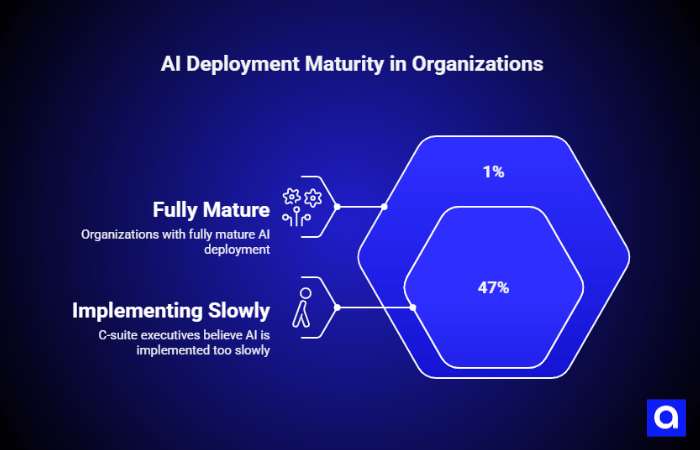
- Only 1% of organizations consider their AI deployment fully mature, while 47% of C-suite executives believe their organizations are implementing AI too slowly. - Source
The Impact of AI on Screening and Shortlisting Candidates
Screening is where AI in the hiring process delivers some of its most measurable wins. AI development in recruitment powers the resume parsing, skill extraction, and candidate ranking that make high-volume hiring possible. These text classification models process thousands of applications in minutes, and the accuracy numbers back up the hype.
- 58% of recruiters who use AI find it most useful for candidate sourcing, and 56% find it most useful for screening candidates. - Source
- AI screening tools achieve 89 to 94% accuracy rates, with resume parsing at 94% and skill matching at 89% accuracy. - Source
- Automated screening reduces initial candidate review time by 71% while improving match accuracy. - Source
- AI-led interview screening shows candidates had a 53% success rate in subsequent human interviews, compared to only 29% for those screened by traditional resume methods. - Source
- 82% of companies use AI for reviewing resumes, 40% use AI chatbots for candidate communication, and 42% use AI to scan social media. - Source
- 57% of recruiters say AI makes writing job descriptions easier and faster. - Source
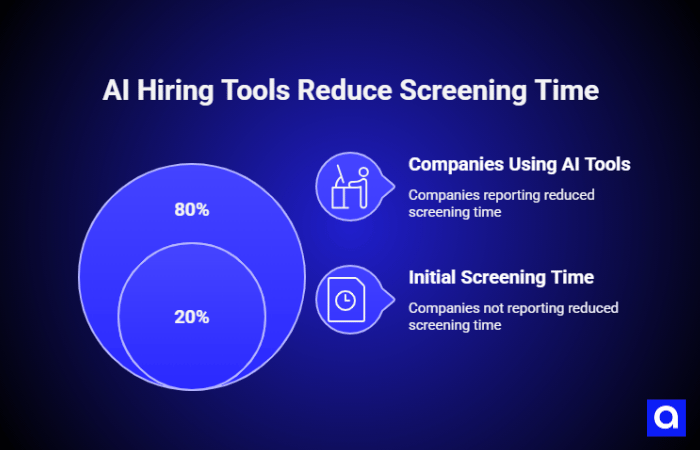
- 80% of companies report reduced screening time with high-volume AI hiring tools. - Source
The Impact of AI on Time-to-Hire and Cost Savings
If you want to build the business case for using AI for recruiting, this section gives you the ammunition. The cost and speed improvements are real, and companies like Hilton and Unilever have the case studies to prove it.
- AI reduces time-to-hire by 33% on average, and some organizations see reductions of 50%. - Source
- Companies report 20 to 40% lower cost-per-hire when AI automates screening and scheduling. - Source
- AI recruitment can reduce hiring costs by 30% per hire and increase revenue per employee by 4%. - Source
- Hilton reduced their time-to-fill ratio by 90% and improved their hiring rate by 40% using AI-powered recruitment tools. - Source
- Unilever saved £1 million annually and boosted workforce diversity by 16% after embedding conversational AI into graduate recruitment. - Source
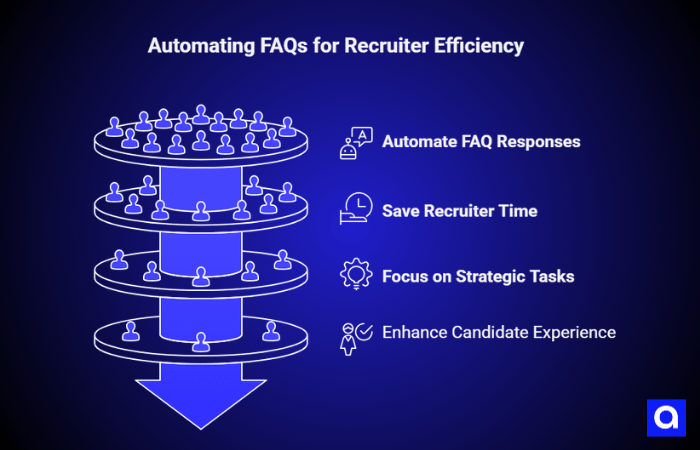
- Automating candidate FAQs saves recruiters 4 to 8 hours per week. - Source
The Impact of AI in Interviewing and Candidate Assessments
AI-powered interviews and assessments have scaled massively. The volume of AI-driven evaluations, the growing trust among HR leaders, and the accuracy gains all point to a category that is becoming mainstream fast.
This is a strong text classification example in practice: algorithms classify candidate responses, score them against rubrics, and predict fit.
- Nearly 20 million assessments and video interviews were completed on HireVue's platform in just Q1 2024. - Source
- AI trust among HR leaders rose from 37% in 2024 to 51% in 2025. - Source
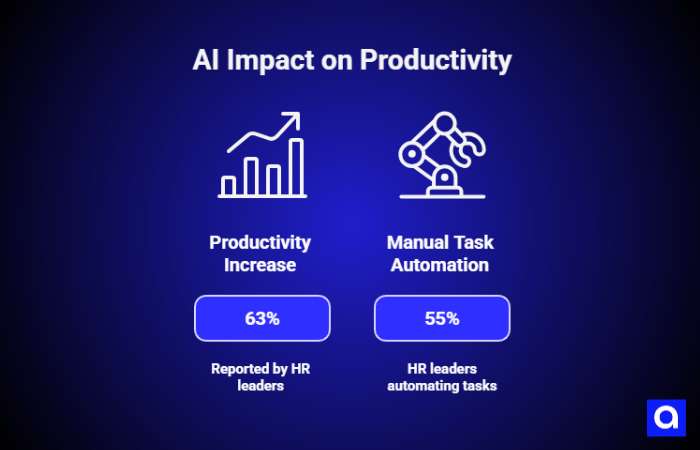
- HR leaders report 63% greater productivity using AI, with 55% automating manual tasks and 52% improving business efficiency. - Source
- Coding interview AI aids cut grading time by 50%+ while increasing rubric adherence. - Source
- AI-driven interview analytics boost hiring accuracy by 40%, and predictive analytics improve talent matching by 67%. - Source
AI vs. Traditional Recruitment Methods
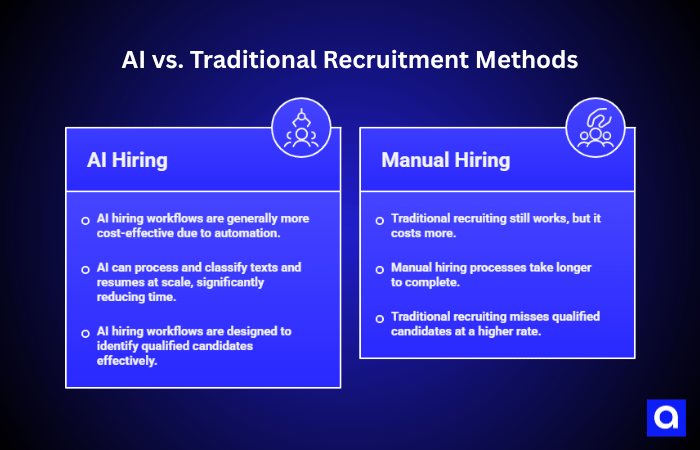
The numbers make a strong case for AI over manual hiring workflows. Traditional recruiting still works, but it costs more, takes longer, and misses qualified candidates at a higher rate. Here is where the classification of texts and resumes at scale gives AI a clear edge.
- According to Gartner, by 2027, 75% of hiring processes will include certifications and tests for workplace AI proficiency. - Source
- The average time to fill a role is 42 days, according to SHRM, and AI tools help reduce that timeline by automating sourcing, screening, and scheduling. - Source
- HR leaders report 63% greater productivity from AI, with 55% using it to automate manual tasks and 52% saying it improves business efficiency. - Source
- Job boards and social sites account for 49% of all applications but contribute less than 24.6% of actual hires. - Source
- Skills taxonomy combined with AI tagging cuts req-to-intake time by approximately 30%. - Source
- A field experiment found job seekers using algorithmic resume assistance were hired 8% more often. - Source
- AI resume parsing reduces paid resume database spend by approximately 15%. - Source
How AI Is Transforming Recruitment Workflows
Beyond screening and interviews, AI is reshaping recruiters' day-to-day work. From chatbots that handle initial inquiries to AI agents that manage entire workflows, the operational transformation is already underway. Think of it as text classification in NLP applied at every stage: sorting queries, categorizing candidate intent, and routing responses automatically.
- 45% of recruiters say AI helps automate tasks so they can spend time on more fulfilling work, and 42% say it helps them manage a larger number of candidates. - Source
- Recruiter productivity increases by 60% when AI handles administrative tasks. - Source
- AI-powered chatbots handle 67% of initial candidate inquiries without human intervention, improving response times by 89%. - Source
- 73% of organizations use chatbots for initial candidate screening, 68% for FAQ responses, and 62% for interview scheduling. - Source
- GenAI summarization reduces meeting note time for intake and kickoff calls by approximately 70%. - Source
- 52% of talent leaders plan to add autonomous AI agents to their teams in 2026. - Source
- AI can forecast skills gaps 3 years in advance, and 80% of organizations are expected to adopt this capability by 2025. - Source
Benefits of AI in Recruiting (Data and Performance Metrics)
The performance data tells a clear story: AI makes hiring faster, improves candidate quality, reduces bad hires, and boosts retention. Deep learning text classification models and predictive analytics sit behind many of these gains, scoring candidates on dimensions that human reviewers often miss.
- 86.1% of recruiters say AI in the hiring process makes it faster. - Source
- Candidates selected by AI have an 18% higher chance of accepting a job offer when extended. - Source
- Organizations using AI for recruiting see a 31% increase in quality of hire. - Source
- Advanced analytics predict job performance with 78% accuracy and retention likelihood with 83% accuracy. - Source
- Predictive hiring models reduce bad hires by 75% and improve employee retention by 34%. - Source
What Is the Opinion of Recruiters on AI in the Hiring Process?
Recruiter sentiment toward AI in recruiting is mostly positive, but it comes with real caveats. Most see AI as a powerful tool, not a replacement for human judgment. The tension between efficiency gains and concerns about fairness runs through every survey.
- 67% of hiring decision-makers say the main advantage of using AI for recruiting is its ability to save time. - Source
- 68% of recruiters think AI can help remove biases from the hiring process. - Source
- 73% of recruiters agree that AI will change how organizations hire, and 70% of TA professionals agree that AI improves hiring efficiency. - Source
- Only 31% of recruiters let AI decide whether they should hire someone, while 75% want human involvement in the final decision. - Source
- 35% of recruiters worry that AI may exclude candidates with unique skills and experiences, and 26% fear AI will destroy HR jobs. - Source
Candidate Experience and Perception of AI-Based Recruitment
Here is where the picture gets complicated. While recruiters are largely on board, candidates are far more skeptical. Transparency about AI in recruitment matters a lot, and most job seekers want to know when algorithms are involved in evaluating their applications.
- Only 26% of applicants trust AI to evaluate them fairly. - Source
- 49% of U.S. job seekers believe AI recruiting tools are more biased than human recruiters. - Source
- 66% of Americans are not aware that employers are using AI in the hiring process. - Source
Challenges and Risks of AI in Talent Acquisition
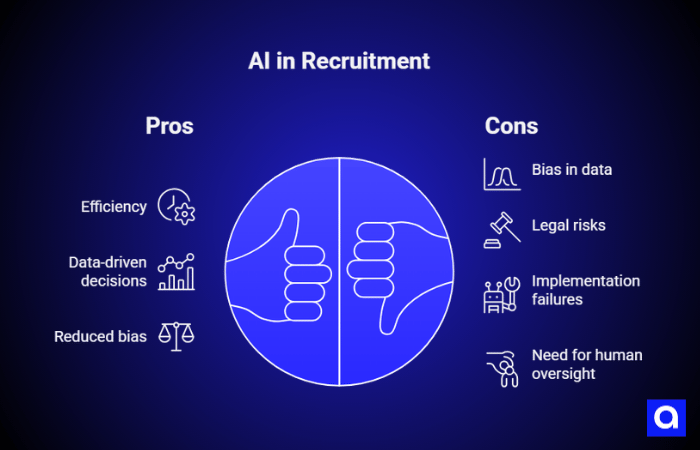
AI in recruitment is not without serious risks. Bias, legal exposure, and implementation failures are documented problems. The good news is that these risks are manageable with the right oversight, auditing, and human involvement. The text classification methods that power these systems are only as fair as the data they train on.
- Amazon famously abandoned its AI recruiting tool after discovering it was biased against women, penalizing resumes containing the word "women's." - Source
- Recent research found AI platforms preferred white-sounding names 85% of the time and never favored Black male names over white male names in resume screening. - Source
- 74% of companies that use AI for hiring struggle to achieve and scale value from their AI initiatives, and 70% of implementation hurdles stem from people and process issues, not the technology itself. - Source
- NYC Local Law 144 requires an annual bias audit and candidate notices before using automated employment decision tools in hiring. - Source
- The EU AI Act classifies hiring AI as high-risk, with compliance obligations phasing in through 2026 and 2027. - Source
- Only 22% of TA leaders believe their organizations can effectively manage teams that combine humans and AI agents. - Source
How Many Recruiters and Companies That Use AI for Hiring?
To give you a clear snapshot of market penetration, here is who is using AI today across company size, HR function, and geography.
- 87% of companies globally rely on AI-based recruitment in their hiring process. - Source
- 44% of HR executives have started using AI for HR recruitment, and 29% have fully implemented one or more AI solutions. - Source
- Over 51% of companies currently reflect the growing use of AI in recruitment, with this number expected to rise to 68% by the end of 2025. - Source
- 35.5% of small and medium-sized businesses allocate budgets to recruiting tools that use machine learning in recruitment. - Source
- Over 100 startups are actively building AI tools for human resource managers. - Source
AI Hiring Trends: 2026 and Beyond
The next few years will bring agentic AI, mandatory AI proficiency assessments, and tighter regulation. If you are planning your recruiting strategy for 2027 and beyond, these projections from Gartner, the World Economic Forum, and Korn Ferry will shape your roadmap.
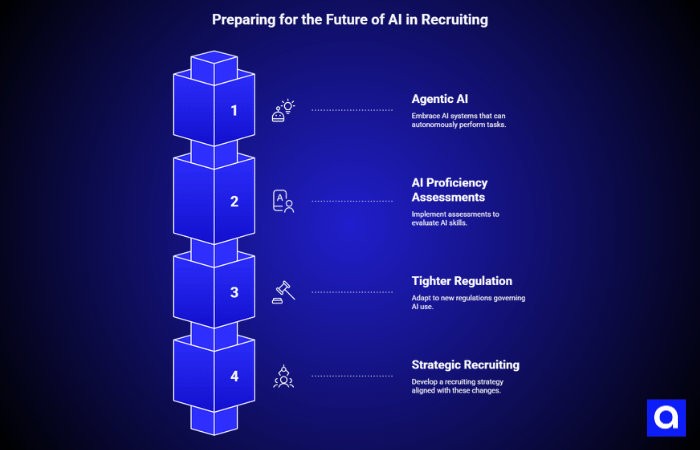
- AI in recruiting will reach 81% adoption by 2027, driven by competitive pressure and measurable ROI. - Source
- According to Gartner, 75% of hiring processes will include AI proficiency certifications and tests by 2027. - Source
- The World Economic Forum's Future of Jobs Report predicts AI will handle 71% of initial recruitment statistics by 2030, with AI managing the majority of first-stage processes. - Source
- By 2030, 94% of AI in recruitment processes are expected to incorporate AI technology at some level. - Source
- According to Korn Ferry, 52% of talent leaders plan to add autonomous AI agents to their teams in 2026, and companies are creating digital identities for AI agents with permissions, responsibilities, and access controls. - Source
- By 2030, half of enterprises will face irreversible skill shortages in critical roles due to GenAI accuracy decline, skills erosion, and uncompetitive pay. - Source
- Through 2026, 50% of global organizations will require "AI-free" skills assessments to counter critical-thinking atrophy caused by GenAI use. - Source
- Korn Ferry forecasts that by 2036, AI agents will outnumber humans 1,000 to 1 in customer service. - Source
Additional AI Recruitment Statistics and Insights
A few more data points that did not fit neatly into the sections above, but are too interesting to leave out.
- 48% of hiring managers admit to having some form of bias that can negatively impact interviews. - Source
- Properly implemented AI reduces hiring bias by 56 to 61% across gender, racial, and educational categories when continuously monitored. - Source
- HR dashboards powered by AI development enhance decision-making by 60%. - Source
- Only 22% of TA leaders believe their organizations can effectively manage human-AI hybrid teams. - Source
If you are building or scaling AI-powered recruitment tools and need experienced engineers who understand machine learning in recruitment, NLP, and text classification methods from the ground up, Azumo can help. Our nearshore AI and ML development teams work in your time zone and integrate directly into your workflow. Let's get in touch today and build something that actually moves the needle for your hiring pipeline.
References
- AI Recruitment Market Size, Growth Analysis, 2035
https://www.marketresearchfuture.com/reports/ai-recruitment-market-8289 - AI Recruitment Market Size & Share, Growth Analysis 2035
https://www.researchnester.com/reports/ai-recruitment-market/6828 - Artificial Intelligence (AI) Recruitment Market Size, Trends & Share Analysis
https://www.mordorintelligence.com/industry-reports/ai-recruitment-market - Artificial Intelligence in HR Market Size & Share Report
https://www.grandviewresearch.com/industry-analysis/artificial-intelligence-hr-market-report - AI Recruitment Statistics 2026: Global Data & Trends
https://www.demandsage.com/ai-recruitment-statistics/ - HireVue’s 2025 AI Report Shows the Majority of HR Leaders Trust AI Hiring Decisions
https://www.hirevue.com/press-release/hirevues-2025-ai-report-shows-the-majority-of-hr-leaders-trust-ai-hiring-decisions - 100 AI Recruitment Statistics You Need to Know Heading Into 2026
https://www.hiretruffle.com/blog/best-ai-recruitment-statistics - The State of AI in 2023: Generative AI’s Breakout Year
https://www.mckinsey.com/capabilities/quantumblack/our-insights/the-state-of-ai-in-2023-generative-ais-breakout-year - State of Artificial Intelligence in Human Resource Management
https://engagedly.com/wp-content/uploads/2023/08/Engagedly_State_Of_AI_in_HR_2023.pdf - Top 100+ AI in Recruitment Statistics for 2026
https://www.secondtalent.com/resources/ai-in-recruitment-statistics/ - Hiring With AI Doesn’t Have to Be So Inhumane. Here’s How
https://www.weforum.org/stories/2025/03/ai-hiring-human-touch-recruitment - 43 AI Recruitment Statistics for Recruiters and Staffing Agencies [2024]
https://www.carv.com/blog/ai-recruitment-statistics-for-recruiters-and-staffing-agencies - AI Recruitment Statistics 2026: Latest Insights & Trends
https://digiexe.com/blog/ai-recruitment-statistics/ - 150+ AI Recruitment Statistics and Trends for 2026
https://www.wecreateproblems.com/blog/ai-recruitment-statistics - Gartner Unveils Top Predictions for IT Organizations and Users in 2026 and Beyond
https://www.gartner.com/en/newsroom/press-releases/2025-10-21-gartner-unveils-top-predictions-for-it-organizations-and-users-in-2026-and-beyond - Time to Fill and Time to Hire Metrics | Recruiting Metrics FAQ
https://resources.workable.com/tutorial/faq-time-to-fill-hire - From Traditional to AI-Enabled Recruitment
https://selectprism.ai/blogs/from-traditional-to-ai-enabled-recruitment - Experimental Evidence on the Productivity Effects of Generative Artificial Intelligence
https://www.nber.org/system/files/working_papers/w30886/w30886.pdf - AI in Recruitment Trends
https://www.kornferry.com/insights/featured-topics/talent-recruitment/ai-in-recruitment-trends - AI Recruitment Statistics
https://resourcera.com/data/artificial-intelligence/ai-recruitment-statistics/ - The Future of Recruiting
https://business.linkedin.com/hire/resources/future-of-recruiting - Gartner Survey Shows Just 26 Percent of Job Applicants Trust AI Will Fairly Evaluate Them
https://www.gartner.com/en/newsroom/press-releases/2025-07-31-gartner-survey-shows-just-26-percent-of-job-applicants-trust-ai-will-fairly-evaluate-them - AI Hiring Risks and Inclusion
https://www.powerpersonnel.com/ai-hiring-risks-inclusion/ - Amazon Scraps Secret AI Recruiting Tool That Showed Bias Against Women
https://www.reuters.com/article/world/insight-amazon-scraps-secret-ai-recruiting-tool-that-showed-bias-against-women-idUSKCN1MK0AG/ - AI Adoption in 2024: 74% of Companies Struggle to Achieve and Scale Value
https://www.bcg.com/press/24october2024-ai-adoption-in-2024-74-of-companies-struggle-to-achieve-and-scale-value - Automated Employment Decision Tools
https://www.nyc.gov/site/dca/about/automated-employment-decision-tools.page - Gartner Says AI Revolution and Cost Pressures Are Two Forces Driving the Top Four Trends for Talent Acquisition in 2026
https://www.gartner.com/en/newsroom/press-releases/2025-10-07-gartner-says-ai-revolution-and-cost-pressures-are-two-forces-driving-the-top-four-trends-for-talent-acquisition-in-2026 - Strategic Predictions for 2026
https://www.gartner.com/en/articles/strategic-predictions-for-2026
Frequently Asked Questions
.avif)
About the Author:
Head of People | HR Analyst & Technical Recruiter | Specialist in People Ops, Data-Driven HR & Talent Strategy
Gerardo Bortolotto, Head of People at Azumo, leads recruitment, onboarding, and culture-building initiatives for a diverse, remote-first team across Latin America and the U.S

.avif)