.svg)
.png)


.avif)
The global AI customer service market hit $15.12 billion in 2026, and 91% of customer service leaders say they feel pressure to implement AI this year. Yet according to SurveyMonkey, 79% of Americans still prefer to talk to a human when they need help.
That tension between business momentum and customer preference tells the real story of artificial intelligence customer service right now. Companies are investing at record levels. Customers are warming up to bots for quick tasks, but still want a real person for anything complicated.
Below, the data breaks down exactly where things stand across 40 AI customer service statistics covering market size, consumer sentiment, industry adoption, tools, ROI, speed, satisfaction, and what comes next.
AI in Customer Service Market Size and Growth Statistics
The money flowing into AI-based customer support tells you how seriously businesses take this space.
1. The global AI customer service market reached $15.12 billion in 2026, up from $12.06 billion in 2024, and it is growing at a 25.8% CAGR toward $47.82 billion by 2030. - Source
2. Live chat, which is heavily AI-powered, achieves 87% CSAT compared to 61% for email and 44% for phone. And 68% of customers agree that quick responses are the most positive aspect of chatbots, according to Userlike. - Source1, Source2
3. Grand View Research values the market at $13.01 billion in 2024 and projects it will reach $83.85 billion by 2033 at a 23.2% CAGR. The same report shows North America holds 37.2% of the global revenue share. - Source
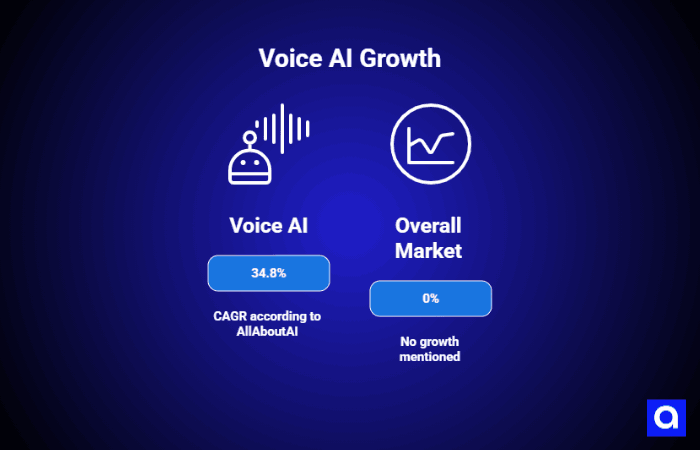
4. The voice AI segment within customer service is growing faster than the overall market, at a 34.8% CAGR according to AllAboutAI. Think phone-based AI agents, voice bots, and real-time speech analytics. This is one of the hottest sub-segments in the space. - Source
5. Conversational AI will reduce contact center labor costs by $80 billion by 2026. That is not just a savings estimate. It reflects the scale at which AI for customer service automation is replacing repetitive agent tasks. - Source
6. There are now 987 million chatbot users globally, up from under 500 million in 2022, according to DemandSage. Nearly doubled in about three years. - Source
7. The generative AI segment for customer service specifically is on track to reach $755.58 million in 2026, scaling toward $2.89 billion by 2032, according to Electroiq. - Source
Consumer Sentiment Toward AI in Customer Service
Here is where the conversation gets interesting, because the AI customer service statistics do not say customers hate AI. It says they are selective about when and how they want to use it.
8. A December 2025 SurveyMonkey study of 2,017 US adults found that 79% of Americans strongly prefer interacting with a human over an AI agent for customer service. - Source
9. A parallel study from Metrigy (503 consumers) puts the number at 84.7% preferring humans. Even when guaranteed issue resolution, 80.1% still choose a human. - Source
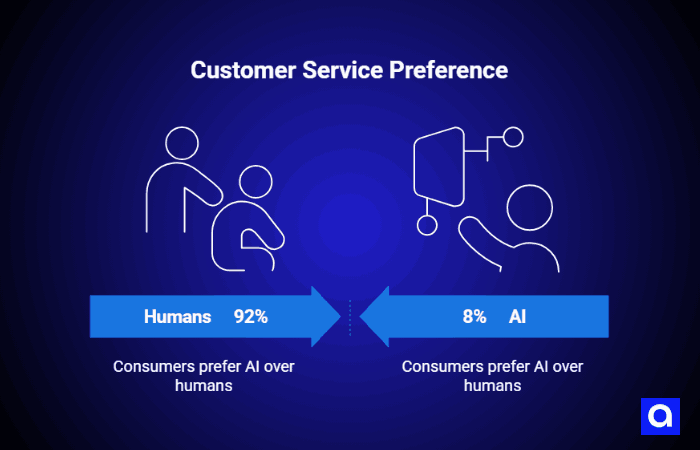
10. Only 8% of consumers prefer AI over humans in customer service. Those who cite better availability (41%), speed (37%), and more accurate information (30%). - Source
11. According to Netfor, 93.4% of consumers prefer humans for customer service overall. But 62% prefer chatbots for simple, routine requests, and 74% want chatbots specifically for quick questions that do not require complex problem-solving. - Source
12. Zendesk data shows 51% of consumers prefer bots when they want immediate service. Speed is the single biggest factor that shifts sentiment toward AI in customer engagement. - Source
13. On the flip side, 75% of customers prefer human agents for complex, sensitive, or emotionally driven issues. This is why hybrid models (AI handles the fast stuff, humans handle the nuanced stuff) keep outperforming pure-AI or pure-human setups. - Source
14. According to Kinsta, 41% of consumers feel customer service has worsened due to AI, and 63% do not believe AI replacing customer service agents entirely is feasible. - Source
15. That said, 56% of customers believe bots will be able to hold natural, human-like conversations by 2026, per Zendesk CX Trends data. Expectations are rising alongside skepticism. - Source
AI Adoption Statistics Across Customer Service Industries
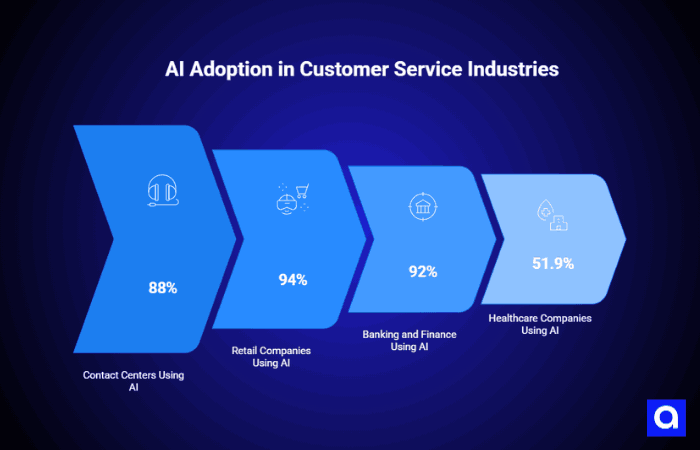
Before we get into sector breakdowns, two numbers frame the big picture. 88% of contact centers report using some form of AI, but only 25% have fully integrated automation into daily workflows.
Retail
16. According to MarketsAndMarkets, retail and e-commerce hold a 21.2% market share of the overall conversational AI market, the largest of any vertical. - Source
17. AllAboutAI reports that 94% of retail companies using AI for customer service say AI has helped decrease operational costs. Early adopters also report a 26.7% lift in revenue and a 32.6% gain in customer satisfaction. - Source
18. E-commerce companies using AI chatbots see a 36% increase in repeat purchases through automated post-sale engagement, according to Gorgias. - Source
19. Mid-market retailers are adopting AI chatbots 3x faster than both small sellers and enterprise retailers. The mid-market is where the action is right now. - Source
Banking and Finance
20. Banking and finance follow telecom in AI adoption with a 92% adoption rate focused on security, speed, and upselling, according to AllAboutAI. - Source
21. According to McKinsey, financial services companies using AI for customer support report 35% faster claim processing and a 28% improvement in fraud detection response times. - Source
22. Bank of America's AI assistant Erica has handled 2 billion interactions and resolves 98% of customer queries within 44 seconds, with clients engaging 56 million times per month. That is a real-world proof point for what a well-built AI assistant looks like at scale. - Source
Healthcare
23. According to Accenture, healthcare AI adoption grew by 51.9% as providers automate non-clinical tasks like appointment scheduling, prescription management, and patient communication. - Source
24. Master of Code Global reports that 75% of leading healthcare companies are experimenting with or planning to scale generative AI across their organizations. - Source
25. NIB Health Insurance saved $22 million through AI-driven digital assistants, reducing customer service costs by 60%. - Source
Telecommunication
26. Telecom leads all industries in AI adoption, with 95% of providers integrating AI into customer support workflows according to AllAboutAI. - Source
27. According to Master of Code Global, 97% of communications service providers report that conversational AI positively impacts customer satisfaction. Personalization via AI in telecom is linked to 5 to 15% revenue growth, while automation brings a 30% reduction in operational costs. - Source
The Use of Artificial Intelligence in Client Support Applications
So, where exactly does AI show up inside customer service operations? Chatbots get the most attention, but the use cases go much deeper.
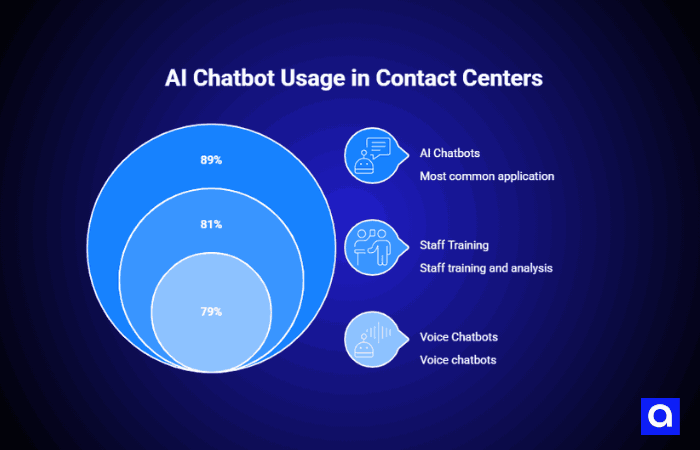
28. AI chatbots are the most common application, used by 89% of contact centers to simulate human-like conversations and provide quick responses. Another 81% use AI for staff training and performance analysis, and 79% use voice chatbots. - Source
29. According to Master of Code Global, the most popular applications break down as follows: routing requests (29%), analyzing feedback (28%), and chatbots or self-service tools (26%). - Source
30. AI triage systems achieve an average of 89% accuracy in correctly categorizing and routing support tickets in real time. - Source
31. According to NextPhone, 65% of incoming support queries were resolved without human intervention in 2025, up from 52% in 2023. That is a big jump in just two years. - Source
32. Agents using AI handle 13.8% more customer inquiries per hour and are 35% less likely to feel overwhelmed during calls, according to Deloitte data reported by Electroiq. - Source
Most Popular AI Tools in Customer Service
The tool you pick depends on your company size, tech stack, and how far along you are with automation. Here is a quick look at the platforms showing up most in 2026:
| Tool | Best For | Key Feature | Pricing Signal |
|---|---|---|---|
| Zendesk AI | Enterprise with complex workflows | Omnichannel, 80+ languages | Suite plans + add-ons |
| Intercom Fin | SaaS, growth teams | 40 to 50% automated resolution | From $0.99/resolution |
| Salesforce Agentforce | CRM-driven enterprise | Deep CRM context, governance layer | From $30+/user |
| Freshdesk Freddy AI | SMBs | Easy setup, 41.56% improvement in first response time | Mid-range pricing |
| Tidio Lyro | Small businesses, e-commerce | Fast setup (under 1 hour), affordable | From $32.50/month |
| Ada | Enterprises needing high automation | AI agents with testing/optimization controls | Custom pricing |
| Gorgias | E-commerce | Shopify-native workflows | Per-ticket billing |
| HubSpot Service Hub | Marketing/sales-aligned teams | CRM integration, shared inbox | Included in HubSpot plans |
According to a 90-day study by Fini Labs across 10 industries, agentic AI achieves 70 to 85% autonomous resolution rates compared to 40 to 60% for standard AI and 20 to 40% for rule-based bots. That gap is why newer agentic platforms are getting so much attention.
And for a real-world example at scale: Klarna's AI chatbot now handles 2.3 million conversations and manages two-thirds of all its customer service interactions.
ROI and Financial Impact Statistics of AI in Customer Service
This is the section that matters most if you are trying to build an internal business case.
33. Companies see an average return of $3.50 for every $1 invested in AI customer service. Top performers report up to 8x ROI. - Source
34. ROI compounds over time. According to typedef.ai, Year 1 ROI averages 41%, Year 2 hits 87%, and Year 3 exceeds 124% as AI systems improve through accumulated learning. A Forrester study cited in the same report found that modeled customers achieved 210% ROI over three years with payback under 6 months. - Source
35. According to Freshworks, the cost per customer interaction dropped 68% after AI implementation, from $4.60 to $1.45. - Source
36. Gartner benchmarks self-service at $1.84 per contact versus $13.50 for agent-assisted interactions. That is a 7.3x cost difference, which explains why so many companies are pushing self-service options hard. - Source
Response Time and Efficiency Statistics with AI
Speed is the one area where AI-driven customer experience has a clear, measurable advantage over human-only support. And customers notice.
37. According to ChatMaxima, AI has cut First Response Time by up to 74% within the first year of implementation. Customer expectations for initial response speed increased 63% between 2023 and 2024, so this is not just nice to have anymore. - Source
38. According to Freshworks, AI-enabled companies resolve tickets in an average of 32 minutes, while non-AI companies can take up to 36 hours. That is a massive gap. Klarna's AI specifically cut average resolution from 11 minutes to 2 minutes, an 82% improvement. - Source1, Source2
Customer Preferences and Satisfaction Statistics
Key Benefits of AI in Customer Service
39. When AI is done well, the satisfaction numbers speak for themselves. According to Lorikeet (citing Dante AI data), 92% of businesses report improved CSAT after implementing AI. - Source
Common Concerns About AI in Customer Service
But the concerns are real and worth paying attention to if you are planning an AI rollout.
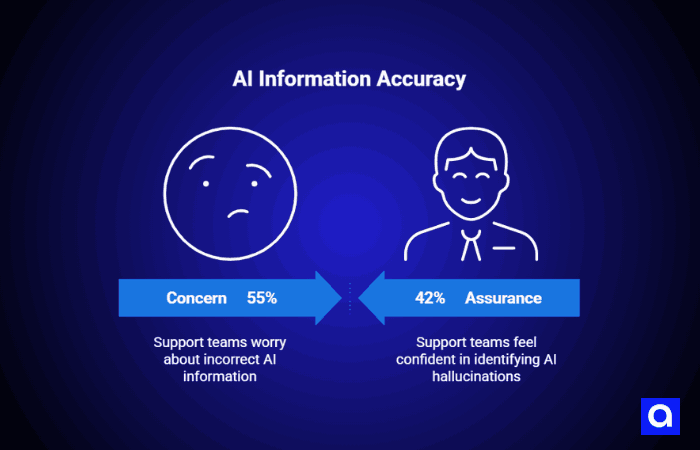
40. According to Master of Code Global, 55% of support teams believe AI can provide incorrect information, and only 42% feel confident they could detect those hallucinations. That is a gap that needs better guardrails and human oversight, not just more automation. - Source
41. SurveyMonkey found that 14% of consumers would lose trust in a business if they interacted with an AI agent that did not clearly disclose it was AI. Getting AI wrong is not a minor issue. It is a brand risk. - Source
Additional Industry and Business Statistics
A few more data points that did not fit neatly into the sections above but still tell an important part of the story:
42. 42% of organizations expect to hire for AI-focused CX roles (conversational AI designers, automation analysts) by the end of 2026. - Source
43. According to Bayelsawatch, 77% of service agents report rising workload, and 56% experience burnout. These are key drivers pushing businesses toward AI-assisted support. And per PwC's 2024 CEO Survey, 70% of global CEOs consider generative AI a technology that will change how businesses create value within the next three years. - Source
44. One big gap remains: according to ChatMaxima, only 33% of companies currently offer omnichannel support that integrates AI tools like chatbots and video calls. Understanding what companies use AI for customer service across all channels reveals just how much room for growth remains. - Source The agent architecture behind this shift is still maturing broadly, with only 23% of organizations actively scaling agentic AI company-wide. Regulated fields like healthcare are adopting at a similar pace, where 75% of U.S. health systems now run at least one AI application.
If you are building AI-powered customer service tools or thinking about scaling your CX operations with intelligent automation, Azumo's AI and ML development team can help you go from strategy to production. Let's get in touch and talk about what that looks like for your business.
References
- AI for Customer Service Market: https://www.marketsandmarkets.com/Market-Reports/ai-for-customer-service-market-244430169.html
- AI In Customer Support Statistics And Trends (2026): https://bayelsawatch.com/ai-in-customer-support-statistics/
- What Do Your Customers Actually Think About Chatbots? https://connect.lime-technologies.com/en/blog/consumer-chatbot-perceptions/
- AI For Customer Service Market (2025 - 2033) https://www.grandviewresearch.com/industry-analysis/ai-customer-service-market-report
- AI in Customer Service 2026: 61+ Stats on ROI, Accuracy, Costs & Global Adoption: https://www.allaboutai.com/resources/ai-statistics/customer-service/
- Gartner Predicts Conversational AI Will Reduce Contact Center Agent Labor Costs by $80 Billion in 2026: https://www.gartner.com/en/newsroom/press-releases/2022-08-31-gartner-predicts-conversational-ai-will-reduce-contac
- AI Chatbot Statistics 2026 (Market Share & Trends): https://www.demandsage.com/chatbot-statistics/
- AI Customer Service Statistics By Market Size, Region And Facts (2025): https://electroiq.com/stats/ai-customer-service-statistics/
- Customer service trends & statistics for 2026: Why consumers still trust humans over AI: https://www.surveymonkey.com/curiosity/customer-service-statistics/
- Study Reveals 85% of Consumers Still Prefer Humans Over AI: https://customerservicemanager.com/85-of-consumers-still-prefer-humans-over-ai/
- AI Has Taken over Customer Service, but Consumers Want Humans Back (A National Online Survey of 1,011 U.S. Consumers): https://kinsta.com/blog/ai-vs-human-customer-service/
- 59 AI Customer Service Statistics for 2026: https://www.zendesk.com/blog/ai-customer-service-statistics/
- New Data Shows 4 Ways Automation Impacts Customer Service: https://www.gorgias.com/blog/automation-impact-on-cx-data
- 55+ AI Customer Support Statistics and Trends for 2026: https://chatmaxima.com/blog/ai-customer-support-statistics-2026/
- BofA’s Erica Surpasses 2 Billion Interactions, Helping 42 Million Clients Since Launch: https://newsroom.bankofamerica.com/content/newsroom/press-releases/2024/04/bofa-s-erica-surpasses-2-billion-interactions--helping-42-millio.html
- AI in Customer Service Statistics: 50+ Actionable Insights for your Business Strategy: https://masterofcode.com/blog/ai-in-customer-service-statistics
- AI Customer Support Statistics: 30 Numbers You Need to Know: https://chatmaxima.com/blog/ai-customer-support-statistics/
- AI Customer Service Statistics for 2025: Market Size, Regional Growth, Industry Trends, and Key Insights: https://completeaitraining.com/news/ai-customer-service-statistics-for-2025-market-size/
- AI Customer Service Statistics 2026: 75+ Data Points Shaping the Industry: https://www.getnextphone.com/blog/ai-customer-service-statistics
- Beyond the Noise: Orchestrating AI-driven Customer Excellence: https://assets.kpmg.com/content/dam/kpmg/xx/pdf/2024/10/customer-experience-excellence-report-2024.pdf
- Customer Service ROI: How to Improve with AI in 2025: https://www.sprinklr.com/blog/customer-service-roi/
- Benchmarks to Assess Your Customer Service Costs: https://www.gartner.com/en/documents/5164231
- The Customer Service Benchmark Report 2025: https://www.freshworks.com/assets/resources/Customer-Service-Benchmark-Report-2025.pdf
- AI Customer Service Statistics 2026: 47 Data Points: https://www.dante-ai.com/news/ai-chatbot-statistics-2026-why-75-of-customers-prefer-ai-chatbots
Frequently Asked Questions

About the Author:
Founder & CEO | Azumo
Chike Agbai, Founder & CEO of Azumo, leads a nearshore software development firm that builds intelligent applications using top-tier Latin American talent.



.avif)