.svg)
.png)


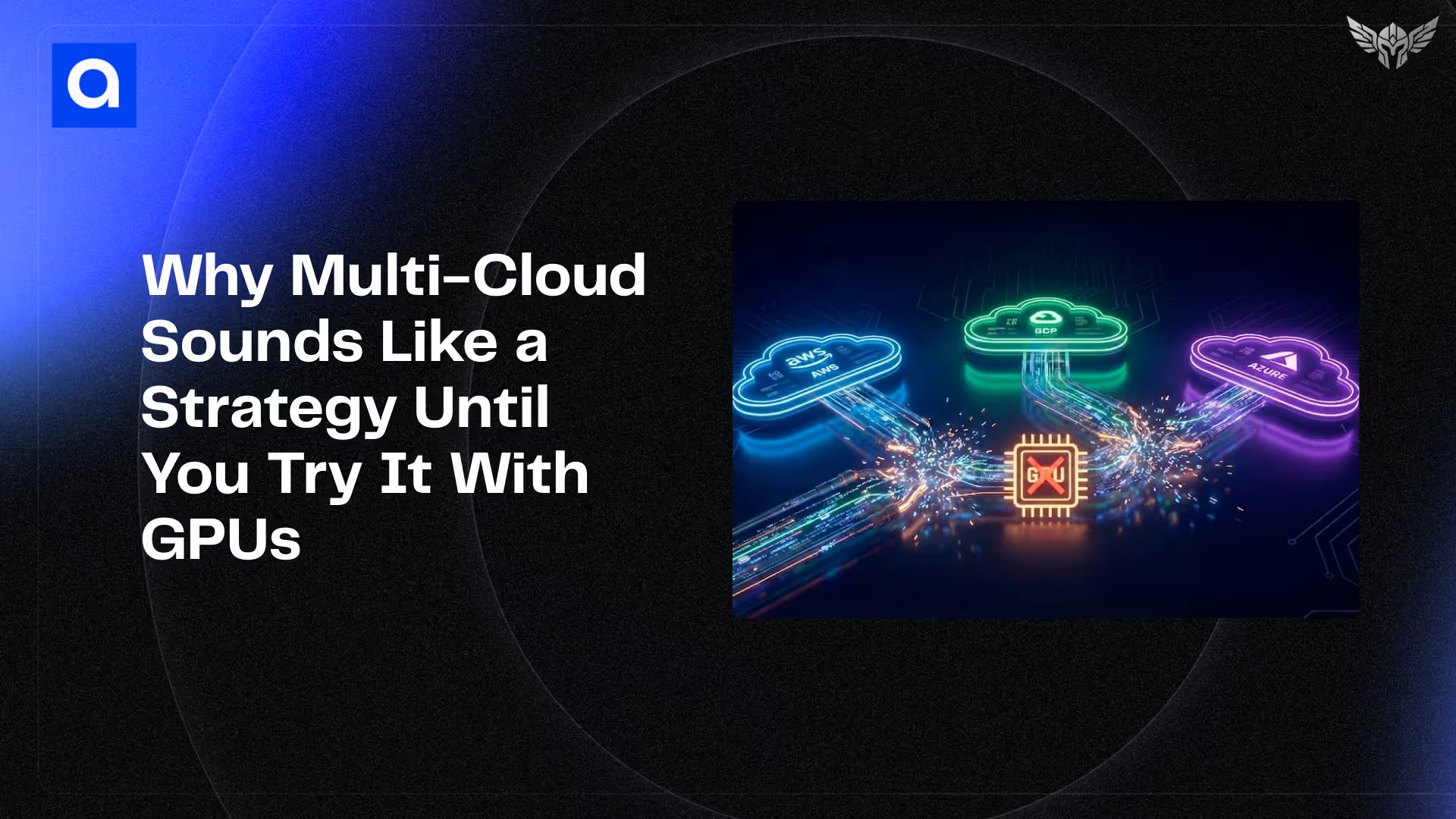
Multi-cloud infrastructure has become conventional wisdom in enterprise infrastructure planning. The pitch appeals to sound instincts: by distributing workloads across multiple cloud providers, organizations gain flexibility, avoid vendor lock-in, reduce risk from single-provider failures, and access competitive pricing.
Infrastructure teams have spent the last decade successfully applying these principles to compute, storage, and networking, building portable applications that run on AWS, Azure, Google Cloud, or on-premises with minimal friction. The patterns work well. Containers enable portability. Kubernetes provides unified control. Infrastructure-as-code ensures reproducibility. Organizations with mature cloud and DevOps practices still struggle when extending these patterns to GPU infrastructure due to fundamental architectural differences.
The logic suggests that these same patterns should work for GPU workloads. In theory, they do. In practice, multi-cloud GPU infrastructure reveals fundamental assumptions that collapse under accelerated computing's unique constraints.
GPU infrastructure introduces problems that traditional multi-cloud computing was never designed to handle.
Unlike compute, memory, and networking—which have largely standardized across providers—GPU offerings remain fractured.
AWS provides NVIDIA GPUs across multiple generations in specific instance families, each with different networking capabilities and performance characteristics.
Google Cloud prioritizes TPUs, with NVIDIA GPUs available in different configurations.
Azure combines NVIDIA GPUs with custom silicon. The landscape represents fundamental divergence in product philosophy, not a choice between equivalent options.
When building multi-cloud for traditional workloads, you assume near-equivalence across providers. With GPUs, you're assuming you can port performance-sensitive code across fundamentally different hardware architectures. The assumptions break immediately.
GPU constraints extend beyond hardware specifications. They affect networking, storage, observability, cost modeling, and operational procedures in ways traditional compute does not.
A workload optimized for NVIDIA CUDA on A100 GPUs does not simply "work" on TPUs or newer architectures without substantial rework. The software ecosystem's CUDA dominance in deep learning means switching providers requires revalidating models, rerunning benchmarks, and managing performance variability that your primary environment never encountered.
The promise of multi-cloud portability becomes a source of complexity, risk, and hidden costs that accumulate until operations become unsustainable.
We've observed consistent outcomes when organizations attempt truly agnostic multi-cloud GPU strategies: they reduce single-provider dependency while dramatically increasing complexity, operational burden, performance inconsistency, and total cost of ownership that frequently exceeds single-provider approaches.
This seems counterintuitive until you examine where real operational costs actually live. They do not exist in hourly compute rates. They exist in engineering effort, infrastructure specialization, incident response complexity, and the opportunity cost of building abstraction layers instead of solving actual business problems.
Why Traditional Multi-Cloud Patterns Break Down for GPUs
Successful multi-cloud strategies rest on abstraction layers that hide provider specifics while preserving application behavior. This works well for most infrastructure. Container images are portable. Kubernetes manifests are broadly compatible. Terraform abstracts cloud APIs into unified syntax.
These abstractions work because underlying resource models are similar enough that indirection effectively bridges them. Compute is compute. Storage is storage. A running container doesn't care whether it executes on AWS EC2 or Azure VMs. The abstraction layer adds minimal overhead, and portability's benefit vastly outweighs the cost.
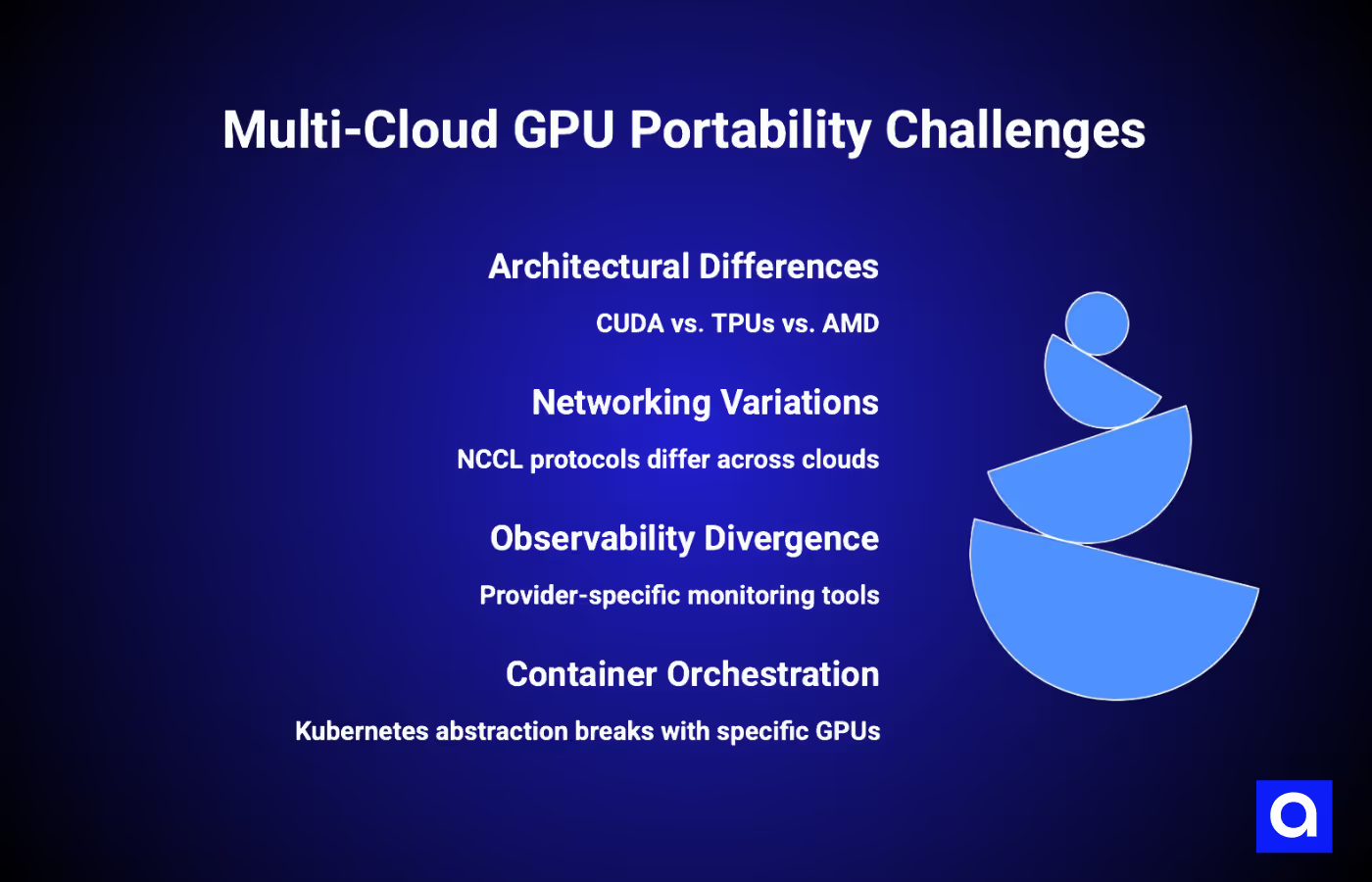
Multi-cloud GPU infrastructure breaks this assumption fundamentally. A CUDA-optimized model running on NVIDIA A100 GPUs is not equivalent to the same model running on Google TPUs or AMD MI300X GPUs. The difference is not minor API variations that abstraction layers smooth over. It is architectural. CUDA is proprietary programming built specifically for NVIDIA. The deep learning ecosystem assumes NVIDIA dominance.
Porting CUDA code to TPUs means switching programming models entirely. The same conceptual operation requires different implementations. Performance characteristics shift. Memory layouts differ. Optimization techniques that improve one architecture actively harm another. Comprehensive LLM model evaluation becomes essential when comparing performance across different cloud GPU providers. Building truly portable abstractions that hide these differences requires such thick indirection layers that you forfeit most GPU performance benefits.
This challenge extends beyond code execution environments. GPU instances across providers come with different networking capabilities, different storage options, different placement group strategies, and different multi-GPU communication approaches.
An application optimized for NVIDIA NCCL collective communication protocols on AWS needs validation and potential rework on Azure. Physical topologies differ. Bandwidth characteristics differ. Latency patterns differ. What works as an all-reduce operation across eight H100 GPUs in an AWS placement group may perform poorly across the same GPUs distributed in an Azure cluster due to underlying network topologies.
These are concrete performance penalties, not abstract concerns. They directly impact model training time, inference latency, and ultimately the economics of running AI workloads.
Observability divergence creates another critical failure point for generic multi-cloud GPU strategies. Monitoring GPU utilization, tracking thermal characteristics, detecting performance degradation, and correlating infrastructure events to application behavior requires deep provider-specific instrumentation.
NVIDIA's GPU Cloud tools integrate closely with AWS infrastructure. Google's stack assumes you're using their monitoring products. Azure presents a different telemetry landscape entirely.
Building a unified observability layer across all three environments forces a difficult choice: create a thick abstraction normalizing metrics across providers, accepting fidelity loss and missed provider-specific insights, or maintain provider-specific observability stacks that fragment operational visibility. In practice, organizations usually do both. They create thin abstractions for headline metrics while maintaining provider-specific dashboards for detailed debugging.
This fragmentation becomes acute when troubleshooting performance issues requiring deep understanding of provider-specific GPU behavior. You cannot quickly debug anomalies when your observability tools only show normalized metrics that hide underlying variation.
The Container Orchestration Problem deserves specific attention because it's where organizations expect portability to work but reality is more nuanced. Kubernetes has become standard for container orchestration, and it supports GPU scheduling. Multiple cloud providers offer Kubernetes-as-a-service products. This convergence creates expectations that GPU workloads are portable across Kubernetes clusters.
In some cases, this expectation holds. Simple containerized applications with reasonable GPU requirements can migrate between providers with modest effort. The moment you need specific GPU hardware, you need to tune for provider-specific characteristics, or you need to optimize for cost-efficiency dependent on provider-specific offerings, the abstraction breaks.
A Kubernetes manifest requesting "any NVIDIA GPU" might schedule on completely different hardware depending on which provider your cluster runs on. The underlying performance, cost, and reliability characteristics can vary dramatically.
An autoscaling policy that works correctly for A100 GPUs at a specific price point becomes dangerous when it schedules workloads on H100 GPUs at different cost structures, or on provider-specific GPU variants with different scaling properties.
Multi-Cloud GPU Redundancy: Why Failover Strategies Fail
Organizations pursuing multi-cloud GPU strategies frequently cite availability as primary motivation. The reasoning seems straightforward: if GPU resources become unavailable at one provider, workloads can failover to another, maintaining service continuity.
This logic would be compelling if GPU scarcity were randomly distributed across providers. It is not. GPU scarcity follows market-wide demand. When demand for GPUs is high, it's high across all providers simultaneously. AWS, Google Cloud, and Azure face identical underlying GPU supply constraints.
When new models like GPT-4 or Claude create demand surges, all providers experience capacity constraints. When NVIDIA releases new architectures, supply limitations affect all providers. Building redundancy assuming one provider will have capacity when another does not is betting against market fundamentals.
This dynamic has played out repeatedly over the past two years. During peak GPU demand periods, all cloud providers simultaneously reported capacity limitations for popular GPU types.
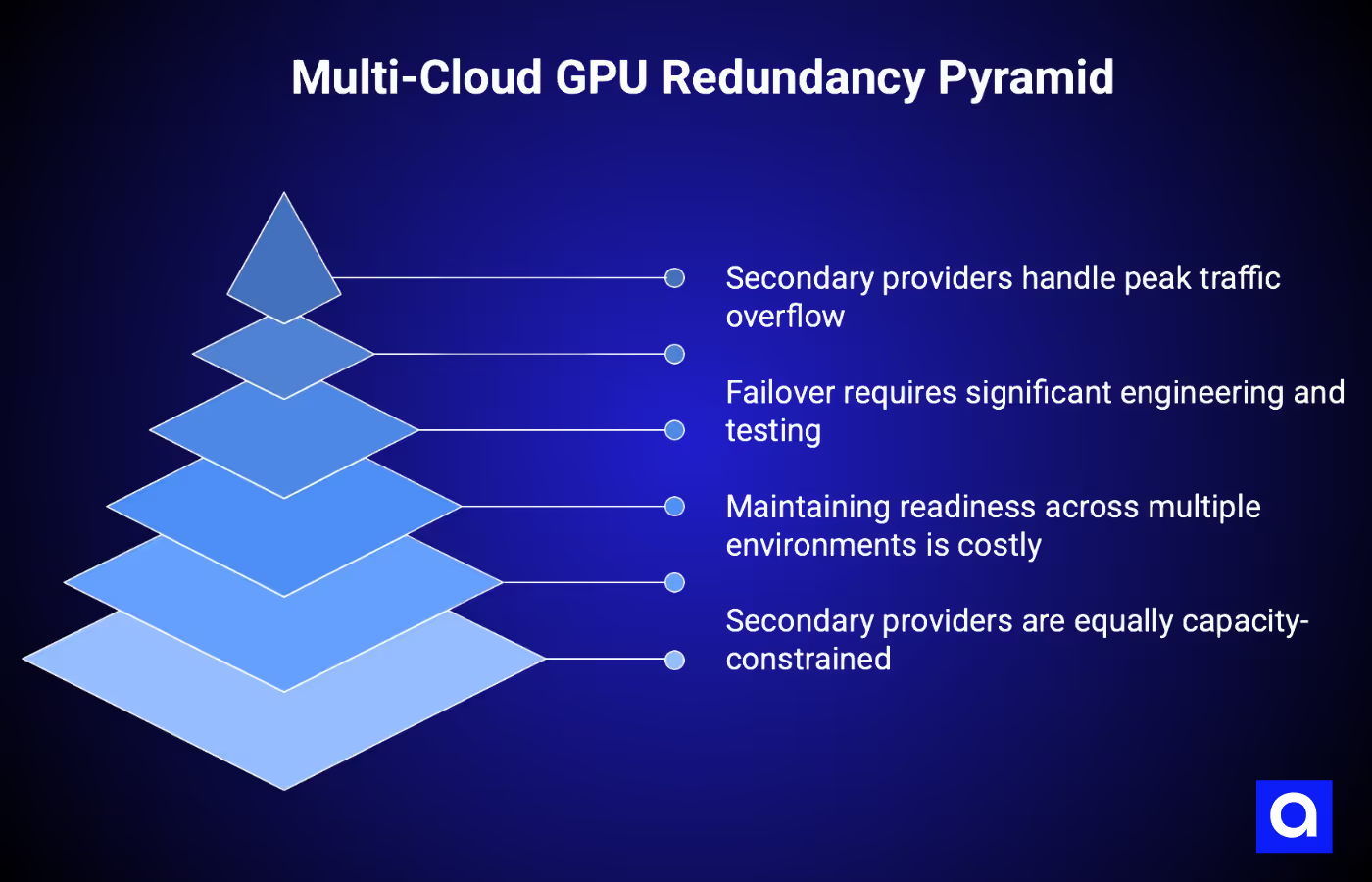
Organizations with workloads spread across multiple providers couldn't failover because secondary providers were equally capacity-constrained. The theoretical multi-cloud redundancy benefit disappeared precisely when needed most.
What remained was the complexity of maintaining readiness across multiple environments, with actual availability benefit reduced to narrow edge cases: isolated provider outages affecting some datacenters but not others, which are relatively rare and brief. For most organizations, the realistic availability benefit of multi-cloud GPU infrastructure is marginal compared to complexity and cost.
Maintaining readiness across multiple providers is itself costly, and organizations underestimate this cost. Running a truly capable failover environment requires sufficient capacity at secondary providers to actually handle failover traffic.
If your primary environment runs H100 GPUs at AWS and your secondary environment is "available" but only holds token capacity, that secondary environment is theoretical. In real failover scenarios, you cannot instantly provision new capacity; new requests get rejected or delayed.
True redundancy requires meaningful capacity across all providers. This means paying for idle capacity at secondary providers specifically to ensure availability during failover. The math is unforgiving. If your primary cluster is 80% utilized and you want to maintain true failover capability at a secondary provider, you need approximately 80% of that capacity sitting idle at the secondary provider. You're paying for GPU infrastructure twice, most of the time, to protect against simultaneous provider failures that rarely occur.
Failover challenges extend beyond capacity planning. Switching an application from one provider to another requires more than starting workloads in a different environment. Data needs to move, or be reaccessed, or exists in provider-specific storage systems lacking equivalents in the failover provider. State needs transfer. Caches need rebuilding. Distributed model replicas need synchronization.
A datacenter-to-datacenter failover well-understood for traditional infrastructure becomes complex data movement and state reconciliation choreography for GPU workloads. The failover process, which should be automatic to be truly reliable, becomes a choreography requiring significant engineering to make reliable.
Organizations frequently discover their planned failover procedure has subtle bugs or performance characteristics not apparent in design reviews. The first real failover event often becomes a painful learning opportunity.
The distinction between what's theoretically possible and what's operationally reliable for GPU multi-cloud failover is substantial. In practice, many organizations maintaining multi-cloud GPU environments use the secondary provider as a safety valve for peak traffic overflow, not as true hot failover.
This is honest representation of what's typically achievable: cost optimization and capacity overflow handling, rather than true high-availability failover. If your actual use case is overflow handling, that's legitimate multi-provider usage. But it should be acknowledged for what it is, not dressed up in availability rhetoric.
Multi-Cloud Computing Cost Optimization: What’s The Hidden Complexity?
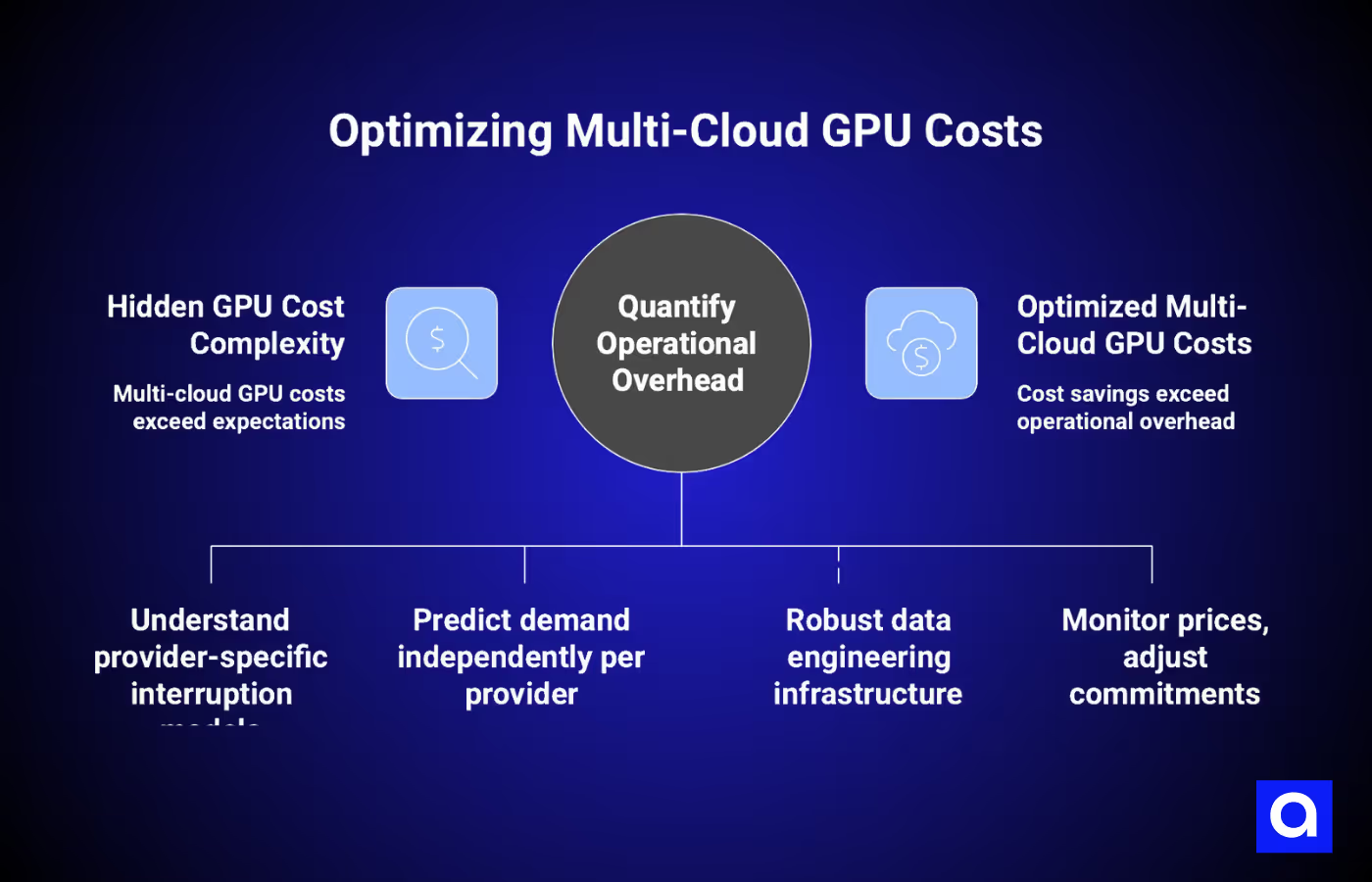
Multi-cloud proponents frequently argue that cost optimization is a primary benefit of distributing workloads across providers. By comparing prices and routing workloads to the cheapest provider, organizations can reduce infrastructure spending.
This logic is sound in principle and works reasonably well for stateless workloads like batch processing where migration between providers is straightforward. For GPU infrastructure, the cost optimization thesis becomes substantially more complex and frequently delivers less benefit than expected.
Pricing comparison challenges begin with the fact that GPUs are not simple commodities sold at standardized prices. AWS offers the same GPU hardware in different instance families with different price points depending on what other resources are bundled.
A GPU instance might be sold as part of a highly optimized instance family with specific networking characteristics, or as a more generic compute environment with the same GPU. Reserved instances add another dimension with different commitment periods and different discount levels depending on your upfront commitment. Savings plans add yet another pricing model. Spot instances introduce variable pricing fluctuating based on current demand. Comparing "the cost of GPU compute" across providers requires assumptions about instance sizing, commitment levels, usage patterns, and whether you're comparing reserved pricing, on-demand pricing, or some blend.
The comparison is rarely apples-to-apples. An H100 GPU at AWS on-demand pricing looks expensive compared to Google Cloud spot pricing, but layer in data transfer costs, integration costs, and the operational overhead of managing spot instances, and the comparison becomes muddy.
Spot instance complexity deserves specific attention because it's where organizations expect cost savings but frequently encounter operational friction. Spot instances offer significant discounts, sometimes 70-80% off on-demand pricing, in exchange for possible interruption.
For workloads handling interruption cleanly, spot instances are excellent cost optimization tools.
For GPU training, depending on your checkpointing strategy and training duration, spot instances can provide meaningful savings. Managing spot instances across multiple providers requires different operational approaches. AWS spot instances have specific interruption characteristics. Google Cloud preemptible VMs have different behaviors. The tooling for managing spot workloads differs. The allocation policies differ.
An organization using spot pricing across multiple providers effectively needs to understand and optimize for each provider's specific interruption model. This specialization cost often exceeds savings from lower hourly rates.
Reserved capacity conflicts create another hidden cost center in multi-cloud GPU strategies. If you have committed capacity at AWS through reserved instances, you're paying a sunk cost for that capacity regardless of whether you use it.
Adding a secondary provider means making a separate capacity commitment there as well. The reserved instances you purchased at your primary provider don't carry over to your secondary provider. You can't flexibly move capacity between them. You need to predict demand at each provider independently and commit capacity accordingly.
If you predict demand incorrectly at one provider, you either have idle reserved capacity or insufficient committed capacity and need to pay on-demand rates for overflow. The friction of managing multiple independent capacity commitments often means organizations make suboptimal commitment decisions, paying more for on-demand capacity than they would have if they'd committed correctly to a single provider.
Egress costs represent a frequently underestimated aspect of multi-cloud GPU economics. Moving data out of a cloud provider incurs charges. These charges vary by provider but are universally present and can be substantial. Organizations need robust data engineering infrastructure to manage data pipelines efficiently across multiple cloud providers. If your GPU workloads consume significant input data or generate significant output data that needs moving between providers or to on-premises infrastructure, egress costs can easily exceed hosting cost savings from using a cheaper secondary provider.
An organization paying $0.12 per GB for egress might be moving terabytes of model training data in and out of GPU environments daily. Egress costs can quickly dwarf hourly compute savings from choosing the cheaper provider.
This calculation is especially important for organizations doing large-scale batch processing or dealing with large model artifacts. A training job that saves 20% on compute costs but incurs 40% additional egress costs is not cost-optimized; it's worse off than using a single provider.
We've calculated that the operational overhead of managing cost optimization across multiple providers should be quantified in engineering time. Optimizing provider selection requires monitoring prices, understanding when commitments should be adjusted, managing workload movement between providers, and continuously evaluating whether current distribution is optimal. This is not a fire-and-forget decision.
Market conditions change. Provider offerings evolve. Demand patterns shift. Maintaining truly optimized multi-cloud GPU environments requires continuous attention. The engineering cost of managing this optimization frequently exceeds cost savings.
An organization with one engineer spending 20% of their time optimizing provider selection across multiple cloud providers is making a trade-off: that engineer is not building features, improving reliability, or solving other engineering problems. At typical cloud engineer salary levels, the 20% time cost often exceeds multi-cloud savings.
Operational Burden of Multi-Cloud GPU Infrastructure at Scale
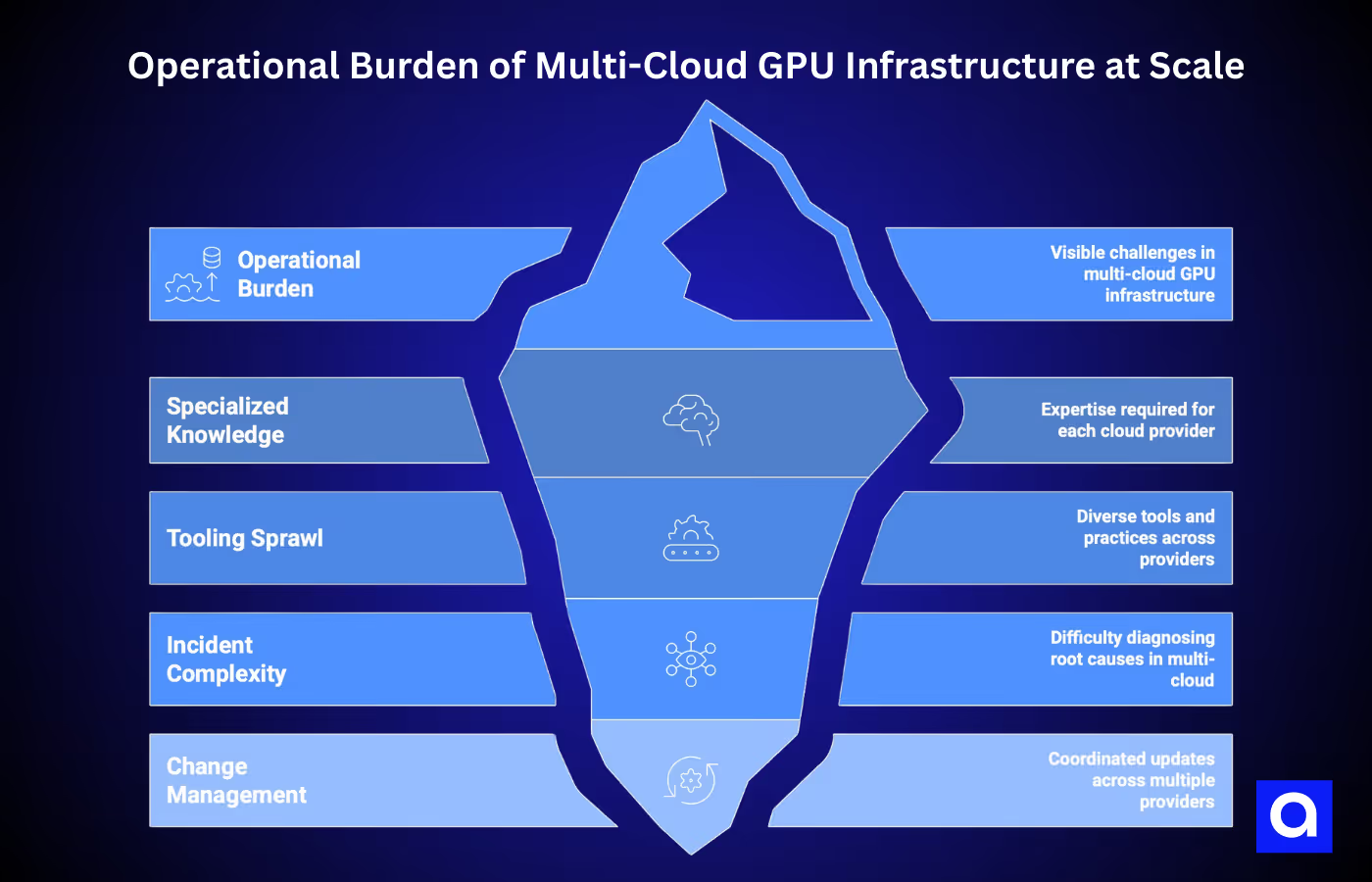
The operational burden of multi-cloud GPU infrastructure increases non-linearly as scale grows. A small pilot with a handful of GPU instances across two providers is manageable. A production environment with hundreds or thousands of GPU instances across multiple providers becomes a complex system requiring substantial specialized knowledge, sophisticated tooling, and careful operational procedures.
Specialized knowledge per provider represents a real hiring and retention challenge. Each cloud provider has its own GPU offerings, best practices, common failure modes, and unique tooling. Someone expert in AWS GPU instances has learned patterns specific to AWS. That expertise doesn't fully transfer to Google Cloud.
An organization maintaining production GPU infrastructure across multiple providers needs engineers with deep expertise in each provider or must accept that some provider-specific optimizations and debugging will be suboptimal.
Hiring engineers with expertise in multiple GPU providers is harder than hiring single-provider experts because the available pool is smaller and the learning curve is steeper. Many organizations find it more practical to partner with experienced AI development companies than to build multi-cloud GPU expertise internally.
Retaining these engineers is harder because they're valuable and many organizations compete for the same talent. The operational cost of hiring and retaining multi-cloud GPU expertise is substantial and is often not factored into cost-benefit analyses of multi-cloud strategies.
Tooling sprawl is a natural consequence of multi-cloud infrastructure. The gold standard for GPU infrastructure automation at AWS might be CloudFormation templates with AWS-optimized patterns.
Google Cloud has different tooling and different best practices. Azure has yet another approach.
An organization maintaining production infrastructure across all three could theoretically use Terraform to abstract across providers, and that's a reasonable approach, but Terraform abstracts many provider-specific capabilities.
You end up creating more generic infrastructure that doesn't take advantage of provider-specific optimizations.
Alternatively, you maintain provider-specific tooling stacks and accept that your infrastructure management looks different across providers.
Either approach creates cognitive overhead.
Engineers need to understand multiple tooling approaches. Playbooks and runbooks need to be provider-specific. Automated deployments become more complex. Orchestrating a deployment across multiple providers requires meta-orchestration. Error handling needs to account for provider-specific failure modes.
The net result is that infrastructure deployment, which should be well-understood and routine, becomes a complex orchestration problem with more failure modes and requiring more specialized knowledge.
Incident response complexity increases dramatically in multi-cloud environments, especially when incidents involve GPU infrastructure. GPU workloads are sensitive to small infrastructure variations. A network issue affecting one provider might manifest as training job performance degradation or inference latency increases.
When an incident occurs in a multi-cloud environment, determining which provider is the root cause requires deep understanding of how the workload spans providers, where data flows, and how the application interacts with each provider's infrastructure. Is the problem with GPU instances at AWS or the storage system at Google Cloud or the networking between them?
Diagnosing this becomes harder when you have unfamiliar provider-specific tools and when your engineers are not deep on each provider's diagnostics capabilities. Mean time to resolution for GPU-related incidents tends to increase in multi-cloud environments compared to single-provider environments, holding engineer skill constant.
Change management becomes another source of operational friction. Rolling out infrastructure changes, updating GPU drivers, deploying new kernel versions, or adjusting configurations should ideally be coordinated and automated. In multi-cloud environments, changes that should be straightforward become choreographed across multiple providers.
A firmware update to GPU infrastructure might be handled automatically by one provider and require manual intervention at another. Deploying a new CUDA version that includes performance improvements needs validation on each provider separately because performance characteristics and compatibility might vary.
Coordinating updates across multiple providers increases risk and complexity. It also increases the time required to respond to security vulnerabilities or performance problems requiring infrastructure-level fixes.
When Multi-Cloud GPU Strategy Makes Sense
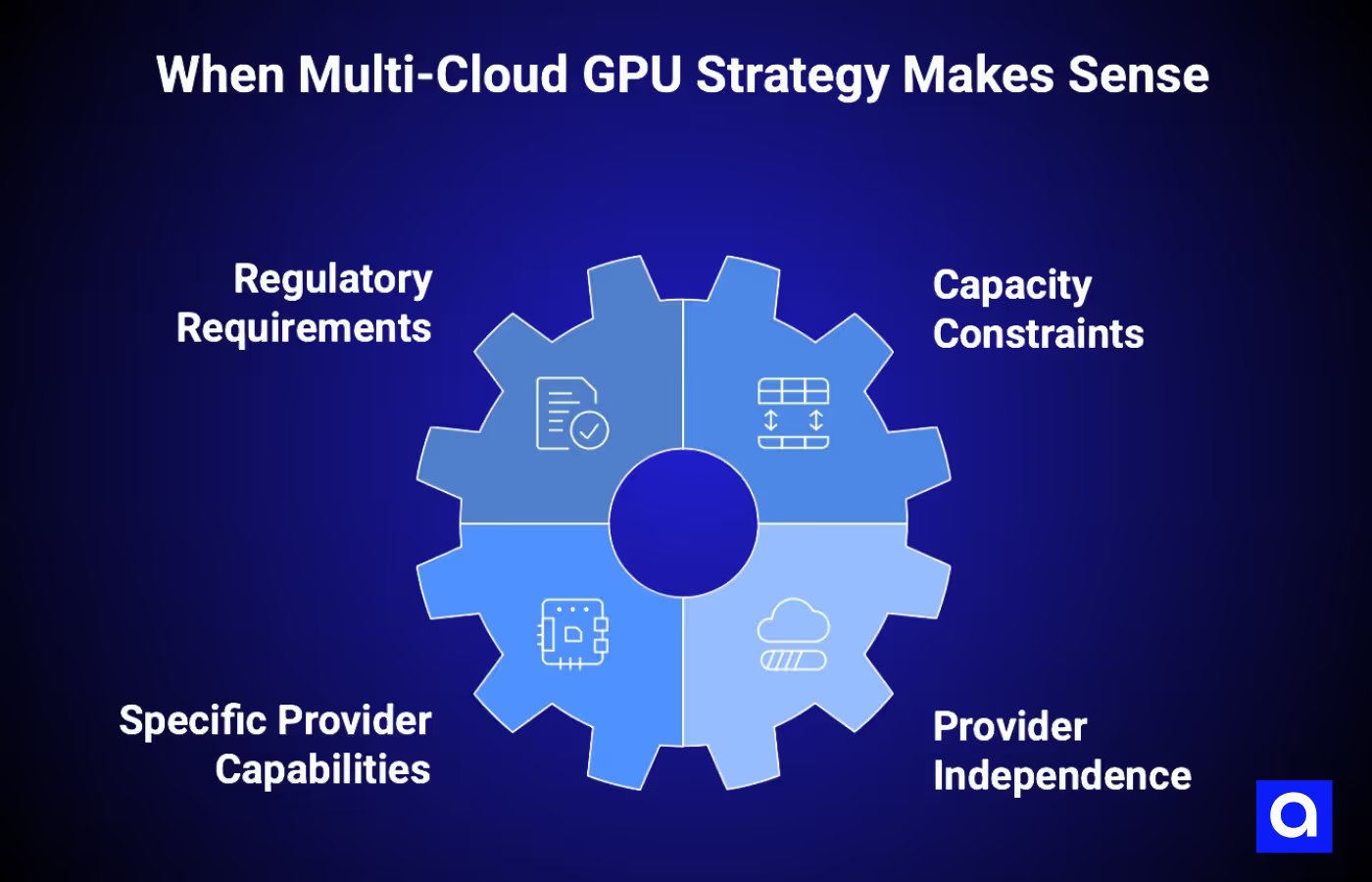
Despite substantial operational and cost challenges, multi-cloud GPU infrastructure is not categorically wrong. There are legitimate scenarios where multi-cloud GPU strategies make sense and deliver real value. Recognizing these scenarios is important for avoiding over-generalization.
Regulatory requirements sometimes necessitate multi-cloud or multi-region strategies. Organizations subject to data residency regulations might need to ensure workloads and data remain within specific geographic boundaries or regulatory jurisdictions.
If your primary provider doesn't offer infrastructure in a required jurisdiction, using a secondary provider becomes a regulatory mandate, not an optimization choice.
Similarly, some regulations require geographic redundancy or prevent dependence on a single provider. In these cases, multi-cloud is a compliance requirement, and the operational costs are non-negotiable.
The question then shifts from "should we use multi-cloud" to "given that we must, how do we optimize the operational approach?"
Genuine capacity constraints sometimes make multi-cloud necessary. Organizations with intensive GPU requirements exceeding what a single provider can supply might need multiple providers simply to access sufficient capacity.
A large AI development organization might need thousands of GPUs for parallel training experiments. AWS might have limited capacity for certain GPU types. Adding Google Cloud or Azure to access additional capacity becomes economically rational.
This is fundamentally different from choosing multi-cloud for flexibility or redundancy. You're choosing multi-cloud because you have genuine utilization exceeding single-provider capacity. The operational cost of managing multiple providers is justified because the alternative is not running your workloads at all.
Specific provider capabilities sometimes drive multi-cloud strategies. Google TPUs might offer superior performance for certain workloads compared to NVIDIA GPUs. Some organizations might need specific Azure services unavailable elsewhere.
If your core workload genuinely performs better on a specific provider and your secondary workload performs better on another provider, and the workloads are sufficiently different that they don't interfere with each other, then multi-cloud is rational.
You're optimizing for performance characteristics, not abstracting over provider variation. The key is being honest about whether the workload difference is real or whether you're just finding justification for a multi-cloud strategy that doesn't actually serve a purpose.
Provider independence and avoiding vendor lock-in is sometimes cited as a reason for multi-cloud strategies, but it deserves skepticism. True vendor independence is harder to achieve with GPU infrastructure than with traditional compute.
Once you've optimized your workloads for specific GPU hardware and provider ecosystems, moving away from that provider becomes expensive and operationally risky, regardless of how many providers you initially chose. Multi-cloud doesn't eliminate vendor lock-in; it distributes it. You're locked in to each provider you use.
The theoretical freedom to move workloads between providers needs to be weighed against operational complexity and costs of maintaining that portability. For most organizations, accepting some level of primary provider dependence in exchange for operational simplicity is a more pragmatic trade-off than attempting to maintain artificial provider independence through multi-cloud complexity.
Primary Provider Strategy: Smarter Multi-Cloud GPU Approach
We recommend that organizations reconceptualize their GPU infrastructure strategy away from symmetric multi-cloud toward a primary provider strategy with targeted use of additional providers for specific purposes.
This approach acknowledges the reality that one provider will almost certainly be your primary GPU home. Accept this and optimize for it. The question becomes where and when supplementary providers add value rather than complexity.
A primary provider strategy means choosing one provider as your primary GPU home based on factors like availability of specific GPU hardware, cost structure, regulatory alignment, existing relationships, or organizational experience.
Most infrastructure decisions and optimization should be made with this provider in mind. Your primary engineering expertise should develop around this provider. Your standard tooling, practices, and runbooks should be based on primary provider best practices.
This creates deep domain knowledge and operational efficiency. It also means that you're not constantly fighting abstraction layers and can take advantage of provider-specific capabilities and optimizations.
A secondary provider becomes a targeted supplement. Rather than attempting to maintain full production-grade infrastructure at multiple providers, use secondary providers for specific purposes where they add clear value. Overflow capacity during peak demand is a legitimate use case.
If your primary provider reaches capacity and you have additional workload that needs to run, using a secondary provider for overflow is more cost-effective than storing that work in a queue or turning customers away.
Specialized workloads that perform better on specific hardware are another legitimate use case. If you have GPU workloads that genuinely perform better on different hardware architecture, clustering those workloads at the provider that has that hardware makes sense.
Regulatory compliance for specific workloads is another targeted use case. If you have workloads subject to specific data residency requirements that only a secondary provider can satisfy, use that provider for those specific workloads rather than spreading all workloads across multiple providers.
Application-level abstraction provides better results than infrastructure-level abstraction for many organizations. Rather than attempting to build generic infrastructure that can run on any provider, design your applications to be aware of their execution environment and to optimize for the provider they're running on.
This means accepting that different deployments will look somewhat different, but it also means that each deployment can be optimized for its specific environment. You avoid the performance penalty of thick abstraction layers and the operational complexity of maintaining them. Applications that need to move between providers due to capacity constraints or failover scenarios can do so, but the movement is treated as a migration event rather than a seamless transparent transition. Migrations are not instantaneous but they're not that expensive if managed thoughtfully.
We work with clients who've deployed GPU infrastructure across multiple clouds using platforms like Valkyrie, which provides multi-cloud GPU brokering across AWS, Google Cloud, Azure, and additional providers like RunPod and Vast.ai.
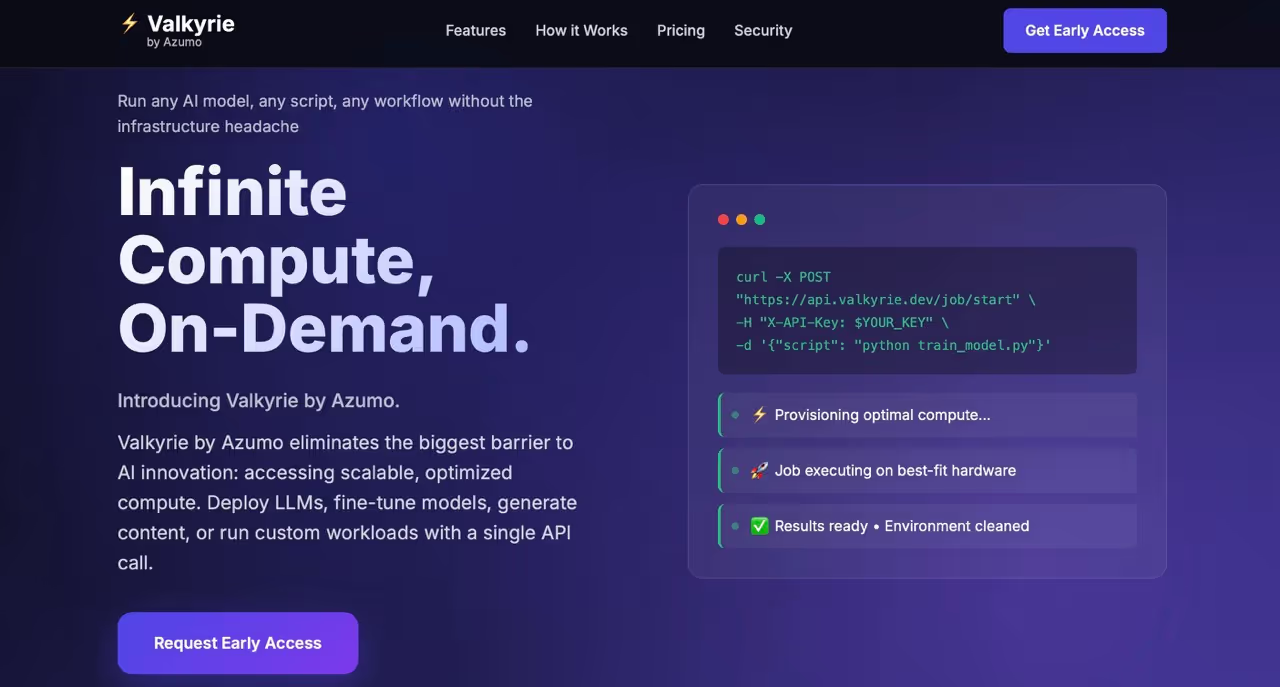
Rather than managing GPU provisioning across multiple providers separately, organizations interact with a unified API that handles provider selection, pricing comparison, capacity management, and orchestration.
This approach provides the benefits of multi-provider access without requiring your organization to develop deep expertise in each provider's GPU infrastructure. Unified observability and operational tooling mean that incident response is simpler and more consistent. Integration with MCP standards means that your applications can be portable across providers through a broker rather than requiring you to build that portability yourself.
Organizations report operational cost reductions reaching up to 90%, reflecting the elimination of many friction points that come with manually managing multi-cloud GPU infrastructure.
Building Sustainable GPU Infrastructure: Beyond Multi-Cloud Computing
A sustainable GPU strategy requires balancing four sometimes competing concerns: cost, availability, operational simplicity, and flexibility. Every decision point in your infrastructure represents a trade-off across these dimensions. Making good trade-offs requires understanding what you're prioritizing for your organization.
Cost is important but it's not the only variable. The cheapest GPU infrastructure is often the most complex to operate. Cost and operational complexity are often in tension. A strategy that saves 15% on compute costs but requires doubling your infrastructure operations team size is not actually a win on total cost. True cost optimization includes the cost of operational complexity. Organizations frequently optimize for hourly compute rates and miss the much larger cost of operating those resources.
Hiring engineers, retaining expertise, building tooling, managing incidents, and developing operational procedures are frequently larger expenses than the compute infrastructure itself. A strategy that costs 5% more on compute but requires 50% less operational overhead is almost always superior.
Availability needs to be defined specifically rather than pursued as an abstract goal. What is your actual availability requirement? For many AI workloads, particularly batch training and offline processing, some interruption is acceptable as long as work isn't permanently lost.
For inference workloads serving customer-facing applications, availability requirements are typically higher.
For training workloads used internally, they're often lower. Availability strategies should match actual requirements rather than pursuing maximum theoretical availability that's not operationally cost-effective.
For many organizations, a primary provider with excellent availability within that provider is more cost-effective than multi-cloud strategies attempting to provide cross-provider failover.
Flexibility is valuable but it should be defined in terms of real scenarios rather than theoretical ones. What flexibility actually matters to your organization? The ability to move to a different provider if your current provider has a serious problem is real flexibility. The ability to migrate training jobs between providers is also real flexibility. The ability to migrate serving infrastructure between providers is real flexibility. The ability to use marginal differences in hourly rates to optimize cost is flexibility that might not be worth operational cost.
Being clear about what flexibility you actually need helps avoid building infrastructure for flexibility you don't actually use.
Building a sustainable strategy means making intentional trade-offs across these dimensions. For many organizations, a primary provider strategy with excellent availability within that provider, streamlined operations through unified tooling and expertise, and targeted flexibility for specific purposes delivers better overall outcomes than attempting to maintain true multi-cloud symmetry.
The key is making this decision intentionally rather than defaulting to multi-cloud complexity because it sounds like best practice. Multi-cloud makes sense in specific scenarios. For most organizations most of the time, it doesn't. Recognizing the difference is the first step toward sustainable GPU infrastructure strategy.
Not sure what level of flexibility actually makes sense for your GPU infrastructure? Azumo helps teams design cloud and GPU strategies based on real operational needs, not theoretical best practices. Talk to our experts to build a setup that’s resilient, cost-effective, and purpose-built for your workloads.

About the Author:
Chief Technology Officer | Software Architect | Builder of AI, Products, and Teams
Juan Pablo Lorandi is the CTO at Azumo, with 20+ years of experience in software architecture, product development, and engineering leadership.



.avif)