.svg)
.png)


.avif)
By early 2026, 88% of companies use AI in at least one part of their business, but only six percent are true AI high performers. This shows a big gap between just using AI and getting real results.
In this article, we share 65 important AI agent statistics, covering market size, adoption, ROI, risks, failure rates, and trends through 2030. These numbers give technology leaders the insights they need for effective AI development.
AI Agent Market Growth Statistics
AI agents are no longer experiments and are becoming core business tools. Research shows the market is growing more than 44% each year, showing rapid adoption across industries. The latest agentic AI market growth statistics confirm that this shift is accelerating as companies move from pilot projects to large-scale deployments.
At Azumo, we see these trends in every client project, where AI initiatives now move directly into funded production.
Total Market Valuation Statistics for AI Agent Technology
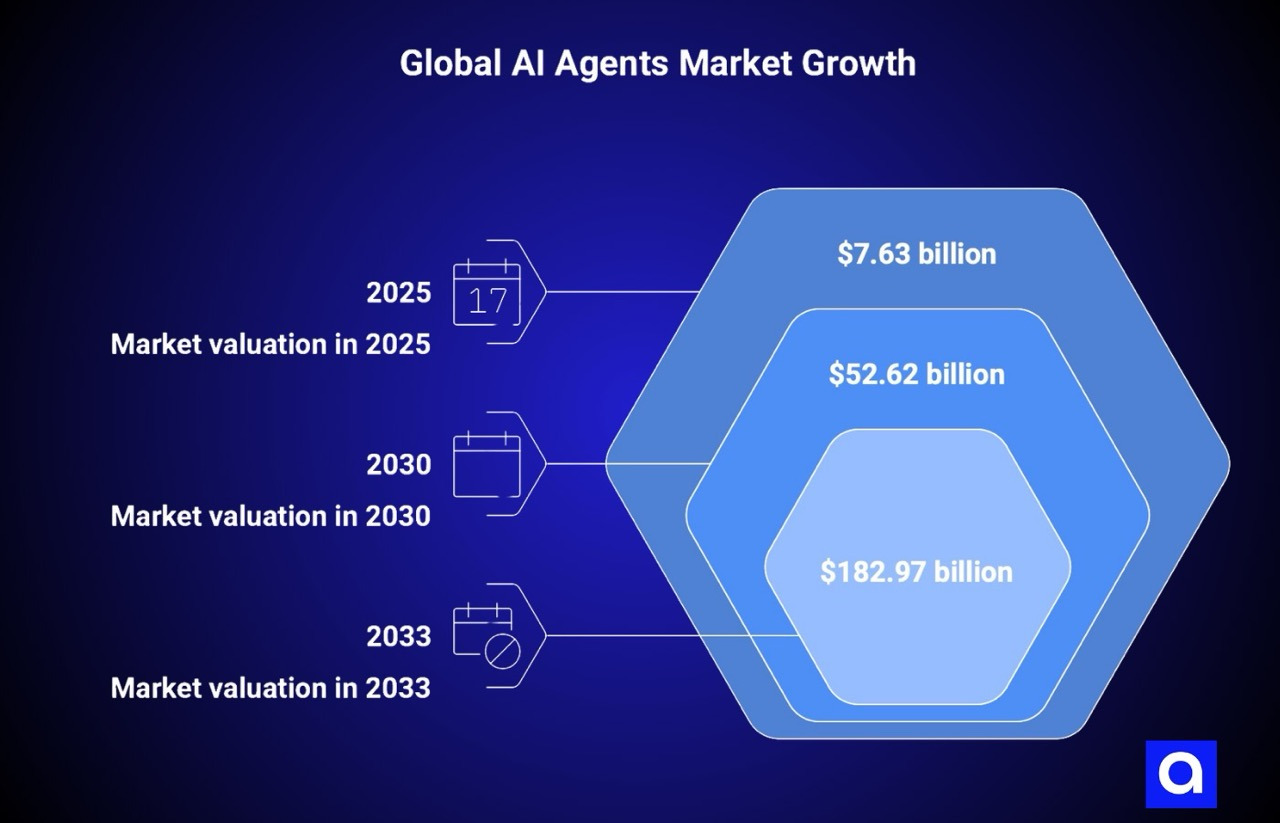
- The global AI agents market was valued at $7.63 billion in 2025 and is projected to reach $182.97 billion by 2033, growing at a CAGR of 49.6% from 2026 to 2033. - Source
- The global AI agents market is expected to reach $50.31 billion by 2030, registering a CAGR of 45.8% from 2025 to 2030, driven by advances in AI, machine learning, and NLP. - Source
- The AI agents market is projected to grow from $7.84 billion in 2025 to $52.62 billion by 2030 at a CAGR of 46.3%. - Source
- The broader agentic AI market, including orchestration and infrastructure, is projected to expand from $7.06 billion in 2025 to $93.20 billion by 2032 at a CAGR of 44.6%.- Source
- The global enterprise agentic AI market was estimated at $2.58 billion in 2024 and is projected to reach $24.50 billion by 2030, growing at a CAGR of 46.2%. - Source
- In Gartner's best-case scenario, agentic AI could drive roughly 30% of enterprise application software revenue by 2035, surpassing $450 billion, up from just 2% in 2025. - Source
- By 2028, AI agents will intermediate more than $15 trillion in B2B spending, reshaping how enterprises buy, sell, and manage procurement. - Source
Regional Growth Statistics: Which Markets Lead in AI Agent Deployment?
The geographic picture is just as important as the global totals shown in the AI agent usage statistics. North America currently leads in overall spending and enterprise adoption. However, Asia Pacific is growing at a faster rate than any other region, driven by strong government AI programs and rapid expansion of cloud infrastructure.
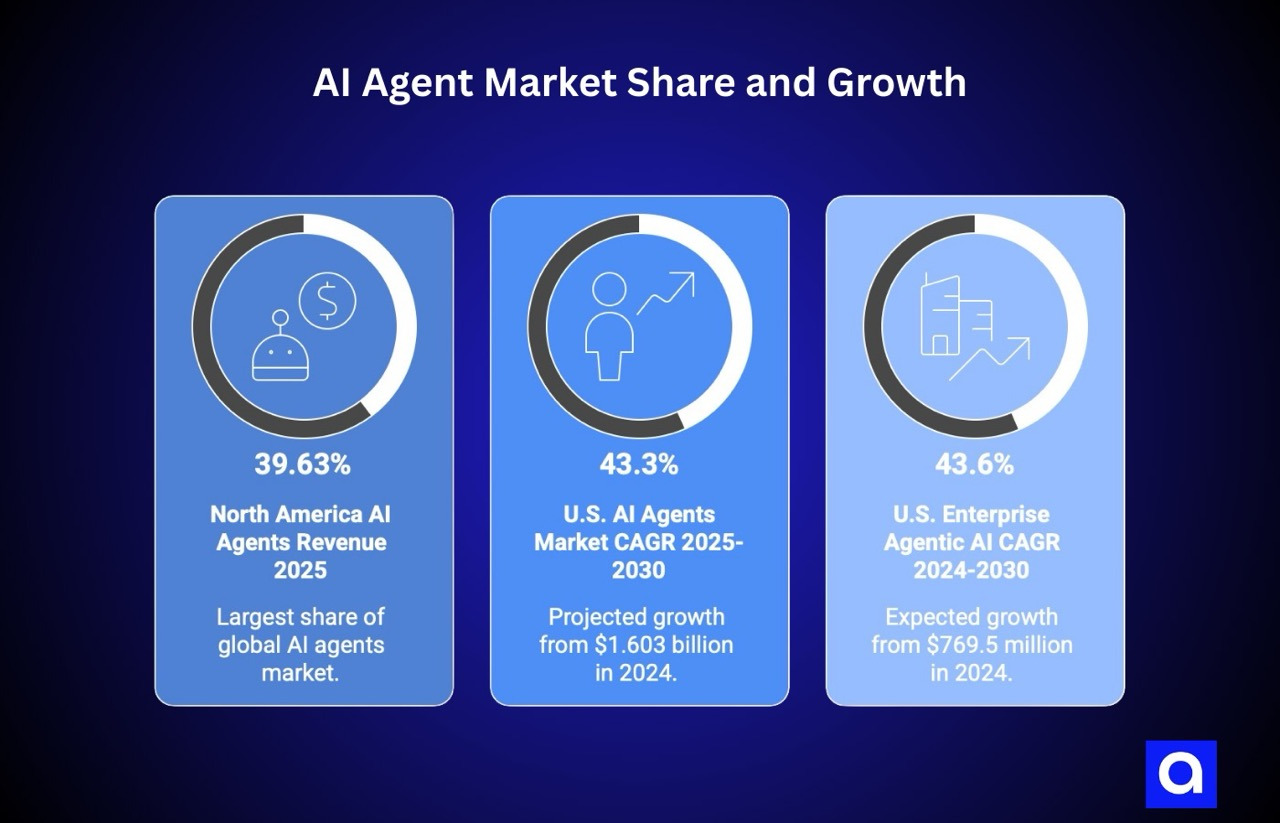
- North America held the largest share of the global AI agents market, accounting for 39.63% of revenue in 2025, reflecting the high concentration of enterprise AI vendors like Microsoft, Google, AWS, Salesforce, and IBM.
- The U.S. AI agents market was estimated at $1.603 billion in 2024 and is projected to grow at a CAGR of 43.3% from 2025 to 2030. - Source
- Asia Pacific is the fastest-growing region in the agentic AI market, driven by government-led AI initiatives, enterprise deployments in BFSI and telecom, and rapid cloud infrastructure expansion.
- The U.S. enterprise agentic AI market was estimated at $769.5 million in 2024 and is expected to grow at a CAGR of 43.6% through 2030. - Source
If you are planning AI agent rollouts for a global organization, these regional dynamics are worth factoring in. The competitive intensity is not limited to Silicon Valley anymore.
Enterprise AI Agent Adoption Statistics
McKinsey's 2025 State of AI survey, covering 1,993 participants across 105 countries, paints a clear picture: Agentic AI adoption is near-universal, but scaling remains the hard part. Almost everyone is doing something with AI. Very few are doing it in a way that truly transforms their business.
That tension between broad deployment and limited breakthrough impact is the defining challenge of 2026. And it shows up in stat after stat.
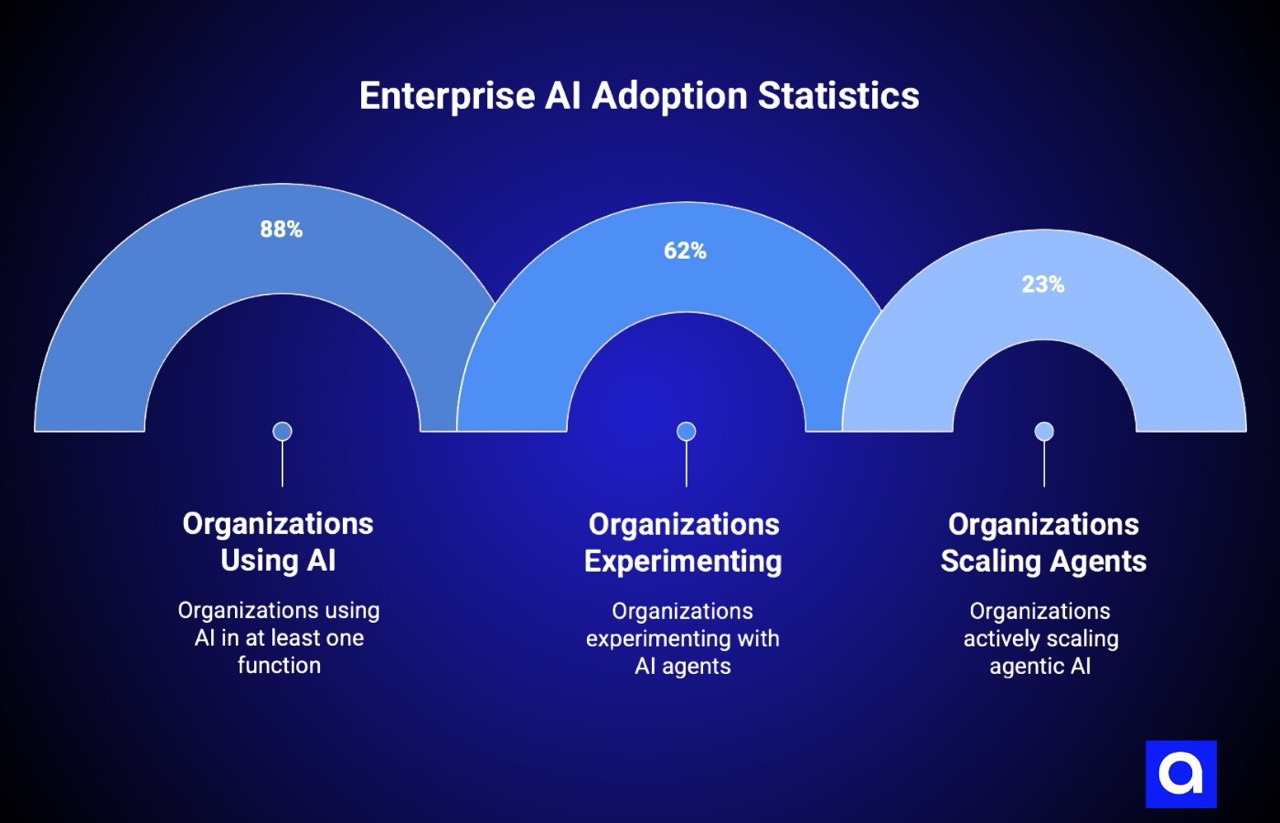
- 88% of organizations now use AI in at least one function (2025), up from 78% the prior year and a massive leap from 20% in 2017.
- 62% of organizations are at least experimenting with AI agents: 23% are actively scaling agentic AI in at least one business function, while an additional 39% have begun experimenting.
- Only 6% of organizations qualify as true AI high performers (where more than 5% of EBIT is attributable to AI), and these companies are at least 3x more advanced in scaling AI agents than the average company.
- 61% of CEOs globally confirm they are actively adopting AI agents today and preparing to implement them at scale, based on a survey of 2,000 CEOs across 33 countries and 24 industries. - Source
- 85% of companies expect to customize agents to fit their unique business needs, based on Deloitte's survey of 3,235 leaders across 24 countries. - Source
- Worker access to AI rose by 50% in 2025, and the number of companies with 40%+ of AI projects in production is set to double within six months. - Source
- While twice as many business leaders report transformative AI impact in 2025 compared to the prior year, only 34% say they are deeply transforming their business with AI.
- 40% of enterprise applications will be integrated with task-specific AI agents by end of 2026, up from less than 5% today.
- 25% of enterprises using GenAI are expected to deploy AI agents by 2025, growing to 50% by 2027. - Source
- 92% of firms plan to increase their AI budgets within the next three years.
The bottom line is that adoption is widespread, but real transformation is still rare. The companies that are pulling ahead are redesigning workflows, setting up governance from the start, and scaling generative AI across multiple functions. They are not just deploying tools. If you are planning how to use generative AI in your business, that distinction is critical.
Statistics on the Adoption of AI Agents by Different Industries
While enterprise adoption is broad, the depth and maturity of AI agent use vary significantly by industry. Recent agentic AI usage statistics show that customer service, software engineering, and sales are leading in measurable deployments. However, each sector follows a different adoption curve and sees returns in different ways.
Some industries focus on cost reduction and efficiency, while others prioritize speed, automation, or revenue growth. Understanding these differences is key to setting realistic expectations and building the right strategy. Let’s break it down.
Adoption of AI Agents in Customer Service
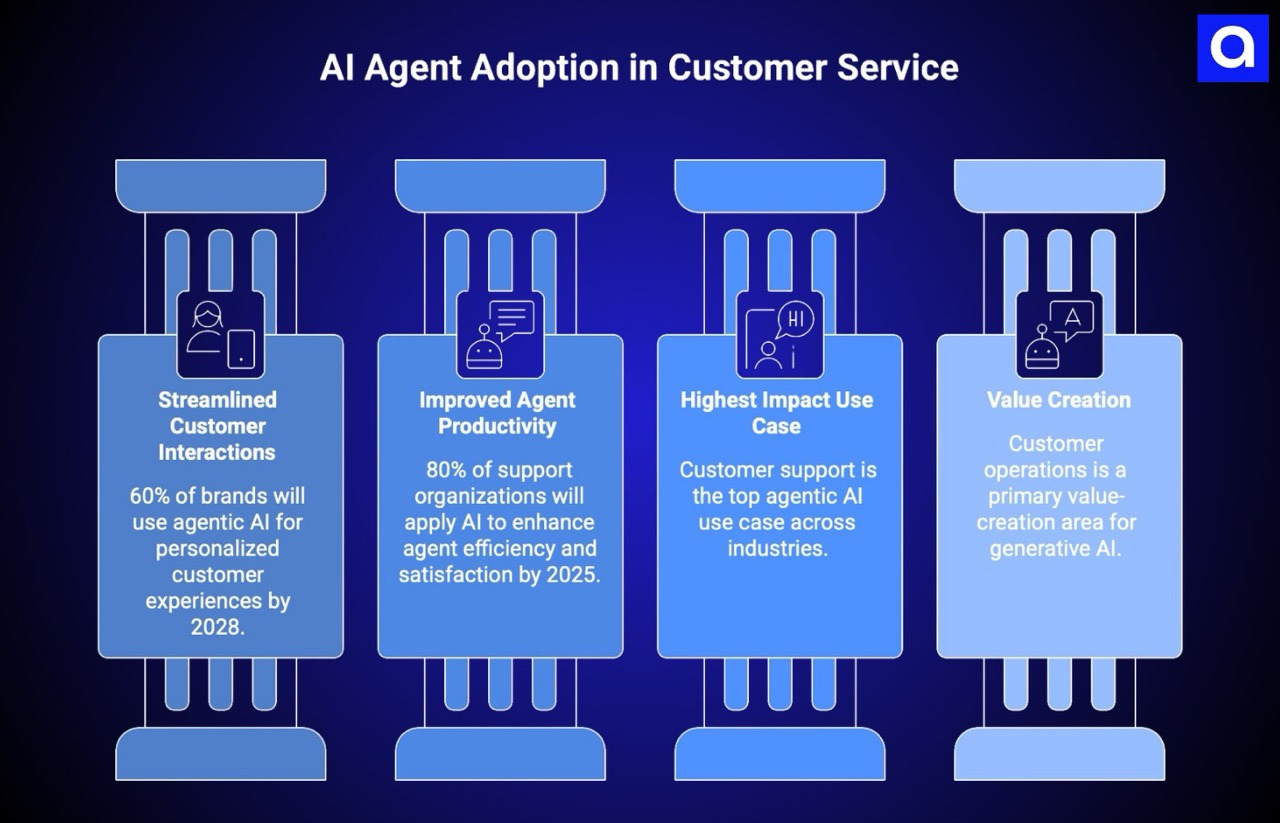
Customer service is where AI agents have been adopted the most. The use cases are clear, the data pipelines are already in place, and the benefits are easy to see, such as fewer tickets per human agent, faster resolution times, and higher customer satisfaction.
For example, Deloitte found that an airline now uses AI agents to rebook flights and reroute luggage automatically, freeing human agents to focus on more complex or sensitive situations. Many of these deployments also leverage open-source LLMs, which let companies customize models to their needs while keeping control over data and costs.
- 60% of brands will use agentic AI to deliver streamlined one-to-one customer interactions by 2028. - Source
- By 2025, 80% of support organizations will apply AI in some form to improve agent productivity and customer satisfaction.
- Customer support ranks as the highest-impact agentic AI use case across industries, followed by supply chain management, R&D, knowledge management, and cybersecurity.
- Customer operations is one of the primary value-creation areas for generative AI, alongside marketing and sales, software engineering, and R&D. - Source
One important note: despite this strong automation potential, human oversight remains critical. Gartner's research points out that agentic AI in customer interactions requires strong data governance and ethical personalization frameworks. Without those guardrails, you risk eroding the very customer trust you are trying to build.
Agentic AI Adoption Statistics in Software Engineering
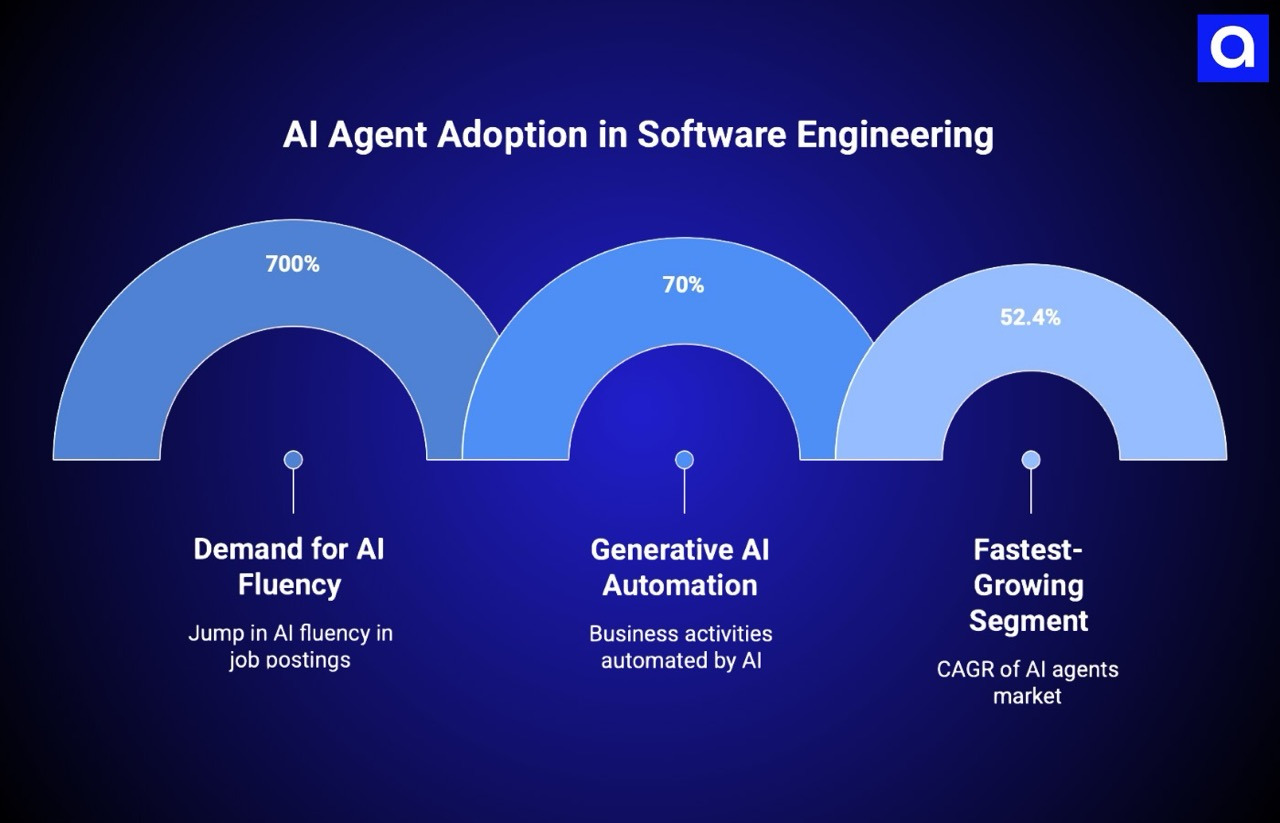
This one hits close to home. If you are a software engineer, engineering leader, or CTO reading this, you are building the very systems these statistics describe. AI agents are not just a product category you ship to customers. They are reshaping how your own team writes code, reviews pull requests, tests applications, and manages deployments.
- The coding and software development segment of the AI agents market projects a CAGR of 52.4% from 2025 to 2030, making it the fastest-growing agent role segment.
- Demand for AI fluency in job postings has jumped nearly sevenfold in two years, with software engineers among the roles most actively seeking AI-skilled candidates. - Source
- Generative AI could enable automation of up to 70% of business activities across almost all occupations by 2030, with software engineering among the top-impacted functions. - Source
- Software engineering ranks alongside customer operations and marketing as the highest-value AI impact area in the enterprise, with cost and productivity benefits leading adoption priorities.
The practical takeaway: the teams that figure out how to pair AI agents with senior engineering judgment will ship faster and build better products. The teams that treat AI coding tools as a magic shortcut will accumulate technical debt faster than they can write it off.
At Azumo, our engineers already work alongside AI-augmented workflows every day. We have seen firsthand what works and what creates more problems than it solves.
Adoption of AI Agents in Sales and Marketing
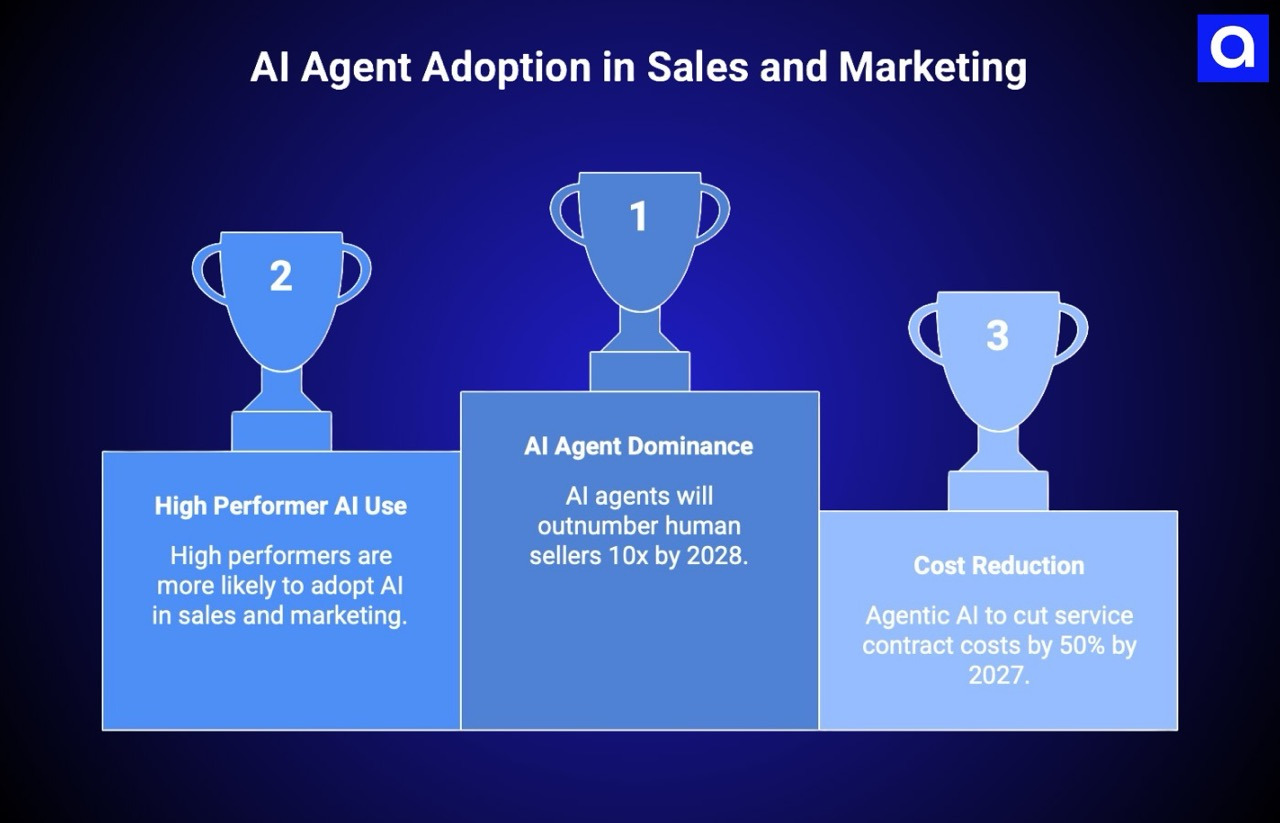
Sales and marketing teams are deploying AI agents at scale, but the relationship between "more agents" and "better results" is more complicated than you might expect.
- AI agents will outnumber human sellers by 10x by 2028, yet fewer than 40% of sellers will report that AI agents improved their productivity. - Source
- Marketing and sales consistently rank among the top 3 functions for AI use, and high performers are far more likely to report AI adoption here than their peers.
- Agentic AI is expected to cut the cost-to-value gap in process-centric service contracts by at least 50% by 2027 as AI replaces standardized workflows with context-rich orchestration.
That stat #30 deserves a closer look. More agents does not automatically mean more seller productivity. Gartner VP Analyst Melissa Hilbert put it plainly: beyond a certain point, more AI does not mean more output. The architecture of those agents, how they fit into existing sales workflows, and whether they are solving real problems versus generating noise, all of that matters more than the sheer volume of agents deployed.
This is exactly why lean, well-governed agent architecture outperforms brute-force AI deployments. It is an area where Azumo brings a lot of hands-on experience.
AI Agent Statistics on Measured ROI and Business Performance
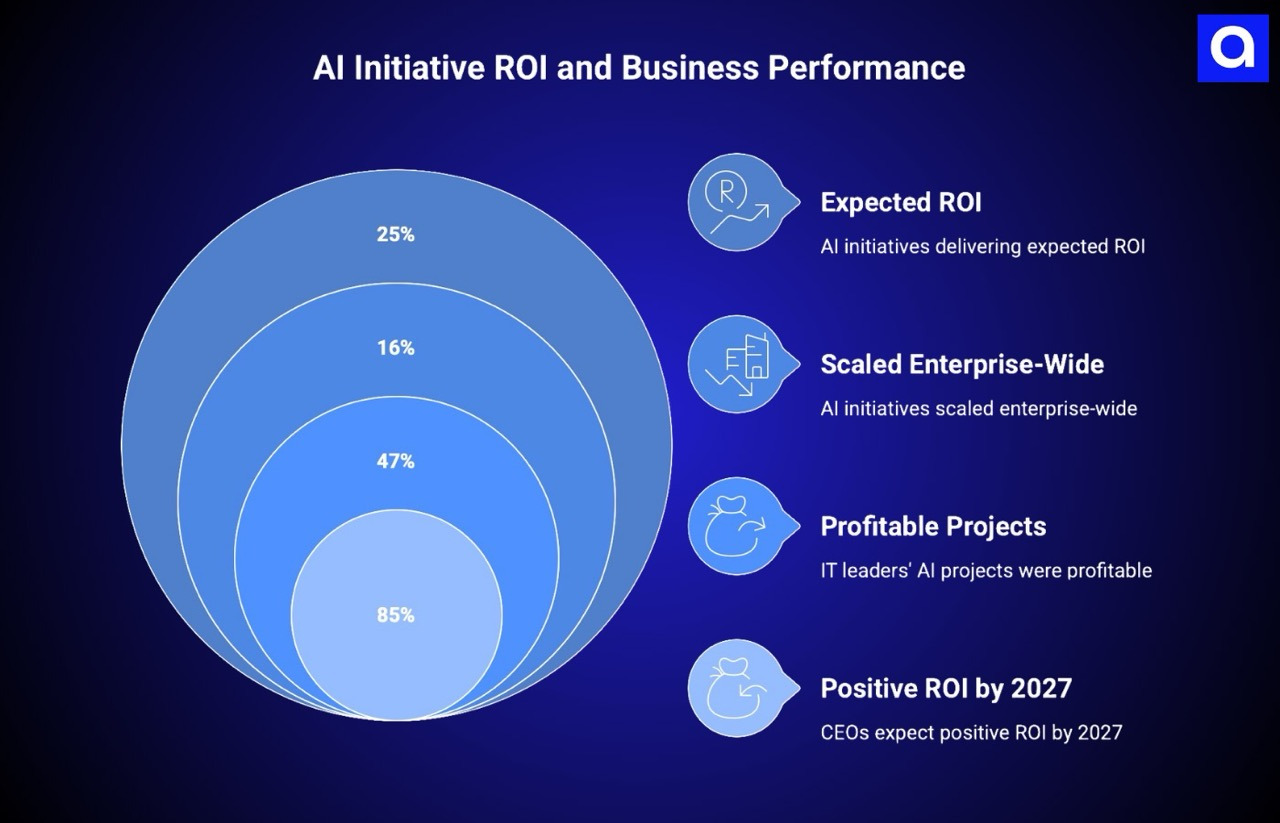
Now let's talk about the question every executive actually wants answered: "What's the return?"
The honest answer is that ROI from AI agents is real but uneven. The numbers below tell a more nuanced story than most vendor marketing will give you. And that honesty is exactly what makes these stats useful for planning.
- Only 25% of AI initiatives have delivered expected ROI over the past few years, and only 16% have been scaled enterprise-wide, based on IBM's survey of 2,000 CEOs across 33 countries.
- Only 47% of IT leaders said their AI projects were profitable in 2024; one-third broke even, and 14% recorded losses, based on an IBM-commissioned survey of 2,400+ IT decision-makers. - Source
- By 2027, 85% of CEOs surveyed expect a positive ROI from scaled AI efficiency, and 77% expect returns from AI-driven growth and expansion.
- Enterprises that fully account for technical debt in their AI business cases project 29% higher ROI than those that do not; ignoring technical debt can reduce AI returns by 18 to 29%. - Source
- 66% of organizations report productivity and efficiency as the primary benefits from enterprise AI adoption, but revenue growth remains largely aspirational, with 74% hoping to grow revenue vs. just 20% already doing so. - Source
- Generative AI could unlock $2.6 to $4.4 trillion in annual economic value across 63 use cases, with the largest share in customer operations, marketing and sales, software engineering, and R&D.
- 64% of organizations say AI is enabling innovation, but only 39% report enterprise-level EBIT impact, and most of those say AI accounts for less than 5% of EBIT.
The path to strong AI agent ROI runs through clear strategy, governance, and workflow redesign, not just deployment. McKinsey's high performers invest more than 20% of their digital budgets in AI and redesign workflows around it. The technology is the easy part. The organizational change is where the real value gets created or lost.
AI Agents Statistics on Technology Architecture and Capabilities
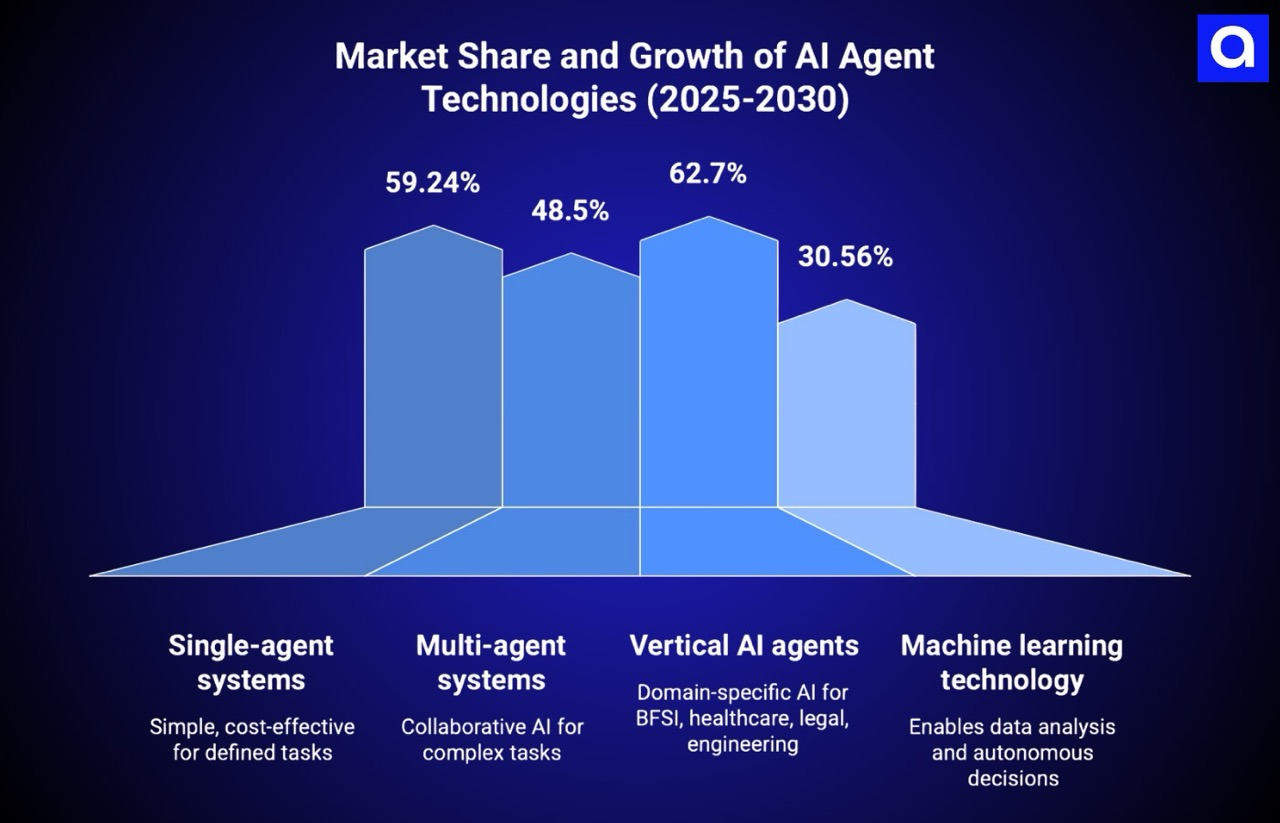
AI agent architecture is evolving fast. The market is shifting from single-agent deployments toward multi-agent ecosystems, and from horizontal, general-purpose tools toward vertical, industry-specific agents. If you're a CTO or VP of Engineering making build-vs-buy decisions right now, these architecture trends directly affect your roadmap.
- Single-agent systems held 59.24% market share in 2025, favored for their simplicity, lower cost, and suitability for well-defined tasks.
- Multi-agent systems are projected to grow at a CAGR of 48.5% during 2025 to 2030, outpacing overall market growth as enterprises demand AI for complex, collaborative tasks.
- Vertical AI agents are expected to grow at the highest CAGR of 62.7% from 2025 to 2030, with domain-specific agents for BFSI, healthcare, legal, and engineering as the fastest-growing segment by type.
- The machine learning technology segment led the AI agents market with 30.56% revenue share in 2025, enabling AI agents to analyze large datasets and make autonomous decisions.
- By 2028, AI agent ecosystems will allow multi-application, multi-function collaboration, and one-third of user experiences will shift from native applications to agentic front ends.
Here is the nuance that matters most for technically-minded readers: multi-agent architecture is not inherently better than single-agent. Gartner's own recommendation is to use AI agents where they deliver clear value or ROI, use automation for routine workflows, and use assistants for simple retrieval. Matching architecture to task type is the core competency that separates high performers from the rest.
If you're working through these architecture decisions, Azumo's engineering teams can help you design agent systems that match the right level of complexity to the right business problem.
Agentic AI Statistics on Security and Compliance Challenges
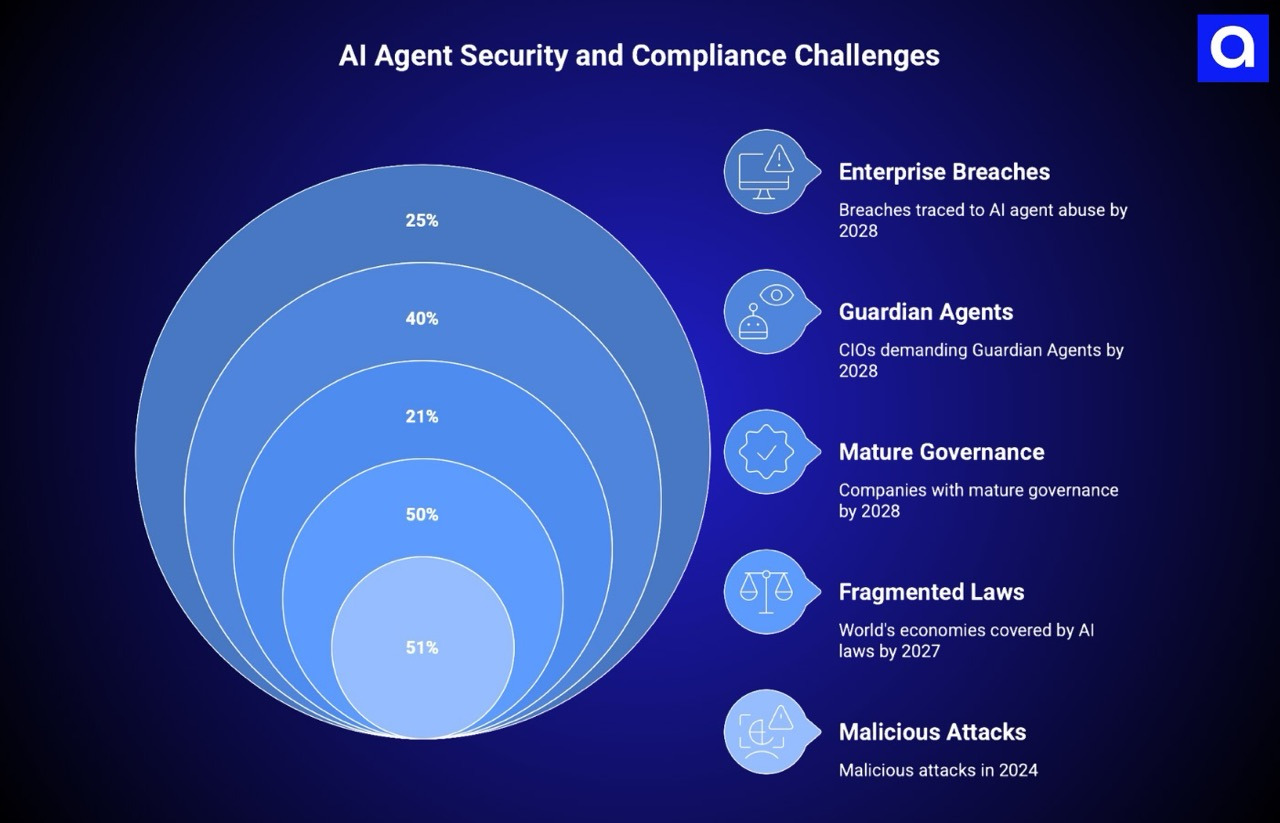
Gartner, Deloitte, and IBM all flag governance as the primary constraint on scaling agentic AI in the enterprise. The headline finding from Deloitte's 2026 report is stark: only 1 in 5 companies has a mature governance model for autonomous AI agents. That means 80% of organizations deploying agents are doing so without the governance infrastructure to manage them safely at scale.
- By 2028, 25% of enterprise breaches will be traced to AI agent abuse, from both external attackers and malicious internal actors. - Source
- By 2028, 40% of CIOs will demand "Guardian Agents" to autonomously track, oversee, or contain the results of AI agent actions.
- Only 1 in 5 companies (21%) has a mature model for governance of autonomous AI agents, and the organizations seeing the most success take a measured approach by starting with lower-risk use cases and scaling deliberately.
- Fragmented AI laws will cover half of the world's economies by 2027, driving an estimated $5 billion in compliance spending as organizations establish governance teams and deploy oversight tools.
- The average cost of a data breach involving 50M+ records was $375 million in 2024, and 51% of attacks in 2024 were malicious (vs. 25% IT failure and 24% human error). - Source
- 72% of CEOs view proprietary data as critical for unlocking generative AI value, while 68% identify integrated enterprise data architecture as their top infrastructure need, both pointing toward security-first AI deployment.
- Gartner expects more than 2,000 "death by AI" claims by end of 2026, tied to safety failures involving autonomous systems, prompting regulatory investigations and product recalls.
These risks are manageable with the right approach. Governance is not a blocker; it is a catalyst. Organizations where senior leadership actively shapes AI governance achieve far greater business value than those delegating it purely to technical teams. At Azumo, we build governance into agent systems from day one, not as an afterthought.
AI Agent Implementation Failure Rate Statistics
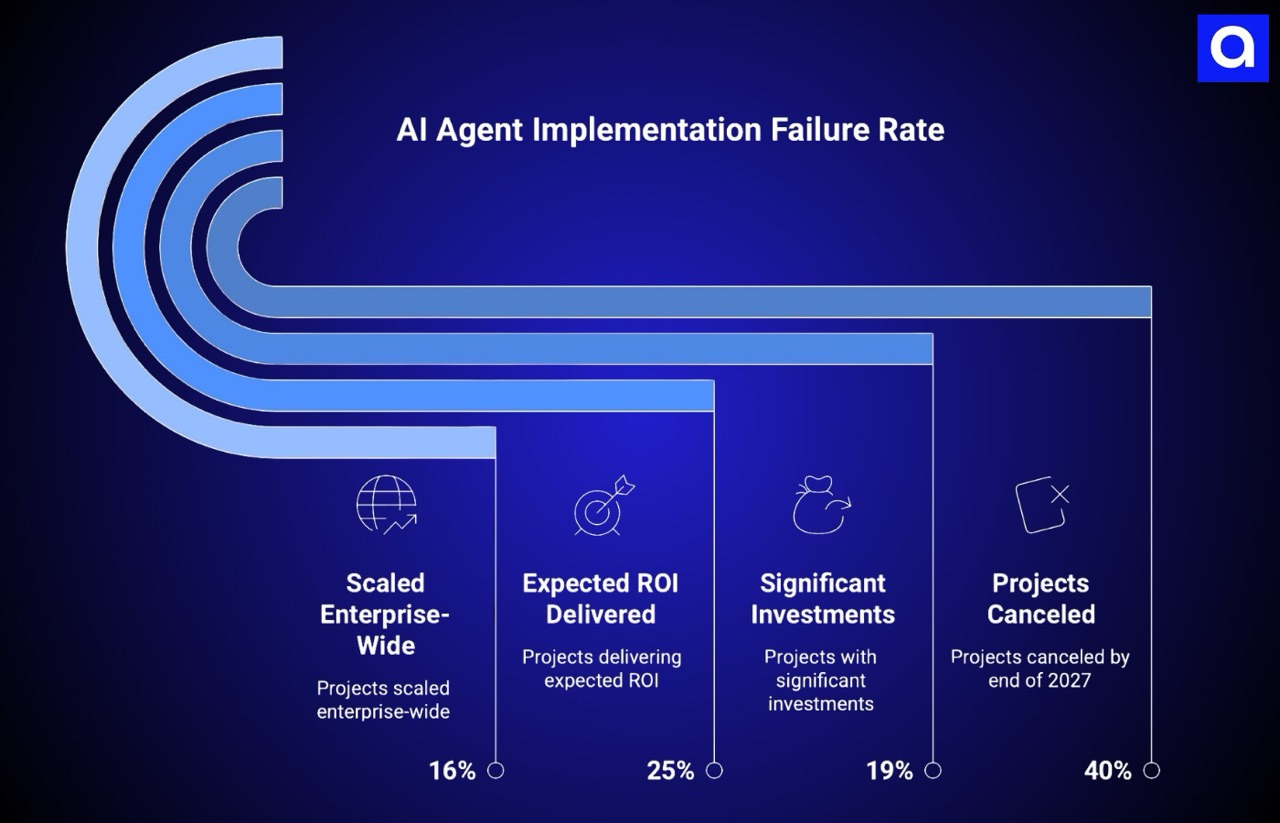
Most statistics articles skip this section entirely. We are not going to do that. The failure rate data is sobering, and it is worth addressing head-on. If you understand why AI agent projects fail, you can build yours to succeed.
- Over 40% of agentic AI projects will be canceled by the end of 2027, with escalating costs, unclear business value, and inadequate risk controls as the primary drivers. - Source
- In a January 2025 Gartner poll of 3,412 respondents, 19% had made significant investments in agentic AI, 42% made conservative investments, and 31% were in wait-and-see mode.
- Only 25% of AI initiatives delivered expected ROI, and only 16% scaled enterprise-wide, based on IBM's 2025 CEO Study of 2,000 CEOs globally.
- Only about one-third of organizations have begun scaling AI across the enterprise; two-thirds remain in experimentation or proof-of-concept phase.
- 64% of CEOs acknowledge that FOMO drives investment in AI technologies before they fully understand the value those technologies bring, and this is a leading contributor to project failure.
- Many vendors contribute to failure through "agent washing", which means rebranding existing RPA, chatbots, or AI assistants as agentic AI without adding real agentic capabilities.
These numbers do not suggest avoiding AI agents. They suggest approaching them strategically. McKinsey's high performers share one trait: they treat AI as a catalyst for organizational transformation, not a tool to layer onto existing workflows. Execution, governance, and clear business alignment are what separate the 25% that see returns from the 75% that do not.
That is exactly how Azumo builds AI agent systems: start with the business problem, design the architecture to match, build governance in from sprint one, and measure outcomes continuously. Agent adoption is still consolidating inside a broader enterprise AI wave, where enterprise AI adoption now sits at 88% of organizations using AI in at least one business function. Customer-facing teams are furthest along that curve: AI projected to handle 95% of customer service interactions by the end of 2026.
The Future: Projections of AI Agents in 2027 to 2030
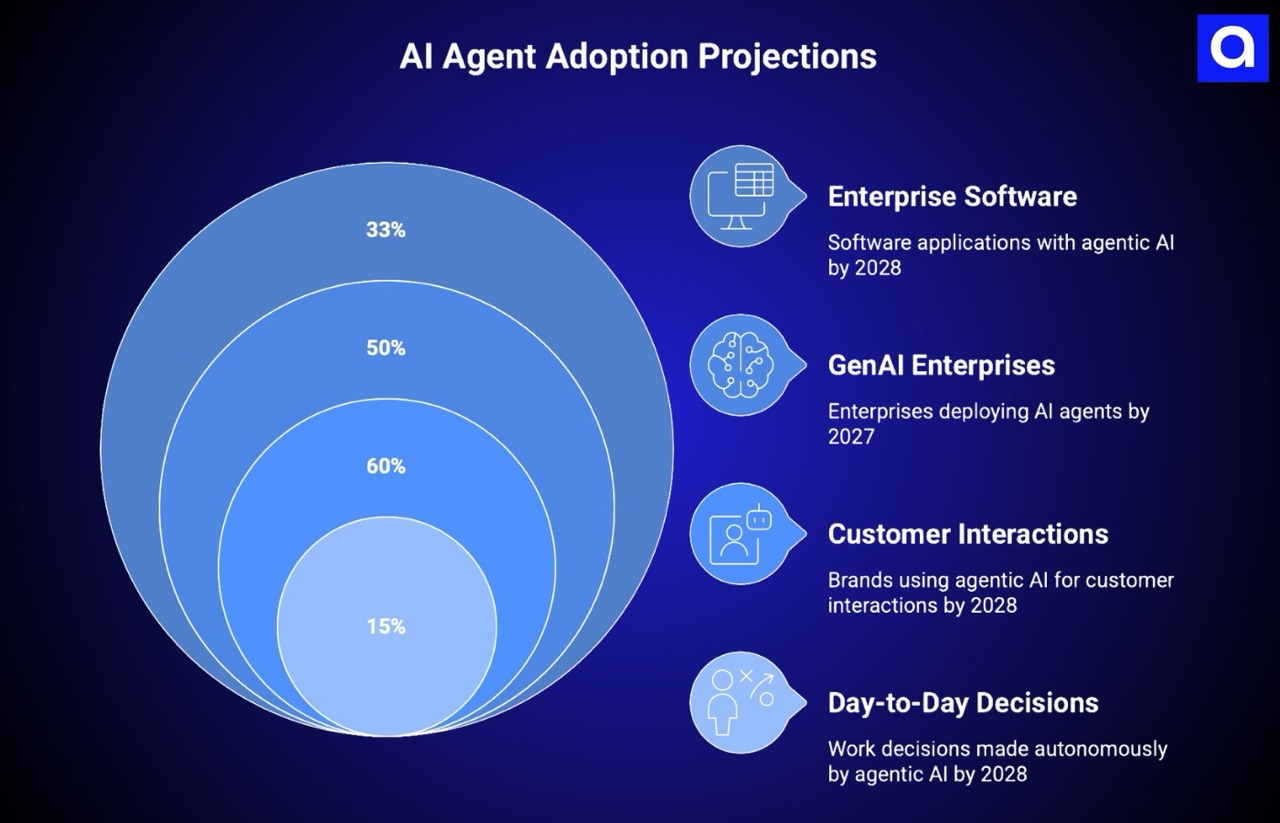
These are not decade-long guesses. These are near-term projections from the world's leading research firms, and they describe a world that is two to four years away. The window to build AI agent infrastructure that is production-ready, governed, and ready to scale is right now.
- By 2028, at least 15% of day-to-day work decisions will be made autonomously by agentic AI, up from 0% in 2024. - Source
- 33% of enterprise software applications will include agentic AI by 2028, up from less than 1% in 2024. - Source
- 50% of enterprises using GenAI will deploy AI agents by 2027, up from approximately 25% today.
- In McKinsey's midpoint scenario, AI-powered agents and robots could generate roughly $2.9 trillion in U.S. economic value per year by 2030, representing an average automation adoption of 27% of current work hours.
- 60% of brands will use agentic AI for personalized one-to-one customer interactions by 2028.
- AI agents will outnumber human sellers by 10x by 2028, though fewer than 40% of sellers will report that agents improved their productivity.
- By 2028, 40% of CIOs will demand Guardian Agents to oversee and contain AI agent actions.
- AI agents will intermediate $15 trillion+ in B2B spending by 2028.
The trajectory is clear. AI agents are moving from optional to foundational enterprise infrastructure. The question is not whether to build them, but how to build them well.
All statistics in this article are sourced directly from original research reports published by McKinsey, Gartner, Deloitte AI Institute, IBM Institute for Business Value, Grand View Research, and MarketsandMarkets. Sources will be refreshed quarterly.
Ready to build AI agents that actually make it to production? Talk to an Azumo engineer.
References:
- https://www.mckinsey.com/capabilities/quantumblack/our-insights/the-state-of-ai
- https://www.grandviewresearch.com/industry-analysis/ai-agents-market-report
- https://www.prnewswire.com/news-releases/ai-agents-market-size-to-hit-50-31-billion-by-2030-at-cagr-45-8---grand-view-research-inc-302447060.html
- https://www.marketsandmarkets.com/Market-Reports/ai-agents-market-15761548.html
- https://www.marketsandmarkets.com/Market-Reports/agentic-ai-market-208190735.html
- https://www.grandviewresearch.com/industry-analysis/enterprise-agentic-ai-market-report
- https://www.gartner.com/en/newsroom/press-releases/2025-08-26-gartner-predicts-40-percent-of-enterprise-apps-will-feature-task-specific-ai-agents-by-2026-up-from-less-than-5-percent-in-2025
- https://www.digitalcommerce360.com/2025/11/28/gartner-ai-agents-15-trillion-in-b2b-purchases-by-2028/
- https://www.grandviewresearch.com/industry-analysis/us-ai-agents-market-report
- https://www.grandviewresearch.com/industry-analysis/us-enterprise-agentic-ai-market-report
- https://newsroom.ibm.com/2025-05-06-ibm-study-ceos-double-down-on-ai-while-navigating-enterprise-hurdles
- https://www.deloitte.com/us/en/about/press-room/state-of-ai-report-2026.html
- https://www.deloitte.com/us/en/what-we-do/capabilities/applied-artificial-intelligence/content/state-of-ai-in-the-enterprise.html
- https://www.deloitte.com/global/en/about/press-room/deloitte-globals-2025-predictions-report.html
- https://www.gartner.com/en/newsroom/press-releases/2026-01-15-gartner-predicts-60-percent-of-brands-will-use-agentic-ai-to-deliver-streamlined-one-to-one-interactions-by-2028
- https://www.mckinsey.com/capabilities/tech-and-ai/our-insights/the-economic-potential-of-generative-ai-the-next-productivity-frontier
- https://www.mckinsey.com/mgi/our-research/agents-robots-and-us-skill-partnerships-in-the-age-of-ai
- https://www.mckinsey.com/capabilities/people-and-organizational-performance/our-insights/the-organization-of-the-future-enabled-by-gen-ai-driven-by-people
- https://www.gartner.com/en/newsroom/press-releases/2025-11-18-gartner-predicts-by-2028-ai-agents-will-outnumber-sellers-by-10x-yet-fewer-than-40-percent-of-sellers-will-report-ai-agents-improved-productivity
- https://filecache.mediaroom.com/mr5mr_ibmnewsroom/198550/IBM_ROI_of_AI_Report-December_2024.pdf
- https://www.ibm.com/thought-leadership/institute-business-value/en-us/report/technical-debt-ai-roi
- https://www.deloitte.com/global/en/issues/generative-ai/state-of-ai-in-enterprise.html
- https://www.gartner.com/en/newsroom/press-releases/2024-10-22-gartner-unveils-top-predictions-for-it-organizations-and-users-in-2025-and-beyond
- https://www.ibm.com/downloads/documents/us-en/115dcc7faf363f21
- https://www.gartner.com/en/newsroom/press-releases/2025-06-25-gartner-predicts-over-40-percent-of-agentic-ai-projects-will-be-canceled-by-end-of-2027
- https://www.gartner.com/en/newsroom/press-releases/2024-10-21-gartner-identifies-the-top-10-strategic-technology-trends-for-2025
- https://www.gartner.com/en/articles/intelligent-agent-in-ai
Frequently Asked Questions

About the Author:
Founder & CEO | Azumo
Chike Agbai, Founder & CEO of Azumo, leads a nearshore software development firm that builds intelligent applications using top-tier Latin American talent.



.avif)