
Custom AI Financial Forecasting Software Development Services: A Guide for CFOs, FP&A Teams and Fintechs
AI financial forecasting helps businesses predict revenue, cash flow, expenses, and financial performance. It analyzes historical data, updates projections, and supports scenario planning while reducing manual spreadsheet work. Azumo develops custom AI financial forecasting software that improves planning accuracy, automates workflows, and integrates with existing financial and business systems.
Financial forecasts often depend on spreadsheets, historical averages and assumptions that take days to update when actual results change. That becomes harder to manage as revenue models, products, customer behavior and operating costs grow more complex.
AI financial forecasting can bring historical financial data, operational drivers and external signals into the same forecasting process. Instead of replacing the FP&A model or assumptions your team already trusts, custom software can automate data preparation, identify patterns, produce baseline forecasts and update projections as new results arrive.
The value of AI for financial forecasting is not simply generating another prediction. The software should help finance teams understand what changed, which drivers caused the change and how different assumptions could affect the next month, quarter or year.
If your current forecasting process is becoming difficult to maintain or standard planning tools cannot reflect the drivers behind your business, Azumo can help assess the data, models and integrations needed to build a forecasting system around the way your finance team already plans.
Key takeaways
- Azumo develops custom AI financial forecasting software that combines financial and operational data, generates forecasts, supports scenario planning, and connects results to the finance systems your team already uses.
- Custom forecasting software can work alongside your existing FP&A process rather than replacing established budgets, assumptions or finance controls.
- Forecast accuracy should be measured against the process you use today. A model needs to outperform a meaningful baseline before its output becomes useful for planning.
- Revenue, cash flow, expenses and working capital often require different models and business drivers, rather than one model for every financial line item.
- Forecasts should update as actual results change, while finance teams retain control over assumptions, scenarios and manual adjustments.
- Custom development makes more sense when proprietary data, unusual revenue models or complex integrations limit standard forecasting platforms.
- Cost depends heavily on data readiness, model scope and integrations, with broader platforms requiring more investment than a focused revenue or cash-flow forecasting model.
How Azumo Develops Custom AI Financial Forecasting Software
We develop forecasting software around the financial questions your team actually needs to answer.
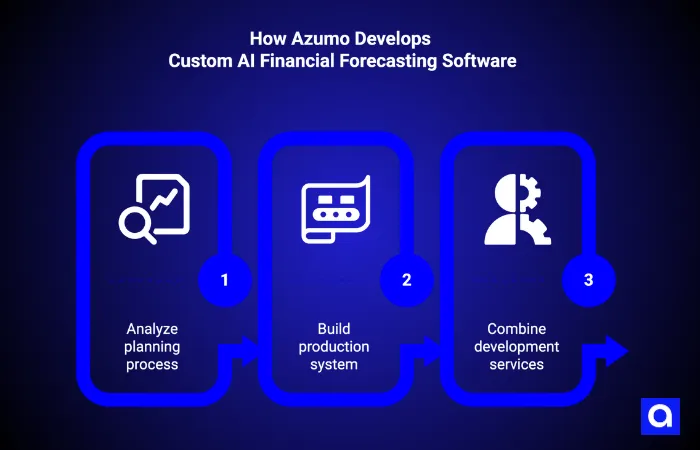
Our engineers first look at the existing planning process: which forecasts matter, how frequently they are updated, which assumptions finance teams control and where the underlying data comes from. Revenue forecasting may depend heavily on CRM pipeline and customer retention, while cash forecasting may require bank balances, receivables, payables and payment schedules.
From there, we can build the data pipelines, forecasting models, scenario logic, dashboards and integrations needed to turn those inputs into a production system.
Azumo has built production AI since 2016, covering predictive machine learning, data engineering, cloud infrastructure and production deployment.
Our AI development services and fintech AI development services allow our engineers to combine model development with financial product engineering, data integrations and the operational workflows around forecasting.
What AI Financial Forecasting Development Expertise Does Azumo Have?
Financial forecasting requires more than a time-series model. The team also needs to understand financial data, business drivers and how forecasts are used inside planning and decision workflows.
Our experts bring 20 years of experience from RBC and Jefferies across enterprise software investment banking, M&A, capital markets and corporate finance; five years at JPMorgan across prime brokerage, derivatives and software engineering; and 10 years at BlackRock across AI infrastructure, MLOps, asset-management operations and data-pipeline development.
Azumo has also built forecasting systems in production. In our work with Stovell AI, we helped develop predictive software for financial asset managers and energy-market clients. The platform includes daily forecasting, borrow-rate prediction and forward-looking market signals, with live AI models operating in production for more than eight years.
Forecasting also depends on a strong data foundation. For Bento, our engineers brought together more than 50 fragmented financial and product data sources into a structured analytics environment that supported financial planning and management visibility.
For your forecasting project, that combination means we can work across the financial data, predictive models, application layer and production infrastructure instead of treating forecasting as an isolated data-science exercise.
How Azumo Builds Forecasting Software Around Your Planning Process
We start with the decisions the forecast needs to support.
For example, a CFO may need a 13-week cash forecast, quarterly revenue projections and an annual operating plan. The same model should not necessarily handle all three because the data, horizon and business drivers are different.
Our engineers map the current forecasting process, identify the data behind each forecast and establish the baseline your team uses today. We then determine where predictive models can improve the process and where finance-controlled assumptions should remain explicit.
A custom system can combine statistical forecasts with business inputs such as pipeline stages, pricing changes, hiring plans, payment terms or planned investments. Finance teams can adjust those assumptions, run scenarios and compare AI-generated forecasts against the operating plan.
Once the models are validated, we connect the forecasts with the ERP, FP&A platform, CRM, banking data or BI tools already used by the business. The aim is to improve the forecasting workflow without forcing finance teams to rebuild every part of the planning process.
Should You Build Custom AI Financial Forecasting Software or Use an Off-the-Shelf Solution?
Off-the-shelf planning platforms already handle many common forecasting, budgeting and scenario-planning needs well. If the financial model is fairly standard and the platform supports the required integrations and assumptions, custom software may not add enough value.
Custom development becomes more useful when the forecast depends on proprietary business drivers, several internal systems or modeling logic that standard tools cannot represent.
A hybrid approach is also possible. Your existing FP&A platform can remain the interface finance teams use while custom AI models supply forecasts, confidence ranges or driver analysis through an integration layer.
How Much Does Custom AI Financial Forecasting Software Cost?
At Azumo, the budget depends on how many forecasts you need, the quality of the underlying data and how deeply the software needs to connect with your finance stack.
Azumo prices AI development by Delivery Unit (DU), from $499 to $899 per DU depending on the tier: Starter at $899, Growth at $699 and Platform at $499 per DU. The number of DUs a forecasting project needs depends on its scope and complexity.
A focused revenue or cash-flow model built on clean historical data will usually require fewer DUs than a forecasting platform that combines revenue, liquidity, expenses, working capital, scenario planning and several operational data sources.
Your budget will also increase when historical data needs significant preparation, forecasts require several granular levels, external data must be licensed or integrated, or finance teams need a complete planning interface around the models.
ERP, CRM, banking and data-warehouse integrations can be another major cost driver because the forecast is only useful if the underlying data stays current.
For current rates, see Azumo's pricing page. For broader budgeting, see Azumo's AI development cost guide.
How Long Does It Take to Develop AI Financial Forecasting Software?
Timelines follow the same Delivery Unit tiers. If you want to validate one forecasting use case first, such as a single revenue or cash-flow forecast, a focused first project fits the Starter tier, which typically runs 2 to 6 weeks.
A production system takes longer because the work extends beyond model training. Financial data needs to be connected and cleaned, benchmarks established, integrations built and forecasts tested against actual results.
A focused production forecasting system typically fits the Growth tier at 1 to 4 months, while a broader platform with several models, systems and business units fits the Platform tier at 4 to 6+ months.
The timeline is usually shorter when historical data is already centralized, business drivers are clearly defined and finance teams agree on how forecast accuracy will be measured.
What Can Custom AI Financial Forecasting Software Predict?
Custom forecasting software can support several financial questions, but each forecast should be built around the data and decisions behind it.
- Revenue, Sales, and Recurring Revenue: Forecast bookings, recognized revenue, subscriptions, renewals or sales using historical performance alongside CRM pipeline, pricing, seasonality and customer behavior.
- Cash Flow, Liquidity, and Cash Runway: Model expected inflows and outflows using bank balances, receivables, payables, payroll, debt obligations and planned spending. For organizations that also need broader liquidity and exposure analysis, AI financial risk management development services can extend forecasting into risk monitoring.
- Operating Expenses and Profit Margins: Forecast payroll, cloud costs, vendor spend, marketing expenses and other operating costs, then evaluate how those changes affect margin.
- Working Capital and Budget Variances: Estimate receivables, payables, inventory or other working-capital movements and identify areas where actual performance is starting to move away from budget.
The strongest forecasts often combine financial history with the operational variables that actually cause those numbers to change.
How Does AI Financial Forecasting Software Work?
AI financial forecasting software turns historical financial and operational information into models that can estimate future outcomes and update those estimates as new data arrives.
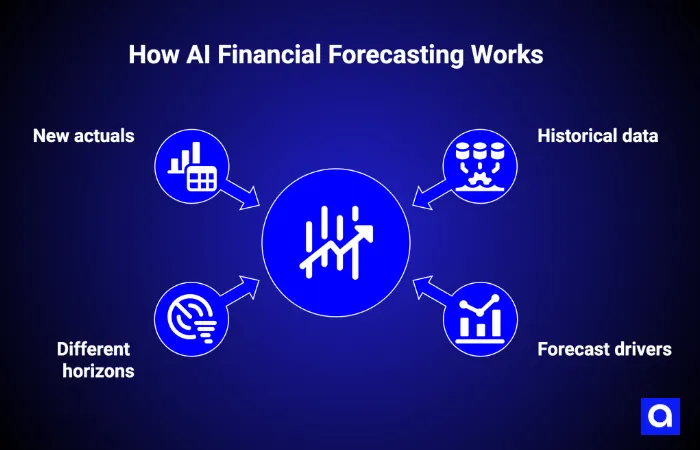
AI Combines Historical Financial and Operational Data
The first step is building a consistent dataset.
Financial results may come from the general ledger, ERP and banking systems, while the drivers behind those results may live in CRM, billing, payroll, product or operational platforms.
The software can bring those sources together at the level required by the forecast. For example, monthly revenue forecasting may combine recognized revenue, pipeline, churn, pricing and customer cohort data.
Data quality matters here. Missing periods, accounting changes, acquisitions or inconsistent category definitions need to be addressed before the model can learn meaningful patterns.
AI Identifies the Drivers Behind Financial Outcomes
A useful forecast should do more than extend last year's trend.
Models can evaluate which variables have historically moved with revenue, cash flow, expense or another target. Those relationships may include pipeline coverage, customer retention, transaction volume, headcount, payment timing, seasonality or external economic indicators.
Finance teams should still be able to see which variables materially influence the forecast. Business knowledge can then be used to challenge relationships that appear statistically strong but do not make operational sense.
AI Generates Forecasts Across Different Time Horizons
Different decisions require different horizons.
A treasury team may care about daily or weekly cash positions. FP&A may work with monthly rolling forecasts, while leadership may need quarterly and annual projections.
The model architecture can reflect those differences instead of forcing one forecast horizon onto every use case. Short-term models may depend more heavily on current operational data, while longer-term forecasts may rely more on structural assumptions and scenarios.
Forecasts Update as Actual Results Change
Once new actuals arrive, the software can compare them with the previous forecast and update future projections.
That does not mean the model should silently rewrite the financial plan. Finance teams can keep approved budgets and management assumptions separate from the predictive baseline.
This distinction allows teams to compare budget, AI forecast, adjusted forecast and actual results rather than losing the original planning assumptions every time the model updates.
Key Features of Custom AI Financial Forecasting Software
The feature set should reflect how finance teams build, review and use forecasts rather than simply adding more predictive models.
- Automated Financial Data Integration: Pull financial and operational data from ERP, CRM, banking and other systems without rebuilding spreadsheets before every forecast cycle.
- AI-Powered Revenue Forecasting: Generate projections from historical revenue and business drivers such as pipeline, seasonality, pricing or retention.
- Intelligent Cash Flow Forecasting: Model incoming and outgoing cash using balances, receivables, payment behavior and expected obligations.
- Expense and Budget Forecasting: Estimate operating costs and compare expected results with approved budgets.
- Scenario Planning and What-If Analysis: Change assumptions such as hiring, pricing, growth or payment timing and see how the forecast responds.
- Predictive Analytics and Anomaly Detection: Surface unusual movements or changes that may require finance teams to revisit an assumption.
- Interactive Financial Dashboards and Reporting: Compare forecasts, budgets, actuals and scenarios without exporting every result into another tool.
- Explainable AI and Forecast Transparency: Show important drivers, assumptions, model versions and changes so finance teams can understand how the forecast was produced.
The software should make forecasting easier to challenge, not harder. A model that produces an accurate number but cannot explain what changed will be difficult for finance teams to rely on.
What Data Is Required to Build AI Financial Forecasting Software?
You don't need every financial dataset to start development, but the available data must match the forecast you want to produce.
- General Ledger and Historical Financial Data: Provides the baseline for revenue, expense, balance-sheet and variance analysis.
- Revenue and Sales Data: Gives the model historical bookings, recognized revenue, renewals, churn, pricing and sales performance.
- Expense and Cost Data: Supports payroll, operating expense, margin and cost forecasts.
- Cash Flow and Banking Data: Adds balances, receipts, payments and liquidity information. When records come from several accounts or systems, AI bank reconciliation development services can support the matching and exception workflows needed to keep financial data consistent.
- CRM and Pipeline Data: Adds opportunities, stages, expected close dates and sales activity that may influence forward revenue.
- Operational Business Drivers: Headcount, customer volume, transactions, subscriptions, inventory, utilization or other variables can explain changes that accounting data alone cannot.
- External Market and Economic Data: Rates, inflation, commodity prices, market data or other external variables may improve some forecasts when there is a meaningful relationship with the business.
More data is not automatically better. A smaller set of reliable drivers often creates a more useful model than hundreds of weak or unstable variables.
How Does AI Financial Forecasting Software Integrate With Your Finance Stack?
Forecasting software should sit inside the flow of financial data rather than require finance teams to maintain another isolated database.
- ERP and Accounting Systems: Pull actual revenue, expenses, balances and ledger data and return forecast or variance information where supported.
- FP&A and Budgeting Platforms: Supply predictive baselines or scenarios while keeping the existing budgeting and approval process in place.
- CRM Systems: Bring pipeline, customer and sales information into revenue forecasts.
- Banking and Treasury Systems: Add balances and cash movements to liquidity and cash-flow forecasting.
- Data Warehouses: Use an existing financial data model rather than creating duplicate pipelines when trusted data is already centralized.
- BI and Reporting Tools: Publish forecasts, driver analysis and scenario results into dashboards executives and finance teams already use.
- Operational Systems and External Data Sources: Add product usage, headcount, supply, transaction or market information when those variables influence financial results.
Our data engineering services can support the pipelines, transformations and data models behind these integrations.
For fintechs, forecast outputs may also connect with other financial AI systems. For example, liquidity projections can support broader AI financial risk management development services, while transaction and settlement data from AI payment processing software can provide additional operating signals for cash forecasting.
How Do You Validate the Accuracy of Custom AI Financial Forecasting Software?
Start by comparing the AI forecast with the process your team uses today.
If a model cannot outperform a reasonable baseline such as the current FP&A forecast, a seasonal model or a simple rolling average, its added complexity may not be justified.
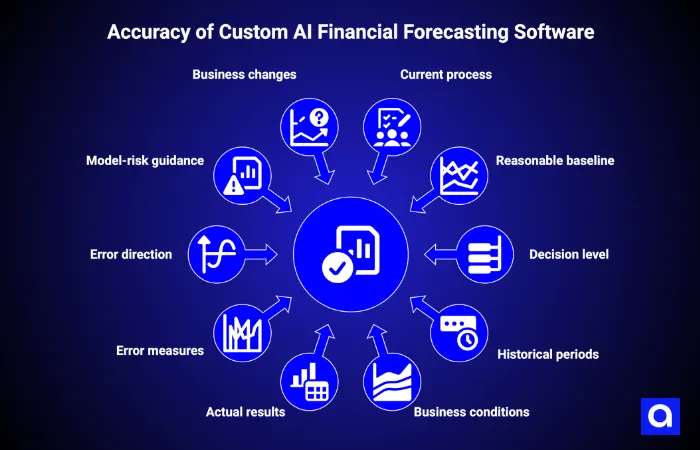
Accuracy should also be measured at the level where decisions are made. A revenue forecast can look accurate at company level while performing poorly by region, product or customer segment. The same applies to cash flow: a strong quarterly forecast may still miss short-term liquidity pressure.
Use historical periods the model did not train on and test how it performs across different business conditions. Forecast error should then be tracked against actual results after deployment.
Do not measure only one metric. Depending on the use case, teams may compare absolute error, percentage error, bias and forecast stability. The direction of the error can matter too: consistently overestimating cash is a different operational problem from producing equally sized errors in both directions.
For banking organizations where a forecasting model falls within model-risk governance, the Federal Reserve's revised 2026 Model Risk Management guidance emphasizes developmental testing, validation, outcome analysis and ongoing monitoring for models within scope.
Validation should continue after launch. If pricing changes, a new product launches or the customer mix shifts, the relationships learned from historical data may no longer hold.
What Are the Business Benefits of AI Financial Forecasting Software?
The benefit is not simply that AI produces forecasts faster. The bigger value comes from shortening the distance between new information and a finance decision.
- Faster Forecast Updates: New actuals and operational data can refresh projections without rebuilding the full model manually.
- Less Manual Spreadsheet Work: Finance teams spend less time collecting, cleaning and copying data between files.
- More Frequent Rolling Forecasts: Forecast cycles can move from occasional large updates toward more frequent revisions as conditions change.
- Better Scenario Analysis: Teams can change assumptions and compare the impact across revenue, cash, costs and margins more quickly.
- Earlier Visibility Into Cash and Performance Risks: Changes in collections, pipeline, expenses or operating drivers can surface before they become obvious in period-end reporting.
- More Consistent Forecasting Across Business Units: Shared data definitions and model logic reduce differences caused by separate spreadsheets and local forecasting methods.
- Better Understanding of Forecast Drivers: Finance teams can see which operational and financial variables are contributing most to a change in the outlook.
AI should give FP&A teams more time to interpret the forecast, challenge assumptions and work with the business rather than simply automate the creation of another spreadsheet.
How Can You Choose an AI Financial Forecasting Software Development Partner?
Start with the forecast, not the AI stack.
Ask a prospective partner how they would define the target, horizon and baseline for a revenue, cash-flow or expense forecast. They should be able to explain which business drivers belong in the model and which assumptions should remain under finance control.
Then ask how the team would prove that the model adds value. A strong partner should be prepared to backtest against historical periods, compare results with your existing forecasting process and explain where the model performs poorly as well as where it performs well.
Data engineering experience is just as important as modeling. ERP, CRM, banking and operational data rarely arrive in one clean forecasting dataset, so the development team should know how to build and maintain those integrations.
Look at production experience as well. Azumo's work with Stovell AI is a useful example of why this matters: predictive models have operated in production for more than eight years, with forecasting outputs embedded in software used by financial and market professionals.
Finally, ask who controls the forecast after launch. Finance teams should be able to adjust assumptions, run scenarios and understand why a projection changed without relying on engineers for every planning cycle.