
Custom AI Regulatory Compliance Software Development for Banks and Fintechs
AI regulatory compliance helps banks and fintechs monitor regulatory changes, identify compliance gaps, and streamline policy reviews. It automates research, control mapping, and evidence collection while maintaining human oversight. Azumo develops custom AI regulatory compliance software that simplifies compliance workflows, improves auditability, and integrates with existing financial and risk management systems.

Regulatory compliance gets harder when your team has to track more rules across more products, jurisdictions and internal systems. A single regulatory update can affect policies, controls, reporting obligations and several business units at once.
Your team still has to determine what changed, which products or entities are affected, how the new requirement compares with existing controls and what evidence is needed to document the response. When that information is spread across GRC platforms, policy repositories, spreadsheets and operational systems, even a relatively small change can create a lot of manual work.
AI regulatory compliance software can help you connect those steps. It can monitor approved regulatory sources, extract potential obligations, retrieve related policies and controls, surface possible gaps and prepare the supporting context your team needs for review.
You can keep defined requirements and approvals under explicit rules, use AI for research, comparison and prioritization, and leave material interpretations with the compliance professionals responsible for them.
Azumo's fintech AI development services combine AI engineering, financial software development and systems integration to build compliance solutions around the processes and controls your team already uses.
Key takeaways
- Azumo builds AI regulatory compliance software around existing GRC, policy, risk and financial systems, rather than creating another disconnected compliance repository.
- Regulatory monitoring is only the first step. Useful software should connect a new requirement with affected policies, controls, owners, evidence and remediation work.
- AI-generated compliance outputs need traceable sources. Reviewers should be able to see the regulation, policy or evidence behind a suggested interpretation or mapping.
- Rules, AI and human review serve different purposes. Fixed requirements can stay deterministic, while AI supports research, comparison, classification and prioritization.
- Custom development becomes more useful when compliance spans several products, legal entities, jurisdictions or proprietary control frameworks.
- Regulatory status matters. A proposed rule, final requirement, guidance document and effective obligation should not enter the workflow as if they were the same.
- The AI system itself needs ongoing governance, including permissions, testing, versioning, monitoring and audit trails.
How Azumo Builds AI Regulatory Compliance Software
We start with the compliance workflow your team already uses and identify where regulatory work becomes slow, fragmented or difficult to trace.
Our engineers map how a regulatory change moves from source to action: where it is captured, how your team assesses impact, which policies and controls are involved, who owns the review and where supporting evidence lives. That often means connecting GRC platforms, policy repositories, case-management tools, internal databases and financial applications.
Through our custom software development services, we can build the workflow, integrations and approval logic needed to keep those systems working as one compliance process.
From there, we separate the work that should stay explicit from the work AI can support. Deadlines, ownership rules, escalation paths and required approvals remain deterministic. AI can compare regulatory text with internal policies, identify candidate obligations, retrieve related controls and summarize changes, while our AI document processing development for financial services capabilities helps structure information from regulatory documents, policies and supporting evidence for further review.
We also design the system so important outputs remain traceable. Your team should be able to see which regulation, policy, control or evidence informed a recommendation before deciding what action to take.
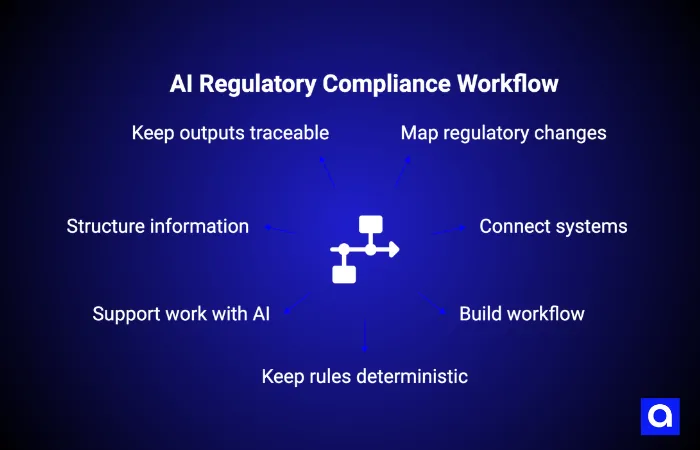
Higher-impact interpretations and approvals remain with the compliance professionals responsible for them. The result is a system that helps your team move from regulatory change to reviewed action faster without hiding accountability inside the model.
What Financial and Compliance Technology Experience Does Azumo Have?
Regulatory compliance software sits between financial operations, internal controls, data, reporting and governance. That makes financial-domain experience important alongside AI engineering.
Azumo's financial-services team includes 20 years of experience across RBC and Jefferies in enterprise software investment banking, M&A, capital markets and corporate finance; five years at JPMorgan across prime brokerage, derivatives and software engineering; and 10 years at BlackRock across AI infrastructure, MLOps, asset-management operations and data-pipeline development.
Our work with Six Lambda is particularly relevant. Six Lambda provides financial regulatory-compliance technology for monitoring political contributions and pay-to-play policies. Azumo re-architected the platform, supported daily automated monitoring and helped reduce total cost of ownership by approximately 60%.
That experience matters because compliance applications need more than accurate AI output. They also need reliable data pipelines, permissions, workflow logic, observability and systems that remain maintainable after launch.
How We Translate Compliance Requirements Into Production Software
We start with a real regulatory workflow and trace what happens after a new requirement appears.
A compliance team may need to determine the status and effective date of the change, identify affected products or entities, find related policies and controls, decide if remediation is required and document the final decision.
We turn those steps into explicit software components. Regulatory documents remain connected to their source and metadata. AI can extract candidate obligations and retrieve related internal material. Workflow rules assign the assessment to the correct owner, while approvals and changes are recorded.
Once an interpretation is approved, the system can connect the outcome with policy management, control remediation, case management or reporting workflows.
The goal is to shorten the path from regulatory change to a reviewed and documented response, not to let AI turn regulatory text directly into operational changes.
How Can AI Turn Regulatory Changes Into Actionable Requirements?
A regulatory feed can tell your team that something changed. It cannot, by itself, tell the business what needs to happen next.
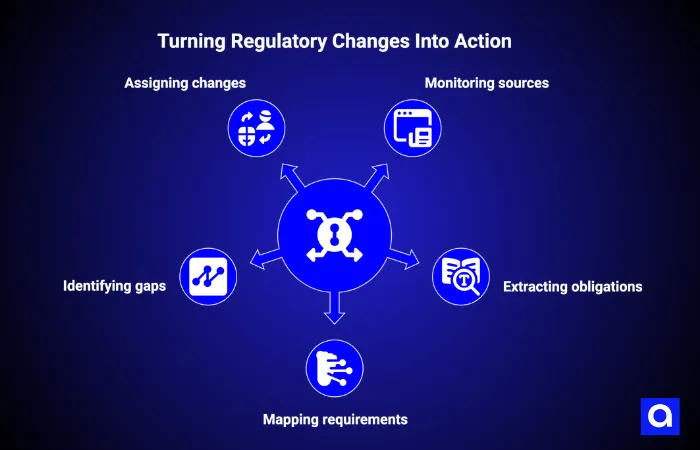
Monitoring Regulatory Sources
The system can monitor approved regulators, supervisory publications, bulletins and other sources relevant to your products and jurisdictions.
Each update should retain information such as regulator, jurisdiction, publication date, regulatory status and effective date.
That distinction is important. In April 2026, for example, FinCEN issued a proposed rule to reform financial-institution AML/CFT program requirements. A regulatory intelligence system should surface the proposal for assessment while preserving that it is not yet a final requirement.
Extracting New Obligations
AI can turn lengthy regulatory material into candidate requirements, deadlines, thresholds and affected areas for review.
The source should remain attached to every extracted obligation. Your compliance team should be able to return directly to the regulatory text instead of relying on an AI summary as the authoritative version.
Ambiguous language and cross-references still require professional interpretation.
Mapping Requirements to Policies and Controls
AI can search internal policies, procedures and control libraries for content related to a new requirement.
A single regulation may affect several controls rather than one policy. The software can surface those potential relationships and show the passages or evidence behind them.
Your team then confirms the mapping instead of beginning every regulatory assessment with a manual search across repositories.
Identifying Compliance Gaps
Once requirements and controls are connected, the system can flag areas that may need attention.
A potential gap could mean no control appears to address the requirement, an existing policy is narrower than the new obligation, required evidence is missing or a control has not been tested recently.
The important point is that AI identifies a candidate gap. Compliance determines if the gap is real and what remediation is required.
Assigning Changes for Review
The workflow can route each regulatory impact to the correct policy owner, legal team, risk function or business unit.
Instead of receiving an isolated task, the reviewer can receive the regulatory source, extracted obligation, related controls and supporting comparison together.
Approved changes can then move into policy updates, remediation, testing or reporting.
How Can AI Help Compliance Teams Work With Policies, Controls and Evidence?
- Policy review and comparison: Compare regulatory changes with current policies and previous versions while surfacing the sections that need attention.
- Control mapping: Connect regulatory obligations with existing controls, owners and testing procedures.
- Evidence collection: Retrieve approved logs, documents, reports and other evidence from connected systems and associate them with the relevant control.
- Compliance gap analysis: Identify requirements that may lack sufficient policy, control or evidence coverage.
- Audit preparation: Assemble regulations, policies, controls, evidence and approval history into a traceable review package.
- Regulatory reporting: Collect required information, check completeness and prepare draft reporting material for authorized review.
- Exception tracking: Maintain ownership, deadlines, remediation status and supporting evidence for open compliance issues.
- Third-party compliance review: Compare vendor information and documentation with internal requirements and applicable regulatory obligations.
What Should AI Be Allowed to Do in a Compliance Workflow?
Not every compliance task should receive the same level of automation.
AI is strongest at finding, comparing, organizing and prioritizing information. Accountability for material compliance decisions should remain visible.
How Do You Keep AI Compliance Outputs Source-Backed and Auditable?
An AI-generated compliance answer has limited value if the reviewer cannot see where it came from.
Material outputs should preserve the regulation, guidance, policy, control or evidence used to generate them. If the system flags a potential compliance gap, your team should be able to open both the regulatory requirement and the related internal control from the same workflow.
Versioning is equally important. Regulations, internal policies and controls change at different times, so the audit trail needs to preserve which versions were used when an assessment was made.
The system should preserve differences between jurisdictions, entities and products rather than flattening them into one compliance framework. This is especially important for AI credit scoring software, where compliance requirements may vary by market, lending product and customer type.
Retrieval-based AI should be limited to approved sources for compliance use cases that require controlled knowledge. Access controls should also restrict sensitive policies and evidence to authorized users.
Azumo's security practices include SOC 2 compliance, encryption in transit and at rest, role-based access controls and security testing, which can support the broader security architecture around financial compliance applications.
How Can AI Regulatory Compliance Software Support Multiple Jurisdictions?
A multi-jurisdiction compliance platform should preserve differences rather than merge regulations into one generic knowledge base.
Each requirement can carry attributes such as regulator, jurisdiction, legal entity, product, regulatory status and effective date. That allows shared technology to support several markets while keeping the obligations themselves separate.
For example, DORA has applied since 17 January 2025 to financial entities within its scope and includes requirements around ICT and third-party risk. The EBA also requires in-scope entities to maintain registers of contractual arrangements with ICT third-party providers.
A U.S. fintech may instead need workflows spanning FinCEN rules, federal financial regulators and state requirements.
The same document-processing, search, evidence and workflow capabilities can be reused across jurisdictions, while the underlying regulatory logic remains specific to the relevant market and product.
How Does AI Compliance Software Fit Into Your Existing GRC and Financial Systems?
Introducing AI does not require replacing a GRC platform that already works.
A custom AI layer can sit between regulatory sources and the systems holding policies, controls, risks, evidence and remediation tasks.
For example, AI may identify a potential new obligation and retrieve related policies, while the GRC platform remains the authoritative record for the control, owner and testing history. Once the compliance team confirms the impact, the workflow can update or create the appropriate task through an integration.
Evidence may also live outside the GRC system, including cloud environments, document repositories, ticketing tools, transaction platforms and data warehouses.
Our data engineering services can help establish the pipelines and consistent identifiers needed to connect regulations, controls, entities and evidence without creating duplicate or conflicting records.
Financial compliance workflows may also depend on AI-powered KYC software and AI transaction monitoring software. Connecting these workflows gives your compliance team access to relevant alerts, investigations and evidence without replacing the systems that generate them.
What Data, Policies and Regulatory Sources Does the System Need?
AI regulatory compliance software needs a controlled information environment, not unrestricted access to every document inside the organization.
External sources may include regulations, official guidance, supervisory notices, enforcement publications and approved regulatory-data services. Each record should retain its source, jurisdiction, date and regulatory status.
Internal information may include policies, procedures, control libraries, risk assessments, previous regulatory mappings, testing results, audit evidence and remediation history.
Organizational context matters too. A requirement affecting one product or legal entity should not automatically be mapped across the entire business.
The harder problem is often consistency. Duplicate policies, inconsistent control names and evidence without clear ownership make automated compliance analysis less reliable. AI can make that information easier to search, but it cannot compensate for an unclear compliance data model.
Should You Add AI to Your Existing GRC Platform or Build a Custom Compliance System?
The right architecture depends on how much of your current compliance environment already works well.
If the current GRC platform already manages controls, ownership, evidence and remediation effectively, a custom AI layer is often enough.
A full custom platform becomes more relevant when compliance processes are spread across disconnected tools or the existing platform cannot represent the regulatory model without extensive manual workarounds.
How Do You Validate and Monitor AI Regulatory Compliance Software?
Compliance AI needs to be tested against real regulatory work before teams depend on it.
How to test compliance outputs before production?
Build evaluation sets from regulatory documents and compliance decisions the organization already understands.
For obligation extraction, test if the system finds the correct requirement, source, date and scope. For control mapping, include examples where the correct outcome is no match. For regulatory research, verify that answers remain supported by approved sources rather than merely sounding plausible.
Testing should also include amendments, cross-references, similar rules from different jurisdictions and outdated guidance.
Reviewer corrections matter as much as model scores. If compliance professionals regularly reject the same type of suggestion, that is a useful production signal.
How to monitor the system as regulations change?
Monitoring needs to cover the information feeding the AI as well as the model itself.
A regulator may change a page structure, a source feed may stop updating or an internal repository may contain a newer policy version than the AI index. Those failures can produce stale compliance outputs without an obvious application error.
Track source freshness, unsupported responses, reviewer corrections, retrieval quality and mapping performance over time.
Regulation of AI can also change alongside the financial rules the software monitors. For example, transparency obligations under Article 50 of the EU AI Act started applying on 2 August 2026 for covered providers and deployers of certain AI systems.
What Features Matter Most in AI Regulatory Compliance Software?
The most useful features connect regulatory information with actual compliance work.
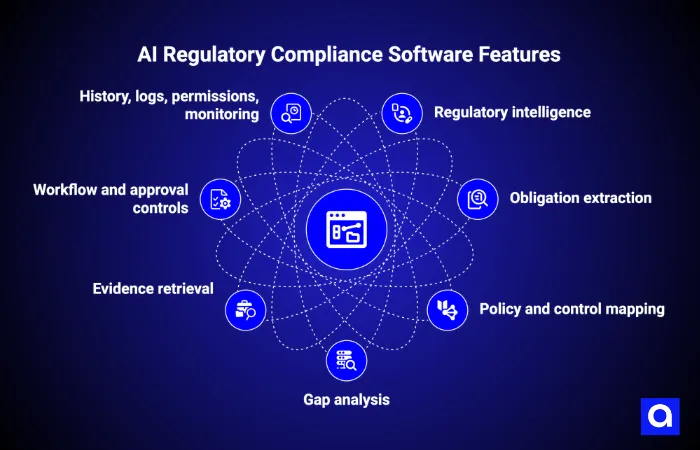
A regulatory intelligence layer should monitor approved sources, preserve document history and distinguish new publications from amendments or final requirements. Obligation extraction can convert dense regulatory material into structured candidate requirements for review.
Policy and control mapping should connect those obligations with the organization's existing framework while preserving the evidence behind each suggested relationship.
Compliance teams also need gap analysis to identify areas that may lack sufficient policy, control or evidence coverage, along with evidence retrieval that makes audit preparation easier.
Workflow and approval controls should assign changes to the correct owners and prevent AI-generated interpretations from becoming approved compliance positions without the required review.
Finally, version history, audit logs, permissions and production monitoring should make it possible to reconstruct what the system knew, what it recommended and what the team ultimately approved.
What Does It Take to Build Custom AI Regulatory Compliance Software?
Scope is driven primarily by the number of regulatory domains, data sources, integrations and workflows the system needs to support.
How much does AI regulatory compliance software cost?
Azumo currently prices software and AI development at $499 to $899 per Delivery Unit. A Delivery Unit is a defined, testable feature or sub-feature with its own acceptance criteria. Integration surface, data sensitivity, UI complexity, third-party dependencies and testing depth influence complexity.
A focused regulatory research or policy-comparison capability requires less engineering than a platform monitoring several jurisdictions, mapping requirements across a large control library and collecting evidence from operational systems.
Private deployment, multilingual regulatory content, historical document migration and complex permissions can increase scope further.
How long does AI regulatory compliance software take to build?
Azumo's current Delivery Unit model lists approximately 2 to 6 weeks for Starter engagements, 1 to 4 months for Growth projects and 4 to 6 months or more for larger Platform engagements.
A focused first release can start with one regulatory domain and a limited number of approved sources.
Broader compliance platforms take longer because integrations, taxonomies, permissions, historical content and evaluation datasets need to be prepared alongside the AI functionality.
The strongest approach is usually to validate one workflow first and expand after your compliance team has tested the output on its own regulatory material.
How Can Banks and Fintechs Choose an AI Regulatory Compliance Development Partner?
Give a prospective partner one real regulatory change and ask them to explain how the system would process it.
The answer should cover how the software identifies the source and regulatory status, extracts candidate obligations, finds related controls, preserves supporting evidence and routes the assessment to the correct owner.
Then introduce failure cases. Ask what happens when two sources appear inconsistent, an internal policy is outdated or the AI cannot find enough evidence to support its suggestion.
A capable partner should also understand the surrounding engineering. Permissions, GRC integrations, regulatory taxonomies, data lineage, audit trails and monitoring can be as important as the model itself.
Azumo's Six Lambda work provides direct evidence of engineering inside a financial regulatory-compliance platform, while our financial-services background adds experience with the systems and processes surrounding regulated financial products.
The final test is the partner's view of automation. A strong team should be able to identify the compliance decisions that should stay under explicit rules or professional approval rather than treating maximum AI autonomy as the goal.