
Custom AI Bank Reconciliation Software Development Services: A Guide for Banks, Fintechs and Finance Teams
AI bank reconciliation helps banks and finance teams match transactions, identify discrepancies, and reduce manual work. It handles complex payments, flags exceptions, and supports faster financial closing while keeping human oversight. Azumo develops custom AI bank reconciliation software that automates matching and integrates with existing banking, accounting, and payment systems.
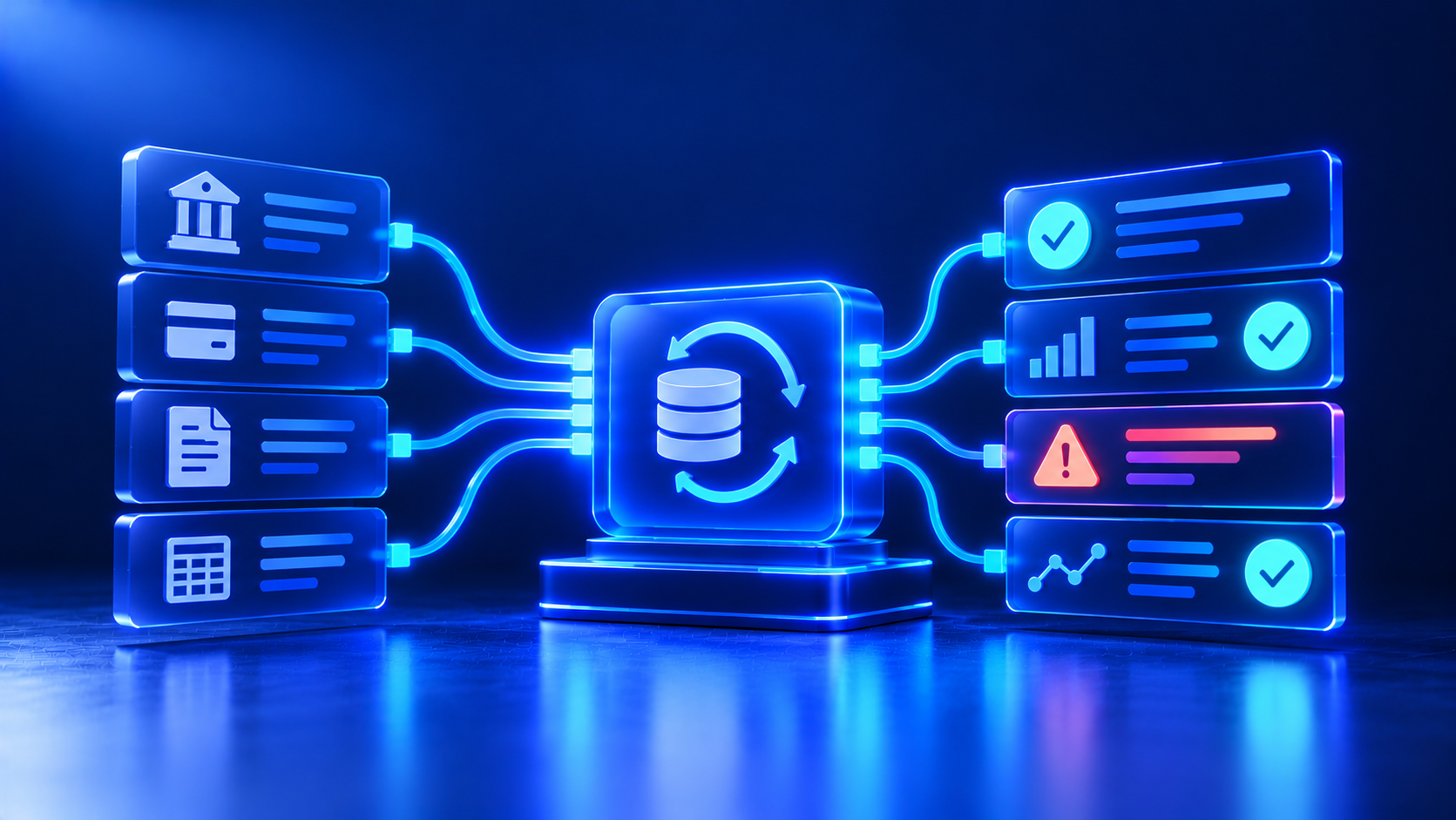
As your transaction volume grows, reconciliation usually gets harder. You may match bank activity against ledgers, payment processors, and internal systems while also dealing with timing differences, fees, partial payments, and inconsistent references.
AI bank reconciliation software can reduce that manual work. It combines fixed reconciliation rules with machine learning to identify likely matches, score confidence and send uncertain transactions to your finance team for review.
The goal is not to automate every decision. It automates the matches you can trust and keeps higher-risk or ambiguous cases under human control.
At Azumo, we build around the finance systems and controls you already use. Through our fintech AI development services, our engineers can connect your bank feeds, ledgers, payment platforms and internal applications, then design the matching logic, exception workflows, approval controls and model monitoring around your reconciliation process.
Key takeaways
- Azumo develops AI bank reconciliation software around existing financial workflows and controls. Our engineers combine rules-based matching, AI models, exception handling and system integrations based on how your reconciliation process actually works.
- AI bank reconciliation works best alongside deterministic rules. Exact and predictable transactions do not need a complex model. AI adds more value when records contain timing differences, inconsistent descriptions, split payments or other ambiguity.
- Confidence scoring is central to safe automation. High-confidence matches can move through predefined workflows while lower-confidence cases stay visible for human review.
- Custom development becomes more valuable as reconciliation complexity increases. Multiple entities, currencies, banks, payment processors and internal accounting rules can exceed what a standard platform handles comfortably.
- Exception management matters as much as transaction matching. The system should explain why something did not reconcile, prioritize the issue and give finance teams enough context to resolve it.
- Auditability has to be designed into the workflow. Match logic, model versions, approvals, overrides and source records should remain traceable.
- Continuous reconciliation can reduce period-end pressure. Instead of allowing mismatches to accumulate until close, finance teams can identify and address them as transactions arrive.
How Azumo Develops Custom AI Bank Reconciliation Software Around Your Existing Financial Workflows
You may already have reconciliation rules that work well. We do not replace them just to introduce AI.
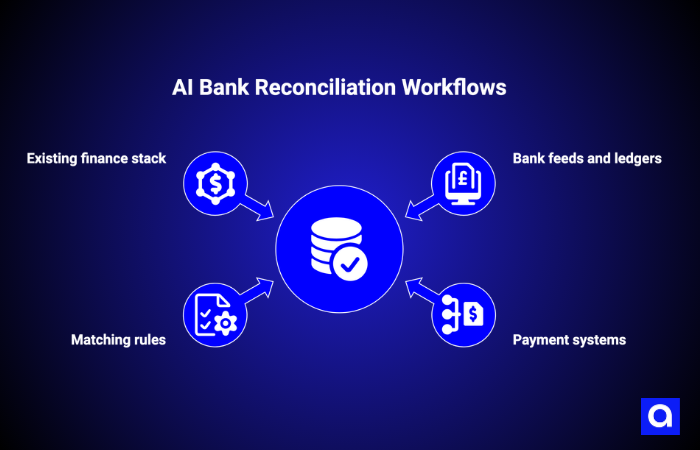
Our engineers review your bank feeds, ledgers, payment systems, matching rules and recurring exceptions to identify where automation can reduce manual work.
Exact matches can remain rules-based, while AI can help with ambiguous transactions, timing differences and harder-to-match records. Low-confidence cases can still go to your finance team for review.
We also build around your existing ERP, accounting platforms, banking APIs and payment systems, so you can improve reconciliation without replacing the finance stack that already works.
What AI Bank Reconciliation Development Expertise Does Azumo Have?
Bank reconciliation depends on more than a matching model. You need reliable financial data, stable integrations and clear controls around every automated match.
Azumo combines AI engineering with direct financial-services experience. Our team brings 20 years of experience from RBC and Jefferies across enterprise software investment banking, M&A, capital markets and corporate finance; five years at JPMorgan across prime brokerage, derivatives and software engineering; and 10 years at BlackRock across AI infrastructure, MLOps, asset-management operations and data-pipeline development.
That experience matters when reconciliation involves bank feeds, ledgers, payment processors, ERP systems and financial data that does not arrive in one consistent format.
Our work with Bento is particularly relevant. Azumo brought together 50+ fragmented financial and product data sources into a structured analytics environment, demonstrating the data-engineering work required before financial automation can operate reliably.
For reconciliation projects, our engineers can build the data pipelines, deterministic matching rules, tolerance logic and machine-learning models around your transaction patterns. We can also connect the workflow with ERP systems, ledgers, banking APIs and payment processors while keeping matches, approvals, overrides and rule changes traceable.
After launch, our MLOps development services can monitor model performance and changes in transaction behavior. Monitoring should also cover the underlying data, because a changed bank format, incomplete payment feed or failed ERP synchronization can affect reconciliation even when the model itself is working correctly.
How Azumo Builds Reconciliation Software Around Your Existing Financial Workflows
We start with the transactions your finance team already reconciles reliably and separate them from the cases creating manual work.
Recurring transfers or payments with stable identifiers may only need deterministic rules. More complex cases, such as one processor settlement covering hundreds of payments, fees, refunds and chargebacks, may require additional matching logic. The same applies when bank descriptions, settlement dates or amounts do not line up cleanly with ERP records.
We typically structure the workflow in layers:
- Exact matching handles clean, predictable transactions.
- Tolerance rules account for expected timing, rounding and amount differences.
- AI matching evaluates records that fixed rules cannot resolve reliably.
- Confidence thresholds determine which matches can be approved automatically.
- Exception workflows send uncertain or higher-risk cases to your finance team.
- Monitoring and feedback track match quality and help improve the workflow over time.
The system should also detect problems outside the matching logic. If a bank feed stops, an integration returns incomplete records or reconciliation behavior changes unexpectedly, your team should see the issue before unreliable data flows further into the process.
The result is a reconciliation system built around your existing financial data, controls and approval process, with AI applied only where it improves the work.
Should You Build Custom AI Bank Reconciliation Software or Use an Existing Platform?
Existing reconciliation products can be a strong choice when the financial workflow is standardized and supported integrations already cover the required systems.
Custom development becomes more relevant when the reconciliation logic itself is specific to the business.
If you use one accounting platform and only a few straightforward bank accounts, an off-the-shelf reconciliation tool may be enough.
The case for custom development gets stronger when you need to reconcile data across multiple processors, bank files, settlement networks, entities or currencies, especially when your matching and approval logic is specific to how your finance team works.
You may also want to keep your existing ERP in place. In that case, we can build the reconciliation layer around it, ingest data from your current systems, process matches and exceptions, and send approved results back to the financial system of record.
How Much Does Custom AI Bank Reconciliation Software Cost?
The cost of your AI bank reconciliation software will depend on more than the matching model. Integrations, transaction volume, data quality, matching complexity and the controls you need around automated decisions can all change the scope.
For your project, we would look at factors such as:
- Number of banks, accounts and legal entities
- ERP, general ledger and payment processor integrations
- Transaction volume and processing frequency
- Multi-currency requirements
- One-to-many and many-to-one matching complexity
- Quality of your historical reconciliation data
- Exception and approval workflows
- Security, audit and deployment requirements
Azumo prices development work at $499-$899 per Delivery Unit, with the final investment depending on the amount of engineering capacity your reconciliation project requires. A project connecting one bank source with one accounting platform will require a different level of effort from a reconciliation layer spanning multiple banks, payment rails, subsidiaries and ledgers.
We scope the work around your transaction volume, data quality, matching complexity, integrations and automation requirements rather than starting with a fixed software package.
See Azumo’s pricing for more details.
How Long Does It Take to Develop AI Bank Reconciliation Software?
Your timeline will depend on how many systems you need to connect, how clean your reconciliation data is and how much of the workflow you want to automate.
For a focused use case, an initial pilot can often fit into an 8–12 week window. Thomson Reuters uses the same range for AI pilot programs in accounting and audit environments, followed by a longer rollout once the workflow has been validated.
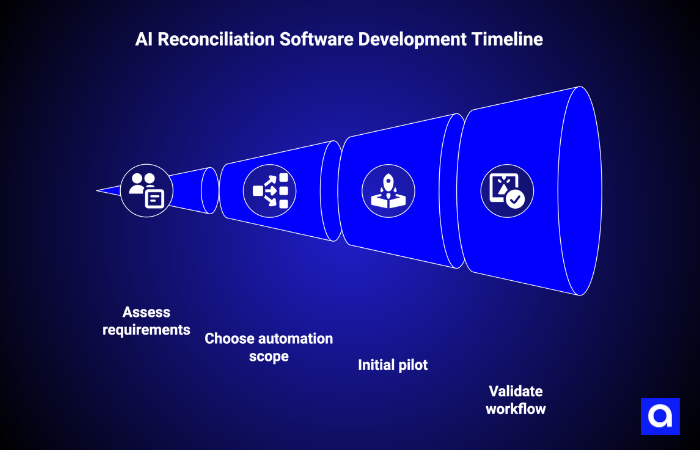
At Azumo, we would usually take you through several stages:
- Discovery and workflow mapping. We document your reconciliation flows, data sources, matching rules, common exceptions and approval requirements.
- Data and integration work. Our engineers connect your bank, ledger, ERP and payment data and make sure the records are consistent enough for automated matching.
- Matching logic and AI development. We keep reliable deterministic rules in place and add AI where it can improve fuzzy matching, exception handling or more complex transaction relationships.
- Parallel validation. We run automated reconciliation alongside your existing process so your finance team can compare results before more matches are allowed to move through automatically.
- Production rollout. Once match quality, controls and exception workflows meet your requirements, we can expand the system to additional accounts, entities or transaction types.
- Monitoring and refinement. After launch, we monitor false matches, low-confidence cases, recurring exceptions and changes in transaction patterns.
If you have a relatively clean data environment and a limited number of integrations, you can move faster. A multi-entity reconciliation platform spanning several banks, processors and ledgers will usually require a longer phased rollout.
We generally recommend scaling automation only after you have validated it on your own transaction data. That gives your finance team a chance to test the matching logic, review exceptions and adjust thresholds before more decisions move through automatically.
What Reconciliation Problems Can AI Handle?
AI adds the most value when transactions contain relationships that cannot be captured reliably with one exact rule.
Timing and Settlement Differences
A payment may appear in an operational system today but settle at the bank several days later.
Instead of treating every date mismatch as an exception, the system can consider expected settlement windows alongside transaction amount, processor and historical settlement behavior.
Missing or Inconsistent Transaction References
Bank references are not always clean.
Names may be abbreviated, identifiers may be removed and payment descriptions may differ from the format stored in the ledger. Fuzzy matching can compare several attributes instead of requiring one exact reference.
Partial and Split Payments
A customer may pay only part of an invoice or divide one obligation across several payments.
The reconciliation engine needs to identify the relationship between those records without incorrectly clearing the remaining balance.
One-to-Many and Many-to-One Transactions
A single deposit may represent several ledger transactions, while several bank movements may correspond to one accounting entry.
Microsoft’s 2026 account reconciliation work specifically includes enhanced support for 1:1 and 1:many matching scenarios along with fuzzy logic and tolerance rules.
Bank Fees and Other Deductions
Processor fees, banking charges and other deductions can create predictable differences between gross internal records and net bank settlements.
A reconciliation system can model these components instead of repeatedly sending expected deductions to the exception queue.
Foreign Exchange Differences
Transactions may be initiated and settled at different exchange rates.
The system can account for currency, transaction date, settlement date and permitted FX tolerance while preserving the underlying accounting treatment for review.
Refunds, Reversals and Chargebacks
Reversals can arrive separately from the original transaction. A useful reconciliation engine links the related events instead of evaluating each record independently.
For payment-heavy environments, reconciliation can also connect with AI payment processing development workflows to align settlements, refunds, chargebacks and processor activity with the corresponding financial records.
Duplicate or Missing Transactions
AI and anomaly detection can help surface repeated records or expected transactions that do not appear in the corresponding source. When unusual transaction patterns may indicate more than a reconciliation error, the same data can also support AI fraud detection development workflows.
These cases should be investigated rather than automatically corrected.
How Is AI Bank Reconciliation Different From Rules-Based Reconciliation?
AI does not make deterministic reconciliation obsolete.
In fact, a strong architecture deliberately keeps predictable reconciliation logic outside the AI model.
A common mistake is using machine learning where a simple rule would be safer.
For example, if transaction ID, currency and amount match exactly, there is little reason to ask a model to decide. Machine learning becomes more useful when records disagree slightly or the relationship involves several transactions.
This hybrid model is also reflected in current enterprise reconciliation approaches. Appinventiv describes probabilistic matching and confidence thresholds layered into reconciliation workflows, while Microsoft is adding fuzzy matching, tolerance support and more complex relationship matching to its reconciliation agent.
How Does AI Improve Reconciliation Exception Management?
The purpose of AI reconciliation is not only to increase automatic matches. It should also reduce the amount of work required to understand the transactions that remain unmatched.
A traditional exception queue may simply tell the accountant that two balances differ.
An AI-assisted workflow can identify likely matches, explain the factors behind them, categorize and prioritize exceptions and route them to the appropriate reviewer.
For more complex workflows, AI agent development can support multi-step exception handling, such as gathering related records, checking predefined conditions and routing the case to the right reviewer.
Higher-risk anomalies can also connect with AI transaction monitoring development workflows when they require investigation beyond the reconciliation process.
Low-confidence cases should not disappear into automation. They should become more visible.
Microsoft’s Account Reconciliation Agent, for example, provides suggested actions, contextual analysis and justification for exceptions while allowing users to accept a recommendation or select another resolution. It also records agent activity.
For a custom system, the exception strategy should reflect the company's financial risk.
A $5 timing difference in a low-risk operational account does not need the same escalation path as an unexplained six-figure settlement mismatch. Materiality, transaction type, age and model confidence can all influence the review workflow.
What Types of Financial Reconciliation Can AI Automate?
You can use AI reconciliation beyond a simple bank-to-ledger comparison. The same matching and exception logic can support several finance workflows, depending on the systems and transaction data you need to connect.
Bank-to-General-Ledger Reconciliation
You can match bank activity against your general ledger to identify cleared transactions, timing differences and balances that need investigation.
Payment and Settlement Reconciliation
If you process payments through gateways or processors, AI can compare expected settlements with actual deposits while accounting for fees, refunds and chargebacks.
Card Transaction Reconciliation
You can reconcile card activity across authorization, clearing, settlement and ledger records, helping your finance team identify missing or inconsistent transactions across the payment lifecycle.
Accounts Receivable Reconciliation
AI can help match incoming payments to invoices and open receivables, including cases where references are incomplete or one payment covers several invoices.
Cash and Treasury Reconciliation
If you manage cash across several accounts or entities, AI can compare cash movements with internal records and surface unresolved differences earlier.
Intercompany Reconciliation
You can compare transactions recorded by related entities before consolidation and flag differences in amounts, dates or currencies for review.
Multi-Entity and Multi-Currency Reconciliation
If your finance operation spans subsidiaries, bank accounts or currencies, we can apply consistent reconciliation logic while preserving entity-specific rules, FX treatment and approval requirements.
The right scope depends on where reconciliation creates the most manual work in your finance process. You may start with one workflow, such as bank-to-ledger matching, then expand the same reconciliation layer to payments, intercompany transactions or treasury activity as your requirements grow.
How Does AI Bank Reconciliation Software Work?
The technical architecture varies, but a production reconciliation workflow usually has three core stages.
AI Reconciliation Software Standardizes Transaction Data
Data first needs to become comparable.
Bank files, APIs, ERP exports and payment platforms may use different field names, formats, date standards and identifiers. Our engineers can build pipelines that convert these inputs into a common reconciliation schema while preserving the source data.
When information also arrives through statements, invoices, remittance files or other financial documents, AI document processing development for financial services can extract and structure the relevant fields before they enter the matching workflow.
Normalization can include:
- Date and timestamp formatting
- Currency normalization
- Counterparty standardization
- Transaction reference parsing
- Debit and credit conventions
- Entity identifiers
- Payment processor fields
- Invoice references
- Settlement batch identifiers
This stage is critical. AI cannot compensate reliably for an uncontrolled data pipeline.
AI Reconciliation Software Matches Transactions
Your reconciliation process can start with exact rules for IDs, amounts and references, then use tolerance logic for expected date, FX or rounding differences. AI can handle the harder cases by comparing signals such as similar counterparty names, close amounts and previous match patterns.
Each proposed match should show a confidence score and enough context for your team to understand it. You can automate high-confidence matches, send medium-confidence cases for review and route low-confidence records into the exception workflow.
You can also set different thresholds by account, transaction type or risk level. We recommend starting conservatively and increasing automation only after the model performs reliably on your own transaction data.
How Should AI Bank Reconciliation Software Handle Controls and Auditability?
AI should make a reconciliation process easier to inspect, not harder.
Every automated match should retain enough information for another person to understand what happened. These controls can also support broader AI regulatory compliance development requirements when financial institutions need traceable approvals, model outputs, overrides and audit evidence.
That can include:
- Source transactions
- Matching rule or model used
- Match score
- Reason for the proposed relationship
- Model version
- Timestamp
- User or system action
- Approval
- Manual override
- Adjustment
- Linked supporting documents
When AI can influence your financial records, you need to be able to explain how each decision was made.
That means keeping enough evidence around automated matches, approvals and overrides for your finance and audit teams to review later. PCAOB auditing standards emphasize the need for sufficient audit evidence and reliable information supporting financial reporting processes.
You also need controls around the AI itself. The NIST AI Risk Management Framework highlights areas such as reliability, accountability, transparency, explainability, privacy and security. For your reconciliation workflow, those principles translate into practical controls:
- Keep high-risk decisions reviewable. Material, unusual or ambiguous transactions should stay with your finance team.
- Separate configuration from approval. A user who changes matching rules should not automatically have unrestricted authority to approve the resulting matches.
- Version your matching logic. You should be able to identify which rule or model version produced a particular result.
- Monitor false matches. A high auto-match rate has little value if incorrect transactions are being cleared.
- Preserve override history. If your team rejects or changes an AI-generated match, that decision should remain traceable.
- Limit access to financial data. Permissions should follow least-privilege principles so users and models only access the data they need.
We can build these controls directly into the reconciliation workflow instead of treating governance and auditability as separate layers added after deployment.
Reconciliation data can also support AI financial risk management development by surfacing recurring discrepancies, unusual cash movements and operational weaknesses that may require broader risk analysis.
How Can AI Bank Reconciliation Support Continuous Reconciliation and Faster Close?
If your team waits until period-end to reconcile, unresolved transactions can build up quickly. By the time close starts, finance may be working through weeks of bank activity, payment records and exceptions at once.
Continuous reconciliation spreads that work across the period. Your software can process transactions as data becomes available, clear routine matches and surface exceptions earlier.
That means:
- You can investigate discrepancies sooner. Missing settlements and unmatched payments are easier to resolve while the context is still recent.
- You enter close with fewer unresolved items. Your team can focus on material exceptions instead of catching up on routine matching.
Cleaner, more frequently reconciled data can also improve the inputs used in AI financial forecasting development, since forecasts are less likely to rely on unresolved balances or incomplete transaction records.
This approach is already appearing in enterprise finance software. Microsoft’s Account Reconciliation Agent supports regular reconciliation and proactive exception identification rather than relying only on period-end review.
You also do not need every workflow to run in real time. We can set reconciliation frequency around your settlement cycles, transaction volume and reporting needs, from near-real-time processing to hourly, daily or overnight runs.
What Are the Benefits of AI Bank Reconciliation?
AI bank reconciliation can help your finance team automate more of the transactions that exact-match rules cannot resolve, including records with timing differences, inconsistent references, partial payments or more complex relationships. The objective is not to maximize automation at any cost. It is to increase reliable match rates while keeping uncertain or higher-risk cases visible for review.
As more routine transactions are matched automatically, your team spends less time comparing records manually and more time investigating the exceptions that actually need attention. When a transaction does not reconcile, the software can surface likely matches, related records and the factors behind the exception, giving reviewers more context from the start.
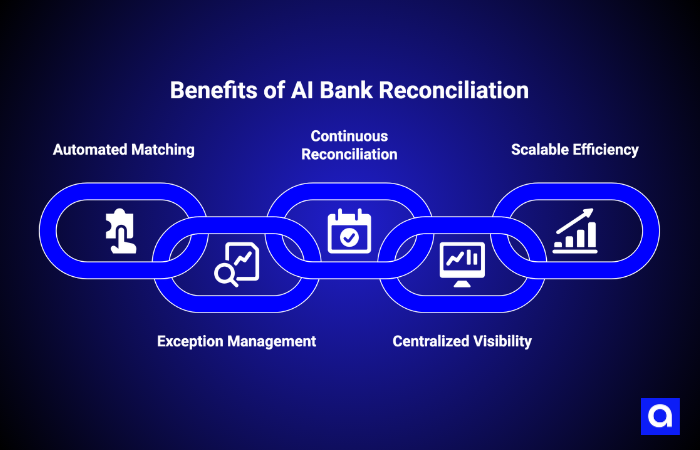
Continuous reconciliation can also help you identify missing settlements, duplicate transactions and unexplained differences earlier instead of discovering them at month-end. With fewer unresolved items accumulating during the period, the close can become faster and more predictable, with fewer last-minute investigations.
For organizations working across multiple accounts, entities or payment channels, a centralized reconciliation layer can improve visibility into matched transactions, open exceptions and aging items. Standardized matching logic, approvals and audit trails also make the process easier to control and review.
As transaction volumes grow, the same system can process more routine activity without requiring manual reconciliation work to increase at the same rate. Your team can continue focusing on complex exceptions and higher-value finance work instead of scaling headcount alongside transaction volume.
How Can Companies Choose an AI Bank Reconciliation Software Development Partner?
Your development partner needs to understand more than AI. Reconciliation sits inside your financial control environment, so the team should also be comfortable with accounting data, integrations, security and auditability.
Look at how a potential partner approaches the areas that will determine if the system works reliably in production:
- Financial workflows: Can the team work with ledgers, settlement flows, close processes and reconciliation controls?
- Data engineering: How will they normalize inconsistent data and detect incomplete or delayed feeds?
- Matching architecture: Do they know when to use deterministic rules and when AI actually adds value?
- Integrations: Can they connect your ERP, bank feeds, payment processors and internal systems?
- Human review: How will uncertain or material matches reach your finance team?
- Explainability and auditability: Can you see why transactions were matched and who approved or changed a decision?
- Model monitoring: How will the team detect declining match quality or changes in transaction behavior?
- Security and deployment: Can the architecture meet your access, hosting and data-protection requirements?
At Azumo, we cover these areas with financial software, data engineering services and AI expertise in the same delivery team. Our engineers can build the data pipelines and integrations, develop the matching logic and exception workflows, then monitor model performance after the system goes live.
You should not have to trust a reconciliation model blindly. We design the software so your team can see what was matched automatically, understand which transactions still need attention and stay in control of the decisions that carry more financial risk.