
Custom AI Customer Onboarding Software Development Services for Banks and Fintechs
AI customer onboarding helps banks and fintechs automate document collection, identify missing information, and streamline identity verification. It reduces delays, improves customer experiences, and supports compliance through human oversight. Azumo develops custom AI customer onboarding software that simplifies workflows and integrates with existing CRM, KYC, fraud detection, and banking systems.

Customer onboarding can become difficult long before a KYC check fails. Customers may enter the same information several times, upload documents that are not reviewed until later, wait for internal teams to resolve exceptions, or reach a point where the next step is unclear.
For banks and fintechs, those delays create work on both sides. Customers wait longer to access the product, while operations, compliance and risk teams spend time chasing documents, moving information between systems and reviewing cases that could have been resolved earlier.
AI customer onboarding can coordinate more of that journey across applications, documents, KYC providers, fraud systems and internal approval workflows. The goal is not to give one AI model control over account opening. It is to automate repetitive work, interpret less structured information and give your team better context when human judgment is still required.
Azumo builds AI customer onboarding software around the financial systems already in place. Through our fintech AI development services, we can connect AI with customer data, verification providers, financial applications and internal controls without forcing you to replace technology that already works.
Key takeaways
- Azumo develops AI customer onboarding software around your existing financial systems, including CRM, KYC, fraud, account-opening and internal platforms.
- AI does not need to control every onboarding decision. Deterministic requirements can remain rules-based while AI handles document interpretation, case summaries, personalization and prioritization.
- KYC, fraud detection and onboarding orchestration should remain distinct parts of the architecture, so each system keeps a clear responsibility.
- Custom development becomes more useful when onboarding differs by product, customer type, jurisdiction or risk profile, or when existing platforms require too many manual workarounds.
- Human review remains important for conflicting information, higher-risk customers and low-confidence outputs.
- The best starting point is usually one measurable source of friction, such as document processing, missing-information follow-up or exception routing.
- Onboarding performance should be measured after launch, including completion time, drop-off, manual touches, missing information and human overrides.
How Azumo Builds AI Customer Onboarding Software
We start with the onboarding process your customers and internal teams already use, then identify where delays, duplicate work and avoidable handoffs are happening.
Our engineers map the full journey from application intake and document collection through identity verification, risk checks, manual review, approval and account activation. We look at which system owns each piece of data, how information moves between teams, where customers are asked to repeat themselves and which steps regularly create exceptions.
From there, we separate three types of work. Deterministic requirements, such as mandatory fields, eligibility rules and approval conditions, remain explicit. We use AI where the workflow requires interpretation, such as extracting information from documents, identifying inconsistencies, summarizing a case, or deciding which exception to review first. Higher-risk or unclear cases remain with the team responsible for the final decision.
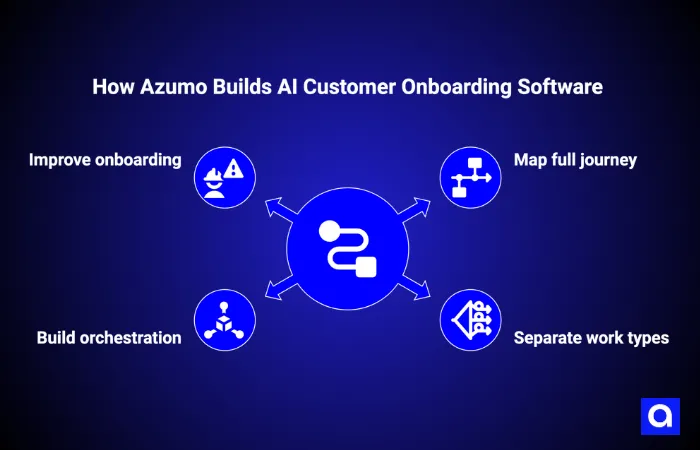
We then build the orchestration around your existing CRM, KYC provider, fraud tools, account-opening platform and internal systems. Our data engineering services can connect and normalize customer information across those systems, so the onboarding layer knows what's already been completed, what is still missing, and what should happen next. It prevents customers and internal teams from working from different versions of the same case.
The final system is designed to improve the parts of onboarding that create the most friction without replacing controls that already work. That can mean fewer manual handoffs, earlier detection of missing information, clearer exception routing and a more consistent path from application to activation.
What Financial and AI Experience Does Azumo Bring to Customer Onboarding?
AI customer onboarding software sits between customer data, identity verification, financial systems, risk controls and operational workflows. Building the model is only one part of the project.
Azumo has built production AI since 2016, while our financial-services team brings domain experience from major financial institutions. That includes 20 years across RBC and Jefferies in enterprise software investment banking, M&A, capital markets and corporate finance; five years at JPMorgan across prime brokerage, derivatives and software engineering; and 10 years at BlackRock across AI infrastructure, MLOps, asset-management operations and data-pipeline development.
That combination matters because onboarding problems are often data and workflow problems before they are AI problems.
Our work with Bento is relevant here. Azumo brought together more than 50 fragmented financial and product data sources into a structured analytics environment. Similar data-engineering challenges appear when customer, CRM, verification and account information sits across several systems.
Our work with Six Lambda provides another useful example. Azumo re-architected a financial regulatory-compliance platform and reduced total cost of ownership by approximately 60%, demonstrating the production engineering and compliance-software experience required for regulated financial workflows.
These are not presented as direct customer-onboarding case studies. They demonstrate the financial data, compliance and production AI capabilities that custom onboarding software relies on.
How We Turn Your Existing Onboarding Journey Into an AI Workflow
We first map what actually happens today rather than designing an idealized process from scratch.
A customer may begin in a web or mobile application, upload supporting documents, complete identity verification, trigger KYC and fraud checks, wait for an internal review and then move into account creation.
Each step may use a different system.
We identify which parts already work reliably and leave them in place. Development then focuses on the points creating repeated work or unnecessary delays.
For example, AI may extract information from an uploaded statement and compare it with application data, while an explicit eligibility rule remains deterministic. The system may summarize conflicting KYC results for a reviewer, but the escalation or approval decision can stay with the compliance team.
Once those boundaries are clear, we connect the AI components with the existing systems and test the complete workflow against real onboarding scenarios before increasing automation.
Where Does Customer Onboarding Usually Break Down?
Onboarding friction usually comes from several smaller problems rather than one obvious failure.
Customers Repeating the Same Information
A customer may provide personal or business information during application intake, enter similar details during identity verification and then answer the same questions again when the case moves to another team.
If approved information already exists in one system, the onboarding workflow should retrieve it instead of asking the customer to recreate it.
AI can help normalize information across different structures, but the system should still preserve which source is authoritative.
Missing Documents Discovered Too Late
A document can be uploaded successfully and still be unusable.
It may be outdated, incomplete, illegible or missing information required later in the journey. If that problem is discovered only after manual review, both the customer and the onboarding team lose time.
AI document processing services can extract information from uploaded files, identify obvious gaps and help request missing material while the customer is still active in the process.
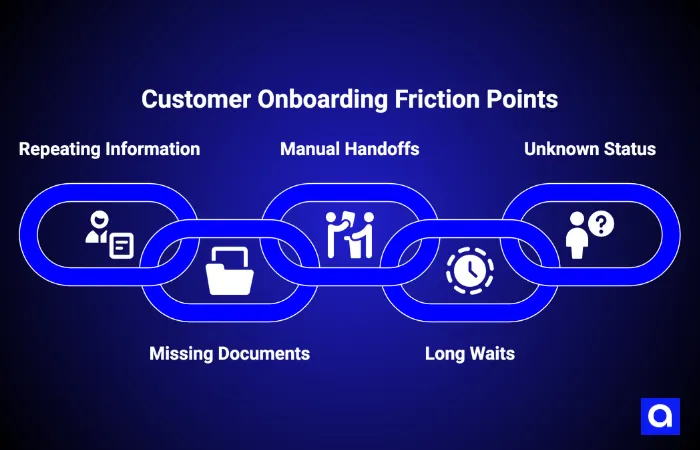
Too Many Manual Handoffs
A single onboarding case may move between sales, operations, KYC, fraud, compliance and account-opening teams.
Each handoff creates an opportunity for context to disappear.
A shared onboarding workflow can preserve which checks have already been completed, which information remains outstanding, why a case was escalated and what the next reviewer needs to do.
Instead of rebuilding the history manually, the next team receives the case with the relevant context already assembled.
KYC and Risk Checks Creating Long Waits
The verification itself is not always what causes the delay. Problems often appear when results are incomplete, conflicting or require interpretation.
A custom onboarding layer can bring those results into the same workflow and route straightforward cases differently from those requiring more investigation.
Our AI-powered KYC software can support document review, customer-risk workflows and integrations with existing identity and verification providers without turning the onboarding application into the source of every compliance decision.
Customers Not Knowing What Happens Next
A customer who has submitted the required information should not have to guess if the application is waiting for another document, an external check or an internal approval.
The onboarding system can expose an appropriate status and request the next required action based on the actual state of the case.
That also prevents generic reminder sequences from asking customers for documents they have already provided.
Where Can AI Improve the Onboarding Journey?
- Before the Customer Starts an Application: AI can use approved product and eligibility information to guide customers toward the appropriate onboarding path and avoid unnecessary steps.
- While Information and Documents Are Being Collected: The system can identify missing fields, extract information from uploaded files and detect conflicts between documents and application data.
- During Verification and Risk Review: AI can bring together KYC, identity and fraud results, summarize the case and prioritize applications that need attention.
- When an Application Needs More Information: The workflow can identify exactly what is missing and request the relevant field or document instead of sending a generic reminder.
- When a Case Needs Human Review: AI can prepare the application, verification results, risk signals and previous actions so the reviewer starts with useful context.
- After the Customer Is Approved: The workflow can move approved information into account setup, servicing or customer-success systems and trigger the next required actions.
What Should Stay Rules-Based and What Should AI Handle?
AI is most useful where onboarding requires interpretation. Requirements that already have a clear answer generally do not need a model.
The strongest architecture usually combines all three. Rules preserve explicit requirements, AI handles interpretation and prioritization, and people retain control where judgment matters.
Can You Add AI Without Replacing Your Current Onboarding Platform?
In many cases, yes.
Your existing CRM, onboarding portal, identity provider or account-opening platform may already handle most of the process well. Replacing it simply to introduce AI can create more complexity than value.
When an AI Layer Is Enough
An AI layer makes sense when the underlying onboarding workflow is sound but selected steps still create too much manual work.
Your existing platform may already manage forms, customer status and approvals. The missing capability could be document extraction, application summaries, intelligent follow-ups or exception prioritization.
Those capabilities can be added through APIs and supporting services while the current platform remains the system of record.
This approach also gives your team a clearer way to measure impact because the new capability can be compared with the process it replaces.
When a Full Custom Onboarding Platform Makes More Sense
A broader custom platform becomes more useful when the workflow itself is fragmented.
You may have different systems for each product, several KYC providers, spreadsheets used for exceptions, separate onboarding processes for individuals and businesses or extensive manual routing between internal teams.
Adding one more isolated AI tool can make that environment harder to manage.
A custom onboarding platform can become the orchestration layer across those systems while specialist services such as identity verification and fraud screening remain in place.
How Does AI Customer Onboarding Integrate With Your Existing Financial Systems?
AI customer onboarding software normally coordinates several existing systems rather than replacing them.
Your CRM may provide prospect and relationship information. The onboarding application collects forms and documents. Identity and KYC providers return verification results. Fraud platforms contribute risk signals. Core banking or account-opening systems create the final account, while customer-support and notification systems manage communication around the process.
The onboarding layer needs a stable way to exchange information across those systems while preserving the source of each record.
For example, the KYC provider can remain responsible for identity verification while the onboarding workflow determines what happens after the result. AI fraud detection software can contribute a risk signal without becoming the authoritative source for customer identity.
Fintech AI development services can support the broader integration layer across customer systems, financial APIs, risk tools and internal applications.
The integration should also account for later changes. A customer profile update, new fraud signal or compliance event may need to trigger additional verification after the original onboarding process is complete.
What Data Does AI Customer Onboarding Software Need?
AI customer onboarding software needs enough context to understand the customer, the product they are applying for and the current onboarding stage. It does not need access to every piece of data the organization holds.
Customer and application records provide the basic profile and submitted information, while KYC and identity systems contribute verification status and approved risk data. Uploaded documents and CRM records can add the supporting context needed to complete the journey.
More data is not always better. For organizations subject to GDPR, the data minimization principle requires personal data to be limited to what is necessary for the intended purpose. NIST’s Digital Identity Guidelines similarly emphasize collecting only the identity evidence and attributes needed for proofing.
The bigger challenge is often consistency across systems. A CRM, identity provider and core financial platform may all represent the same customer differently, so those records need to be aligned before AI can reliably assemble the case.
Access should also follow the task. An AI component preparing a missing-document request should only receive the information required to complete that action, not unrestricted access to the customer’s full financial record.
How Does AI Customer Onboarding Handle Exceptions and Human Review?
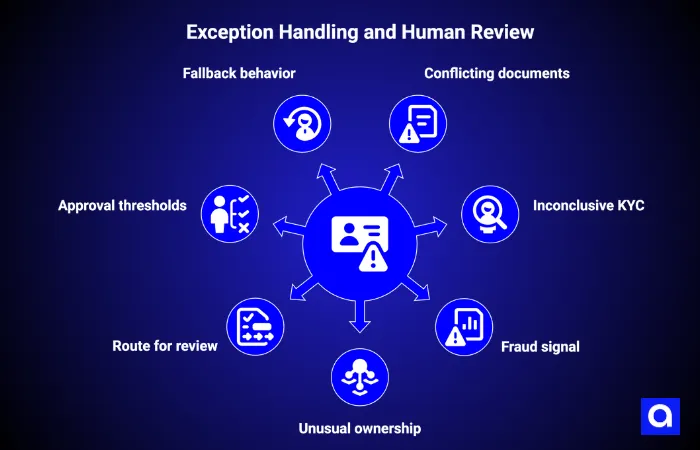
A production onboarding workflow needs a defined path for cases the software cannot resolve confidently.
An uploaded document may conflict with application data. A KYC result may be inconclusive. A fraud signal may exceed a threshold. A business customer may have an ownership structure outside the standard workflow.
Those cases should not disappear into an undifferentiated manual queue.
The system can classify the exception, gather relevant evidence and route it to the team authorized to handle that type of case. The reviewer should see what triggered the exception, which systems were checked and what information the AI used.
Confidence thresholds can control how much automation is permitted. Routine completeness checks may run automatically, while higher-impact recommendations can remain drafts until a person approves them.
Fallback behavior matters too. If a KYC provider or financial system becomes unavailable, the workflow should pause the dependent action, surface the failure and follow a defined fallback. Missing verification data should never be interpreted as approval.
How Much Does Custom AI Customer Onboarding Software Cost?
Azumo's current pricing lists development at $499 to $899 per Delivery Unit, with the final investment determined by the scope and engineering capacity the project requires.
For AI customer onboarding software, cost usually grows with the number of customer journeys, document workflows, verification providers, financial-system integrations and approval paths involved.
A focused capability that checks application completeness or prepares case summaries requires substantially less engineering than a platform coordinating retail and business onboarding across several countries, KYC providers, fraud systems and core financial applications.
Data readiness also matters. If customer records use inconsistent identifiers or important onboarding information still lives in spreadsheets and disconnected databases, more engineering work is required before reliable automation can begin.
Security requirements, customer-facing interfaces, workflow configurability, deployment architecture and testing depth also affect the scope.
How Long Does It Take to Build AI Customer Onboarding Software?
The timeline depends on how much of the onboarding journey is changing.
Azumo's Delivery Unit tiers provide a useful planning reference. Starter projects typically take about 2 to 6 weeks, Growth projects about 1 to 4 months, and Platform projects 4 to 6+ months, depending on scope.
A focused capability such as document classification, missing-information detection or an internal onboarding assistant will generally move faster than a complete onboarding platform.
Broader projects take more time when they need to connect several KYC providers, fraud systems, CRM records, customer-facing applications and core financial infrastructure.
Data access can affect the schedule as much as model development. A technically straightforward AI capability will still be delayed if a critical internal system lacks a reliable integration path or customer data needs significant cleanup first.
What Should You Measure After Launch?
A successful deployment should improve the onboarding process, not simply increase the amount of AI being used.
- Time to Complete Onboarding: Track how long customers take to move from the first application step to the defined activation point.
- Drop-Off by Stage: Measure where customers leave the process so the team can identify specific points of friction.
- Manual Touches per Customer: Track how often operations, onboarding or compliance staff need to intervene in a typical case.
- Missing Information Rate: Measure how often applications reach later stages without the required data or documents.
- Exception and Escalation Rate: Monitor how many cases leave the standard path and which conditions create the most escalations.
- Human Override Rate: Track how often reviewers change an AI-supported recommendation. Increasing overrides can indicate problems with the model, workflow or underlying data.
These metrics should be compared with the pre-AI onboarding process. A higher automation rate is not useful if customer confusion, exceptions or incorrect routing also increase.
What Features Matter Most in AI Customer Onboarding Software?
The most useful features are the ones that keep customers moving while preserving control over important decisions.
Your system needs a reliable customer profile and onboarding state so every workflow knows what has already been completed and what remains outstanding. Document intake and processing can structure uploaded files, check completeness and surface discrepancies earlier.
Configurable workflow logic should let operations teams define different paths by customer type, financial product, geography or risk level without rebuilding the application each time a requirement changes.
KYC, identity and fraud systems should remain separate integrations. The onboarding platform brings their results into the workflow but does not blur the responsibility of each service.
The customer-facing experience matters too. Progress tracking, contextual requests and automated follow-ups can tell customers what they need to do next without asking repeatedly for information they have already supplied.
For internal teams, exception queues and human approval controls should provide the evidence behind each case. Permissions and audit logs should preserve who or what changed a status, approved an application or overrode a recommendation.
Finally, monitoring should cover both the AI and the systems feeding it. A model cannot produce reliable output if a document pipeline, verification provider or customer-data integration has stopped returning complete information.
How Can Banks and Fintechs Choose an AI Customer Onboarding Development Partner?
Give a prospective development partner one real onboarding journey and ask them to explain how they would build it.
For example, describe a business customer that completes an application, uploads ownership documentation, passes through identity verification and fraud screening, and then requires internal approval before account activation.
The team should be able to explain which steps remain deterministic, where AI adds measurable value, which third-party systems stay in place and where human judgment is required.
Then introduce a failure case. Ask what happens if the application and uploaded document contain conflicting information or an identity provider stops responding. The answer should cover evidence, routing, fallback behavior and monitoring rather than simply saying the AI will handle it.
Financial data and integration experience are equally important. Onboarding can touch CRM records, customer applications, identity providers, fraud services and core financial systems in the same journey.
Security should also be evaluated independently from AI capabilities. Azumo's security practices include SOC 2 compliance, encryption in transit and at rest, role-based access controls and security testing.
A useful partner should also be willing to identify the parts of onboarding that should not be automated. Custom AI creates more value when it removes unnecessary work without weakening the controls your financial product depends on.