
Custom AI Wealth Management Software Development Services: A Guide for Wealth Managers, Banks and Fintechs
AI wealth management helps financial advisors monitor portfolios, analyze investment data, and deliver personalized client services. It automates routine tasks, supports financial planning, and improves decision-making while keeping advisors in control. Azumo develops custom AI wealth management software that connects existing financial systems, streamlines workflows, and improves advisor productivity.

Your wealth management team may already have portfolio systems, a CRM, financial planning software, custodian feeds and internal research tools. The challenge is often getting those systems to work together well enough to give advisors useful intelligence at the right time.
AI in wealth management can help bring that data into advisor workflows. It can prepare client summaries, surface portfolio changes, search investment research, identify next-best actions, support financial planning and monitor portfolios for changes that need attention.
The goal is not to hand investment decisions over to a model. It is to give your advisors better information, automate repetitive work and keep recommendations, approvals and client communication under the controls your firm requires.
At Azumo, we build AI around the wealth management systems you already use. Through our fintech AI development services, our engineers can connect portfolio data, CRM records, custodian feeds, market data and internal research, then design the AI workflows, approval controls and monitoring around how your advisors actually work.
Key takeaways
- Azumo builds AI wealth management software around your existing advisor workflows and financial systems. Our engineers connect the data, models and controls rather than adding a standalone AI tool your team has to work around.
- AI can give advisors more time for client-facing work. Meeting preparation, research, portfolio monitoring, reporting and follow-ups can all be partially automated.
- Personalization depends on connected data. Client goals, holdings, transactions, risk profiles and advisor notes need to be available in a consistent structure before AI can provide useful context.
- Human oversight remains important. Portfolio recommendations, client communications and other high-impact outputs should have review controls based on your firm’s policies and risk level.
- Custom development makes more sense when your investment process is differentiated. Proprietary research, portfolio methodologies, complex integrations and advisor workflows can be difficult to fit into generic wealth platforms.
- AI needs production monitoring after launch. Models, data feeds and recommendation logic should be tested and monitored as markets, client data and workflows change.
How Azumo Develops Custom AI Wealth Management Software
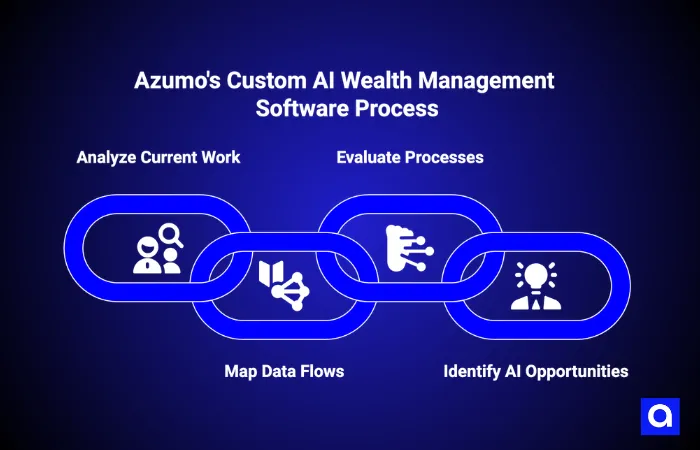
We do not start by deciding which model to use. We start with the work your advisors, portfolio managers and operations teams already perform.
Our engineers look at where client data lives, how portfolio information moves between systems, which steps are manual and which decisions require professional judgment. That may include CRM activity, portfolio analytics, research, financial planning, onboarding, reporting and client communications.
From there, we identify where AI can reduce friction without taking control away from the people responsible for the client relationship.
What AI Wealth Management Development Expertise Does Azumo Have?
Wealth management software sits between financial data, investment logic, advisor workflows and regulatory controls. That is why direct financial-services experience matters alongside AI engineering.
Azumo’s financial-services team includes 20 years of experience from RBC and Jefferies across enterprise software, investment banking, M&A, capital markets and corporate finance; five years at JPMorgan across prime brokerage, derivatives and software engineering; and 10 years at BlackRock across AI infrastructure, MLOps, asset-management operations and data-pipeline development. Azumo also works directly with portfolio management, rebalancing, performance attribution, market feeds, regulatory reporting and advisor technology.
That experience is reflected in production work. With Stovell AI, our engineers helped turn quantitative models into a financial AI platform that has remained in production for more than eight years, including forecasting and forward-looking market signals.
For Bento, we unified 50+ financial data sources into a structured analytics environment, giving the company clearer management and financial visibility. That kind of data work becomes important when portfolio, CRM, custodian and client information sits across several systems.
Our work with Six Lambda also involved re-architecting a financial regulatory-compliance platform, improving reliability while reducing total cost of ownership by about 60%.
For your wealth management project, that means we can work across the AI models, financial data, integrations and production application rather than treating each layer as a separate problem.
How Azumo Takes an AI Wealth Management Product From Use Case to Production
We normally begin with one workflow where AI can create measurable value.
You may want to reduce advisor preparation time, monitor portfolios for drift, search internal research or improve client reporting. Each of those requires a different combination of data, models and controls.
Our team can take the project through several stages:
- Workflow discovery. We map how your advisors work today, which systems they use and where AI could remove repetitive steps.
- Data readiness. Our engineers identify the client, portfolio, market and research data needed for the use case and address gaps before model development.
- Architecture and model selection. We determine where deterministic financial logic, machine learning, generative AI or AI agent development makes sense.
- Integration. We connect the AI layer with your CRM, portfolio-management systems, custodians, market-data providers and internal applications.
- Validation. Your team tests outputs against real workflows before AI is given broader access or autonomy.
- Production rollout. We deploy the approved use case with permissions, logging, monitoring and review controls.
- Ongoing monitoring. We track model behavior, input quality and performance after launch.
This staged approach helps you validate the system on your own data and investment workflows before expanding it across more advisors, clients or use cases.
Should You Build Custom AI Wealth Management Software or Use an Existing Platform?
An existing wealth platform may be enough if your workflows are standardized and the AI capabilities you need are already available.
Custom development becomes more valuable when your advantage comes from the way your firm combines data, research, investment methodology and advisor judgment.
If your advisors already work effectively inside one platform and only need basic summarization or automation, adding another custom application may create unnecessary complexity.
The case changes if you need AI to work across several custodians, a CRM, portfolio software, proprietary research and internal approval processes. In that environment, we can build the AI layer around the technology you already use instead of forcing your team into another disconnected platform.
How Much Does Custom AI Wealth Management Software Cost?
Your cost will depend on the use case you are building.
An internal advisor copilot connected to approved research and CRM records is a different project from a client-facing platform that combines portfolio analytics, financial planning, real-time market feeds and personalized recommendations.
Azumo prices AI engagements by Delivery Unit (DU), at $499 to $899 per DU depending on the tier: Starter at $899 per DU, Growth at $699 per DU and Platform at $499 per DU. Starter engagements typically run 2 to 6 weeks, Growth engagements 1 to 4 months and Platform engagements 4 to 6+ months. The number of DUs your project needs depends on scope, data readiness and integration depth. You can see the details on our pricing page.
For AI wealth management software, the final cost depends on portfolio and custodian integrations, market-data requirements, advisor workflows, model complexity, deployment environment and the condition of the underlying client and portfolio data.
For your project, we would look at factors such as:
- Number of AI use cases
- CRM, custodian and portfolio integrations
- Number of client and portfolio data sources
- Real-time market-data requirements
- Proprietary investment models or calculations
- Advisor and client-facing interfaces
- Historical data quality
- Generative AI or agent workflows
- Review and approval requirements
- Security and deployment architecture
- Model monitoring and ongoing maintenance
A focused advisor assistant may be relatively contained. A wealth platform that supports financial planning, investment research, portfolio monitoring and client recommendations across several systems will require a broader engineering effort.
How Long Does It Take to Develop AI Wealth Management Software?
Your timeline depends on data readiness, integrations and how close the AI gets to client or investment decisions.
For a focused AI use case, a pilot can often fit into an 8- to 12-week testing window once the necessary data and integrations are available. Thomson Reuters uses the same 8- to 12-week range for controlled AI pilot programs in professional-services environments, followed by a broader rollout after validation.
At Azumo, we would typically move through:
- Discovery and workflow mapping. We define the advisor workflow, users, data sources and success criteria.
- Data and integration work. Our engineers connect the systems required for the first use case.
- AI development. We build the model, retrieval layer, recommendation logic or agent workflow.
- Validation. Your advisors test outputs against real client and portfolio scenarios.
- Controlled rollout. We deploy the system to a defined user group before expanding access.
- Monitoring and refinement. We track output quality, adoption and model performance after launch.
If you already have clean portfolio data and modern APIs, the implementation can move faster. A firm with several custodians, legacy systems and fragmented client records will usually need more integration and data work before the AI layer is ready.
What Do RIAs and Private Banks Use AI Wealth Management Software For?
RIAs and private banks can use AI to reduce administrative work around advice while giving advisors faster access to client and portfolio information. Common use cases include:
- Preparing advisor meeting briefs
- Summarizing recent portfolio activity
- Identifying allocation drift or concentration risk
- Searching approved investment research
- Monitoring client accounts for relevant changes
- Preparing personalized client communications
- Supporting financial-planning scenarios
- Generating draft reports and review materials
- Identifying clients who may need proactive outreach
- Supporting onboarding and data collection
- Automating internal research and operations workflows
Industry adoption is moving beyond experimentation. EY reported in its 2025 wealth and asset management survey that 95% of surveyed firms had scaled GenAI across multiple use cases, with client engagement and advisor-support workflows becoming important areas of investment.
The most useful implementations tend to put AI inside the tools advisors already use instead of expecting them to open a separate chatbot and manually recreate client context.
How Does AI Wealth Software Integrate With Custodians, CRM and Portfolio Systems?
Your AI application needs controlled access to the systems that hold client and investment information.
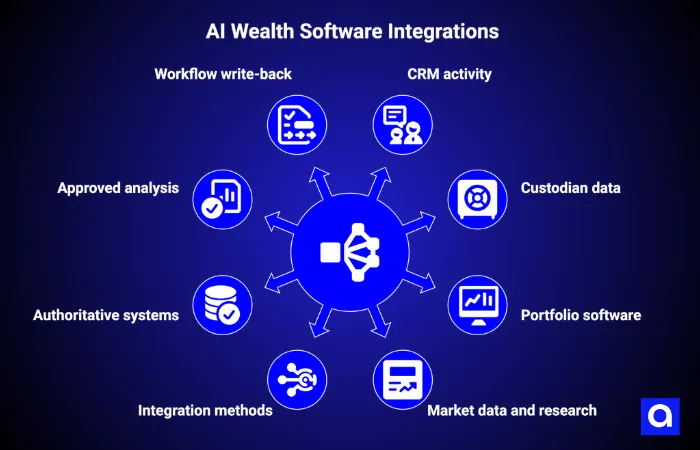
For example, an advisor copilot may need CRM activity to understand recent client conversations, custodian data to see current holdings and portfolio software to calculate performance or allocation. It may also need approved market data and research before it can explain why a portfolio has changed.
We can connect those systems through APIs, data feeds, files, databases or integration services available in your environment.
You do not need to replace your current wealth-management stack to add AI. We can build integrations with:
- Portfolio management systems. Pull holdings, performance, allocation and account information into advisor workflows.
- CRM platforms. Use relationship history, activities, notes and client segmentation to provide context.
- Custodian and brokerage systems. Retrieve balances, positions, transactions and account data through supported feeds or APIs.
- Trading and order management platforms. Surface information needed for portfolio review or controlled rebalancing workflows.
- Financial planning software. Connect goals, assumptions and planning scenarios with the broader client profile.
- Market data providers. Bring in quotes, historical pricing, fundamentals, corporate actions and other approved data.
- Client portals and mobile apps. Deliver controlled insights and reporting through the interfaces clients already use.
- Internal data warehouses and knowledge bases. Give advisor-facing AI access to proprietary research, policies and historical data.
The AI layer should not become a second source of truth. Your custodian, CRM or portfolio system can remain authoritative while the AI application retrieves the information it needs, performs the approved analysis and writes back only where your workflow allows it.
The integration design should also define what the AI can read, what it can write and which actions need approval.
For example, an advisor copilot may be allowed to retrieve portfolio information and draft a recommendation but not submit an order or send the recommendation directly to the client.
Our data engineering services can also help normalize the different schemas, identifiers and update schedules used across those systems before the data reaches the AI layer.
Where Does AI Fit Across the Wealth Management Lifecycle?
AI can support several stages of the client relationship without needing to automate the entire wealth-management process.
Client Acquisition and Onboarding
You can use AI to summarize prospect information, extract data from onboarding documents, prepare client profiles and identify missing information before an account moves forward.
For regulated onboarding workflows, AI can also connect with AI-powered KYC development to support document review, verification and risk-based customer checks.
Financial Planning and Goal Setting
AI can bring together goals, cash-flow information, risk tolerance and existing assets to help advisors prepare planning scenarios.
The system can generate comparisons or surface changes that deserve discussion, while the advisor remains responsible for interpreting the plan with the client.
Investment Research and Portfolio Construction
Your investment team can use AI to search research, summarize earnings material, retrieve internal investment views and compare relevant market information.
AI can also support portfolio construction by evaluating constraints, allocation targets and risk characteristics. Deterministic optimization methods may remain more appropriate for the actual calculation when the rules are mathematically defined.
Portfolio Monitoring and Rebalancing
AI can continuously monitor portfolios for changes in allocation, concentration, risk or client circumstances.
Instead of asking advisors to review every account manually, the system can surface portfolios that require attention and explain which condition triggered the alert.
Advisor-Client Engagement
AI can prepare meeting briefs, summarize previous conversations and draft follow-up communications.
Deloitte’s 2026 analysis of agentic AI in wealth management points to embedded copilots as a major source of advisor productivity. It also highlights Morgan Stanley’s use of AI to summarize meetings, generate follow-ups and log notes into CRM workflows.
Your advisors should still review client-facing content before it is sent, particularly when the output could be interpreted as investment advice or a recommendation.
Reporting and Ongoing Servicing
AI can help prepare periodic reports, summarize performance drivers and turn structured portfolio data into first-draft commentary.
It can also monitor client accounts for events that may require service, such as cash accumulation, expiring positions, major allocation changes or upcoming planning reviews.
What Data Does AI Wealth Management Software Development Need?
AI becomes useful only when it can access reliable context.
Your system may need:
- Client goals, preferences and risk profiles to understand the client’s objectives and constraints.
- Holdings, transactions and portfolio performance to analyze the current investment position.
- Market and pricing data to evaluate portfolio movements and investment conditions.
- Financial planning data to support goals-based analysis and scenarios.
- Investment research and documents to ground advisor-facing AI in approved information.
- Advisor notes and client interactions to provide relationship context and reduce repetitive preparation.
The difficult part is often not collecting more data. It is making sure the data refers to the same client, account, security and point in time across systems.
We can build the pipelines and entity mappings that bring that information together while preserving lineage back to the original source.
Sensitive client information also needs access controls. The AI application should only retrieve the data its user and workflow are authorized to access.
What Features Should AI Wealth Management Software Include?
The right feature set depends on the workflow, but several capabilities are useful across wealth-management applications.
- Unified client view. Give advisors access to relevant portfolio, planning, CRM and interaction data without searching several systems.
- Advisor copilot. Prepare meeting briefs, answer questions about client records and support post-meeting work.
- Portfolio monitoring. Track allocation drift, concentration, cash positions, performance and other conditions defined by the firm.
- Recommendation support. Generate proposed next actions or investment considerations based on approved data and business logic.
- Investment research search. Use retrieval systems to search internal research, approved market content and supporting documents.
- Scenario analysis. Help advisors compare planning or portfolio scenarios without presenting a single model output as certainty.
- Alerts and prioritization. Surface the accounts, clients or portfolios that require attention first.
- Client communication support. Draft explanations, summaries and follow-ups for advisor review.
- Human approval controls. Require professional review before high-impact recommendations or client-facing outputs move forward.
- Audit logs. Record relevant model activity, source information, approvals and overrides.
- Model monitoring. Track model quality, data drift and unexpected changes in production.
FINRA’s 2026 regulatory oversight report specifically highlights governance, testing, monitoring, model-version tracking and human-in-the-loop review as considerations for firms using GenAI.
What Are the Benefits of AI for Wealth Management Firms?
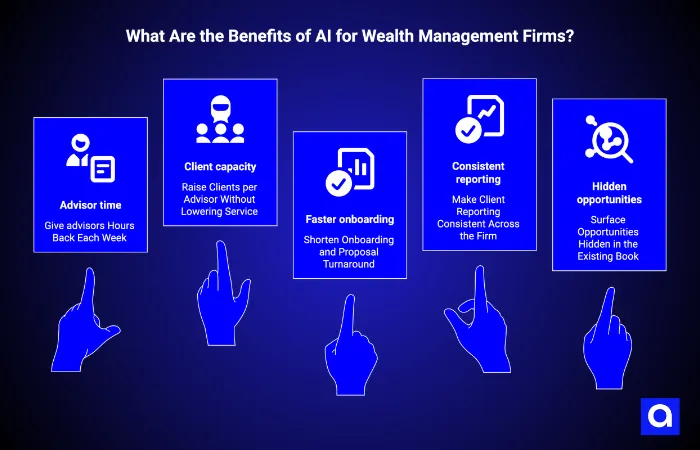
AI Can Give Advisors Hours Back Each Week
Meeting preparation, CRM updates, research retrieval and follow-up work can consume time that advisors could spend with clients.
AI can prepare much of that information before the advisor starts the task.
Deloitte’s 2026 wealth-management analysis modeled advisor productivity gains of roughly 32% in early assistive use cases and higher gains as copilots and controlled agent workflows become more deeply integrated. These are modeled gains, not a guaranteed outcome for an individual firm.
AI Can Raise Clients per Advisor Without Lowering Service
Serving more clients does not have to mean giving every client less attention.
If the software handles routine preparation, monitoring and documentation, advisors can spend more of their time on conversations that require judgment, explanation and trust.
The system can also flag clients who need attention instead of relying on the advisor to manually review the entire book.
AI Can Shorten Onboarding and Proposal Turnaround
AI can extract information from documents, prepare client profiles and identify missing data before an advisor begins manual review.
Our AI document processing development for financial services can also support workflows where information needs to be extracted from statements, forms or other financial documents before it reaches the wealth platform.
AI Can Make Client Reporting Consistent Across the Firm
Client reports often depend on several data sources and individual advisor preparation.
AI can help standardize first-draft summaries and commentary while preserving advisor review before delivery.
This gives the firm more control over tone, approved data and reporting structure without forcing every advisor to start from a blank page.
AI Can Surface Opportunities Hidden in the Existing Book
A large client base contains signals that are difficult for advisors to review manually.
AI can help identify clients with growing cash balances, portfolio concentration, allocation drift, upcoming planning events or other conditions defined by the firm.
The value is not in automatically acting on those signals. It is in helping advisors know where to look first.
How Is AI Wealth Management Different From Traditional Advisory Technology?
Traditional wealth-management software generally waits for the user to request information or perform a defined action.
Your CRM stores relationship data. Your portfolio platform calculates performance. Your financial planning application models scenarios. Your research library stores investment material.
AI can work across those systems and interpret the information in context.
Instead of asking an advisor to open several tools before a meeting, an AI copilot can gather the relevant client record, portfolio changes, planning information and recent notes into one brief.
That does not mean AI should replace the underlying financial calculations or systems of record.
In many workflows, the strongest architecture combines both:
- Traditional systems remain authoritative for portfolios, transactions and client records.
- Deterministic calculations remain responsible for defined financial logic.
- AI retrieves, summarizes, prioritizes and explains information.
- Advisors review recommendations and retain control over higher-impact decisions.
This is particularly important as AI becomes more client-facing. In February 2026, the SEC’s Director of the Division of Investment Management discussed the potential for adviser-provided AI agents that help investors understand fund or adviser information, while also noting that supervision, liability and regulatory treatment remain real considerations.
The right question is therefore not how much of wealth management AI can automate. It is which tasks should be automated, which should be assisted and which should stay under direct professional judgment.
How Can You Choose an AI Wealth Management Software Development Partner?
Your development partner needs to understand more than models and APIs.
Wealth-management software sits between sensitive client data, financial calculations, investment workflows and professional oversight. The engineering team needs to understand how those pieces affect one another.
When evaluating a partner, look at:
- Financial-services experience: Can the team work with portfolio, trading, risk and advisor workflows?
- Data engineering: Can they connect and normalize client, portfolio, custodian and market data?
- AI architecture: Do they know when to use machine learning, generative AI, agents or deterministic logic?
- Integration experience: Can they work with your CRM, custodians, portfolio software and proprietary systems?
- Human review: Can the workflow keep advisors in control of recommendations and client communication?
- Explainability: Can users understand where important outputs came from?
- Security: Can the system enforce permissions around sensitive client and portfolio data?
- Production monitoring: Can the team monitor model quality and data drift after launch?
- Deployment flexibility: Can the software run within your required cloud, network or VPC environment?
You should not have to adapt your investment process to a generic AI layer. Azumo designs the software around your data, your advisors and the level of automation your firm is prepared to govern.