
Custom AI Document Processing Software Development for Financial Services: A Guide for Banks, Lenders and Fintechs
AI document processing helps banks, lenders, and fintechs extract, classify, and validate information from financial documents. It reduces manual data entry, speeds up reviews, and improves accuracy while allowing human oversight. Azumo develops custom AI document processing software that automates workflows and integrates with existing banking, lending, and accounting systems.
Banks, lenders and fintechs process large volumes of statements, loan applications, tax records, identity documents, invoices, contracts and other financial files. The challenge is not simply reading those documents. The information has to reach the right system, pass the right checks and remain easy for employees to verify when something looks wrong.
Custom AI document processing software can automate that workflow around the documents and financial systems already in place. OCR, computer vision, document classification, multimodal AI, validation rules, and human review can work together to turn unstructured files into data underwriting, compliance, accounting, and operations teams can use.
If standard document-processing tools don't fit your document types, validation rules, or financial workflows, a custom system gives you more control over what gets extracted, how results are checked, and where approved data goes next.
If you are exploring a custom document processing system, Azumo can help you assess the workflow, identify the right AI approach and build the software around your existing financial stack.
Key takeaways
- Azumo develops custom AI document processing software for financial services that can classify documents, extract and validate financial data, route low-confidence results for review and integrate with banking, lending, KYC and accounting systems.
- Azumo combines AI engineering with financial software and data expertise, so projects can cover the full workflow from document extraction and validation to system integration, human review and production deployment.
- Custom document processing can fit into your existing financial stack instead of forcing teams into a separate workflow or replacement platform.
- Accuracy should be measured by document type and field, since critical values such as account numbers, income figures or payment amounts may need stricter thresholds.
- Human review still matters. Low-confidence, incomplete or contradictory data should stop for verification before it reaches another financial system.
- Custom development makes the most sense when standard IDP tools cannot support your document formats, validation rules, integrations or deployment requirements.
- Cost depends on document complexity, AI scope and integrations, so a focused workflow can require a very different budget from an enterprise document-processing platform.
How Azumo Develops AI Document Processing Software for Financial Services
We develop document processing software around existing financial workflows, rather than starting with an OCR engine and trying to fit the business process around it.
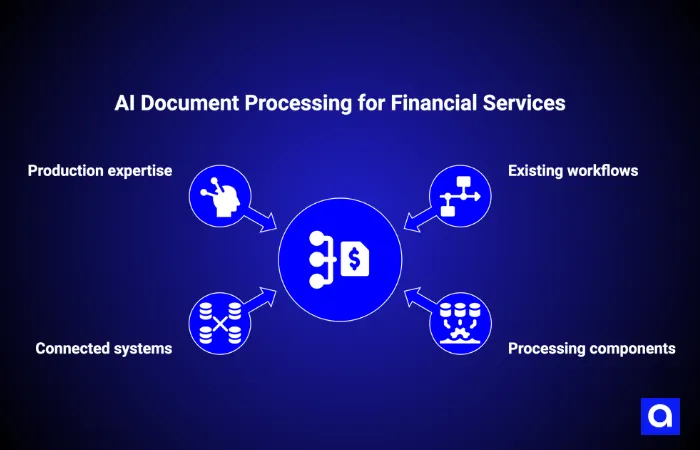
Our engineers can combine document classification, OCR, computer vision, multimodal models, extraction logic and deterministic validation rules. The processing layer can then connect with the banking, lending, KYC, accounting or compliance systems that need the extracted information.
Azumo has delivered production AI systems since 2016, with work spanning computer vision, machine learning, NLP, data engineering and production deployment. Our fintech AI development services extend that expertise into financial products and workflows where AI needs to operate alongside financial data, integrations and regulated processes.
What AI Document Processing Development Expertise Does Azumo Have?
Financial document processing requires more than strong OCR. The team also needs to understand what the extracted data means, where it goes next and what can happen if a financial value is wrong.
Our specialists bring 20 years of experience from RBC and Jefferies across enterprise software investment banking, M&A, capital markets and corporate finance; five years at JPMorgan across prime brokerage, derivatives and software engineering; and 10 years at BlackRock across AI infrastructure, MLOps, asset-management operations and data-pipeline development.
That financial background is backed by production engineering experience. In our work with Stovell AI, Azumo helped develop a financial AI platform with live models that have operated across market cycles for more than eight years. For Bento, our engineers unified more than 50 financial data sources into a decision-ready data environment. With Six Lambda, we re-architected a regulatory-compliance data platform and helped reduce total cost of ownership by 60%.
For a document-processing project, that experience matters because extraction is only one layer. We can also work on the financial data pipelines, integrations, AI infrastructure and production systems that use the extracted information.
How Azumo Builds Document Processing Around Your Existing Financial Workflows
We start with what happens to the document inside your business.
Our engineers look at where it arrives, which fields employees need, what checks they perform, which exceptions require review and where approved data needs to go. A loan package, for example, may need document classification, income extraction, cross-document validation and an underwriting handoff. An invoice may require vendor matching, amount validation and reconciliation instead.
We then build the processing layer around that flow. One component may identify the document type, another can locate fields and tables, and OCR or multimodal AI can extract the required information. Business rules can check totals, dates, formats and relationships between fields before the result moves downstream.
Low-confidence data can stop for review instead of entering the system of record automatically. Existing OCR tools, document stores, KYC providers, loan platforms or accounting systems can remain in place when they already work well.
Should You Build Custom AI Document Processing Software or Use an Off-the-Shelf IDP Platform?
If your team processes predictable documents and a standard IDP platform already supports the required workflow, custom development may add complexity you do not need.
A custom system becomes more useful when the documents, financial rules or downstream processes are specific to your business.
Custom does not mean rebuilding every AI component from scratch. You can keep proven OCR, foundation models or third-party services and customize the extraction schemas, validation logic, integrations and review workflow around them.
How Much Does Custom AI Document Processing Software Cost?
At Azumo, the cost depends on the document workflow you need to automate and how far the system has to extend into your financial stack.
Azumo prices AI development by Delivery Unit (DU), at $499 to $899 per DU depending on the engagement tier: Starter ($899 per DU), Growth ($699 per DU) and Platform ($499 per DU). The number of Delivery Units a project needs grows with scope, so the cost drivers below determine the size of your engagement. See Azumo's pricing page for current details.
For document processing, a focused workflow around one or two consistent document types can require far fewer Delivery Units than a platform that processes bank statements, tax records, IDs, loan packages and contracts across several business units.
Your budget will increase as document layouts become more varied, scan quality becomes less predictable or the software needs custom models, table extraction, cross-document validation, high transaction volumes or human-review interfaces. Integrations with core banking, lending, KYC, accounting and compliance systems also add engineering work.
Security and deployment can have a significant effect as well. A private VPC, regional data processing, customer-managed infrastructure or strict access controls will require more architecture than a standalone extraction API.
For a broader breakdown, see Azumo's AI development cost guide.
How Long Does It Take to Develop AI Document Processing Software?
If you want to prove that AI can reliably process a focused document set first, a proof of concept can fit within a Starter engagement, which typically runs 2 to 6 weeks.
A production system takes longer, especially once extraction has to connect with financial platforms, review queues, validation logic and security controls. Depending on scope, production work typically falls into Growth (1 to 4 months) or Platform (4 to 6+ months) engagements.
You can usually move faster when representative documents are already available, extraction fields are clearly defined and the downstream systems expose usable APIs. Large format variation, poor scans, inconsistent historical data and legacy integrations tend to extend the timeline.
What Financial Documents Can Custom AI Document Processing Software Process?
A custom system can be designed around the documents your teams actually receive rather than a predefined template library.
- Bank Statements and Transaction Records: Extract account details, balances, transaction rows, dates, descriptions, deposits and cash-flow data. For lending workflows, that information can also become an input to AI credit scoring development services when borrower risk models use transaction or financial behavior.
- Loan Applications and Mortgage Documents: Capture applicant information, income, liabilities, property data and supporting evidence. The structured output can feed AI loan underwriting development services instead of requiring underwriters to re-enter application data manually.
- Tax Returns, Payslips, and Income Verification Documents: Extract employer information, income, deductions, reporting periods and year-to-date figures, then compare values across supporting documents.
- KYC and Identity Verification Documents: Process IDs, proofs of address, corporate documents and beneficial-owner records as part of broader AI-powered KYC development services. The FFIEC Customer Identification Program guidance covers both documentary and non-documentary verification methods and the procedures banks should maintain when identity cannot be verified through documents alone.
- Invoices, Receipts, and Payment Documents: Capture vendors, invoice numbers, payment references, tax, line items and totals. That information can also feed AI payment processing development services when document data needs to enter payment or reconciliation workflows.
- Financial Statements and Audit Reports: Extract reporting periods, financial line items, tables, ratios and supporting disclosures. For risk teams, those records can become additional inputs to AI financial risk management development services.
- Contracts, Agreements, and Compliance Documents: Identify parties, dates, limits, obligations, payment terms and other clauses needed for financial, legal or compliance review.
How Does Custom AI Document Processing Software Work?
A reliable workflow usually separates classification, extraction, validation and human review. Asking one model to read the document and make every downstream decision creates unnecessary risk.
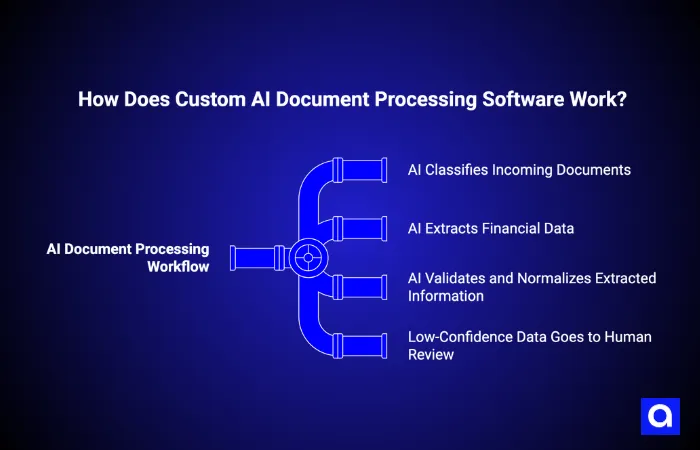
AI Classifies Incoming Documents
The first step is identifying what arrived.
If a customer uploads a package containing an ID, bank statement, tax return and payslip, the system can classify each file or page and send it to the correct extraction workflow. Multi-page documents can also be grouped so related pages remain together.
That matters because an invoice, bank statement and identity document require different fields, checks and confidence thresholds.
AI Extracts Financial Data
Once the software knows the document type, it can extract the information the next workflow actually needs.
OCR may handle text, computer vision can identify field locations, table extraction can reconstruct statement or invoice rows, and multimodal models can interpret information when layout and meaning must be considered together.
For a payslip, you may only need employer name, gross income, pay period and year-to-date income. For a bank statement, the system may need opening and closing balances plus every transaction row.
The extraction stack should be selected against the real document set rather than around one preferred AI model.
AI Validates and Normalizes Extracted Information
Reading a value correctly does not automatically make it usable.
The software can standardize currencies, dates, names and account formats, then apply checks before the data reaches another financial system. For example, it can verify that totals match line items, compare opening and closing balances or check income values across a payslip and tax record.
Missing or contradictory information can be flagged instead of moving forward unnoticed.
Low-Confidence Data Goes to Human Review
Not every extracted field should receive the same treatment.
You can set stricter confidence thresholds for account numbers, income figures, customer identities or other values that affect financial decisions. Lower-risk fields may be accepted at a different threshold.
When review is required, employees can see the original section of the document next to the extracted value, confidence score and validation issue. Once corrected or approved, the data can continue into the next system.
How Do Banks, Lenders and Fintechs Use AI Document Processing?
- Customer Onboarding and KYC Collection: Instead of asking onboarding teams to copy data from IDs, proofs of address and corporate documents, AI can structure those records before verification begins. AI customer onboarding development services can extend the workflow into account opening, customer activation and other onboarding steps.
- Loan Origination and Underwriting: Applications, statements, tax records and income documents can be converted into borrower data before the case reaches an underwriter. AI loan underwriting development services can use that structured information within the broader credit workflow.
- Accounts Payable and Invoice Processing: AI can extract supplier details, invoice numbers, totals, tax and line items before records move into matching, approval or accounting workflows.
- Bank Reconciliation: Statements and payment records can be turned into structured transactions and matched against ledger or settlement data. AI bank reconciliation development services can extend the workflow into automated matching, exception detection and review.
- Fraud and Compliance Review: Document information can add context to account and transaction data. AI Fraud Detection can use inconsistencies or supporting evidence as part of a wider fraud process, while AI transaction monitoring can combine document-derived customer context with ongoing transaction behavior.
- Financial Analysis and Due Diligence: Financial statements, contracts, audit reports and investment records can be converted into structured datasets for comparison and analysis. AI wealth management software can use document-derived portfolio or client information, while AI financial forecasting software development can use validated historical financial data as an input to forward-looking analysis.
- Regulatory Reporting: AI can extract required information and supporting evidence from financial and compliance documents. AI regulatory compliance development services can extend that work into controls, evidence management and reporting workflows.
How Does AI Document Processing Software Integrate With Existing Financial Systems?
Document processing should not stop once a PDF becomes JSON or a spreadsheet. The value comes from getting validated data into the systems where employees and financial applications already work.
- Core Banking Systems: Extracted account, customer or transaction data can move into banking workflows without manual re-entry.
- Loan Origination Platforms: Borrower and supporting-document data can populate applications, underwriting rules and review queues.
- ERP and Accounting Software: Invoice, receipt and statement data can flow into accounts payable, general ledger and reconciliation processes.
- CRM Platforms: Verified information and document status can become part of the existing customer record.
- KYC and AML Systems: Identity and business-document data can feed AI KYC development services, screening and compliance workflows.
- Payment and Reconciliation Systems: Payment references, invoice amounts and settlement information can support AI payment processing and reconciliation processes.
- Document Management Systems: The original document, extracted fields, review status and decision history can remain connected instead of creating another isolated repository.
Our engineers can build the APIs, event flows and data pipelines needed to connect those systems instead of forcing your team to move the full workflow into a new application.
How Do You Measure Accuracy and Control Errors in AI Financial Document Processing?
Do not judge a financial document-processing system by one headline accuracy score.
Start with the errors that matter to the business. A misread optional description is not equivalent to an incorrect account number, borrower income value or invoice total. Measure critical fields separately and set acceptance thresholds based on their impact.
Document classification, OCR, table reconstruction and field extraction should also be tested independently. A model may recognize every word in a statement and still put a transaction in the wrong row or associate a value with the wrong field.
Use a test set that reflects what arrives in production: clean digital PDFs, low-resolution scans, phone photos, rotated pages, new layouts and incomplete documents. The NIST AI Risk Management Framework also emphasizes testing and evaluation across the AI lifecycle, which is a stronger benchmark than testing only on ideal sample documents.
Then add controls around the model. Confidence thresholds can decide which results continue automatically. Validation rules can detect invalid account formats, impossible dates or totals that do not add up. Cross-document checks can flag conflicting customer or financial information.
Accuracy needs to be monitored after launch as well. A new bank statement layout, tax form or document source can change extraction performance without any change to your application code.
How Do You Secure Sensitive Financial Documents in Custom AI Processing Software?
If your documents contain financial, customer or identity information, security needs to cover the full processing path, not just the final database.
Access should follow the work employees actually need to perform. An analyst reviewing one loan file should not automatically receive access to every document in the system. Role-based permissions, environment separation and audit logs can help keep access controlled and traceable.
Documents, extracted data and temporary files should be encrypted in transit and at rest. Logs also need attention so account numbers, identification data or other sensitive fields do not end up in debugging systems unnecessarily.
If an external OCR or AI provider participates in the workflow, check what data it receives, how long it retains files or prompts and which regions process the information. For stricter environments, the processing layer can be designed for a customer-controlled cloud, private VPC or other restricted infrastructure.
Data minimization helps as well. If a downstream system only needs a few validated fields, there may be no reason to send the complete source document to every service in the architecture.
What Features Should AI Document Processing Software Include?
If you are designing custom document processing software, focus on the path from document arrival to trusted financial data.
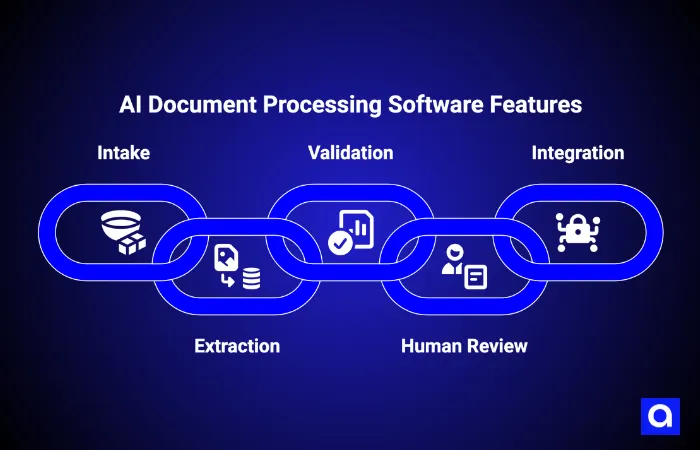
At intake, you may need multi-format uploads, document classification and page separation so PDFs, scans, images and mixed document packages reach the correct workflow automatically.
The extraction layer can include OCR, table extraction, layout analysis and configurable field schemas. Field-level confidence scoring helps distinguish results that can move automatically from those that need another check.
Next comes validation and normalization. Dates, currencies, names, totals and account formats can be standardized, while required-field checks and cross-document comparisons catch inconsistencies before they reach another system.
For exceptions, a human-review interface should show the source document beside the extracted value and explain why the case needs attention. Reviewer corrections and approvals should remain traceable.
Finally, APIs, access controls, audit history, model or template versioning and production monitoring make the document-processing layer usable inside a real financial environment rather than as a standalone extraction tool.
What Are the Business Benefits of AI Document Processing Software Development Services for Financial Services?
- Less Manual Data Entry: Instead of copying values from statements, forms and PDFs, teams can work with structured information that is already prepared for the next step.
- Faster Document Review: Reviewers can focus on flagged fields and exceptions instead of reading every page from the beginning.
- More Consistent Data Extraction: The same extraction and validation logic can be applied across similar documents rather than relying on individual data-entry habits.
- Faster Customer and Loan Processing: Borrower or customer information can reach onboarding and underwriting workflows sooner.
- Fewer Manual Review Bottlenecks: High-confidence documents can keep moving while analysts focus on ambiguous or higher-risk cases.
- Better Use of Unstructured Financial Data: Information in statements, contracts and reports becomes available to lending, reconciliation, forecasting, risk and analytics systems.
- Easier Scaling as Document Volume Grows: Higher document volumes do not have to create a matching increase in manual data-entry work.
How Can You Choose an AI Document Processing Software Development Partner?
Give prospective partners examples of the documents that cause your team the most problems, not only clean sample PDFs.
Ask what they would benchmark first, how they would measure field-level accuracy and what would happen when the system is uncertain. A strong answer should go beyond “we use OCR” and explain the extraction, validation and review strategy for your document set.
Then ask what happens after extraction. How will borrower information reach the loan platform? Where will an invoice exception go? Can the system compare two related documents? How does a reviewer correct a value, and does that correction remain traceable?
The team should also be able to explain how documents and extracted data will be protected, which third-party models may receive the information and how the application can fit into your cloud or VPC requirements.
Financial experience matters because the risk of an extraction error depends on what happens next. A team building for lenders, banks or fintechs should understand that an incorrect income figure, account number or payment amount can affect a real financial workflow.
Finally, ask for evidence of production work. A document AI demo is easy to build. The harder part is keeping extraction reliable as formats change, integrating it with financial systems and operating the software after launch.