


Antrophic's S-1 Is Public: Efficiency, Capacity, Work, and Headless Software
October 29, 2026
Executive Summary
This edition reads Anthropic's S-1, filed publicly on October 26, section by section. The founders' letter tells investors where Anthropic will trade revenue for safety. The market section sizes the opportunity at the value of knowledge work. The financial discussion puts compute efficiency at the center of the business, with revenue per dollar of compute rising from 0.40 to 2.08 in six quarters. Claude now writes over 90% of Anthropic's code, and its technical team tripled anyway. And the distribution strategy puts Claude everywhere, with the software underneath turning into back ends that agents call. Quick Bytes cover Mistral's open weights, Oracle and OpenAI, and cloud earnings.
Top Stories
1. Anthropic's Founders Use the S-1 Letter to Set Investor Expectations
All seven co-founders signed a letter at the front of the S-1. It names four things investors should understand: AI's potential, its risks, Anthropic's approach to building a company, and where its decisions may depart from profit maximization. The founders describe two kinds of departures. One is compute investment that may look outsized at first glance, balanced by a willingness to trade some upside for protection, such as offloading excess compute or raising capital. The other is choices that cost revenue. The letter cites holding back Claude Mythos Preview until safeguards existed, later releasing those capabilities as Claude Fable 5, and keeping Claude free of advertising. Before the IPO, Anthropic will set aside 5% of its equity for a public-benefit fund, plus 2% more for each sustained 50% share price gain, at the board's discretion. The founders have pledged 80% of their personal equity to charity.
Business Impact: Read this as a vendor-risk document as much as a pitch. Anthropic is telling buyers it may delay its most capable models on safety grounds and will not monetize through ads. If you build on Claude, plan for staged access to frontier capabilities rather than day-one general availability.
2. Anthropic Sizes Its Market at the Value of Knowledge Work

The S-1 frames the opportunity around labor, not software budgets. Anthropic estimates that knowledge work represented more than $40 trillion in global economic value in 2025, its own figure derived from U.S. Bureau of Labor Statistics wage data, International Labor Organization labor-income data, and World Bank GDP. It cites IDC's estimate of $22.5 trillion in cumulative economic impact from AI by 2031 and a global knowledge workforce above one billion by 2028, and extends the opportunity to life sciences, robotics, manufacturing, and logistics. The adoption figures behind the claim: more than 11,900 customers paying $100,000 or more a year as of September 30, up from more than 950 a year earlier, more than 1,900 above $1 million, and about 250 above $10 million.
Business Impact: Sizing the market by wages means Anthropic expects to compete for labor spend, so pricing will track the value of the work done. The customer tiers show where that is already happening: about 250 accounts paying more than $10 million a year.
3. Anthropic's S-1 Puts Compute Efficiency at the Center of Its Financial Model
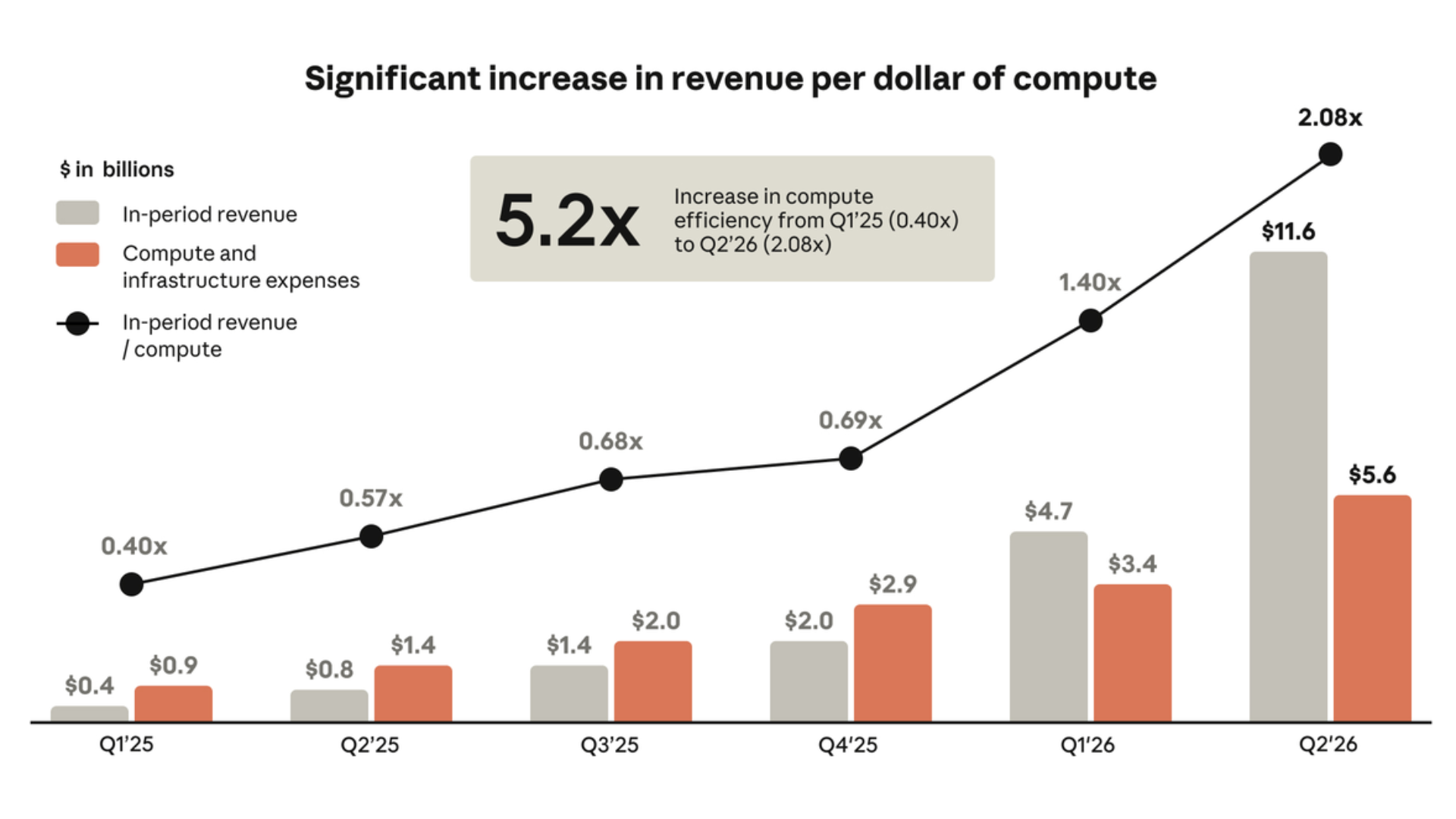
Anthropic defines compute efficiency as the intelligence produced and revenue generated per dollar of compute. Its headline chart shows quarterly revenue divided by compute and infrastructure expense rising from 0.40 in Q1 2025 to 2.08 in Q2 2026. Revenue passed compute spending in Q1 2026, at $4.7 billion against $3.4 billion, and reached $11.6 billion against $5.6 billion in Q2. The filing credits three levers: training methods that get more capability from the same compute, with Claude now helping build its successors, inference optimization, and a proprietary layer that runs workloads across AWS Trainium, Google TPUs, NVIDIA GPUs, and AMD GPUs. Funding it is front-loaded. Compute is typically contracted 12 to 18 months ahead, costs land before the revenue they support, and some financing ties Anthropic to specific chip suppliers. As of June 30, it had raised $141.1 billion and held $131.7 billion in cash and short-term investments.
Business Impact: Efficiency is what lets Anthropic cut prices without cutting margins. The filing says Opus 5.5 lowered cost per task by about 40% compared with Opus 5. Expect cost per task to keep falling and capacity to stay tight, since Anthropic says demand exceeds its available compute.
4. Claude Writes Over 90% of Anthropic's Code, and Its Technical Team Tripled Anyway
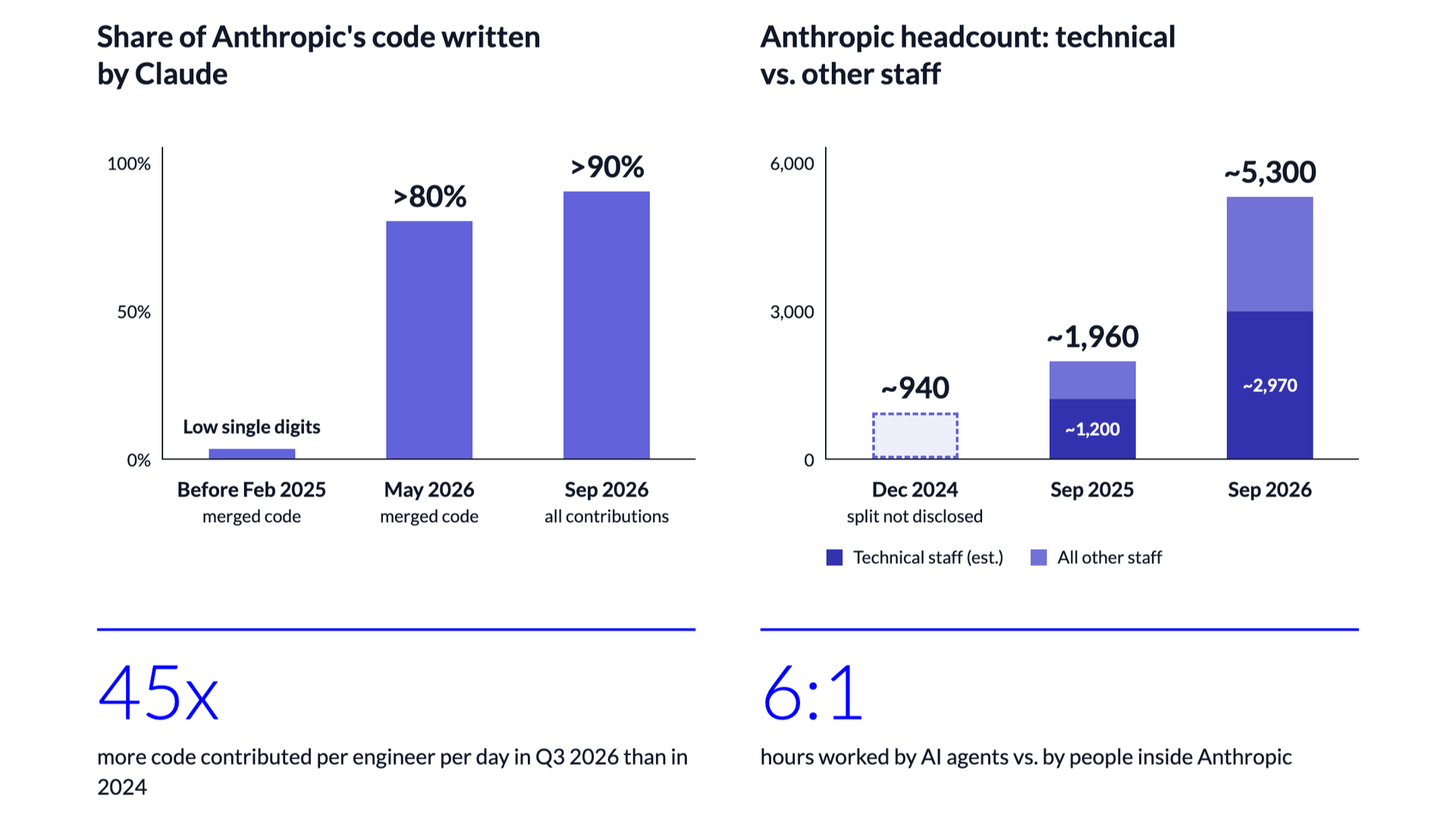
The S-1 says Claude wrote over 90% of contributions to Anthropic's codebase in September 2026, and that daily code contributed per engineer in the third quarter was more than 45 times the 2024 average. Headcount still grew, from about 940 at the end of 2024 to about 5,300 in September 2026. Anthropic's October 16 workforce report puts technical departments at 56% of staff, down from 61% a year earlier. That implies roughly 2,970 technical employees, more than three times the company's entire headcount at the end of 2024. The same report says agents in employee-directed sessions logged six hours for every human hour by August, the junior share of technical hires fell from 27% to 9%, and about 80% of interactive agent session time is spent waiting for human input.
Business Impact: The engineering job moved from writing code to directing and reviewing it, and Anthropic still needed more engineers. Human attention is now the bottleneck. If you are scaling AI-assisted development, budget for review capacity and senior judgment.
5. Anthropic's S-1 Points to Claude Everywhere and Software Going Headless

The filing describes a distribution strategy aimed at putting Claude wherever work happens. Claude is sold on AWS, Google Cloud, and Azure, with Anthropic holding the customer contract and paying each cloud a fee. It reaches further through systems integrators such as Accenture, Deloitte, KPMG, and PwC, through companies like Salesforce and Legora that build products on Claude, and through Ode with Anthropic, a new services company for mid-sized firms. Sales, marketing, and partnerships cost just 19% of revenue in the first half of 2026. The product side points the same way. The S-1 describes Claude Cowork navigating applications and running multi-step workflows for the user, Claude for Microsoft 365 and Claude in Chrome sitting inside existing tools, and MCP connecting agents to enterprise data and systems. In May, Anthropic bought Stainless, which generates SDKs and MCP servers. Our read: the user works in Claude, and the software underneath becomes a back end that agents call. The S-1 flags the tension itself, listing competition with its own software customers as a risk.
Business Impact: If agents become the main way people use software, the interface stops being the product and access becomes the product. We expect the near-term fight to be software vendors charging customers for access to their MCP servers. Before your next major software renewal, ask what agent and MCP access will cost, and pick a partner who has connected Claude to systems like yours.
Quick Bytes
- Mistral Large 4 goes open weight: Mistral published the weights on October 29 under a modified MIT license that is free for self-hosting and fine-tuning but requires a commercial license to resell the model as a hosted service. API pricing is $0.70 input and $2.10 output per million tokens. (Mistral)
- Oracle builds OpenAI into its applications: Oracle AI Workspace connects ChatGPT to Fusion Applications, NetSuite, and OCI, and Oracle AI Security Mesh uses OpenAI cyber models for vulnerability testing. Oracle gave no availability dates. (Oracle)
- Cloud backlogs keep growing: Google Cloud reported $30.7 billion in quarterly revenue and a $561 billion backlog, and Microsoft reported $33.2 billion in Azure revenue and a $677 billion commercial backlog. CNBC reports Microsoft lowered its calendar-year capex expectation to about $170 billion, citing third-party capacity delays. (CNBC)
- GPT-6.1 Terra launches: OpenAI released a mid-tier model at $1 input and $5 output per million tokens, half of GPT-6.1 Sol's rates. (OpenAI)
Industry Impact
The S-1 makes four arguments buyers should weigh. Efficiency is the competitive metric. Anthropic's revenue per dollar of compute rose from 0.40 to 2.08 in six quarters, and that gain is what funds lower prices per task. Capacity is bought a year or more in advance and sometimes tied to specific chips, which is why the backlogs at Alphabet and Microsoft matter to anyone buying inference. The work itself is changing. At the company furthest along, Claude writes most of the code and the scarce resource is people who can direct and review it. And software is heading toward headless, with Claude as the place people work and applications serving agents behind it, which puts a price on agent access. Plan for falling cost per task, tight capacity, review-heavy engineering, and new line items for MCP access in your software contracts.
How Azumo Helps
Anthropic's S-1 describes a go-to-market built on partners who deploy Claude inside existing enterprise stacks. As a certified member of the Claude Partner Network, Azumo brings senior AI engineers, nearshore from LATAM, who design, build, and run Claude deployments, along with multi-vendor routing, agent orchestration and observability, RAG architectures, and regulated-industry delivery. 300+ AI and software projects delivered, SOC 2 compliant, 95% NPS.
Sources
- Anthropic, PBC Form S-1 — SEC
- Anthropic files S-1 with the SEC for proposed initial public offering — Anthropic
- Anthropic IPO live updates: AI lab's S-1 filing — CNBC
- How employment is changing at Anthropic — Anthropic
- Anthropic says its workforce has become less junior and is spending more time in meetings — TechCrunch
- Mistral Large 4 (Le Chonk) is now open weight — Mistral
- Oracle Reinvents Enterprise Computing for the AI Era with OpenAI — Oracle
- Alphabet (GOOGL) earnings Q3 2026 — CNBC
- Microsoft results release, quarter ended September 30, 2026 — Microsoft
- AI build-out hits snag as Google and Microsoft put off raising capex forecasts — CNBC
- Introducing GPT-6.1 Terra — OpenAI