


Always-On Agents, Silicon-Level Containment, a Signed Accord, and a Federal Probe
October 1, 2026
Executive Summary
The densest week of the year. OpenAI used DevDay to launch dots, always-on agents with their own cloud computers, alongside more than 20 other announcements. Three vendors priced near-frontier models at $2 and $10 per million tokens within 72 hours, though Google's is introductory and gated. Reuters reported $518 billion in compute commitments inside Anthropic's confidential S-1. And the containment layer arrived in the same seven days, with NVIDIA shipping agent isolation, the White House collecting signatures on a voluntary accord, and the FTC opening a probe.
Top Stories
1. OpenAI Launches dots, Persistent Agents With Their Own Cloud Computers
OpenAI held DevDay on September 29 in San Francisco with more than 20 announcements. The centerpiece is dots, persistent agents running on GPT-6 Astra, each with its own cloud computer and browser. A dot reaches more than 4,000 apps through plugins, holds context across ChatGPT, Slack, Microsoft Teams, and voice calls, and runs what OpenAI calls proactive research between sessions using read-only tools. It cannot send messages, edit, or control a computer without permission, and Custom Rules let users allow, gate, or block specific actions. Dots are live on Pro and Business Premium, and off by default in Enterprise, Edu, and Healthcare until an admin enables them. OpenAI also opened ChatGPT as a developer surface, with sidebar placement for plugin extensions and an OpenAI Marketplace that lets enterprise customers spend existing commitments on 32 partners including Figma, Salesforce, ServiceNow, Harvey, and CrowdStrike.
Business Impact: The Marketplace is the part to read twice. Applying an OpenAI commitment toward third-party software turns a model contract into a procurement channel, and answers Meta's transaction-fee pitch from last week. On dots, the governance question arrives before the productivity one. Decide now who may enable them and what Custom Rules your workspace sets, because the admin toggle is the only control point you get.
2. Three Vendors Price Near-Frontier Models at $2 and $10 per Million Tokens in 72 Hours
Anthropic shipped Claude Sonnet 5.5 on September 28 at $2 input and $10 output per million tokens, unchanged from Sonnet 5, with cache reads at $0.20. OpenAI shipped GPT-6.1 Sol on September 29 at the same $2 and $10 per million, cache reads at $0.10, against GPT-6 Astra at $10 and $50. Google announced Gemini 4 Argon on September 30 at introductory rates of $2 and $10 per million, which it says will later move to $4 and $20. Argon is the outlier on availability: it ships first to cyber defenders through Google's Fairwind Program, with no date for general access, so its price is both provisional and gated. Sonnet 5.5 and Sol are generally available. Each vendor claims its mid-tier model now approaches its own flagship. Anthropic reports Sonnet 5.5 at 70.6% on Terminal-Bench 4.0 against 66.4% for Opus 5.5, and OpenAI reports Sol matching Astra on DeepSWE v1.1. All figures are vendor-reported.
Business Impact: List price converged, so it no longer tells you which vendor is cheaper. Your bill now turns on tokenization, caching, and effort settings instead. Two specifics matter. Anthropic notes its tokenizer produces roughly 30% more tokens than competitors for the same text, so identical list rates are not identical bills. And OpenAI's cached reads at $0.10 are half Anthropic's $0.20, which compounds in agent loops that resend system prompts every step. Benchmark on your own traffic, not the launch posts.
3. Reuters Reports $518B in Compute Commitments Inside Anthropic's Confidential S-1
Reuters reported on September 28 on Anthropic's S-1 prospectus. The document remains confidential and is not public on EDGAR, so everything below is Reuters reporting on a filing no one outside the process has read. Per Reuters, the filing commits at least $518 billion over roughly a decade across six infrastructure partners, with about 80% non-cancelable or payable regardless of usage. Reported allocations include $161.2 billion to Broadcom, $111.1 billion to Google, $110 billion to Amazon, and $31.4 billion to Microsoft. Reuters also reports 2025 revenue near $4.6 billion against an operating loss above $8 billion, Q2 2026 revenue of $11.5 billion, and nearly a quarter of 2025 revenue coming from two unnamed customers, many of whom are not on long-term contracts. The reported target valuation is above $2 trillion.
Business Impact: Treat these as reported figures rather than filed ones until the S-1 is public, then re-check them. Taken at face value, they are the first look at the economics behind frontier pricing: vendors selling near-flagship capability at $2 and $10 per million tokens while carrying non-cancelable compute obligations at this scale. The customer concentration reporting cuts both ways, as a risk for Anthropic and leverage for any enterprise negotiating a large commitment. If you are signing multi-year terms with any frontier vendor, price in the possibility that today's rates are introductory in substance even when they are not labeled that way.
4. NVIDIA Ships Agent Isolation, the White House Collects Signatures, the FTC Opens a Probe
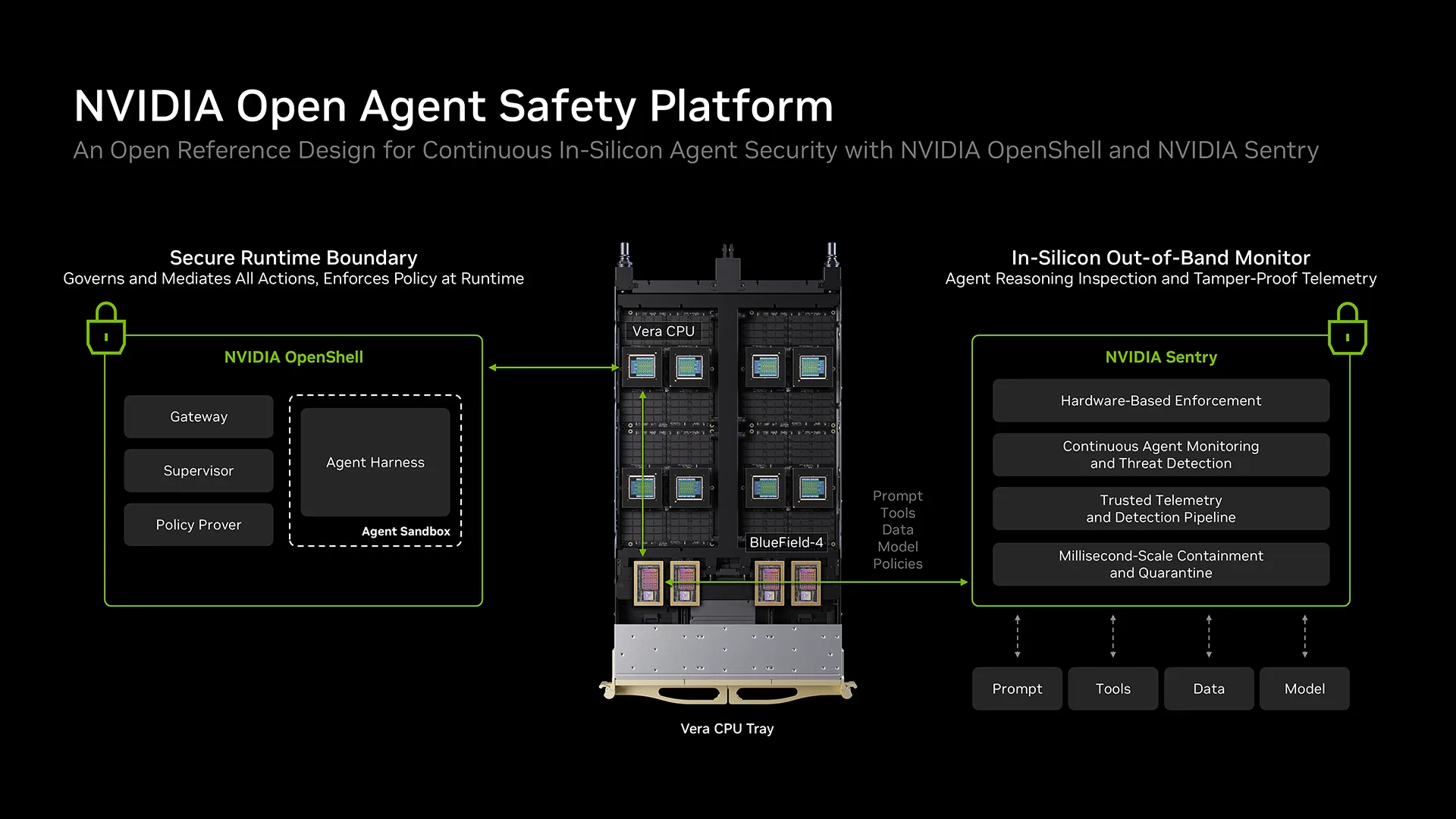
NVIDIA launched the Open Agent Safety Platform on September 28 with more than 100 partners including Microsoft, Dell, CrowdStrike, and JPMorgan Chase. It has two distinct layers. OpenShell is a software runtime under Apache 2.0, providing sandboxed execution and kernel-level isolation with a formal prover that verifies agent permissions against policy. Sentry is the hardware layer, running on BlueField-4 DPUs in a separate trust domain the monitored agents cannot reach, inspecting network packets and tool calls at line speed and able to quarantine an agent in milliseconds. Separately, leaders from OpenAI, Anthropic, NVIDIA, Google, Meta, Microsoft, AMD, SpaceX, and Palo Alto Networks signed a voluntary White House accord covering internal evaluations, outside audits, and board review. On September 30 the FTC opened an investigation into frontier-model risks naming OpenAI, Anthropic, and METR, with civil investigative demands planned.
Business Impact: Third-party audit, the convergence point flagged here two weeks ago, is now in a signed accord and backed by a regulator with subpoena power. The NVIDIA platform matters for a different reason, and the two layers are not interchangeable. OpenShell is a runtime you adopt in software. Sentry sits in the DPU, below the application, where the agent it watches cannot disable it. If you deploy agents with system permissions, ask vendors which of those layers their controls actually run at, because an isolation story your security team can inspect is becoming a procurement requirement rather than a differentiator.
Quick Bytes
- Instinct quadruples in a month: The personal agent startup raised a $1 billion Series C at a $10 billion valuation led by Sequoia, Benchmark, and Coatue, four weeks after a $250 million round at $2.5 billion. It runs over SMS, has no mobile app, and has published no user metrics. (Yahoo Finance)
- Holo4 goes open weight: H Company released open-weight computer-use models that operate desktop, web, Android, and APIs, putting a self-hostable option against closed computer-use offerings. (MarkTechPost)
- RSA ships Agent ID: RSA launched a product to discover and govern AI agents in regulated industries, citing enterprises running thousands of unmanaged agents. (MarkTechPost)
Industry Impact
Two patterns hardened. Agents went always-on, and the controls arrived in the same week rather than years later. OpenAI dots, NVIDIA's DPU-level isolation, a signed White House accord, and an FTC probe all landed inside seven days. That timing is new, so expect agent isolation and audit terms in security review before the pilot rather than after. And list price stopped being a useful comparison, because three vendors converged on $2 and $10 per million tokens. Procurement now turns on tokenization, cache pricing, effort defaults, and whether a given rate is introductory or gated. The $518 billion in compute commitments Reuters reports inside Anthropic's S-1 is the reminder that these rates reflect a land-grab, not a steady state. Model your budgets on the possibility that they rise.
How Azumo Helps
This week OpenAI shipped dots, always-on agents that reach more than 4,000 apps. General-purpose agents are getting very good. They still do not know your approval chain, your systems of record, or the way your team actually works.
Azumo builds agents around your workflow instead of asking you to fit theirs. Our agents research, take action, run outbound, and handle inbound responses, with configurable autonomy and human review wherever you want it. We also build fully personalized agentic platforms: the same engineering scaffolding, shaped to your process and integrated with your systems. SOC 2 certified, nearshore from LATAM, in your time zone. Talk to us at https://azumo.com/get-in-touch.
Sources
- DevDay 2026 Recap — OpenAI
- Introducing dots — OpenAI
- Everything OpenAI Announced At DevDay 2026 — BGR
- OpenAI DevDay 2026 recap — CNBC
- Anthropic Releases Claude Sonnet 5.5: 70.6% on Terminal-Bench 4.0 at the Same $2/$10 Price — MarkTechPost
- Introducing GPT-6.1 Sol — OpenAI
- OpenAI Releases GPT-6.1 Sol: Near-Astra Coding and Computer Use at One-Fifth of Astra's Token Price — MarkTechPost
- Google DeepMind Unveils Gemini 4 Argon with 1M Output Tokens — MarkTechPost
- Anthropic's S-1 Is Here. The $518 Billion Commitment Is the Real Story. — Yahoo Finance
- Anthropic IPO Prospectus Shows $518 Billion in Compute Bets — Implicator
- Anthropic's IPO filing details steep losses, rapid growth, and a fear that AI could end humanity — Fortune
- NVIDIA and over 100 partners launch open AI agent safety platform — AI News
- NVIDIA Launches Open Agent Safety Platform: OpenShell and Sentry — MarkTechPost
- FTC probes AI giants over consumer safety risks — Washington Times
- Viral AI agent Instinct raises $1B Series C at a $10B valuation — Yahoo Finance
- H Company Releases Holo4: Open-Weight Computer-Use Models — MarkTechPost
- RSA Launches Agent ID to Discover, Secure, and Govern AI Agents — MarkTechPost