
.svg)


Autonomous Agents, Ads, and Infrastructure: This Week in Enterprise AI
January 22, 2026
Executive Summary
Anthropic now leads the enterprise LLM market with 32% share, surpassing OpenAI's 25%. OpenAI countered with a $10B compute deal with Cerebras and announced ads are coming to ChatGPT's free tier. Anthropic's Cowork autonomous file agent gained traction among knowledge workers, while Google released MedGemma 1.5 with 3D medical imaging capabilities.
Top AI Developments
1. Anthropic Launches Cowork: AI Agent for Everyday Knowledge Work
On January 12, Anthropic unveiled Claude Cowork, a general-purpose AI agent that automates file management and document processing tasks directly on macOS. Built into the Claude Desktop app, Cowork lets users designate folders where Claude can autonomously read, modify, and organize files through natural language instructions. Early use cases include reorganizing downloads, converting receipt screenshots into expense spreadsheets, and producing first drafts from scattered notes.
Strategic Implications: Cowork represents Anthropic's push beyond conversational AI into autonomous workflow execution—what the company calls "Claude Code for the rest of your work." The tool demonstrates multi-step task orchestration without requiring coding skills, targeting the vast knowledge worker market. Security considerations remain paramount: Anthropic explicitly warns about prompt injection risks and recommends unambiguous instructions. Currently in research preview for Pro subscribers ($20/month), Cowork was reportedly built primarily by Claude Code itself in approximately 1.5 weeks, showcasing AI's self-reinforcing development capabilities.
2. OpenAI Signs $10B Compute Deal with Cerebras for Real-Time Inference
On January 14, OpenAI announced a landmark $10B+ partnership with Cerebras Systems to add 750MW of ultra-low-latency AI compute to their platform. The deployment will roll out in stages from 2026 through 2028, making it the largest high-speed AI inference deployment in the world. Cerebras' wafer-scale systems eliminate bottlenecks that slow inference on conventional GPU-based hardware.
Strategic Implications: With ChatGPT now exceeding 900 million weekly users, OpenAI faces severe compute constraints. This partnership diversifies OpenAI's infrastructure beyond NVIDIA GPUs while targeting a critical bottleneck: real-time inference speed. The deal signals that 2026's AI platform winners may be defined by inference economics, not just model quality. For enterprises, faster inference translates directly to better user experiences and more viable real-time AI applications.
3. OpenAI to Begin Testing Ads in ChatGPT
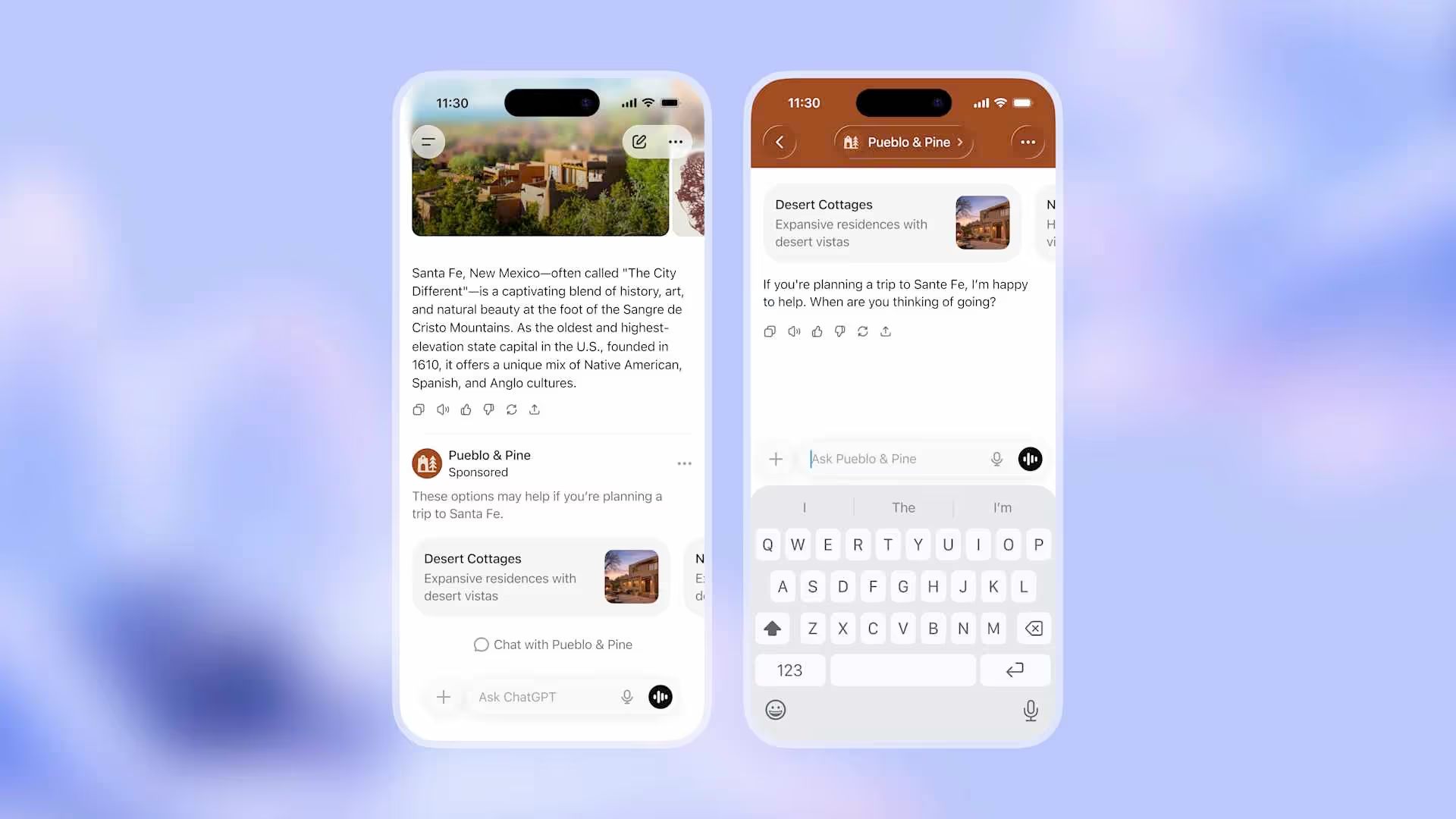
On January 16, OpenAI announced it will begin testing advertisements within ChatGPT in the coming weeks, starting with free and Go tier users in the United States. Ads will appear at the bottom of responses when there's a relevant sponsored product or service, clearly labeled and separated from organic answers. Plus, Pro, and Enterprise subscriptions will remain ad-free.
Strategic Implications: The move reflects OpenAI's urgent need to monetize its 800+ million monthly users to fund its $1.4 trillion AI infrastructure commitment over the next eight years. OpenAI emphasized that responses will not be influenced by ads and user data will not be sold to advertisers. Initial public reaction on social media has been overwhelmingly negative, with many viewing the move as breaking an implicit promise of an ad-free experience. Enterprises should note that business tiers remain protected from ads.
Need a build partner? See top ChatGPT development companies.
4. Anthropic Overtakes OpenAI in Enterprise LLM Market Share
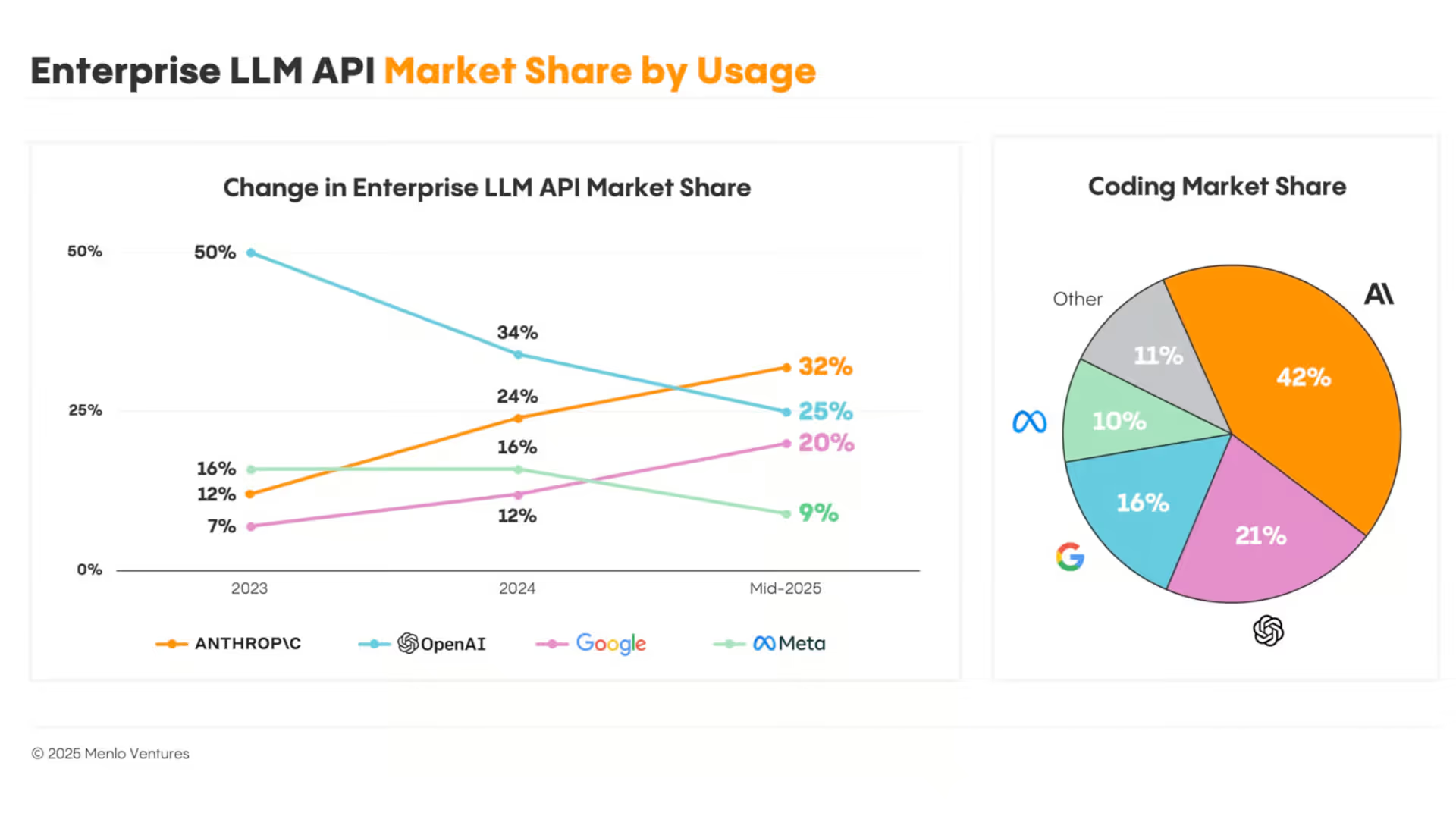
Data discussed at Davos 2026 confirms Anthropic has surpassed OpenAI to lead the enterprise LLM market with 32% share, compared to OpenAI's 25% (down from 50% in 2023). Google holds 20% with Gemini, while Meta's Llama commands 9%. Enterprise LLM spend has more than doubled from $3.5B in November 2024 to $8.4B by mid-2025.
Strategic Implications: Anthropic's enterprise focus is paying dividends—80% of its revenue comes from enterprises compared to OpenAI's 40%. In code generation specifically, Claude holds 42% market share, double OpenAI's share. Anthropic CEO Dario Amodei attributes success to emphasizing safety, reliability, and enterprise-grade features like data governance and compliance. The shift demonstrates that enterprise buyers prioritize trustworthy, production-ready solutions over raw model capabilities.
5. Google Releases MedGemma 1.5 for Advanced Medical Imaging
On January 13, Google released MedGemma 1.5 4B alongside MedASR, expanding its open medical AI capabilities. MedGemma 1.5 can now interpret three-dimensional CT and MRI scans, whole-slide histopathology images, and longitudinal chest X-rays with prior context. Performance improvements include up to 35% accuracy gains on 3D medical imaging and 82% reduction in transcription errors compared to Whisper large-v3.
Strategic Implications: The healthcare AI market reached $52B in 2026, up from $38B in 2025. Google's decision to keep MedGemma free for research and commercial use positions it as the foundation layer for healthcare AI development, while competitors charge premium rates. For healthcare enterprises, this opens pathways to building sophisticated diagnostic tools without massive licensing costs.
Quick Bytes
AI Labor Market "Tsunami" Warning at Davos: IMF Managing Director Kristalina Georgieva warned on January 20 that AI is hitting the labor market "like a tsunami" with most countries and businesses unprepared. Employee concerns about AI job loss jumped from 28% in 2024 to 40% in 2026.
ChatGPT Go Goes Global: OpenAI's $8/month tier expanded to 170+ countries on January 18, becoming their fastest-growing subscription plan with 10x more messages and access to GPT-5.2 Instant.
Model Context Protocol Becomes Standard: Anthropic's MCP, now adopted by OpenAI, Microsoft, and Google, was donated to the Linux Foundation's Agentic AI Foundation, establishing it as the "USB-C for AI" standard for agent-tool communication.
OpenAI Deploys Age-Prediction System: OpenAI introduced behavioral analysis to identify likely minors on ChatGPT, automatically applying tighter safeguards. Adults incorrectly flagged can verify through selfie-based verification.
Industry Impact Analysis
This week's developments reveal the strategic battle lines for 2026:
- Infrastructure is the new moat: OpenAI's $10B Cerebras deal shows that compute capacity and inference speed—not just model quality—determine competitive advantage. Enterprises evaluating AI platforms should consider inference economics as a key criterion.
- Enterprise trust beats consumer scale: Anthropic's market share victory demonstrates that reliability, compliance, and governance features matter more to enterprise buyers than brand recognition or consumer popularity.
- Monetization pressures mount: OpenAI's ad introduction signals that even well-funded AI companies face difficult economics. Enterprise customers should expect pricing pressures and plan accordingly.
- Autonomous agents are maturing: Cowork's practical file-management capabilities show AI agents moving from demos to daily productivity tools. Organizations should begin piloting autonomous workflows for knowledge work.
- Healthcare AI accelerates: Google's MedGemma 1.5 release continues the rapid expansion of medical AI capabilities, creating opportunities for healthcare enterprises to build diagnostic and administrative tools.
Azumo's AI Implementation Expertise
As the enterprise AI landscape rapidly evolves, Azumo brings deep implementation expertise across the full AI lifecycle—from architecture design and model selection to agentic workflow orchestration and compliance frameworks. Our teams have delivered production AI systems for Fortune 500 enterprises across healthcare, financial services, and manufacturing, combining technical depth with industry-specific domain expertise.
Whether you're deploying autonomous agents like Cowork, optimizing inference infrastructure, building healthcare AI applications with MedGemma, or navigating the shifting competitive landscape between OpenAI and Anthropic, Azumo's engineering teams deliver production-ready solutions that drive measurable business outcomes.
Sources
- Anthropic's new Cowork tool offers Claude Code without the code - TechCrunch, January 12, 2026
- First impressions of Claude Cowork, Anthropic's general agent - Simon Willison, January 12, 2026
- OpenAI signs deal, worth $10B, for compute from Cerebras - TechCrunch, January 14, 2026
- OpenAI partners with Cerebras - OpenAI, January 14, 2026
- Cerebras scores OpenAI deal worth over $10 billion ahead of AI chipmaker's IPO - CNBC, January 14, 2026
- OpenAI to begin testing ads on ChatGPT in the U.S. - CNBC, January 16, 2026
- ChatGPT users are about to get hit with targeted ads - TechCrunch, January 16, 2026
- Our approach to advertising and expanding access to ChatGPT - OpenAI, January 16, 2026
- Anthropic Overtakes OpenAI: The New Landscape of Enterprise LLM Market - Medium, January 2026
- Enterprise LLM Spend Reaches $8.4B as Anthropic Overtakes OpenAI - Yahoo Finance, 2026
- OpenAI, Anthropic set sights on enterprise customers at Davos - CNBC, January 21, 2026
- Google AI Releases MedGemma-1.5 - MarkTechPost, January 13, 2026
- Next generation medical image interpretation with MedGemma 1.5 - Google Research, January 2026
- AI impacting labor market 'like a tsunami' as layoff fears mount - CNBC, January 20, 2026
- Introducing ChatGPT Go, now available worldwide - OpenAI, January 18, 2026
This AI Intelligence Brief is generated by Azumo's AI research team to help enterprise leaders stay informed about developments that impact business strategy and technology roadmaps.