
.svg)


The State of AI, December 2025: Model Breakthroughs, Pricing Shifts, and the Scaling Gap
Executive Summary
The past two weeks have witnessed a remarkable acceleration in enterprise AI capabilities, with three major model releases reshaping the competitive landscape. Anthropic's Claude Opus 4.5 emerged as the world's leading coding model, Google launched Gemini 3 with breakthrough multimodal reasoning, and OpenAI introduced GPT-5.1 with enhanced agentic capabilities. Meanwhile, Microsoft's Ignite conference unveiled sweeping Copilot expansions, and new research reveals that while 85% of enterprises are adopting AI agents, only 15% have achieved true enterprise-scale deployment.
Top AI Developments
1. Anthropic Launches Claude Opus 4.5: The New Coding Champion
On November 24, Anthropic released Claude Opus 4.5, claiming the title of "best model in the world for coding, agents, and computer use." The model represents a significant leap in autonomous task execution, reportedly scoring higher on performance engineering exams than any human candidate ever tested.
Key Capabilities:
- Excels at long-horizon, multi-step autonomous tasks requiring sustained reasoning
- Outperforms competitors on SWE-bench Verified coding benchmarks
- Features innovative "effort" parameter (low, medium, high) allowing developers to control token usage and processing time
- Introduces "endless chat" feature for paid users, eliminating context window interruptions
Business Impact: The pricing restructure is particularly notable for enterprises. At $5 per million input tokens and $25 per million output tokens, Opus 4.5 delivers a 67% cost reduction from its predecessor while offering superior performance. This price-to-performance ratio makes advanced agentic AI economically viable for production deployments.
Availability: Claude Opus 4.5 is immediately available through Anthropic's API, Microsoft Foundry, GitHub Copilot paid plans, and Microsoft Copilot Studio, with expanded distribution partnerships accelerating enterprise adoption.
2. Google Gemini 3: Multimodal AI Reaches New Heights
Google launched Gemini 3 on November 18, bringing state-of-the-art reasoning capabilities to text, images, audio, and video. The model, arriving just seven months after Gemini 2.5, demonstrates Google's aggressive development pace in the AI race.
Technical Innovations:
- Achieves record benchmark scores across multimodal understanding tasks
- Introduces Gemini 3 Deep Think for AI Ultra subscribers, featuring parallel thought stream processing
- Launches with new coding application capabilities through Google's Antigravity agent platform
- Delivers improved response formatting and information quality
Ecosystem Expansion: Google simultaneously released gemini-2.5-pro with adaptive thinking, gemini-2.5-flash for faster inference, and Veo 3 for AI video generation. The coordinated launch signals Google's strategy to dominate multiple AI modalities simultaneously.
3. OpenAI Accelerates with GPT-5.1 and Strategic Partnerships
OpenAI announced GPT-5.1 on November 24, focusing on enhanced reasoning, faster response times, and improved agentic capabilities. The release coincided with significant infrastructure and strategic partnerships reshaping the AI landscape.
Model Improvements:
- Optimized token usage on straightforward tasks, reducing costs while maintaining intelligence
- New apply_patch tool for more reliable code editing
- Shell tool enabling direct command execution
- GPT-5.1-Codex-Max variant designed for project-scale development work
Major Partnerships:
- $38 billion commitment with AWS for AI workload infrastructure
- Integration with Anduril for drone defense systems, marking OpenAI's pivot toward military applications
- ChatGPT for Teachers program offering free access to K-12 educators through June 2027
4. Microsoft Ignite: Copilot Becomes Universal
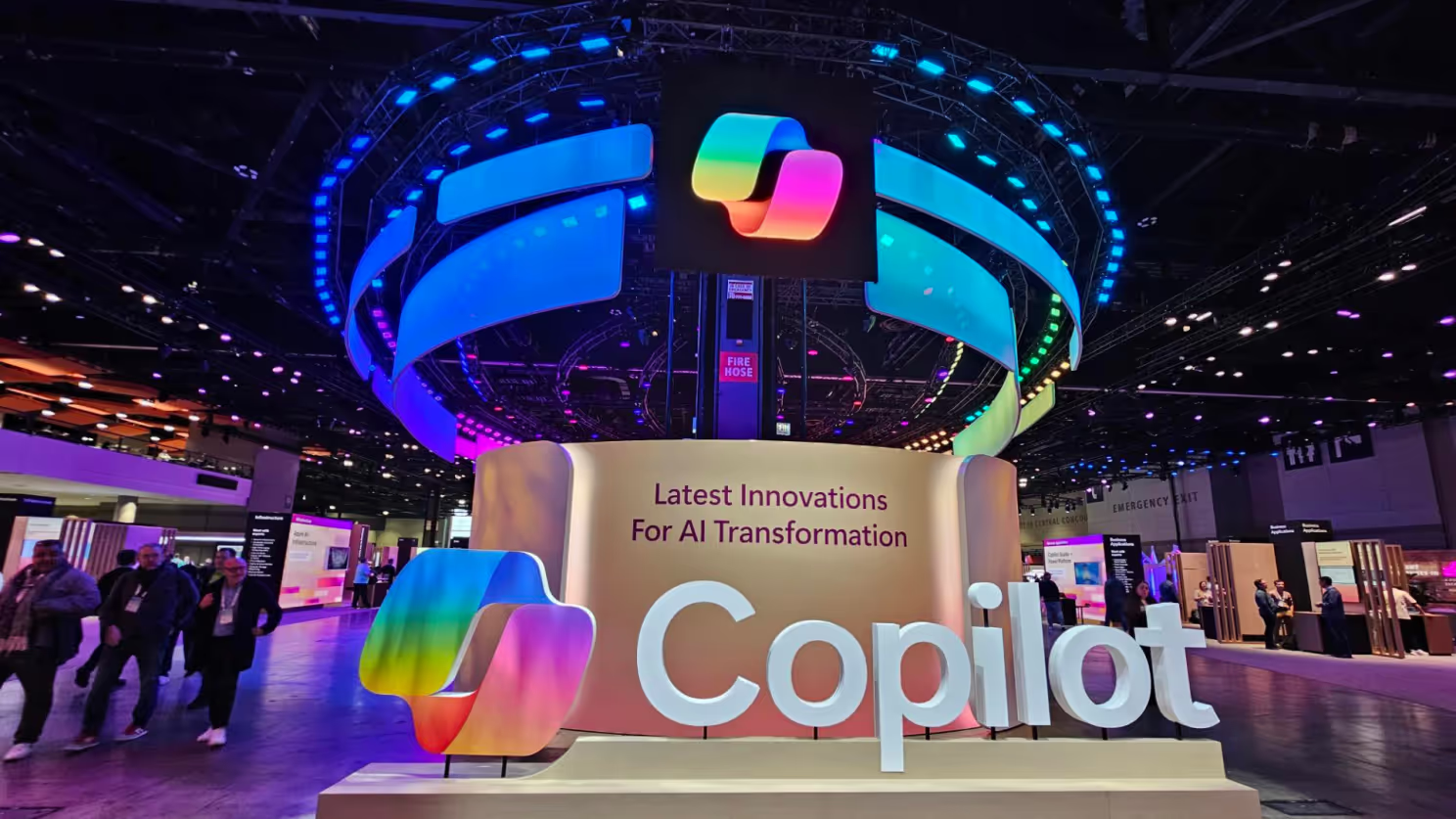
Microsoft's Ignite conference revealed the company's vision of ubiquitous AI assistance across every digital touchpoint. The announcements demonstrate Microsoft's strategy to make Copilot the default interface for productivity software.
Consumer Expansion: Copilot Chat is now available to every Microsoft 365 subscriber at no additional cost, dramatically expanding the user base. Voice capabilities launched in the Microsoft 365 Copilot app, with general availability in December.
Enterprise Offerings:
- Microsoft 365 Copilot Business launches December 1 at $21 per user per month for SMBs with fewer than 300 users
- Academic offering at $18 per user per month for educators and students 13+
- GPT-5 Chat integration in Copilot Studio (GA November 24)
- Sora 2 AI video creation through Frontier Program (December availability)
5. Enterprise AI Reality Check: The Scaling Gap
Multiple November reports reveal a critical disconnect between AI experimentation and production deployment. While adoption enthusiasm remains high, enterprise-scale implementation proves elusive.
Key Findings:
- McKinsey reports 23% of organizations are scaling agentic AI systems, with 39% experimenting
- World Quality Report 2025 shows 89% of organizations pursuing generative AI in quality engineering, but only 15% achieving enterprise-scale deployment
- ISG's 2025 report indicates 31% of AI use cases reached full production—double the 2024 rate but still representing a minority
- Organizations with formal AI strategies report 80% success rates versus 37% for those without strategies
- 42% of C-suite executives report AI adoption creating organizational tensions
Industry Impact Analysis
The convergence of model releases and partnership announcements suggests three critical shifts for enterprises:
1. Economic Viability of Advanced AI: Dramatic price reductions (67% for Claude Opus 4.5) combined with performance improvements are eliminating cost barriers to production AI deployment.
2. Agentic AI Maturation: All three major providers now prioritize long-horizon autonomous capabilities, signaling that AI agents are transitioning from research projects to production tools.
3. Integration Infrastructure: Microsoft's Copilot expansion and the proliferation of model partnerships indicate that AI success increasingly depends on seamless integration into existing workflows rather than standalone applications.
For enterprises, the strategic imperative is clear: formal AI strategies with executive alignment dramatically improve success rates, while ad-hoc experimentation produces limited returns.
Looking Ahead
The next two weeks will likely bring responses from other major AI providers, continued partnership announcements, and deeper integration of these new models into existing platforms. The gap between experimentation and production deployment remains the industry's central challenge—one that Azumo addresses through systematic implementation frameworks that bridge technical capability with organizational readiness, ensuring AI investments deliver measurable business impact.
Sources
- Introducing Claude Opus 4.5 - Anthropic, November 24, 2025
- Anthropic releases Opus 4.5 with new Chrome and Excel integrations - TechCrunch, November 24, 2025
- Anthropic's New Claude Opus 4.5 Reclaims the Coding Crown - The New Stack, November 2025
- Anthropic unveils Claude Opus 4.5, its latest AI model - CNBC, November 24, 2025
- Google launches Gemini 3 with new coding app and record benchmark scores - TechCrunch, November 18, 2025
- Google announces Gemini 3 as battle with OpenAI intensifies - CNBC, November 18, 2025
- Introducing GPT-5.1 for developers - OpenAI, November 2025
- Microsoft Ignite 2025: Copilot and agents built to power the Frontier Firm - Microsoft, November 18, 2025
- The state of AI in 2025: Agents, innovation, and transformation - McKinsey, 2025
- World Quality Report 2025: AI adoption surges in Quality Engineering - Capgemini, November 13, 2025
- State of Enterprise AI Adoption Report 2025 - ISG, 2025