

Angle Health
Healthcare AI Development: LLM-Powered RFP-to-Quote Automation
Azumo designed and developed Automated RFP Intake to Quote Generation with LLMs for Angle Health using Python resulting in measurably improving outcomes such as cle time reduction: from 45 minutes per RFP manually to 5 minutes.
Angle Health
Angle Health is a healthcare technology company bringing quality, tech-enabled health insurance plans to the modern employer and their employees.
Angle Health is a healthcare technology company operating in the U.S. health insurance marketplace. A critical part of their commercial operations is the inbound flow of RFPs (Request for Proposal) and broker/client requests, which arrive primarily through email and are managed as Zendesk tickets.
Angle Health partnered with Azumo to design and implement an end-to-end automation process that transforms unstructured inbound ticket threads and attachments into a structured quote, ready for underwriting review and proposal generation.
Results:
9x
5
90%
The Challenge
Angle Health’s quoting intake process faced a fundamental limitation: the data needed to build a quote is not structured and not consistently located.
Key information could appear in:
- The email body
- The subject line
- One or more attachments
- Or follow-up responses later in the same Zendesk thread
In addition, attachments varied widely in format and content. One of the most important files is typically the census document, which often comes in inconsistent layouts and structures, making standardized processing difficult. In many cases, attachments can be lengthy, sometimes 30+ pages each (e.g., claims, stop-loss reports, and related documentation) which significantly increases the manual effort required to interpret and extract information.
Because of this variability, the quoting team traditionally had to read, interpret, extract, and re-enter information manually despite the process being the primary inbound lead pipeline. Processing a single RFP (i.e., creating a single quote) typically took about 45 minutes manually to complete.
Angle Health needed a solution that could:
- Extract required parameters reliably from messy, evolving ticket threads
- Identify and route attachments based on content
- Normalize census files despite highly variable formats
Generate a quote automatically so humans can shift from manual entry to verification
I’ve worked with Azumo for several years across different projects. Everything they do has been done well.
.avif)
The Solution
Azumo designed and implemented an end-to-end workflow that starts at ticket creation and ends with a generated quote and proposal-ready output.
1. Ticket-triggered ingestion (Zendesk thread + attachments)
The workflow begins when an email notifies that a Zendesk ticket was created. The process automatically retrieves:
- The full message thread (not just the first email)
- All attachments associated with the ticket
This ensures the system has the complete context, including data that arrives later in the conversation.
2. LLM-based parameter extraction (GPT)
Because the input is unstructured and inconsistent, the workflow selectively sends relevant information to an LLM (currently GPT) to extract the key parameters required for downstream quoting.
This step is designed specifically to handle real-world ambiguity where required details may appear across different locations and formats.
3. Attachment classification and routing
All attachments are passed through a content-based classification layer. Based on what each file contains, the workflow routes documents to the appropriate downstream handling logic.
4. Census processing via dedicated microservice
When a census file is detected, it is sent to a specialized census processing microservice that:
- Extracts what it can
- Normalizes and standardizes fields where possible
- Handles major variability in layouts and formatting
5. Quote creation (structured output for underwriting + proposal)
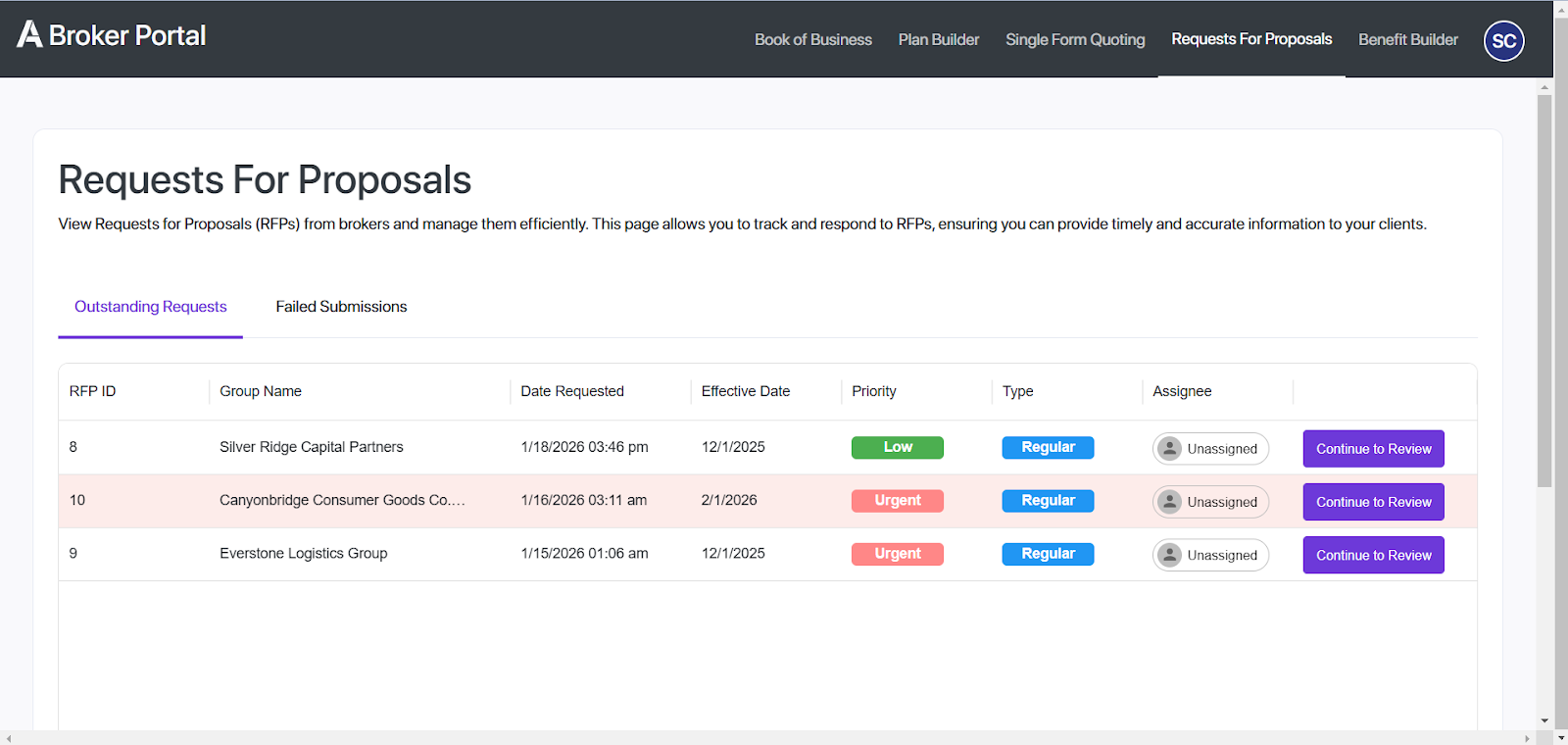
With extracted parameters and processed attachments, the workflow generates the final output: an automatically created quote, which becomes the foundation for the client proposal.
The quote includes:
- Group/company information
- Census data
- Selected medical plans
- Offered pricing
Once underwriting approves the quote, the Sales team sends the proposal PDF by email to the client or broker, keeping the negotiation more personal.
6. Human-in-the-loop operational transition
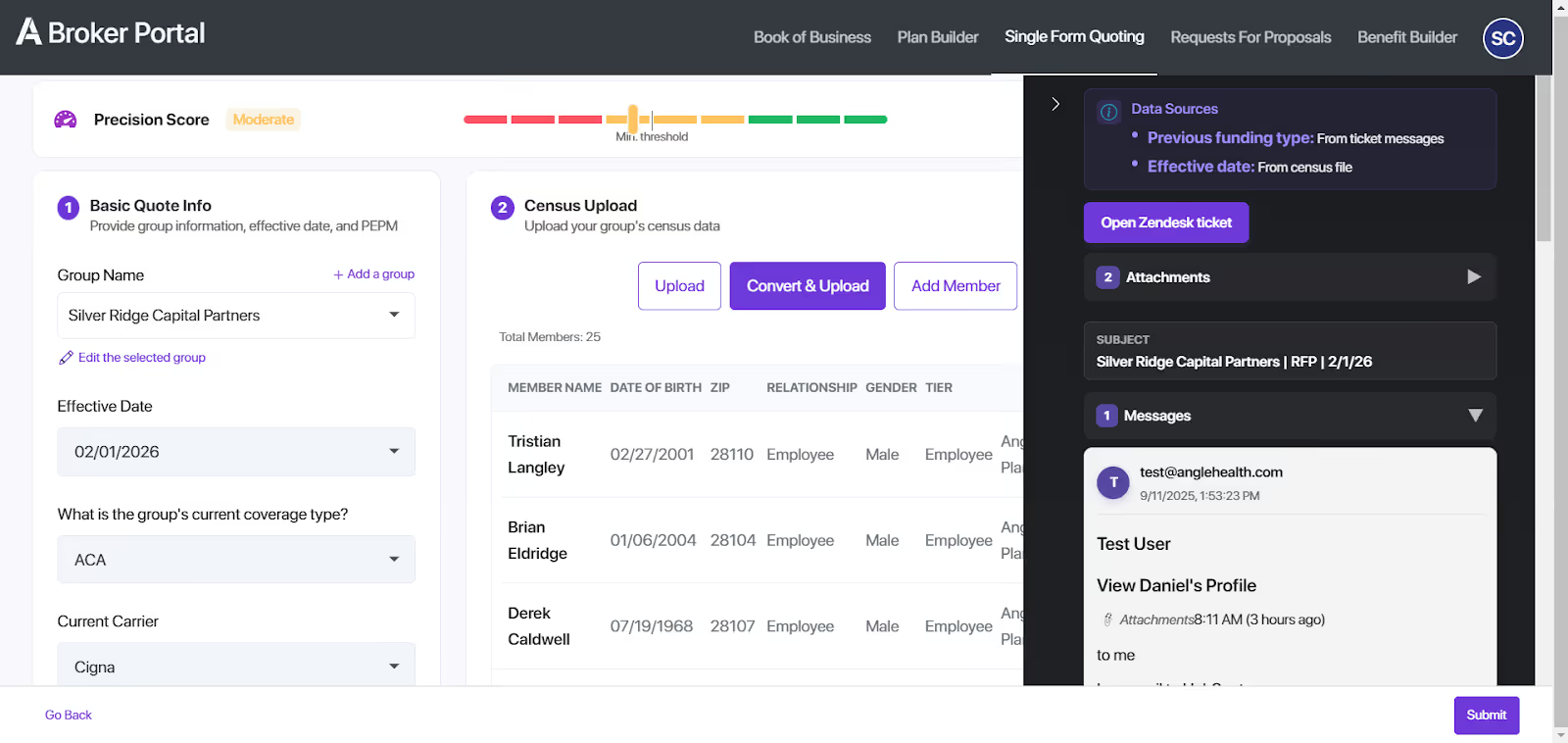
The new system is designed to shift the quoting team’s role over time:
- From manual processing of inbound emails
- To verification of automatically generated quotes, improving throughput without sacrificing control

Results
The workflow created a repeatable, scalable pipeline for Angle Health’s most important inbound lead channel.
Key outcomes include:
- End-to-end automation from Zendesk ticket creation to quote generation
- Cycle time reduction: from 45 minutes per RFP manually to 5 minutes with automation
- Reduced dependence on manual parsing, enabling the quoting team to move toward verification-only workflows
- Improved intake consistency despite unstructured inputs distributed across threads and attachments
- A modular architecture (LLM extraction + classification + census microservice) that supports iteration and expansion
Azumo delivered a critical automation capability for Angle Health’s quoting operation: an end-to-end pipeline that converts unstructured Zendesk ticket threads and attachments into a structured quote ready for underwriting and proposal delivery.
By combining LLM-based extraction, document classification, and specialized census normalization, the solution addresses the core challenge of real-world RFP intake: variability, incomplete structure, and information arriving over time. This workflow has become central to scaling the inbound lead process and is now being evaluated for patenting.