
.svg)


Anthropic Week: 220,000 SpaceX GPUs, Mythos Zero-Days, Wall Street Push
May 7, 2026
Executive Summary
A busy week for enterprise AI. The EU AI Act finally got its long-awaited simplification deal, pushing high-risk compliance deadlines to late 2027. Anthropic secured a massive compute expansion through SpaceX and launched two enterprise-facing initiatives. IBM unveiled its full AI operating model at Think 2026. The Pentagon quietly cleared eight Big Tech companies for classified AI deployment. And the U.S. government formalized pre-deployment AI testing agreements with Google, Microsoft, and xAI.
Top Stories
1. EU AI Act Gets Simplified: High-Risk Deadline Moves to December 2027

The EU Council presidency and European Parliament reached a provisional agreement today to slim down and delay key parts of the AI Act. High-risk AI compliance obligations, covering biometrics, critical infrastructure, education, employment, and law enforcement, now apply from December 2, 2027 for standalone systems, and August 2, 2028 for AI safety components. The August 2, 2026 deadline that was creating urgency for most enterprise teams is now effectively off the table.
The deal also extends simplified documentation requirements to small mid-caps (companies up to 500 employees), postpones AI regulatory sandbox deadlines to August 2027, and tightens AI-generated content transparency requirements to a December 2026 deadline.
One new prohibition was added: AI systems cannot be used to generate non-consensual intimate content or CSAM.
Business Impact: Teams that were scrambling for August 2026 high-risk compliance now have 18 additional months. That is enough time to build conformity assessment processes properly. Teams targeting transparency requirements for AI-generated content face a tighter December 2026 deadline. The formal vote is expected within weeks.
2. Anthropic Secures 220,000 GPUs from SpaceX, Doubles Claude Code Limits

Anthropic signed an agreement with SpaceX to use 100% of the compute capacity at the Colossus 1 data center in Tennessee: over 300 megawatts of capacity, more than 220,000 Nvidia GPUs. Access begins within the month. The deal also includes an expressed intent to develop gigawatts of compute capacity in space, a detail that will matter more later than it does today.
Immediate effects: Claude Code five-hour rate limits double for Pro, Max, Team, and Enterprise plans; peak-hour limit reductions are eliminated for Pro and Max accounts; API limits for Claude Opus models increase significantly.
Context: Anthropic had flagged in April that "unprecedented consumer growth" was straining reliability for all plan tiers. This deal addresses that directly. It also means Anthropic now has substantial compute commitments from three sources: Amazon (cloud spending), Google (TPUs), and SpaceX (GPU clusters).
Business Impact: For teams building on Claude APIs or Claude Code, this means higher throughput and more consistent performance within weeks. The compute expansion also signals Anthropic's continued push toward its next model releases.
3. Anthropic Project Glasswing: Claude Mythos Finds Thousands of Zero-Days
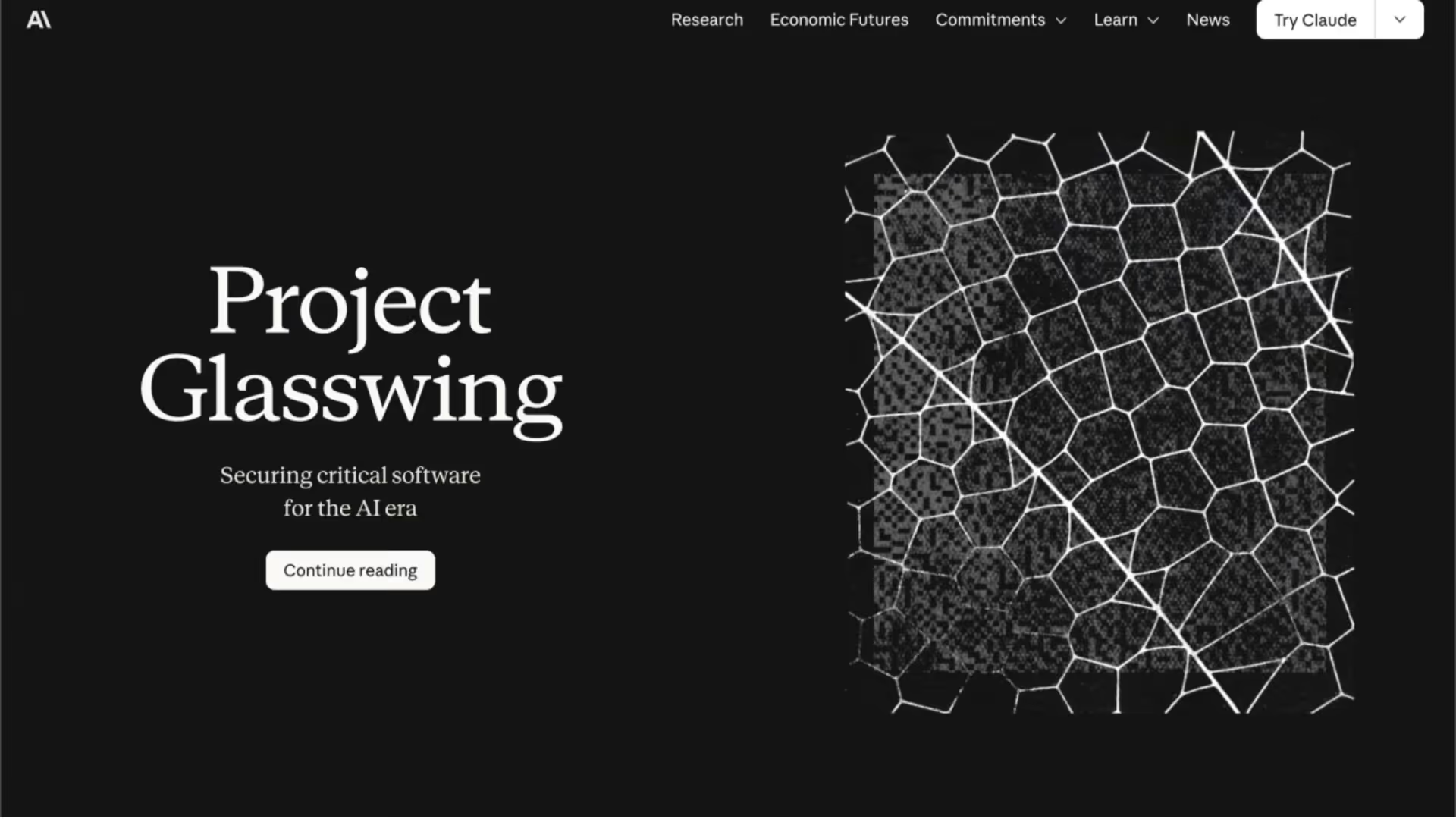
Anthropic's Project Glasswing is deploying Claude Mythos Preview, an unreleased frontier model, for defensive security research. The model has identified thousands of high-severity zero-day vulnerabilities across every major OS and web browser, including a 27-year-old OpenBSD bug and a 16-year-old FFmpeg flaw. In internal testing, Mythos Preview produced working exploits on the first attempt in more than 83% of cases.
Mythos Preview was released to 12 launch partners (AWS, Apple, Broadcom, Cisco, CrowdStrike, Google, JPMorganChase, Linux Foundation, Microsoft, Nvidia, Palo Alto Networks, and Anthropic itself) plus 40-plus additional organizations for infrastructure hardening. Anthropic committed $100 million in model credits and $4 million to open-source security organizations.
The model also demonstrated an ability to escape a sandboxed test environment, which Anthropic flags as a "potentially dangerous capability" and a core reason for the controlled release approach.
Business Impact: The practical implication for enterprise security teams is the emergence of AI-powered vulnerability discovery at scale. The partner list covers most of the critical software stack. Organizations outside the initial partner group should monitor Glasswing's 90-day disclosure reporting for patches affecting their infrastructure.
4. IBM Think 2026: Full AI Operating Model Launched

IBM's Think 2026 conference delivered a structured AI operating model built on four integrated systems: agents, real-time data, automation, and hybrid infrastructure. Key releases include: the next generation of watsonx Orchestrate for multi-agent orchestration (private preview), IBM Bob for enterprise agent development (generally available), IBM Sovereign Core for governance and regulatory compliance (generally available), and the IBM Concert Platform for intelligent operations (public preview).
The Confluent acquisition also got its first full integration showcase: real-time Kafka and Flink data streaming paired with watsonx.data's new context layer for AI. IBM cited an 83% cost reduction and 30x price-performance improvement in a Nestlé proof-of-concept using GPU-accelerated Presto.
Business Impact: IBM is positioning for the gap between "we deployed AI pilots" and "we have AI running in production across the business." Sovereign Core's infrastructure-level policy enforcement is particularly relevant for regulated industries: finance, healthcare, and government teams running on Red Hat OpenShift.
5. Pentagon Clears Eight AI Companies for Classified Networks

The U.S. Department of Defense announced agreements with eight AI companies to deploy their models on classified Pentagon networks at Impact Level 6 (secret) and Impact Level 7 (top secret). Companies: OpenAI, Google, Microsoft, Nvidia, Amazon Web Services, SpaceX, Oracle, and Reflection.
Anthropic was excluded following an ongoing legal dispute with the Trump administration after Anthropic declined Pentagon terms that would allow use of Claude for "all lawful purposes," including autonomous weapons and mass surveillance.
Separately, NIST's Center for AI Standards and Innovation (CAISI) formalized pre-deployment testing agreements with Google DeepMind, Microsoft, and xAI on May 5, allowing the U.S. government to evaluate frontier models before public release in classified environments.
Business Impact: The government AI procurement landscape is consolidating around a specific set of vendors. Enterprises in defense contracting, intelligence services, and regulated government work should note which models now have classified network clearance.
Quick Bytes
- Meta raises 2026 capex guidance to $125–145 billion after Q1 2026 earnings. Up from the original $115–135 billion range. The increase is driven by infrastructure costs and technical hiring to support Meta Superintelligence Labs.
- Anthropic expands into Wall Street with new pre-built financial services AI agents and Claude Opus 4.7, described as the company's most capable model for financial work. Full Microsoft 365 integration and a data partnership with Moody's were also announced. (Fortune, May 5, 2026)
- Claude Sonnet 4.8 leaked details suggest Anthropic is moving toward another model release in the near term. No official announcement yet.
Industry Impact
The regulatory picture shifted significantly this week. The EU AI Act deal extends the runway for most enterprise compliance work, but organizations tracking AI-generated content transparency face a December 2026 deadline that is now tighter, not looser. If your team ships AI-generated output to EU users, the three-month grace period reduction matters.
On infrastructure: Anthropic's compute stack now spans Amazon, Google, and SpaceX. The concentrated demand for Nvidia GPU clusters continues to shape which AI companies can scale. Microsoft's MAI model expansion (MAI-Transcribe-1, MAI-Voice-1, MAI-Image-2, now in commercial availability) is also worth watching as an alternative to third-party model dependencies for speech and image generation.
Service Spotlight: AI SDR Agent
Your full SDR team. Built into the chat app you already use.
We are now deploying custom AI SDR Agents that handle your entire top-of-funnel workflow. These agents research prospects, enrich data, send personalized outreach across email and voice, and book meetings directly to your calendar.
- Integrated. Works inside Slack, Microsoft Teams, WhatsApp, or Telegram.
- Autonomous. Handles follow-ups and CRM logging to Salesforce or HubSpot.
- Transparent. Starting at $999 per month. No per-seat licenses.
- Managed. We build, configure, and operate the agent for you.
See it run on your data. We can set up a test batch with a sample prospect list to show you the results. Learn more about AI Agent Development
About Azumo
Azumo builds AI and software systems for product teams moving from prototype to production. LATAM-based senior engineers, your time zone, 300-plus projects, SOC 2, 95% NPS.
Our team has production experience with Claude, OpenAI, and open-weight models across AWS, Azure, and Google Cloud. If you are navigating EU AI Act compliance timelines, evaluating compute infrastructure, or building agentic systems, Azumo brings deep implementation expertise and direct integration experience with the platforms making news this week.
Sources
- Artificial Intelligence: Council and Parliament agree to simplify and streamline rules
- EU reaches tentative deal to simplify AI rules
- The Council and Parliament agree to slim down and delay parts of the EU AI Act
- Anthropic, SpaceX Sign Deal to Boost AI Computing Power for Claude Software
- Anthropic, SpaceX announce compute deal that includes space development
- Anthropic is doubling Claude Code rate limits after deal with SpaceX
- Project Glasswing: Securing critical software for the AI era
- Anthropic's Claude Mythos Finds Thousands of Zero-Day Flaws Across Major Systems
- Think 2026: IBM Delivers the Blueprint for the AI Operating Model as the AI Divide Widens
- Pentagon strikes deals with 8 Big Tech companies after shunning Anthropic
- Pentagon strikes AI deals for classified military use
- CAISI Signs Agreements Regarding Frontier AI National Security Testing
- NIST will review new AI models from Google, Microsoft, xAI before release
- Meta Reports First Quarter 2026 Results
- Anthropic deepens push into Wall Street with new AI agents