
.svg)


Forget Model Releases: This Week's AI News Just Rewired Three Industries at Once
Executive Summary
OpenAI launched a $4 billion enterprise deployment arm, Anthropic expanded Claude into small business workflows, Google deepened its physical AI bet with a major industrial robotics partnership, and Connecticut enacted one of the broadest U.S. AI laws to date. A week with concrete structural moves, not just model benchmarks.
Top Stories
1. OpenAI Launches $4 Billion Deployment Company to Scale Enterprise AI
OpenAI launched the OpenAI Deployment Company on May 11, a majority-owned subsidiary backed by $4 billion in initial investment at a $10 billion pre-money valuation. The company brings together 19 global investment firms, consultancies, and systems integrators, led by TPG, with Advent, Bain Capital, and Brookfield as co-lead founding partners. Goldman Sachs, SoftBank Corp., and Warburg Pincus are also founding partners.
On day one, the Deployment Company acquired Tomoro, an applied AI engineering firm, adding roughly 150 forward-deployed engineers who will embed directly with enterprise clients. OpenAI describes the mission as helping organizations move AI from pilot to production.
This is a direct play for the implementation market. OpenAI is not just selling API access. It is now building a professional services arm capable of deploying its models inside enterprise workflows at scale.
Business Impact: Enterprise CTOs evaluating OpenAI should note this changes the vendor relationship. OpenAI can now offer embedded implementation support, not just model access. For teams using third-party implementation partners, this creates a new competitive dynamic.
2. Anthropic Launches Claude for Small Business
Anthropic launched Claude for Small Business on May 13, a packaged suite of 15 agentic workflows and connectors targeting small and mid-sized companies. The package integrates Claude directly into QuickBooks, PayPal, HubSpot, Canva, DocuSign, Google Workspace, and Microsoft 365.
Workflows cover the tasks SMBs consistently struggle with: payroll planning, month-end close, invoice tracking, lead triage, contract review, campaign creation, and cash-flow monitoring. The system runs on the Claude desktop app. Users approve each plan before anything is sent, posted, or paid.
Anthropic also partnered with PayPal on a free online course, AI Fluency for Small Business, and is running in-person workshops in 10 U.S. cities starting May 14.
Business Impact: Anthropic is expanding its total addressable market beyond enterprise. For product teams building SMB-focused applications, this establishes a new baseline expectation: pre-built agentic workflows, not just chat interfaces. The packaged workflow model is worth studying as a go-to-market pattern.
3. Google and Fanuc Partner on Physical AI for 1.1 Million Industrial Robots
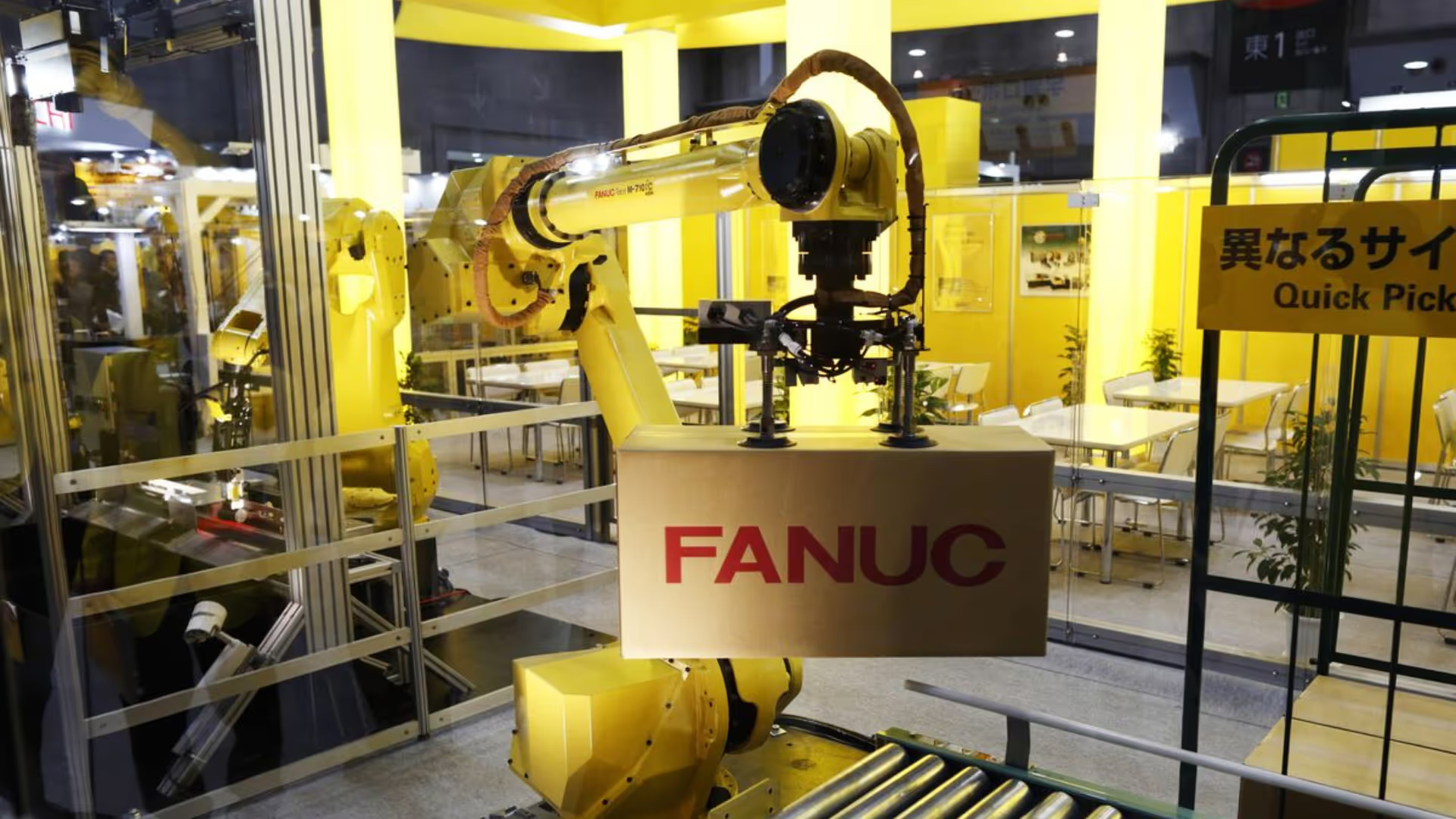
Fanuc, the world's largest industrial robot manufacturer, announced a partnership with Google today to integrate Gemini Enterprise and Google's Intrinsic robotics platform into its systems. The deal covers the 1.1 million Fanuc robots already installed in factories worldwide, giving them the ability to understand natural language instructions, recognize objects, and coordinate autonomously across robot fleets.
Fanuc plans to demonstrate an AI agent system for industrial robots later this month, where collaborative and non-collaborative robots operate together under natural language control. Fanuc shares rose 15.6% to an all-time high on the announcement.
The Google Intrinsic platform is positioning as a horizontal software layer for industrial robotics, analogous to what Android became for mobile. This is the most significant physical AI deployment partnership announced so far in 2026.
Business Impact: For operations and manufacturing technology leaders, this signals that agentic AI is arriving in physical systems ahead of most timelines. Teams planning factory automation or warehouse operations should evaluate Intrinsic and competing platforms now, before procurement decisions crystallize around a single standard.
4. Connecticut SB5 Passed: One of the Broadest U.S. AI Laws Takes Effect in October

Connecticut's SB5, the AI Responsibility and Transparency Act, passed the state legislature on May 1 and Governor Lamont is expected to sign it. Most provisions take effect October 1, 2026.
The law covers three areas that affect enterprise teams directly. First, automated employment decisions: any AI system that produces scores, rankings, or recommendations that are a "substantial factor" in hiring, promotion, discipline, or termination must meet new requirements. This captures resume screening tools, candidate ranking software, and performance analytics. Second, AI chatbot safety obligations, including heightened rules for systems used by or accessible to minors. Third, synthetic content provenance: platforms with more than one million monthly users must embed provenance data into generated audio, image, and video content.
The Connecticut Attorney General enforces most provisions. A private right of action exists for violations involving minors.
Business Impact: October 1 is 20 weeks away. If you use AI in employment decisions, ship AI-generated content to users in Connecticut, or operate consumer AI products, the clock is running. Legal review of your AI stack against SB5's definitions should begin now. Colorado is also advancing similar legislation before its session ends May 13.
5. Google's Android Show Previews Gemini Intelligence and Googlebooks Ahead of I/O

Google held "The Android Show: I/O Edition" on May 12-13, a preview event ahead of Google I/O on May 19. Key announcements: Gemini Intelligence, a cross-app agentic layer debuting on Samsung Galaxy and Google Pixel this summer; Googlebooks, a new category of Android-native premium laptops from Acer, ASUS, and Lenovo launching in fall 2026; and AI-powered widget creation for Android.
Gemini Intelligence is the most significant piece for enterprise developers. It moves across apps, reads what is on screen, and completes multi-step tasks without requiring users to switch between applications. This is Google's answer to the agentic desktop layer, competing with Microsoft's Copilot+ and Apple's upcoming AI features.
The full Google I/O developers conference follows on May 19, where Gemini 4.0 is expected.
Business Impact: Android developers should track Gemini Intelligence APIs closely. Cross-app agentic functionality changes how users interact with software at the OS level, creating both opportunities and disruption for apps that currently own specific workflow steps.
Quick Bytes
- OpenAI deepens U.S. Department of Energy collaboration for AI-accelerated scientific research. No financial terms disclosed. (OpenAI, May 2026)
- Enterprise now accounts for 40% of OpenAI's revenue, with OpenAI expecting consumer and enterprise revenue to reach parity by end of 2026. (CNBC, May 11, 2026)
- Google TPU 8 announced at Cloud Next: Dual-chip architecture with TPU 8t for training (scales to 9,600 TPUs) and TPU 8i for inference (1,152 TPUs per pod). Available through Google Cloud. (Google Cloud, May 2026)
- Gemma 4 Multi-Token Prediction drafters released, delivering up to 3x inference speedup without quality degradation. Gemma 4 has been downloaded more than 60 million times since launch. (Google, May 2026)
Industry Impact
The OpenAI Deployment Company is the most structurally significant move of the week. It signals that the frontier model vendors are no longer content to sit at the API layer. OpenAI now has a professional services arm with the capital and headcount to compete directly for enterprise implementation engagements. That changes the market, and not only for OpenAI's partners.
On regulation: Connecticut's October 1 deadline is the nearest binding compliance date for any U.S. AI law. With automated employment decisions and synthetic content provenance both in scope, this affects a wide range of enterprise software stacks, not just companies building AI products. Colorado may add a second state law before May 13.
Physical AI moved from concept to signed partnership this week. Google and Fanuc represent the first major deployment commitment for agentic control of industrial robot fleets at scale. The question for 2026 is not whether physical AI works. It is which platform becomes the standard.
Service Spotlight: Hello by Azumo - AI Receptionist
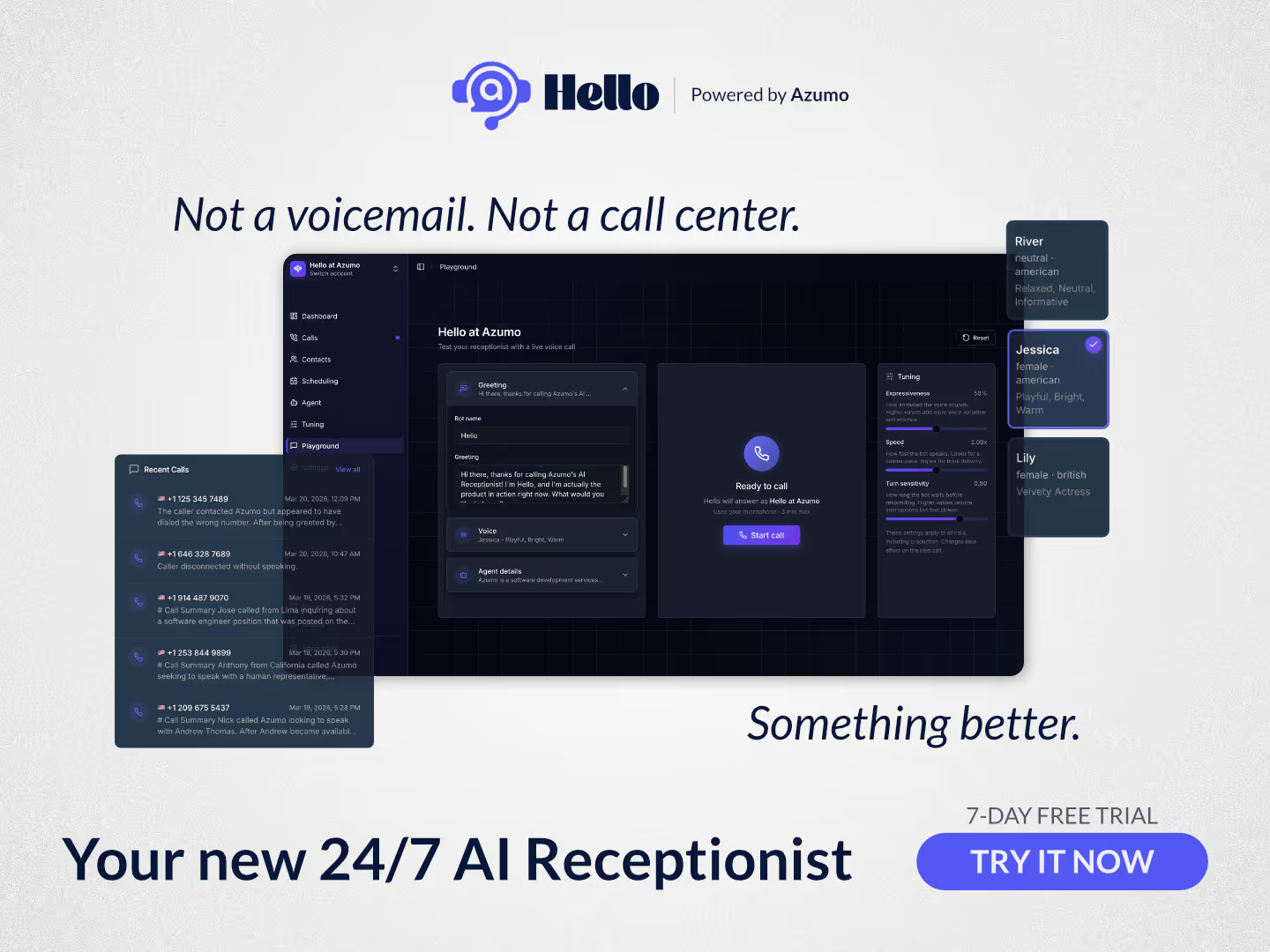
This week Anthropic packaged Claude into 15 SMB workflows. The packaged-agent pattern is the bigger story; Hello by Azumo is our version of that pattern for one of the highest-impact business functions, the phone line.
Hello answers every call 24/7, routes the caller to the right person in real time through Slack, Microsoft Teams, or phone transfer, captures structured messages, and books appointments directly into Google Calendar during the conversation. Setup runs through a guided wizard and goes live in under 30 minutes; no middleware, no IT project.
Built for businesses where a missed call is a lost customer: law firms, medical offices, home services, and real estate. The platform is SOC 2 compliant, with AES-256-GCM encryption, per-tenant data isolation, and role-based access control.
Why it matters: 62% of small business calls go unanswered, and 85% of callers do not call back. For a typical SMB that translates to roughly $6,852 in lost revenue per year, before reputation cost.
Try it free for 7 days at hello.azumo.com. Plans start at $79 per month after trial.
About Azumo
Azumo builds AI and software systems for product teams moving from prototype to production. LATAM-based senior engineers, your time zone, 300-plus projects, SOC 2, 95% NPS.
Our team has production experience with OpenAI, Anthropic, and Google AI platforms, and we have worked through the compliance and implementation challenges that enterprise teams face as AI moves from experiment to core infrastructure. If you are navigating the new enterprise deployment landscape, building agentic workflows, or preparing for state AI compliance deadlines, Azumo brings the implementation depth to move fast without cutting corners.
Sources
- OpenAI launches the OpenAI Deployment Company to help businesses build around intelligence - OpenAI, May 11, 2026
- OpenAI launches AI consulting arm valued at $14 billion - Axios, May 11, 2026
- OpenAI Launches $4 Billion Company to Accelerate Enterprise AI Adoption - PYMNTS, May 12, 2026
- Anthropic courts a new kind of customer: small business owners - TechCrunch, May 13, 2026
- Anthropic's latest Claude release turns your Mac into a small business powerhouse - 9to5Mac, May 13, 2026
- Anthropic courts mom-and-pop shops with Claude for Small Business - Fast Company, May 13, 2026
- Fanuc Shares Jump to Record After Announcing Google AI Robotics Partnership - Bloomberg, May 14, 2026
- Fanuc partners with Google to bring Gemini AI and Intrinsic platform to 1.1 million industrial robots - The Next Web, May 14, 2026
- Unpacking SB5: Connecticut's new AI law - DLA Piper, May 2026
- Connecticut Adopts AI Transparency, Safety, and Consumer Protection Law - Davis Wright Tremaine, May 2026
- Connecticut Poised to Enact One of the Nation's Most Comprehensive AI Laws - Freshfields, May 2026
- Everything announced at The Android Show: I/O 2026 edition - Engadget, May 13, 2026
- Everything Google announced at its Android Show, from Googlebooks to vibe-coded widgets - TechCrunch, May 12, 2026
- OpenAI revenue chief Dresser says enterprise AI adoption is 'at a tipping point' - CNBC, May 11, 2026
- Deepening our collaboration with the U.S. Department of Energy - OpenAI, May 2026