
.svg)


$700B in Hyperscaler Spending, DeepSeek V4 Imminent, March 11 Federal Deadline
March 5, 2026
Executive Summary
DeepSeek is preparing to release V4, a trillion-parameter multimodal model optimized for Chinese domestic chips, timed ahead of China's annual "Two Sessions" parliamentary meetings. The announcement arrives alongside accusations from Anthropic that DeepSeek and two other Chinese labs ran industrial-scale operations to extract Claude's capabilities through 16 million fraudulent queries. AI infrastructure investment continued its relentless climb, with hyperscalers collectively committing nearly $700 billion in data center spending for 2026, led by Amazon at $200 billion and Google at $175-185 billion. On the regulatory front, the U.S. Commerce Department faces a March 11 deadline to identify state AI laws incompatible with federal policy, a decision that will shape the compliance landscape for AI products deployed across multiple jurisdictions.
Top Stories
1. DeepSeek V4 Imminent — Alongside Fresh Allegations of Model Theft
DeepSeek is expected to release V4 during the first week of March, timed ahead of China's "Two Sessions" parliamentary meetings starting March 4. The model is a trillion-parameter mixture-of-experts architecture with approximately 32 billion active parameters, native multimodal capabilities covering text, image, and video generation, a one-million-token context window, and optimization specifically for Huawei Ascend chips. It is targeted primarily at coding and long-context software engineering, with internal benchmarks suggesting performance competitive with or exceeding Claude and GPT-class models on those tasks.
The planned release is strategically notable: DeepSeek has withheld pre-release access from Nvidia and AMD, granting early access exclusively to Chinese chipmakers — a direct signal of the direction Chinese AI development is taking under ongoing U.S. export controls. V4 will be released under an open-source license.
The anticipated launch arrives alongside Anthropic's published findings that DeepSeek, alongside Moonshot and MiniMax, conducted "industrial-scale" distillation attacks on Claude, using approximately 24,000 fraudulently created accounts to generate more than 16 million exchanges specifically targeting Claude's agentic reasoning, tool-use, and coding capabilities.
Business Impact: If V4 delivers on its reported benchmarks, it will offer enterprises an open-weight, highly capable coding model with no dependency on U.S. cloud infrastructure. The distillation allegations, if substantiated, raise legal and IP questions that will likely shape how AI companies structure API access and terms of service moving forward.
2. Hyperscalers Commit Nearly $700 Billion to AI Infrastructure in 2026
A TechCrunch analysis published February 28 quantified the scale of AI infrastructure spending now underway. Amazon leads with a projected $200 billion in capital expenditure for 2026 (up from $131 billion in 2025), Google follows with $175-185 billion (up from $91 billion), and Meta sits at $115-135 billion (up from $71 billion). Combined with Microsoft's commitments, the total approaches $700 billion in annual data center investment from hyperscalers alone.
Notable projects include Hyperion, a 2,250-acre Louisiana site planned at $10 billion with 5 gigawatts of compute backed by nuclear power. Meta separately signed agreements with three nuclear power providers — TerraPower, Oklo, and Vistra — securing up to 6.6 GW of energy over 20 years. NVIDIA CEO Jensen Huang estimates $3-4 trillion will be spent on AI infrastructure through the end of the decade.
Business Impact: The capital concentration at the hyperscaler level is reshaping the competitive landscape. Companies without access to these resources face structural disadvantages in training frontier models, accelerating the bifurcation between model providers and model consumers.
3. U.S. Commerce Department Faces March 11 Deadline on State AI Law Preemption
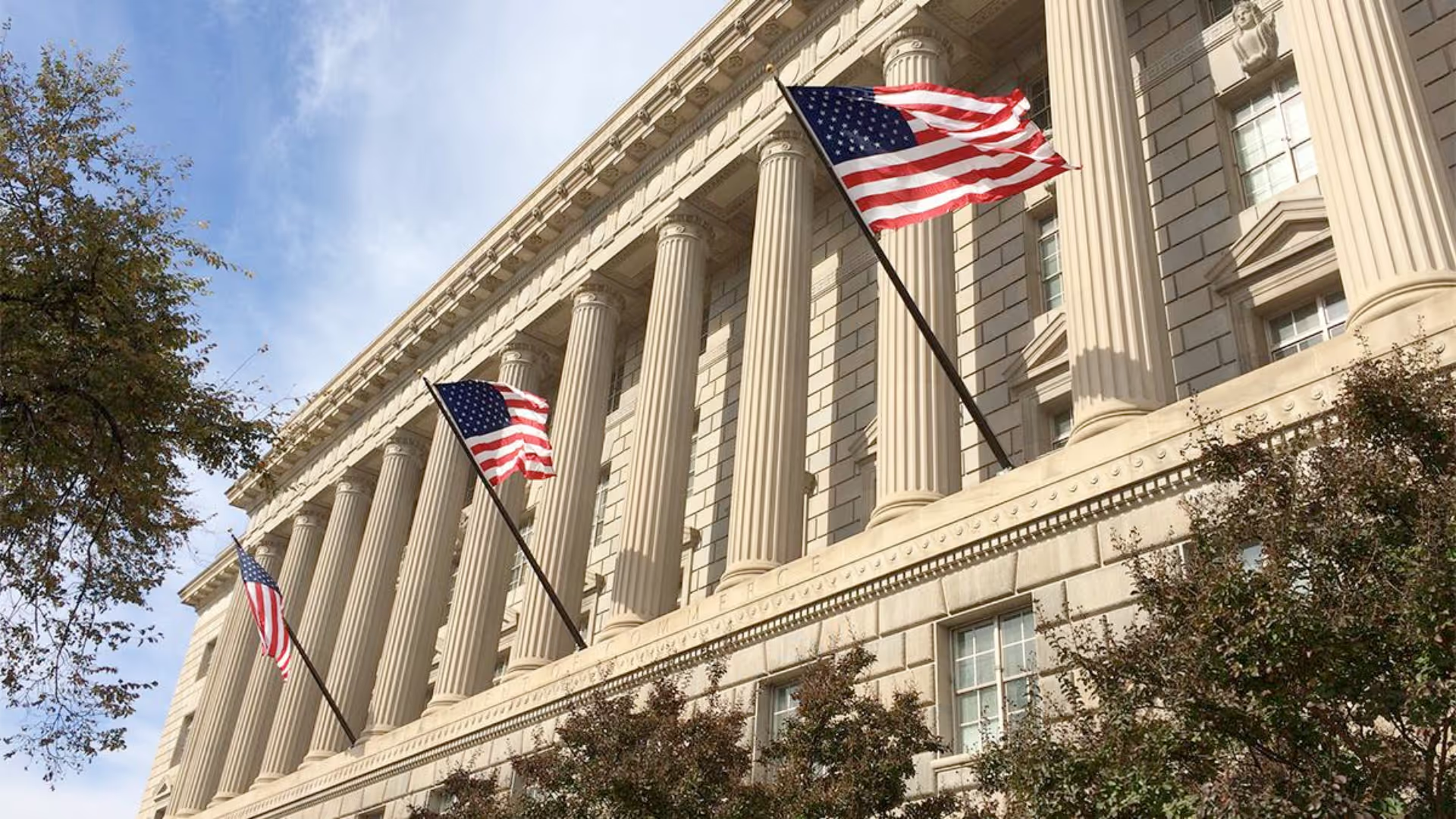
The U.S. Secretary of Commerce is required to publish an evaluation by March 11 identifying state AI laws deemed incompatible with federal policy — a direct consequence of President Trump's December 2025 executive order directing federal agencies to block state-level AI regulation that creates excessive compliance burdens. The FTC faces the same March 11 deadline to issue a policy statement on how the FTC Act applies to AI and when state truthfulness requirements in AI outputs are preempted by federal law.
The EU AI Act's transparency and high-risk system requirements are separately coming into full force by August 2026, creating a split compliance environment for any organization operating across jurisdictions.
Business Impact: Companies with AI products deployed across multiple U.S. states and internationally are navigating overlapping and sometimes conflicting requirements. The March 11 Commerce Department report will be a practical reference for legal and compliance teams assessing exposure.
Quick Bytes
- Infosys + Anthropic: The February 17 partnership to build Claude-powered agentic AI for telecom, financial services, and manufacturing is now in active deployment internally at Infosys, with a dedicated Center of Excellence operational in telecommunications.
- Apple Siri delays: The overhauled Siri built on Google's Gemini models and targeted for iOS 26.4 in March has hit testing snags, with some features now pushed to the May update or iOS 27 in September.
- Microsoft Copilot March update: Microsoft is expanding Copilot free-tier access inside Microsoft 365 apps this month, with Copilot Notebooks gaining public web link grounding and Teams adding AI-assisted message drafting.
- Basis reaches unicorn status: Agentic accounting platform Basis closed a $100 million Series B at a $1.15 billion valuation, with the platform handling audits and tax preparation autonomously.
- OpenAI + Amazon deal extended: OpenAI and AWS announced a $100 billion extension on their compute capacity agreement, ensuring access to large-scale training infrastructure.
Industry Impact Analysis
DeepSeek V4's optimization for non-U.S. chips, combined with the distillation allegations, reflects a broader trend: the U.S.-China AI split is becoming architectural, not just strategic. Chinese labs are building supply chains and model pipelines that are explicitly decoupled from U.S. infrastructure. For enterprises evaluating AI vendors, this bifurcation is now a procurement-level consideration.
The nearly $700 billion in hyperscaler infrastructure spending underscores the growing divide between organizations that can afford to train frontier models and those that will consume them through APIs. For most enterprises, the strategic question is not whether to build or buy AI compute, but how to optimize their position as model consumers in an increasingly concentrated infrastructure landscape.
The March 11 regulatory deadline adds urgency to compliance planning. Organizations deploying AI across multiple states and internationally need to monitor the Commerce Department's evaluation closely, as it will directly affect which state-level requirements remain enforceable.
About Azumo
Azumo helps companies design, build, and scale AI-powered software using the latest models and agentic frameworks. From enterprise integrations to custom AI agents, the team brings technical depth and delivery speed to complex AI projects.
Learn more about Azumo's AI capabilities at azumo.com/artificial-intelligence.
Sources
- DeepSeek plans V4 multimodal model release this week — TechNode
- DeepSeek set to launch V4 amidst allegations of AI hijacking — Capacity
- Anthropic accuses Chinese AI labs of mining Claude — TechCrunch
- Anthropic says Chinese AI firms used 16 million Claude queries to copy model — The Hacker News
- The billion-dollar infrastructure deals powering the AI boom — TechCrunch
- The $3 Trillion AI Data Center Build-Out Becomes All-Consuming For Debt Markets — Bloomberg
- New State AI Laws are Effective on January 1, 2026, But a New Executive Order Signals Disruption — King & Spalding
- AI Regulation in 2026: Navigating an Uncertain Landscape — Holistic AI
- Infosys and Anthropic Announce Collaboration — Infosys Newsroom
- Apple's iOS 26.4 Siri Update Runs Into Snags in Internal Testing — Bloomberg
This newsletter is curated by Azumo's AI Intelligence Scanner to help enterprises stay ahead of critical AI developments that impact business strategy and technology roadmaps.