
.svg)


March 19, 2026
Executive Summary
Anthropic launched Dispatch, a phone-to-desktop remote control layer for its Claude Cowork agent, available first to Max subscribers on March 17. The same day, OpenAI released GPT-5.4 mini and nano, its smallest and fastest models to date, with free-tier access and pricing aggressive enough to target high-volume subagent workloads. Earlier in the week, Microsoft formally announced Copilot Cowork on March 9, a parallel agentic desktop product built in partnership with Anthropic and bundled into its new M365 E7 Frontier Suite. Yann LeCun's AMI Labs closed a $1.03 billion seed round to develop world models as an alternative to language model architectures. Encyclopaedia Britannica and Merriam-Webster filed a copyright suit against OpenAI, alleging that nearly 100,000 articles were scraped to train its models. These five stories cover agentic AI adoption, model economics, infrastructure bets, and the continuing expansion of AI copyright litigation.
Top Stories
1. Anthropic Launches Dispatch: Remote Control for Claude Cowork
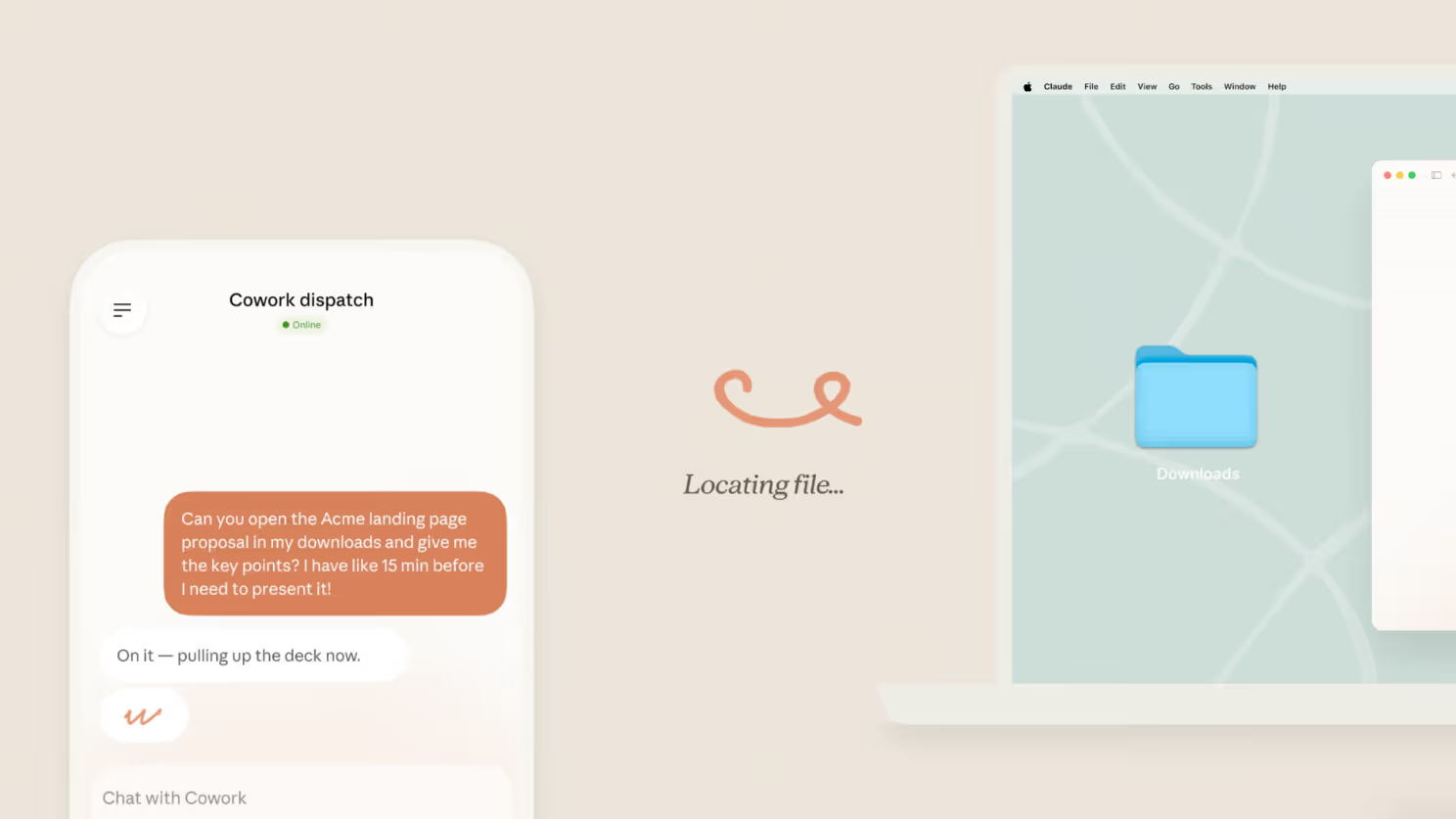
Anthropic released Dispatch as a research preview on March 17, adding remote mobile control to its Claude Cowork desktop agent. The feature creates an end-to-end encrypted channel between the Claude mobile app on a user's phone and the Claude Desktop app running on their Mac. Users assign tasks from their phone, and Claude executes them locally on the desktop in a sandboxed environment. Files remain on the machine. Nothing is sent to Anthropic's servers during execution.
The workflow is straightforward: open Claude Desktop on your Mac, scan the QR code shown in the Dispatch panel to pair your phone, then send instructions from the mobile app while away from the computer. Example tasks include compiling reports from local spreadsheets, drafting briefings from Slack threads or email, reorganizing folder structures, and building presentations from Google Drive files. Early testing showed that Dispatch works with Cowork's existing Connectors but is slow and unreliable on complex multi-step tasks, succeeding roughly half the time in initial reviews. The feature requires Claude Desktop (Mac or Windows x64) plus the Claude mobile app, and a Pro or Max subscription.
Dispatch launched exclusively to Max subscribers ($100–$200/month) on March 17. Pro subscriber access ($20/month) was promised within days.
This launch is also Anthropic's direct answer to OpenClaw, the open-source third-party project (formerly Clawdbot, later Moltbot) that went viral earlier this year for enabling similar phone-to-desktop AI control before Anthropic issued a trademark request over the "Clawd" branding. OpenClaw's creator, Peter Steinberger, subsequently announced he was joining OpenAI and moving the project to an open-source foundation. Anthropic is now shipping the official, privacy-first version of the same capability.
Business Impact: For professionals who leave long-running agentic tasks on their desktops, Dispatch reduces the dependency on being physically present. The security model, local processing with an encrypted mobile bridge, addresses a core concern for enterprise users who cannot send sensitive documents to a cloud inference endpoint. Teams evaluating autonomous AI workflows should test Dispatch alongside existing RPA and automation tools to compare reliability and integration depth.
2. OpenAI Releases GPT-5.4 Mini and Nano for Subagent Workloads
OpenAI released GPT-5.4 mini and GPT-5.4 nano on March 17, completing the GPT-5.4 model family. Mini is positioned as the cost-efficient workhorse for coding, reasoning, and multimodal tasks, running over 2x faster than the previous GPT-5 mini while approaching GPT-5.4's performance on benchmarks including SWE-Bench Pro and OSWorld-Verified. Nano is the smallest and cheapest variant, priced at $0.20 per million input tokens and $1.25 per million output tokens, designed for classification, data extraction, ranking, and supporting roles within multi-agent pipelines.
Both models are available via API and in ChatGPT. Free-tier ChatGPT users get access to GPT-5.4 mini, making it the most capable model ever offered without a paid subscription. The pricing on nano is aggressive enough that processing 76,000 images costs roughly $52 at current rates. OpenAI's framing for both models is explicitly agentic: they are built for systems where a larger model coordinates smaller, faster models on discrete tasks.
Business Impact: The pricing and speed of nano make high-volume automated workflows economically viable for the first time on OpenAI infrastructure. For teams building multi-agent pipelines, these models are worth benchmarking as the subagent layer against alternatives like Claude Haiku and Gemini Flash. Free-tier access to mini also lowers the barrier for developers testing new products before committing to API costs.
3. Microsoft Launches Copilot Cowork Powered by Anthropic's Claude
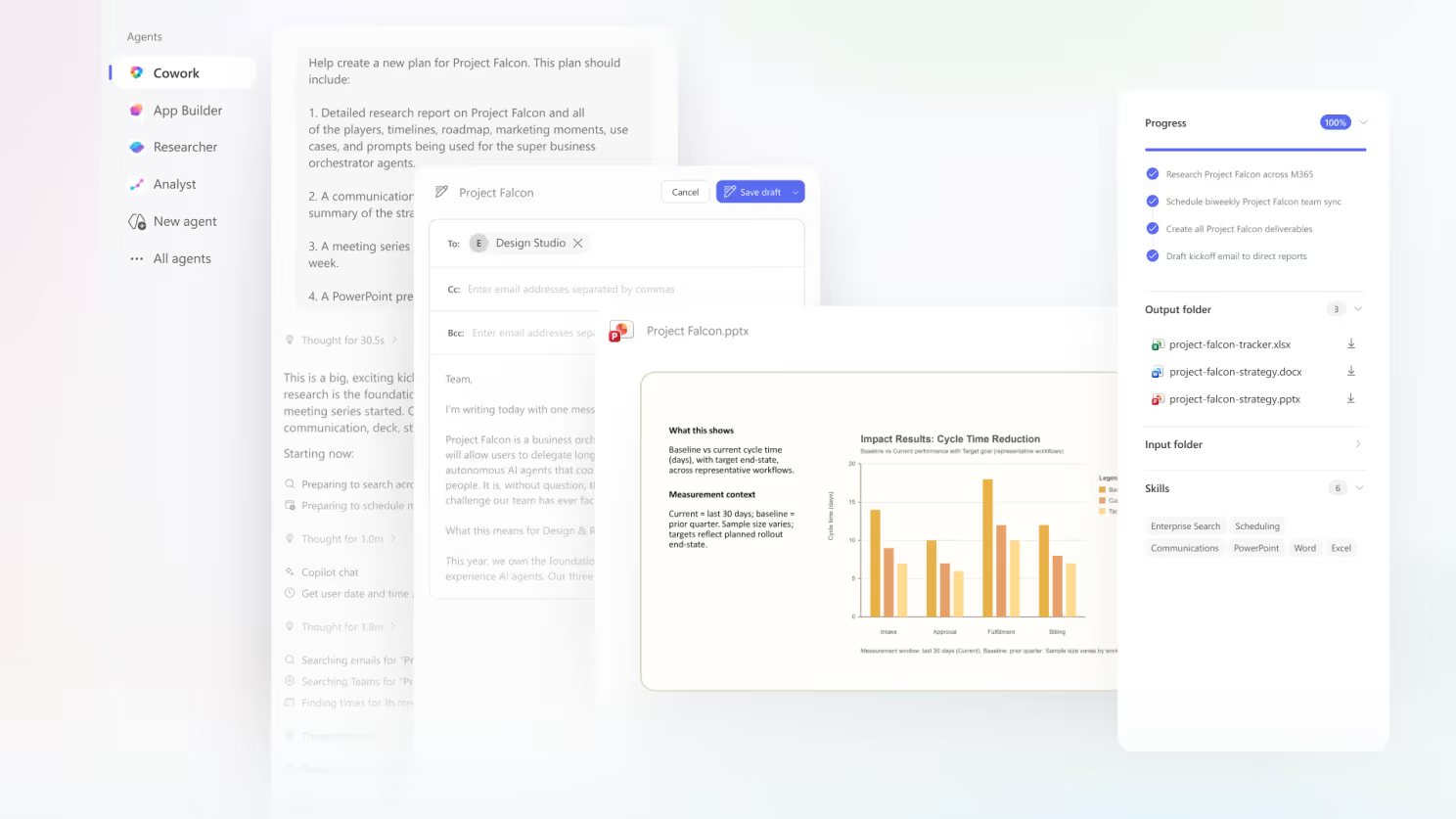
Microsoft announced Copilot Cowork on March 9, an enterprise AI agent product built in close collaboration with Anthropic that brings Claude's Cowork architecture into Microsoft 365 apps. Cowork enables Copilot to break complex requests into multi-step workflows that run across files, applications, and timeframes, producing observable, steerable outputs within Microsoft's security and governance framework. Tasks are no longer confined to a single prompt and response cycle. They can run for minutes or hours and coordinate actions across M365 applications.
The product is part of a broader product push that includes Agent 365 and Work IQ, all bundled into the new Microsoft 365 E7 Frontier Suite at $99 per user per month. A standalone Copilot Cowork license is priced at $30 per user per month. The launch is positioned as moving AI from a drafting and summarizing sidecar to an execution layer for enterprise work. Copilot Cowork launched as a research preview with a limited customer set, with broader rollout through the Frontier program in March.
Business Impact: The direct partnership with Anthropic to bring Claude Cowork into M365 reflects how quickly the agentic AI space is consolidating around a small number of model and infrastructure combinations. Organizations running M365 should evaluate Copilot Cowork as the default path for enterprise agentic workflows before committing to custom-built agent frameworks. The $30/month per-user pricing makes deployment cost predictable at scale.
4. Yann LeCun's AMI Labs Raises $1.03 Billion Seed to Build World Models

Advanced Machine Intelligence Labs, the startup co-founded by Turing Award winner Yann LeCun after leaving Meta, announced a $1.03 billion seed round on March 10 at a $3.5 billion pre-money valuation. The round was co-led by Cathay Innovation, Greycroft, Hiro Capital, HV Capital, and Bezos Expeditions. AMI is headquartered in Paris with offices planned in New York, Montreal, and Singapore. The company is led by LeCun as Executive Chairman and Alexandre LeBrun (co-founder of Nabla) as CEO.
AMI's core thesis is that large language models have a structural ceiling because they are trained on language, not on physical reality. The company is building world models: AI systems trained on sensory data, primarily video, that learn how environments evolve and can simulate the consequences of actions before executing them. LeCun has been arguing this direction publicly for years at Meta's AI Research lab. AMI is now the commercial vehicle for that research direction.
Business Impact: The $1.03 billion seed is one of the largest in European startup history and signals that institutional investors are backing architectural alternatives to transformer-based LLMs. For organizations with long planning horizons, AMI's work is worth tracking as a potential platform shift, particularly for robotics, industrial automation, and embodied AI applications that current LLMs handle poorly.
5. Encyclopaedia Britannica and Merriam-Webster Sue OpenAI Over Training Data

Encyclopaedia Britannica and Merriam-Webster (both owned by Britannica) filed a lawsuit against OpenAI on March 16, alleging copyright and trademark infringement. The complaint centers on two claims: first, that OpenAI scraped nearly 100,000 Britannica articles without permission to train its language models; second, that when ChatGPT's retrieval-augmented generation system generates outputs attributed to Britannica, it creates trademark confusion, particularly when the output includes hallucinated content misattributed to the publisher.
OpenAI responded with its standard position that its models are trained on publicly available data within fair use principles. Britannica joins a growing list of plaintiffs including The New York Times and Ziff Davis, but the trademark angle in this complaint is less common than pure copyright claims and could add a new legal dimension to training data disputes.
Business Impact: The trademark infringement angle is the element to watch. If courts find that RAG-based attribution creates trademark liability, it would require substantive changes to how AI products surface and cite sourced information. Organizations building products that attribute AI-generated content to named sources should monitor this case closely.
Quick Bytes
- OpenAI Google and Microsoft write actions: OpenAI added write actions to ChatGPT's Google and Microsoft app connectors this week, allowing users to draft emails, create documents, and schedule calendar meetings from within ChatGPT. Previously these connectors were read-only.
- Meta compute investment: Meta agreed to purchase up to $12 billion in AI computing capacity from infrastructure provider Nebius through 2027, underscoring continued pressure on GPU supply chains.
- OpenAI enterprise private equity talks: OpenAI is in early discussions with private equity firms to finance a new enterprise-focused AI venture aimed at accelerating commercial adoption beyond its current direct and API distribution channels.
Industry Impact Analysis
Three of this week's top stories, Anthropic Dispatch, Microsoft Copilot Cowork, and OpenAI's GPT-5.4 mini/nano, converge on the same practical question: how do autonomous AI agents run reliably on real work without requiring users to remain present or spend significant money per task? Anthropic and Microsoft are betting on persistent local agents with encrypted mobile bridges. OpenAI is betting on cheap, fast subagent models that sit below a coordinator model in a pipeline. These are complementary architectures and many enterprise deployments will use both.
The AMI Labs funding is worth separating from the near-term agentic story. LeCun's world model approach is a long-cycle research bet that, if it delivers, would change the underlying physics of AI for physical environments. It is not relevant to current enterprise software decisions but is relevant to product roadmaps for companies in manufacturing, logistics, and hardware.
The Britannica lawsuit is the most legally consequential development for enterprise AI product teams. The trademark angle on misattributed hallucinations has not been tested at scale in court. It is a different category of risk than training data copyright and warrants attention from legal and product teams building AI products that surface attributed content.
About Azumo
Azumo builds and scales AI-powered software for product teams that need to move fast without cutting corners on quality or security. The team specializes in custom AI agents, enterprise integrations, and production ML systems, with senior LATAM-based engineers who are time-zone aligned with US teams.
If you are evaluating agentic AI implementations or need to build on top of the latest model platforms, Azumo's AI practice covers the full stack from architecture to deployment.
Sources
- Anthropic Launches Dispatch For Cowork Remote Control - Let's Data Science, March 17, 2026
- Hands-On with Claude Dispatch for Cowork - MacStories, March 17, 2026
- Anthropic launches Dispatch: the "safe" answer to OpenClaw's wild success - Abit.ee, March 2026
- Clawdbot Becomes Moltbot After Anthropic Trademark Issue - Trending Topics, 2026
- Introducing GPT-5.4 mini and nano - OpenAI, March 17, 2026
- OpenAI releases GPT-5.4 mini and nano, its 'most capable small models yet' - 9to5Mac, March 17, 2026
- OpenAI's GPT-5.4 mini and nano are built for the subagent era - The New Stack, March 17, 2026
- Copilot Cowork: A new way of getting work done - Microsoft 365 Blog, March 9, 2026
- Microsoft announces Copilot Cowork with help from Anthropic - VentureBeat, March 9, 2026
- Microsoft debuts Copilot Cowork built with Anthropic's help and E7 software suite - Fortune, March 9, 2026
- Yann LeCun's AMI Labs raises $1.03B to build world models - TechCrunch, March 10, 2026
- Yann LeCun's New AI Startup Raises $1 Billion in Seed Funding - Bloomberg, March 10, 2026
- Encyclopedia Britannica sues OpenAI for copyright and trademark infringement - Engadget, March 16, 2026
- Encyclopedia Britannica Sues OpenAI Over Alleged Copyright Infringement - PYMNTS, March 16, 2026
This newsletter is curated by Azumo's AI Intelligence Scanner to help engineering leaders and product teams stay current on AI developments that affect architecture, tooling, and strategy decisions.