
.svg)


Physical AI's CES Debut, XAI's $20B Mega-Round, And The World Model Revolution
Executive Summary
CES 2026 opened with NVIDIA's Jensen Huang declaring "the ChatGPT moment for robotics is here," unveiling the Rubin platform and open-source models for autonomous vehicles and humanoid robots. Meanwhile, Elon Musk's xAI closed a record-breaking $20 billion funding round with backing from NVIDIA and sovereign wealth funds, valuing the company at $230 billion. OpenAI entered the new year in damage-control mode after Google's Gemini 3 captured market share, while Anthropic secured access to over one million Google TPUs in a multi-billion dollar infrastructure deal. The emergence of commercial world models from Fei-Fei Li's World Labs and Runway signals a fundamental architecture shift toward AI systems that understand and simulate physical reality.
Top AI Developments
1. NVIDIA's Physical AI Revolution at CES 2026
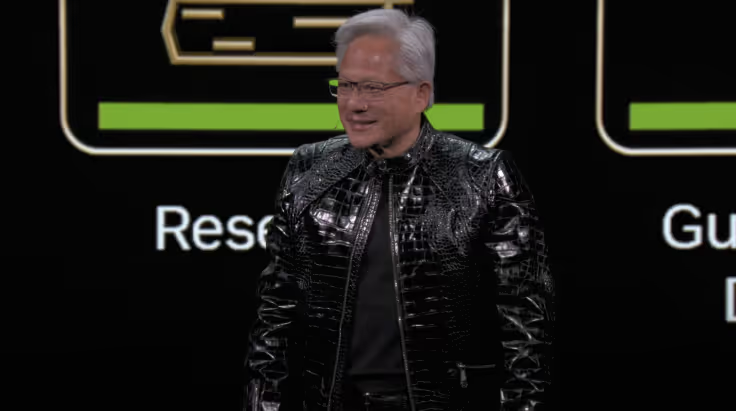
On January 5-7, 2026, NVIDIA founder and CEO Jensen Huang opened CES in Las Vegas with a comprehensive vision for physical AI that positions the company as the infrastructure provider for the robotics revolution.
Rubin Platform: The Next Generation
Huang unveiled Rubin, NVIDIA's first extreme-codesigned, six-chip AI platform now in full production. The successor to Blackwell combines one Vera CPU and two Rubin GPUs in a single processor, delivering transformative performance improvements. According to NVIDIA, Rubin provides a 4x reduction in the number of GPUs needed to train mixture-of-experts models versus Blackwell systems, and a 10x reduction in inference token costs. Products based on the Rubin platform will be available to partners in the second half of 2026.
The platform is framed as ideal for agentic AI, advanced reasoning models, and the next generation of autonomous systems requiring real-time decision-making across massive parameter spaces.
Alpamayo: Autonomous Driving's Foundation Model
NVIDIA released Alpamayo, an open portfolio of reasoning vision language action models, simulation blueprints, and datasets enabling Level 4-capable autonomy. At the core is Alpamayo 1, a 10 billion-parameter chain-of-thought reasoning model that allows autonomous vehicles to "think like a human" when making driving decisions.
The company released 1,700 hours of driving data alongside an open-source simulation framework, positioning the tools as the starter kit for Level 4 autonomy. NVIDIA confirmed partnerships with robotaxi operators planning to deploy fleets powered by NVIDIA's AI chips and Drive AV software stack as early as 2027.
Physical AI Models for Robotics
NVIDIA announced new Cosmos and Isaac GR00T open models for robot learning and reasoning. Cosmos Reason 2 is an open reasoning vision language model that enables intelligent machines to see, understand, and act in the physical world like humans. Isaac GR00T N1.6 is a vision language action model purpose-built for humanoid robots. Cosmos Predict 2.5 provides fully customizable world models that enable physics-based synthetic data generation and robot policy evaluation in simulation.
Huang emphasized the market opportunity: "There's no question in my mind now that this is going to be one of the largest robotics industries." Ali Kani, NVIDIA's automotive VP, added: "We believe physical AI and robotics will eventually be the largest consumer electronics segment in the world."
Business Impact
NVIDIA's CES announcements consolidate the company's position across the entire AI value chain—from training infrastructure to inference optimization to physical AI deployment. For enterprises, this represents both opportunity and risk: access to comprehensive, optimized toolchains for robotics and autonomous systems, but increasing dependency on a single platform provider. The open-source release of Alpamayo and Cosmos models signals NVIDIA's strategy to establish de facto standards in physical AI development.
2. xAI's $20 Billion Mega-Round Reshapes AI Funding Landscape

On January 6, 2026, Elon Musk's xAI completed a $20 billion Series E funding round, exceeding its initial $15 billion target and establishing the company as a fully capitalized competitor to OpenAI and Anthropic.
Investor Composition and Strategic Implications
The round included strategic investments from NVIDIA (reportedly up to $2 billion) and Cisco Investments, alongside traditional investors Valor Equity Partners, Stepstone Group, Fidelity, Baron Capital Group, and sovereign wealth funds Qatar Investment Authority and Abu Dhabi's MGX. The diverse investor base provides xAI with both technological partnerships and global distribution capabilities.
The financing structure includes approximately $7.5 billion in equity and up to $12.5 billion in debt through a special purpose vehicle designed to purchase NVIDIA processors. xAI will rent these chips for five years, allowing Wall Street financiers to recoup their investment while providing xAI with massive compute capacity without immediate capital outlay.
Compute Infrastructure and Product Roadmap
xAI continues expanding its decisive compute advantage through the world's largest AI supercomputers at Colossus I and II, ending 2025 with over one million H100 GPU equivalents. The new funding will accelerate infrastructure buildout and enable rapid development of transformative AI products reaching billions of users.
Grok 5 is currently in training, with xAI focused on launching innovative consumer and enterprise products. The company emphasized its "core mission: Understanding the Universe" through groundbreaking research advancing fundamental AI capabilities.
Market Positioning
At a $230 billion valuation, xAI now ranks among the most valuable private technology companies globally, placing it in direct competition with OpenAI's reported $1 trillion IPO target. The involvement of NVIDIA as both strategic investor and infrastructure partner creates competitive dynamics with NVIDIA's relationships with OpenAI, Anthropic, and other AI leaders.
3. OpenAI's "Code Red" and the Battle for ChatGPT Supremacy

OpenAI entered 2026 in emergency mode after Google's Gemini 3 captured market share and benchmark superiority throughout December 2025. On January 3, CEO Sam Altman sent an internal memo declaring "code red" and directing teams to pause other initiatives to focus exclusively on improving ChatGPT's speed, reliability, and personalization.
Competitive Pressure from Gemini 3
Google's November 18, 2025 launch of Gemini 3 fundamentally shifted competitive dynamics. Benchmark tests showed Gemini 3 surpassing ChatGPT across multiple dimensions, leading to a 6% customer loss for OpenAI—a significant erosion for a market leader. The competitive threat prompted OpenAI's fastest response since the company's founding.
Strategic Priorities
Altman outlined specific focus areas: improving model behavior to win preference on public benchmarks like LMArena, enhancing ChatGPT speed and reliability, reducing "overrefusals" where the model declines benign requests, and expanding the range of questions ChatGPT can successfully answer.
To resource these priorities, OpenAI delayed multiple initiatives including Pulse (a personal assistant product), advertising rollout, and specialized AI agents for health and shopping.
Historical Context and Timeline
Altman revealed this represents the latest in a series of "code red" declarations OpenAI has issued in response to competitive threats. "It's good to be paranoid and act quickly when a potential competitive threat emerges. My guess is we'll be doing these once maybe twice a year for a long time." He indicated code red periods typically last six to eight weeks, suggesting a potential January exit if ChatGPT improvements meet internal targets.
The situation mirrors Google's own "code red" when ChatGPT launched three years ago, threatening the core of Google Search. The role reversal demonstrates how quickly competitive dynamics shift in frontier AI development.
4. World Models: From Research to Commercial Reality
The first week of 2026 confirmed that world models—AI systems that learn internal simulations of how the physical world works—have moved from research curiosity to commercial deployment.
World Labs Launches Marble
Fei-Fei Li's World Labs, which emerged from stealth in November 2024 with $230 million in funding, launched Marble in November 2025 as the industry's first commercial world model. The platform enables users to turn text prompts, photos, videos, 3D layouts, or panoramas into editable, downloadable 3D environments through freemium and paid tiers.
According to Li, Marble represents "the first step toward creating a truly spatially intelligent world model." The technology targets gaming, robotics, virtual production, and eventually scientific simulation and medical applications where three-dimensional spatial understanding is critical.
Runway's GWM-1 Enters Production
Video AI company Runway released its first world model, GWM-1, in December 2025. Runway positions GWM-1 as more general than Google's Genie-3 and other competitors, capable of creating simulations to train agents across domains including robotics and life sciences. The model family includes first-person navigation through generated worlds, robotics-specific simulations, and conversational avatar characters.
Runway CTO Anastasis Germanidis emphasized the strategic importance: "World models are really the most important problem that we need to solve in order to further advance the field. The next stage will be about building systems that can interact with the physical world and understand the physical world. And text alone cannot get us there."
Broader Industry Momentum
The world models paradigm exploded into mainstream AI development in late 2025 and early 2026. Signs of continued momentum include Yann LeCun leaving Meta to start his own world model lab reportedly seeking a $5 billion valuation, Google DeepMind's continued development of Genie models for real-time interactive world generation, and NVIDIA's Cosmos Predict 2.5 enabling physics-based synthetic data generation.
5. Anthropic's Infrastructure Expansion and Multi-Cloud Strategy

Anthropic's October 2025 announcement of a landmark Google Cloud expansion continues to shape 2026 competitive dynamics. The deal provides Anthropic with access to up to one million Google Cloud TPU chips worth tens of billions of dollars, bringing well over one gigawatt of AI compute capacity online in 2026.
Scale and Strategic Rationale
The expansion represents Anthropic's largest TPU commitment yet, driven by the chips' price-performance efficiency and Anthropic's existing experience training and serving Claude models with TPUs. The company emphasized its diversified compute strategy across three chip platforms: Google's TPUs, Amazon's Trainium processors, and NVIDIA graphics processing units. This multi-cloud approach addresses capacity constraints while maintaining negotiating leverage across providers.
Competitive Positioning
Anthropic's infrastructure strategy contrasts with competitors pursuing single-vendor relationships. While OpenAI remains primarily dependent on Microsoft Azure and NVIDIA GPUs, Anthropic's platform diversification reduces supply risk and prevents vendor lock-in. The company has stated it's "optimizing for survival, not spectacle," suggesting a focus on sustainable economics rather than headline-grabbing compute scale.
Model Context Protocol Momentum
Anthropic's Model Context Protocol, described as "USB-C for AI," continues gaining adoption as the standard for connecting AI agents to external tools. Following Anthropic's donation of MCP to the Linux Foundation's Agentic AI Foundation in December 2025, both OpenAI and Microsoft publicly embraced the protocol. Google has begun standing up managed MCP servers to connect AI agents to its products and services. With MCP reducing integration friction, 2026 is positioned to be the year agentic workflows move from demos into daily practice.
Quick Bytes
- AMD at CES 2026: Announced ROCm 7.2 software and expanded on-device AI compute with Ryzen AI Max+ processors supporting models up to 128 billion parameters with 128GB unified memory.
- Lenovo Qira: Launched at CES 2026 as personal ambient intelligence designed to work seamlessly across Lenovo and Motorola devices, representing a new approach to cross-device AI experiences.
- AI Regulation Battle: President Trump's December 11 executive order challenges state AI laws effective January 1, 2026, creating uncertainty around California's Transparency in Frontier AI Act and Texas's Responsible AI Governance Act.
- Healthcare AI Gains: Vi's 2026 State of AI reports show early adopters achieving 10-20% higher scheduling response, 20-50% no-show reduction, and 30-40% documentation improvements.
Industry Impact Analysis
The first week of 2026 reveals three critical trends shaping enterprise AI strategy:
Physical AI Emerges as the Next Platform
NVIDIA's comprehensive CES announcements, combined with commercial world model deployments, signal that AI is moving beyond language understanding into physical interaction. Organizations must now evaluate how autonomous systems, robotics, and spatial intelligence apply to their operations—from warehouse automation and autonomous logistics to virtual design environments and digital twin simulations.
Compute Infrastructure Becomes Competitive Advantage
xAI's $20 billion raise and Anthropic's multi-cloud strategy demonstrate that access to massive compute capacity increasingly differentiates winners from followers. Enterprises face strategic decisions: build relationships with multiple AI providers to ensure capacity access, or commit deeply to single platforms for integration advantages while accepting vendor lock-in risk.
Speed and Reliability Eclipse Raw Capability
OpenAI's "code red" focus on ChatGPT speed, reliability, and reduced overrefusals indicates the market has shifted from "what can AI do?" to "how well does AI do it consistently?" As model capabilities approach parity at the frontier, competitive advantages accrue to providers delivering superior user experience, operational reliability, and seamless integration.
Looking Ahead
The transition from 2025 to 2026 marks AI's evolution from language mastery to physical understanding. The technologies announced this week—autonomous vehicle reasoning models, robotics foundation models, commercial world models, and multi-gigawatt compute infrastructures—establish the foundation for AI systems that operate in and understand the physical world.
For enterprises, 2026 requires expanding AI strategy beyond language models and chatbots to encompass physical AI applications, multi-modal reasoning systems, and real-world autonomous capabilities. Success depends on building teams with expertise spanning traditional AI/ML, robotics, simulation, and physical systems integration.
Azumo provides end-to-end AI implementation expertise spanning language models, computer vision, robotics integration, and physical AI systems, helping enterprises navigate the complexity of next-generation AI deployment through proven methodologies, deep technical capabilities, and strategic guidance that transforms cutting-edge research into measurable business value.
Sources
- AI 2026 trends: bubbles, agents, demand for ROI - Axios, January 1, 2026
- What's next for AI in 2026 - MIT Technology Review, January 5, 2026
- In 2026, AI will move from hype to pragmatism - TechCrunch, January 2, 2026
- NVIDIA Rubin Platform, Open Models, Autonomous Driving: NVIDIA Presents Blueprint for the Future at CES - NVIDIA Blog, January 5, 2026
- NVIDIA Releases New Physical AI Models as Global Partners Unveil Next-Generation Robots - NVIDIA Newsroom, January 5, 2026
- Nvidia CES 2026: Jensen Huang says "ChatGPT moment for physical AI" is coming - Axios, January 5, 2026
- Nvidia launches Alpamayo, open AI models that allow autonomous vehicles to 'think like a human' - TechCrunch, January 5, 2026
- Introducing Lenovo and Motorola Qira, a Personal Ambient Intelligence Designed to Work Across Devices - Lenovo StoryHub, January 6, 2026
- AMD Expands AI Leadership Across Client, Graphics, and Software - AMD, January 5, 2026
- xAI Raises $20B Series E - xAI, January 6, 2026
- Elon Musk's xAI raises $20 billion from investors including Nvidia, Cisco, Fidelity - CNBC, January 6, 2026
- xAI says it raised $20B in Series E funding - TechCrunch, January 6, 2026
- OpenAI CEO Sam Altman declares 'code red' as ChatGPT competition mounts - Yahoo Finance, January 3, 2026
- Inside OpenAI's fragile lead in the AI race, and the 8-week 'code red' to fend off a resurgent Google - Fortune, December 17, 2025
- Sam Altman declares 'Code Red' as Google's Gemini surges - Fortune, December 2, 2025
- Fei-Fei Li's World Labs speeds up the world model race with Marble - TechCrunch, November 12, 2025
- Runway releases its first world model, adds native audio to latest video model - TechCrunch, December 11, 2025
- Why is everyone in AI talking about world models? - Tech Brew, December 18, 2025
- Expanding our use of Google Cloud TPUs and Services - Anthropic, October 23, 2025
- Anthropic to Expand Use of Google Cloud TPUs and Services - Google Cloud, October 23, 2025
- New State AI Laws are Effective on January 1, 2026, But a New Executive Order Signals Disruption - King & Spalding, January 2026
- Vi Releases 2026 State of AI Reports - Yahoo Finance, January 2026
This AI Intelligence Brief is generated by Azumo's AI research team to help enterprise leaders stay informed about developments that impact business strategy and technology roadmaps.