
.svg)


AI Moves Beyond Chatbots: Autonomy, Emotion, and Scaling Risks
January 29, 2026
Executive Summary
The AI community witnessed one of its most explosive open-source phenomena this week when Clawdbot—a personal AI assistant project—rocketed from 5,000 to over 80,000 GitHub stars in just days, only to be forced into rebranding as Moltbot following Anthropic's trademark concerns. The project's viral success caused Mac Mini shortages overnight and sparked a new wave of enthusiasm around autonomous AI agents that can work 24/7 on real-world tasks. Meanwhile, Google DeepMind made strategic moves in emotional AI, Chinese tech giants accelerated their AI model rollouts, and Stanford researchers exposed significant copyright vulnerabilities in production language models.
Top AI Developments
1. Clawdbot's Meteoric Rise and Transformation into Moltbot
The open-source AI assistant project Clawdbot experienced one of the fastest growth trajectories in GitHub history this week, jumping from 5,000 to over 80,000 stars within days before undergoing a forced name change to Moltbot on January 27. Created by developer Peter Steinberger as a self-described "hobby project" in late 2025, the tool went viral throughout Silicon Valley communities for its ability to function as an autonomous personal assistant running 24/7 on local hardware.
What Sparked the Frenzy: The project captured developers' imagination by delivering on the promise of a "personal AI employee" that actually works. Users shared viral stories of the bot autonomously negotiating car purchases, automating 40-hour work weeks, managing email inboxes, and booking travel—all with minimal human intervention. The enthusiasm was so intense that Mac Mini sales spiked overnight, with developers ordering multiple units to run their own instances. Even Google AI Studio head Logan Kilpatrick publicly shared that he'd ordered one.
The Name Change Drama: On January 27, Anthropic reached out to Steinberger regarding the phonetic similarity between "Clawdbot" (and its mascot "Clawd") and their Claude AI assistant, citing trademark concerns. While Steinberger's public messaging remained positive, he was candid on social media: "I was forced to rename the account by Anthropic. Wasn't my decision." The project is now Moltbot, with the creator explaining that "molt fits perfectly—it's what lobsters do to grow." The space lobster mascot, previously named Clawd, is now Molty.
The Crypto Chaos: During the critical window when Steinberger released the old handles to claim the new ones, crypto scammers hijacked both the GitHub and Twitter accounts in approximately 10 seconds, using them to promote a fake $CLAWD token and causing financial losses to unsuspecting community members before the accounts were recovered.
Why It Matters: Moltbot represents the convergence of several trends—local-first AI, open-source accessibility, and the growing demand for practical autonomous agents. Unlike cloud-based assistants with usage limits and privacy concerns, Moltbot runs entirely on your own hardware, giving users complete control. The project's explosive growth demonstrates that the developer community is hungry for AI tools that move beyond chatbots to genuine task automation, even if they require technical setup.
2. Google DeepMind Acquires Hume AI Team for Emotional Intelligence Push

Google DeepMind struck a licensing deal this week to hire Hume AI's CEO and engineering team, bringing advanced emotional intelligence and empathetic voice capabilities to the Gemini platform. Hume AI, which expects $100 million in revenue for 2026, specializes in models that understand and respond to human emotional states through voice analysis and conversational context.
Strategic Implications: This acquisition signals Google's recognition that future AI assistants need emotional intelligence, not just task competence. As AI agents become more autonomous and handle increasingly complex human interactions, the ability to detect frustration, confusion, or satisfaction becomes critical for user experience. Integrating Hume's capabilities could give Gemini a significant advantage in customer service, mental health support, and educational applications where emotional context drives outcomes.
3. Chinese AI Companies Accelerate Model Rollouts Post-DeepSeek
One year after DeepSeek's breakthrough models demonstrated Chinese AI competitiveness, companies from Alibaba to Moonshot are racing to release new AI models with integrated commercial capabilities. Alibaba updated its Qwen AI app to enable users to shop, order food, and make payments without leaving the platform, leveraging integration with Chinese e-commerce ecosystems. Qwen now claims over 100 million monthly active users.
Strategic Implications: Chinese AI development is following a distinctly different path than Western counterparts—prioritizing integrated super-app experiences over standalone AI tools. By embedding AI deeply within commerce, payments, and services platforms, Chinese companies are building moats that Western AI labs cannot easily replicate. This approach also generates proprietary datasets from real transactions, creating a feedback loop that could accelerate commercial AI capabilities.
4. Stanford Researchers Expose Copyright Vulnerabilities in Production LLMs
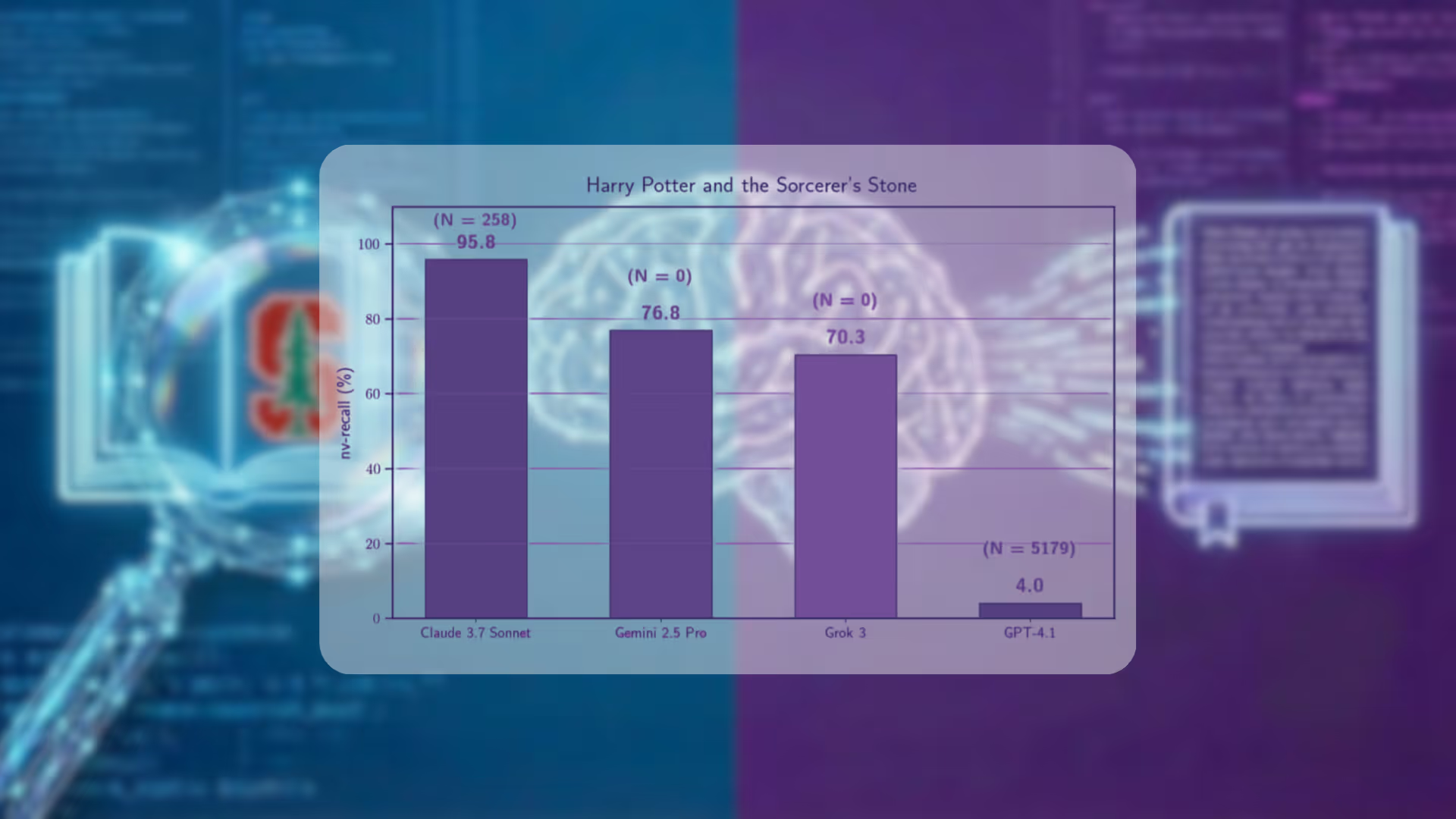
Stanford researchers published findings this week demonstrating they could extract large portions of copyrighted books from multiple production language models. The research showed Claude 3.7 Sonnet reproducing 95.8% of "Harry Potter and the Sorcerer's Stone" nearly verbatim when prompted with specific techniques, raising significant legal and ethical concerns about training data memorization.
Strategic Implications: This research intensifies ongoing debates about AI training practices, copyright law, and fair use. While AI companies have argued that training on copyrighted material constitutes transformative fair use, the ability to extract near-complete works suggests models are memorizing rather than learning abstract patterns. Expect this to fuel both litigation and regulatory scrutiny, potentially forcing architectural changes to prevent memorization or more restrictive training data curation.
5. Cursor Shares Insights from Running Hundreds of Concurrent AI Coding Agents

The AI-powered code editor Cursor shared technical insights this week from running hundreds of concurrent AI agents on single projects, including building a complete web browser from scratch with over 1 million lines of code. The company noted that for extended autonomous tasks spanning multiple hours, GPT-5.2 currently outperforms Anthropic's Opus 4.5, though both models enable previously impossible levels of code generation at scale.
Strategic Implications: As autonomous coding agents mature, the bottleneck shifts from "can AI write code?" to "how do we orchestrate hundreds of agents working simultaneously without conflicts?" Cursor's experience suggests that successful agentic coding requires sophisticated orchestration layers, conflict resolution systems, and model selection strategies that match capabilities to task complexity. Companies building on agentic coding platforms will need new development paradigms that assume AI generates the majority of code while humans focus on architecture and quality assurance.
Quick Bytes
NVIDIA Retail AI Adoption Surges: NVIDIA's latest State of AI in Retail survey finds 58% of companies actively deploying AI, up sharply from the prior year, with 67% of senior marketing leaders expecting high levels of AI-driven disruption to consumer behavior in 2026.
Samsung Doubles Down on Galaxy AI: Samsung announced plans to double the number of mobile devices with Galaxy AI features from approximately 400 million to 800 million units in 2026, signaling massive consumer AI deployment.
Meta Superintelligence Labs Delivers First Models: Meta CTO Andrew Bosworth confirmed at the World Economic Forum that the company's Meta Superintelligence Labs team delivered its first high-profile AI models internally in January 2026, though details remain under wraps.
Fake Clawdbot Malware Warning: Security researchers at Aikido discovered fake Clawdbot VS Code extensions installing ScreenConnect remote access trojans, exploiting the project's viral popularity for malware distribution. Users should only install from official repositories.
Industry Impact Analysis
The Clawdbot/Moltbot phenomenon reveals a critical gap in the current AI landscape: while enterprise AI focuses on incremental productivity gains and cloud-based assistants, developers are building open-source alternatives that deliver genuine autonomy and local control. The project's explosive growth demonstrates that technical users will tolerate complex setup processes if the payoff is an AI that truly works independently.
For enterprises, Moltbot's success offers several lessons:
- Local-First AI Has Strategic Value: Running AI on owned hardware eliminates data privacy concerns, usage costs, and vendor dependencies—particularly valuable for sensitive workflows.
- Autonomy Requires New Interaction Patterns: Moltbot's appeal lies in its ability to work while users sleep, not just respond to prompts. Enterprise AI strategies should prioritize autonomous task completion over conversational interfaces.
- Open Source Accelerates Adoption: Despite trademark conflicts and security incidents, Moltbot's MIT license and transparency built community trust faster than any marketing campaign could achieve.
- The "AI Employee" Frame Resonates: Positioning AI as a "24/7 employee" rather than a "tool" or "assistant" changes user expectations and drives adoption among those seeking genuine automation.
The emotional intelligence acquisition by Google and the copyright vulnerability research from Stanford both point to maturing concerns in AI deployment—moving beyond raw capabilities to address human interaction quality and legal compliance. Companies that navigate these challenges while delivering Moltbot-level autonomy will define the next phase of practical AI.
Azumo's AI Implementation Expertise
As AI moves from chatbots to autonomous agents, enterprises need partners who understand both the technical architecture and the organizational change required for successful deployment. Azumo brings deep expertise in building production AI systems that combine local and cloud capabilities, implement robust security and compliance frameworks, and deliver measurable ROI.
Whether you're exploring autonomous agent architectures, building domain-specific AI capabilities, or navigating the shift from experimentation to scaled production, Azumo's engineering teams deliver solutions that work in the real world, not just in demos.
Sources
- Everything you need to know about viral personal AI assistant Clawdbot, now Moltbot - TechCrunch, January 27, 2026
- Clawdbot Rebrands to Moltbot After Trademark Request from Anthropic - Laravel News, January 27, 2026
- Why viral AI assistant Clawdbot was forced to become Moltbot - Business Today, January 28, 2026
- From Clawdbot to Moltbot: How a C&D, Crypto Scammers, and 10 Seconds of Chaos Took Down the Internet's Hottest AI Project - DEV Community, January 2026
- Clawdbot: The AI Assistant That's Breaking the Internet - DEV Community, January 2026
- Viral ClawdBot in Silicon Valley Drives Massive Mac Mini Sales - 36Kr, January 2026
- Fake Clawdbot VS Code Extension Installs ScreenConnect RAT - Aikido Security, January 2026
- Last Week in AI — January 19–26, 2026 - Medium, January 2026
- One year after DeepSeek, Chinese AI firms from Alibaba to Moonshot race to release new models - CNBC, January 28, 2026
- Moltbot (Formerly Clawdbot): The 24/7 AI Employee That Works While You Sleep - Medium, January 2026
This AI Intelligence Brief is generated by Azumo's AI research team to help enterprise leaders stay informed about developments that impact business strategy and technology roadmaps.