
.svg)


OpenAI vs. Anthropic In Healthcare + NVIDIA's Robotics Play: What It Means For Leaders
Executive Summary
The first two weeks of 2026 have delivered a decisive shift from AI experimentation to enterprise production. OpenAI and Anthropic launched competing healthcare platforms, NVIDIA unveiled its physical AI ecosystem at CES, and DeepSeek's open-source R1 model demonstrated that world-class reasoning capabilities no longer require massive budgets. Meanwhile, enterprises are discovering that agentic AI success depends less on model selection and more on fundamental process redesign—a reality forcing organizations to rethink not just their technology stack, but their entire approach to automation.
Top AI Developments
1. Healthcare AI Race Accelerates as OpenAI and Anthropic Launch Medical Platforms
Both AI giants entered healthcare within 48 hours, with OpenAI launching ChatGPT Health on January 7 and Anthropic unveiling Claude for Healthcare on January 8. OpenAI reports that 230 million users ask health questions weekly on ChatGPT, while both platforms now enable secure medical record integration with strict data isolation guarantees.
Strategic Implications: The simultaneous healthcare push signals AI leaders targeting regulated industries where trust and compliance create natural moats. Both companies emphasize that health data remains isolated from model training—a critical requirement for HIPAA compliance. OpenAI's API platform also launched support for GPT-5.2 in healthcare systems, enabling developers to embed AI directly into clinical workflows.
2. NVIDIA Positions Physical AI as "The ChatGPT Moment for Robotics"
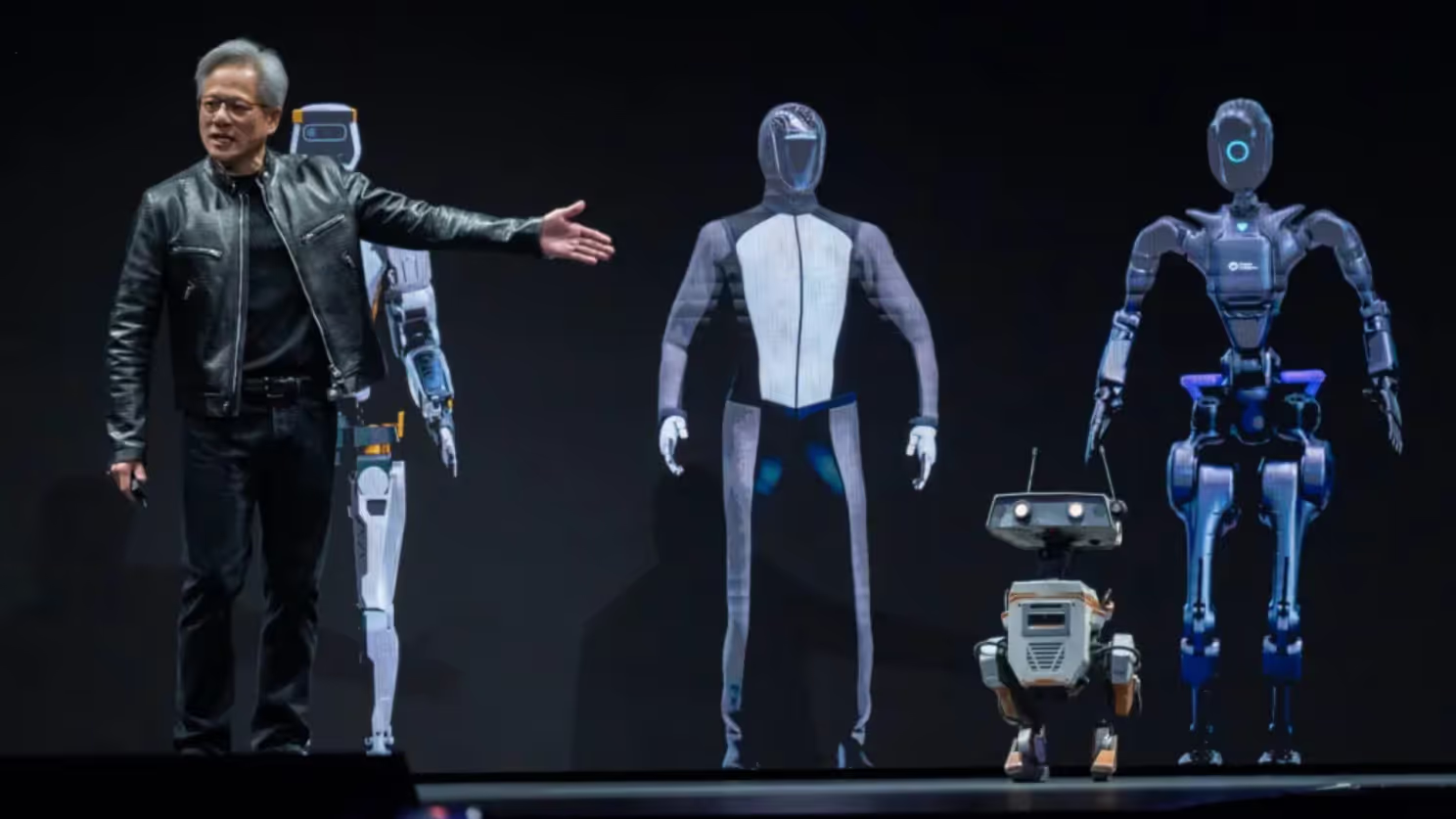
At CES 2026 on January 5, NVIDIA unveiled its Cosmos platform featuring open world models for robot training, the Isaac GR00T N1.6 vision-language-action model for humanoid robots, and the Blackwell-powered Jetson T4000 delivering 4x energy efficiency gains. Global partners including Boston Dynamics, Caterpillar, and LG Electronics debuted robots built on NVIDIA's stack.
Strategic Implications: NVIDIA aims to become the Android of robotics—the default platform for generalist physical AI. The company's strategy combines open models (lowering barriers to entry), world models for simulation-based training (reducing real-world data requirements), and standardized hardware (accelerating deployment). The Siemens partnership to build fully AI-driven manufacturing sites starting with their Erlangen facility in 2026 demonstrates enterprise readiness beyond pilot programs.
3. DeepSeek R1 Disrupts AI Economics with Open-Source Reasoning
Released January 20, 2025, DeepSeek's R1 model achieved OpenAI o1-level reasoning performance while costing approximately 95% less to train and deploy. The 671-billion parameter model with Mixture of Experts architecture activates only 37 billion parameters per forward pass, and the fully open-source release under MIT license permits commercial use and model distillation.
Strategic Implications: DeepSeek R1 represents a fundamental shift in AI economics and accessibility. By demonstrating that reasoning capabilities can emerge purely through reinforcement learning without supervised fine-tuning, the research validates alternative training approaches that dramatically reduce costs. Enterprises now have access to frontier reasoning capabilities without vendor lock-in, accelerating experimentation with agentic workflows that previously required expensive API access to closed models.
4. Enterprise AI Agents Hit the Production Gap
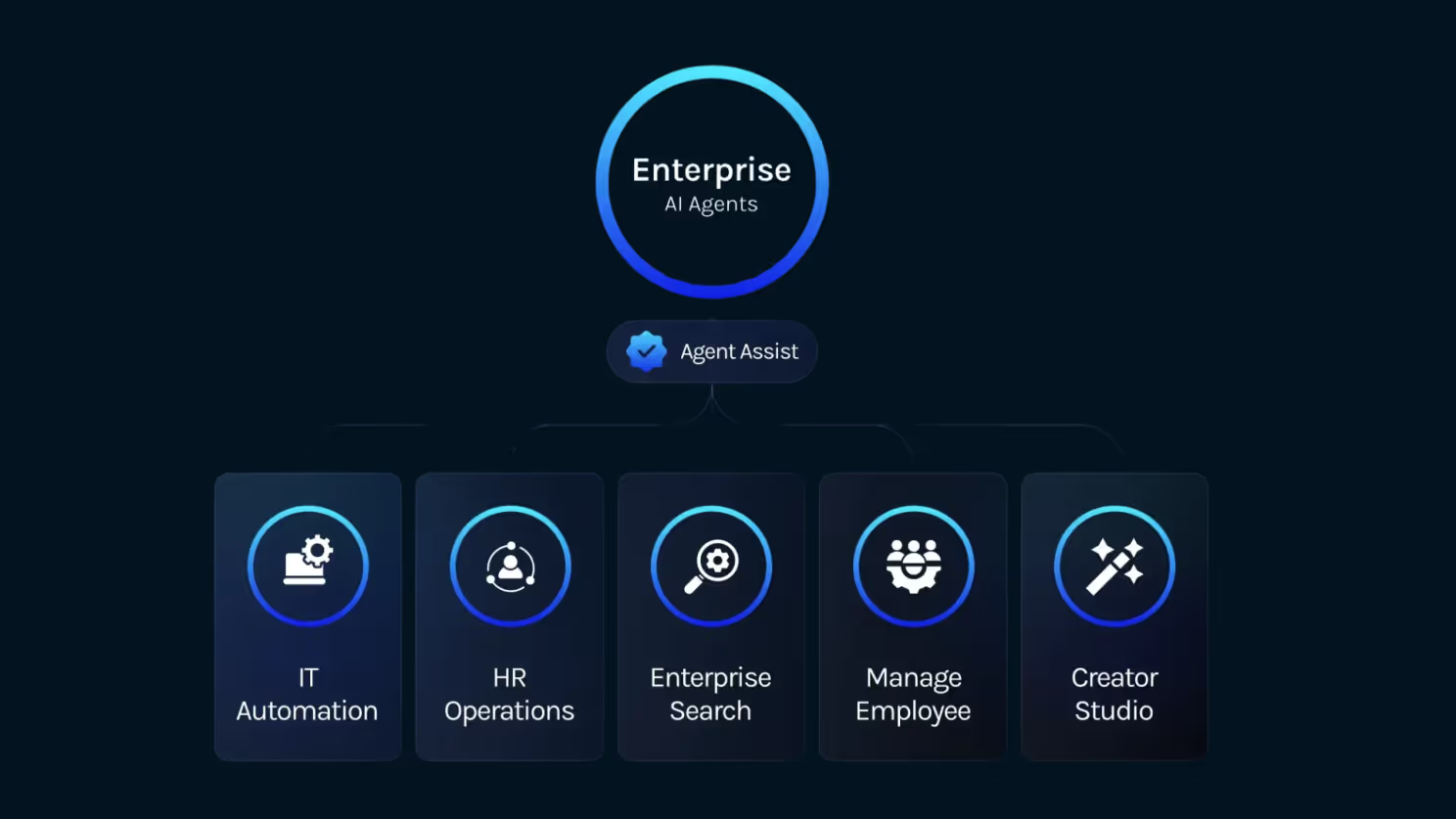
Multiple reports confirm that while nearly two-thirds of enterprises are experimenting with AI agents, fewer than one in four have successfully scaled to production. Deloitte's 2026 Tech Trends identifies "agentic AI strategy" as the defining challenge, while Google Cloud's AI agent trends report emphasizes that true value requires process redesign, not automation of existing workflows.
Strategic Implications: The 2026 inflection point isn't about which models top benchmarks—it's about bridging the gap from experimentation to scaled production. Leading organizations are implementing bounded autonomy frameworks, multi-agent orchestration systems, and agentic operating systems that standardize governance across agent swarms. Anthropic's partnership with Allianz, announced January 9, exemplifies this shift by deploying Claude Code enterprise-wide and building custom agents for multi-step insurance workflows.
5. Small Language Models Emerge as Enterprise AI Pragmatism
AT&T's partnership with Mistral AI demonstrates that fine-tuned small language models (SLMs) achieve 90% cost reduction compared to frontier models while delivering superior accuracy for specific tasks. The SLM market, valued at $930 million in 2025, is projected to reach $5.45 billion by 2032 with a 28.7% CAGR as enterprises prioritize ROI over capability maximalism.
Strategic Implications: The shift to SLMs reflects enterprise pragmatism—deploying specialized models for high-volume, repeatable tasks while reserving frontier models for complex reasoning. SLMs utilizing techniques like Sliding Window Attention handle context windows up to 128,000 tokens with 100x lower cost-per-token than frontier models. This economics enables enterprises to embed AI deeply into operational workflows without prohibitive API costs.
Quick Bytes
World Labs Showcases Marble at CES 2026: Fei-Fei Li demonstrated her spatial intelligence platform with AMD CEO Lisa Su on January 7, highlighting progress in persistent 3D world generation from text, images, or video inputs.
Model Context Protocol Gains Traction: Anthropic's MCP, described as "USB-C for AI," now has adoption from OpenAI, Microsoft, and Google, enabling AI agents to communicate with external tools through a standardized interface donated to the Linux Foundation's Agentic AI Foundation.
Lenovo and NVIDIA Launch Gigawatt AI Cloud Factory: The partnership announced at CES accelerates hybrid AI adoption across personal, enterprise, and public AI platforms through gigawatt-scale infrastructure.
Industry Impact Analysis
The convergence of open-source reasoning models, standardized agent protocols, and domain-specific healthcare platforms signals that 2026's competitive advantage will derive from implementation expertise, not model access. Enterprises that succeed will be those that:
- Redesign processes for agent-first workflows rather than automating existing inefficiencies
- Implement governance frameworks for bounded autonomy and multi-agent orchestration
- Adopt hybrid model strategies combining SLMs for high-volume tasks with frontier models for complex reasoning
- Build on open standards like Model Context Protocol to avoid vendor lock-in
- Prioritize regulated industries where trust and compliance create natural competitive moats
The healthcare launches from OpenAI and Anthropic demonstrate this pattern—both companies are betting that technical capabilities must be matched with regulatory expertise and trust infrastructure to win enterprise deployments.
Azumo's AI Implementation Expertise
As enterprises navigate the shift from AI experimentation to production systems, Azumo brings deep implementation expertise across the full AI lifecycle—from architecture design and model selection to agentic workflow orchestration and compliance frameworks. Our teams have delivered production AI systems for Fortune 500 enterprises across healthcare, financial services, and manufacturing, combining technical depth with industry-specific domain expertise.
Whether you're deploying multi-agent systems, building domain-specific SLMs, or integrating AI into regulated workflows, Azumo's engineering teams deliver production-ready solutions that drive measurable business outcomes.
Sources
- AI 2026 trends: bubbles, agents, demand for ROI - Axios, January 1, 2026
- In 2026, AI will move from hype to pragmatism - TechCrunch, January 2, 2026
- Anthropic's 'do more with less' bet has kept it at the AI frontier - CNBC, January 3, 2026
- NVIDIA Releases New Physical AI Models as Global Partners Unveil Next-Generation Robots - NVIDIA Newsroom, January 5, 2026
- What's next for AI in 2026 - MIT Technology Review, January 5, 2026
- Siemens unveils technologies to accelerate the industrial AI revolution at CES 2026 - Siemens Press, January 2026
- OpenAI unveils ChatGPT Health - TechCrunch, January 7, 2026
- Anthropic Launches Claude AI for Healthcare - The Hacker News, January 2026
- Introducing ChatGPT Health - OpenAI, January 8, 2026
- Anthropic adds Allianz to growing list of enterprise wins - TechCrunch, January 9, 2026
- DeepSeek-R1 Release - DeepSeek API Docs, January 20, 2025
- Nvidia wants to be the Android of generalist robotics - TechCrunch, January 5, 2026
- 5 Key Trends Shaping Agentic Development in 2026 - The New Stack, 2026
- Agentic AI strategy - Deloitte Insights, 2026
- AI agent trends 2026 report - Google Cloud, 2026
- The Rise of the 'Surgical' AI: How AT&T and Mistral are Leading the Enterprise Shift to Small Language Models - TokenRing, January 5, 2026
- AI-Powered Marble Platform Showcased at CES 2026 Keynote - AI News, January 7, 2026
- Lenovo Teams with NVIDIA on Gigawatt AI Factories Program - Lenovo StoryHub, January 2026
This AI Intelligence Brief is generated by Azumo's AI research team to help enterprise leaders stay informed about developments that impact business strategy and technology roadmaps.