
.svg)


Sonnet 4.6 at One-Fifth the Cost, Qwen3.5 Open-Weight, OpenAI Nears $850B
February 19, 2026
Executive Summary
Capital markets and model competition both made headlines this week. Anthropic closed a $30 billion Series G at a $380 billion valuation, then followed up two days later with Claude Sonnet 4.6—a mid-tier model delivering near-Opus performance at one-fifth the cost with a 1M token context window. OpenAI is finalizing a $100 billion round that could value the company at over $850 billion. On the model front, Alibaba's Qwen3.5 landed as a capable open-weight challenger, Meta and NVIDIA formalized a multigenerational infrastructure partnership worth tens of billions, and World Labs raised $1 billion to advance spatial intelligence.
Top AI Developments
Anthropic Closes $30 Billion Series G at $380 Billion Valuation

On February 12, Anthropic announced a $30 billion Series G round, doubling its valuation from $183 billion to $380 billion. The round was led by GIC and Coatue, with co-leads including D.E. Shaw Ventures, Dragoneer, Founders Fund, ICONIQ, and MGX. Nvidia, BlackRock, Goldman Sachs, JPMorgan Chase, and Sequoia Capital also participated.
Underlying the raise are strong operating metrics: Anthropic reports $14 billion in annualized revenue—up from $1 billion at the end of 2024—growing over 10x each year for three consecutive years. Claude Code, its AI coding agent, alone carries a $2.5 billion run-rate and has more than doubled since the start of 2026. Enterprise subscriptions to Claude Code have quadrupled this year, with eight Fortune 10 companies now among Claude's customers.
Business Impact: The funding gives Anthropic the capital to compete aggressively on infrastructure and frontier research. For enterprise buyers, the valuation and revenue trajectory signal a company with the staying power to support long-term AI deployment commitments.
Anthropic Launches Claude Sonnet 4.6 with 1M Token Context Window

Two days after closing its Series G, Anthropic released Claude Sonnet 4.6 on February 17—its most capable mid-tier model to date. The release doubles the context window to 1 million tokens (in beta), enabling processing of entire codebases, lengthy contracts, or dozens of research papers in a single request. Key improvements span coding, computer use, long-context reasoning, agent planning, and instruction following.
In early testing, users preferred Sonnet 4.6 over its predecessor roughly 70% of the time. More notably, it was preferred over Anthropic's flagship Opus 4.5 (November 2025) in 59% of evaluations—delivering near-Opus intelligence at one-fifth the cost ($3/$15 per million tokens vs. $15/$75 for Opus). The model also shows major gains in prompt injection resistance and reduced hallucination rates. Sonnet 4.6 is now the default model for Free and Pro users on claude.ai and is available across the API, Claude Code, and major cloud platforms.
Business Impact: The ability to get Opus-class performance at Sonnet pricing fundamentally changes the cost calculus for enterprise AI deployments. Combined with the 1M token context window, Sonnet 4.6 makes previously cost-prohibitive use cases—such as full-codebase analysis or large document processing—economically viable at scale.
OpenAI Nears $100 Billion Funding Round at $850 Billion Valuation
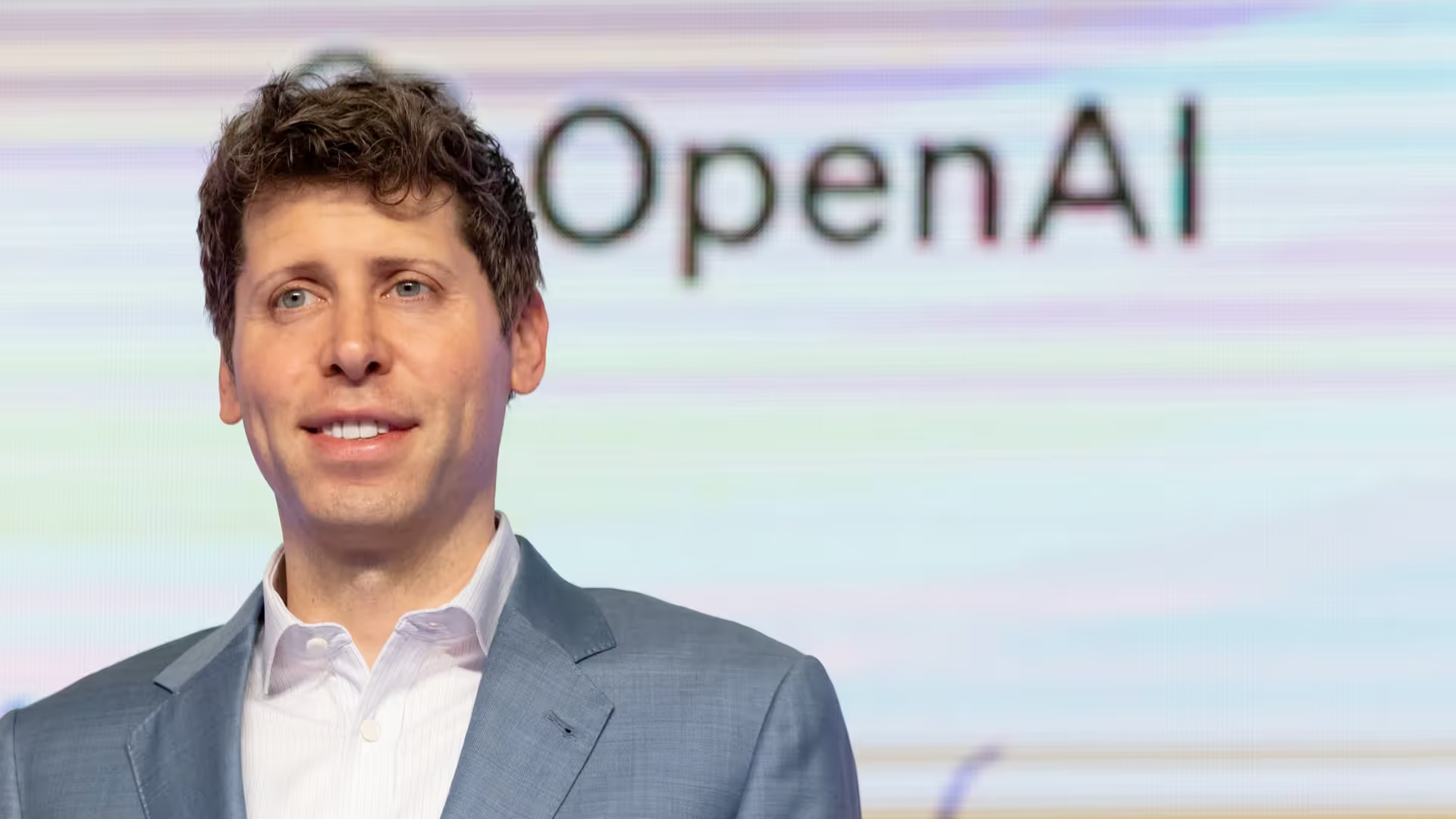
Bloomberg reported on February 19 that OpenAI is finalizing the first phase of a funding round expected to exceed $100 billion, with a pre-money valuation of $730 billion and post-money potentially surpassing $850 billion. Key investors include Amazon (up to $50 billion), SoftBank ($30 billion), Nvidia ($20 billion), and Microsoft. A second phase targeting venture funds and sovereign wealth vehicles is expected to close later, potentially raising the total substantially higher.
Business Impact: At $850 billion, OpenAI would be one of the most valuable private companies ever. The scale of the round—anchored by cloud and chip infrastructure partners—reflects a strategic bet that AI compute and platform demand will remain structurally high for years. Enterprises should read this as confirmation that the core model providers are not going away, and that multi-year AI platform decisions are relatively low vendor-risk.
OpenAI Hires OpenClaw Creator Peter Steinberger to Lead Agent Development
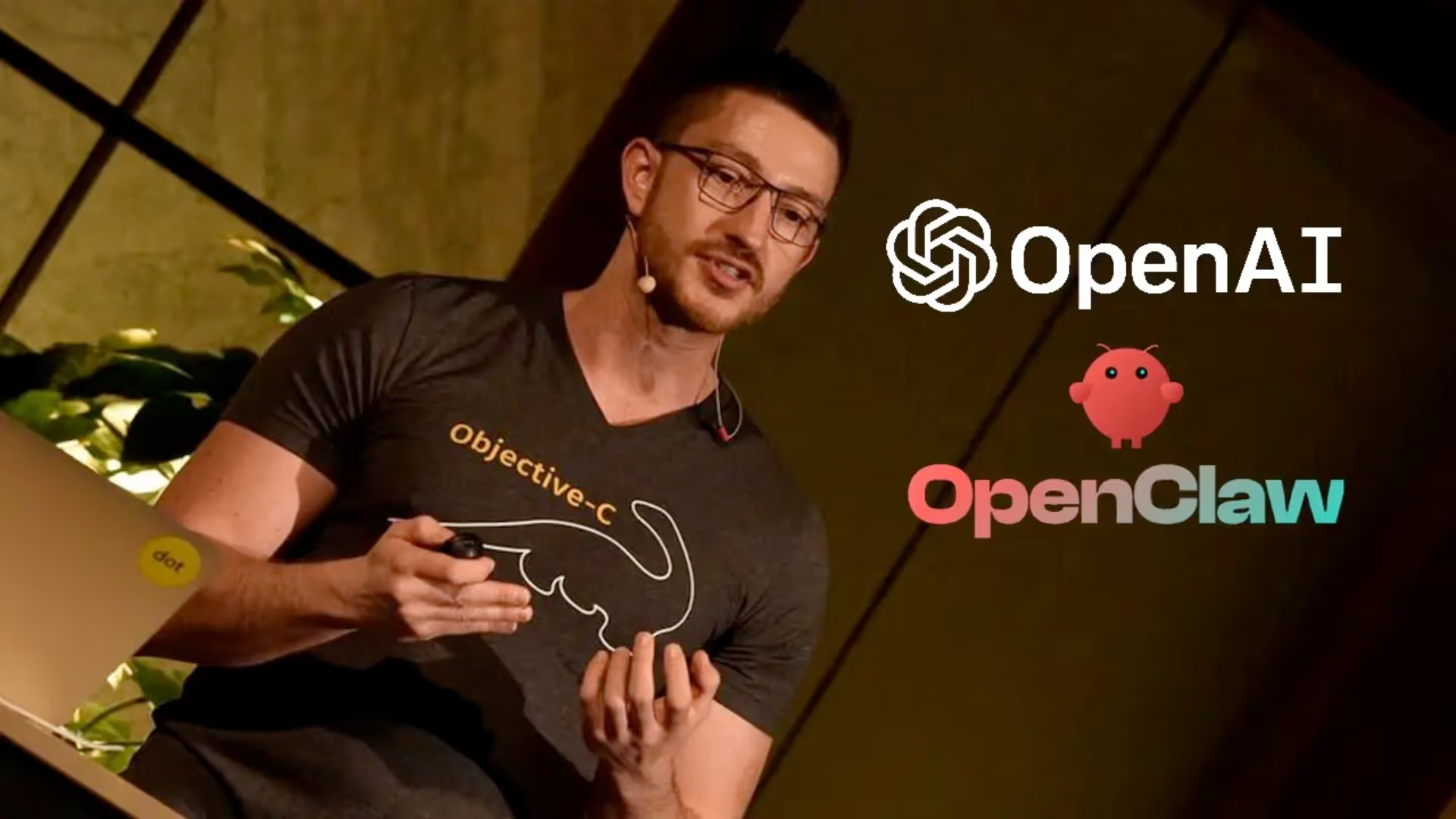
On February 15, OpenAI CEO Sam Altman announced that Peter Steinberger, creator of the viral open-source AI assistant OpenClaw, is joining the company to drive next-generation personal agent development. Altman called Steinberger "a genius with a lot of amazing ideas about the future of very smart agents interacting with each other."
OpenClaw—an agentic AI framework that enables agents to execute commands, interact with external services, and operate with broad system-level permissions—attracted tens of thousands of developers and surged in GitHub stars since its January debut. The project went viral after users created Moltbook, a social network populated entirely by AI agents. The deal is a talent hire, not an acquisition: OpenClaw will move to an independent foundation with OpenAI sponsorship, remaining open-source and multi-model compatible. Steinberger chose OpenAI over competing offers because they agreed to keep the project open-source—his non-negotiable condition.
Business Impact: The hire signals OpenAI's strategic pivot toward agentic AI as the next platform layer beyond chat. For enterprises building agent-based workflows, OpenAI's investment in open-source agent infrastructure suggests the agentic ecosystem will remain interoperable rather than locked to a single provider.
Alibaba Qwen3.5: Open-Weight Agentic AI at 60% Lower Cost
Alibaba released Qwen3.5 on February 16, a 397-billion parameter mixture-of-experts model with full multimodal capabilities and native agentic features. The model activates 17 billion parameters per prompt, supports 201 languages and dialects, and processes 1 million tokens for approximately $0.18. Alibaba claims it runs 8x more throughput at 60% lower cost compared to the previous generation.
Benchmark claims—self-reported by Alibaba—show outperformance against GPT-5.2, Claude Opus 4.5, and Gemini 3 Pro across 80% of evaluated tasks. The open-weight version ships under Apache 2.0, making it deployable on private infrastructure, while a hosted Qwen 3.5-Plus variant runs on Alibaba Cloud. Visual agentic capabilities allow the model to autonomously navigate mobile and desktop UIs without user intervention.
Business Impact: For enterprises running inference on sensitive or regulated workloads, Qwen3.5 provides a frontier-class option with no API dependency or per-token licensing cost. The cost and throughput figures are significant for production-scale deployments where inference economics directly affect margins.
Meta and NVIDIA Sign Multigenerational Infrastructure Partnership
On February 17, Meta and NVIDIA announced a multiyear strategic partnership spanning training, inference, and on-premises infrastructure. The deal includes millions of NVIDIA Blackwell and Rubin GPUs, NVIDIA Spectrum-X Ethernet switches, and—most notably—the first large-scale deployment of NVIDIA Grace CPUs as standalone chips. Meta is already running Grace CPU-only servers for agentic AI workloads that do not require a GPU, reporting up to 2x performance-per-watt improvement for relevant back-end workloads.
Meta plans to spend up to $135 billion on AI infrastructure in 2026, and the NVIDIA partnership is expected to represent tens of billions of that total across multiple generations of hardware.
Business Impact: The move to CPU-only NVIDIA Grace deployments for agentic inference is an important data point for enterprise architects. It signals that the next wave of AI infrastructure is not monolithic GPU clusters—it is a tiered system where lightweight agents run efficiently on specialized CPUs while heavy reasoning tasks consume GPU resources. This architecture will influence how enterprises design their own on-premises AI infrastructure.
Quick Bytes
- World Labs Raises $1 Billion: Fei-Fei Li's startup closed a $1 billion Series C backed by AMD, Nvidia, Autodesk ($200M), Emerson Collective, and Fidelity to advance spatial intelligence models. Its first product, Marble, generates 3D worlds from images, video, or text—with target applications in AR/VR and robotics
- DeepSeek V4 Anticipated: DeepSeek was expected to release V4 around mid-February 2026, with leaked benchmarks claiming 80%+ SWE-bench scores at 10-40x lower inference cost than Western competitors, running on consumer GPUs. An official release had not been confirmed by press time
- Claude Code Reach: 17 U.S.-based AI startups raised $100 million or more in just the first seven weeks of 2026, reinforcing sustained VC conviction in applied AI
Industry Impact Analysis
The week's defining story is capital concentration. Two funding events—Anthropic's $30 billion Series G and OpenAI's $100 billion round—collectively move more than $130 billion into the two leading frontier model providers. Both rounds include major cloud and chip infrastructure players as investors, which ties hardware supply, model access, and platform integration into a single strategic bet. Enterprises selecting AI vendors are effectively selecting into one of these ecosystems.
The Alibaba Qwen3.5 release and anticipated DeepSeek V4 maintain competitive pressure from open-weight models. The Apache 2.0 licensing on Qwen3.5 specifically matters for regulated industries where on-premises deployment is required. The cost economics—60% cheaper with 8x throughput—are not marginal improvements; they change the unit economics of inference-heavy applications.
The Meta-NVIDIA CPU deployment is a signal worth monitoring: disaggregating compute by workload type (agentic inference on CPU, heavy reasoning on GPU) points toward tiered infrastructure design as the default pattern for large-scale AI deployments.
Azumo: Your Partner in AI Transformation
Navigating simultaneous shifts in model capability, infrastructure architecture, and regulatory compliance requires more than awareness—it requires engineering depth. Azumo brings deep implementation expertise across the full AI stack: model selection, agent architecture, cost optimization, and production deployment. Whether you are evaluating open-weight alternatives like Qwen3.5 for on-premises deployment or building enterprise agent workflows on top of Claude or OpenAI, Azumo's teams help you move from evaluation to production with confidence.
Sources
- Anthropic raises another $30B in Series G, with a new value of $380B - TechCrunch, February 12, 2026
- Anthropic raises $30 billion in Series G funding at $380 billion post-money valuation - Anthropic, February 12, 2026
- GIC Leads $30 Billion Series G in Anthropic - GIC Newsroom, February 2026
- Introducing Claude Sonnet 4.6 - Anthropic, February 17, 2026
- Anthropic releases Sonnet 4.6 - TechCrunch, February 17, 2026
- Anthropic's Sonnet 4.6 matches flagship AI performance at one-fifth the cost - VentureBeat, February 2026
- OpenAI reportedly finalizing $100B deal at more than $850B valuation - TechCrunch, February 19, 2026
- OpenAI Funding on Track to Top $100 Billion in Latest Round - Bloomberg, February 19, 2026
- OpenClaw creator Peter Steinberger joins OpenAI - TechCrunch, February 15, 2026
- OpenAI hires OpenClaw founder Peter Steinberger in push toward autonomous agents - SiliconANGLE, February 15, 2026
- OpenClaw creator Peter Steinberger joining OpenAI, Altman says - CNBC, February 15, 2026
- Alibaba unveils Qwen3.5 as China's chatbot race shifts to AI agents - CNBC, February 17, 2026
- Alibaba releases multimodal Qwen3.5 mixture of experts model - SiliconAngle, February 16, 2026
- Alibaba Launches Qwen 3.5 AI Model, Claims Outperformance Of US Rivals - Dataconomy, February 17, 2026
- Meta Builds AI Infrastructure With NVIDIA - NVIDIA Newsroom, February 17, 2026
- Meta expands Nvidia deal to use millions of AI chips in data center build-out, including standalone CPUs - CNBC, February 17, 2026
- Meta already deploying Nvidia's standalone CPUs at scale - The Register, February 17, 2026
- AI pioneer Fei-Fei Li's World Labs raises $1 billion in funding - Bloomberg, February 18, 2026
- Here are the 17 US-based AI companies that have raised $100M or more in 2026 - TechCrunch, February 17, 2026
This newsletter is curated by Azumo's AI Intelligence Scanner to help enterprises stay ahead of critical AI developments that impact business strategy and technology roadmaps.