
.svg)


Enterprise Agent Platforms Arrive as Inference Gets 10x Cheaper
February 12, 2026
Executive Summary
OpenAI and Anthropic both launched major enterprise platforms this week, with OpenAI unveiling Frontier for managing AI agents like employees and Anthropic releasing Claude Opus 4.6 with collaborative agent teams. Meanwhile, NVIDIA's Rubin platform begins production deployment at Microsoft's Azure superfactories, promising 10x inference cost reductions, and Chinese AI labs prepare to challenge Western dominance with DeepSeek V4's imminent release.
Top AI Developments
OpenAI Frontier: Enterprise AI Agent Management Platform
On February 5, 2026, OpenAI launched Frontier, a comprehensive platform for building, deploying, and managing AI agents within enterprise environments. Unlike traditional chatbots, Frontier treats AI agents as coworkers with shared context, onboarding processes, and clear permissions across business systems.
The platform connects siloed data warehouses, CRM systems, ticketing tools, and internal applications to provide AI agents with the same business context human employees receive. Critically, Frontier is an open platform that can manage agents built outside of OpenAI, addressing enterprise concerns about vendor lock-in.
Business Impact: Early adopters including Intuit, Uber, State Farm, and Thermo Fisher are already using Frontier. This signals that AI is moving beyond experimentation into mission-critical infrastructure. Enterprises can now standardize agent management across multiple AI providers while maintaining governance and security controls.
Anthropic Claude Opus 4.6: Agent Teams and Million-Token Context
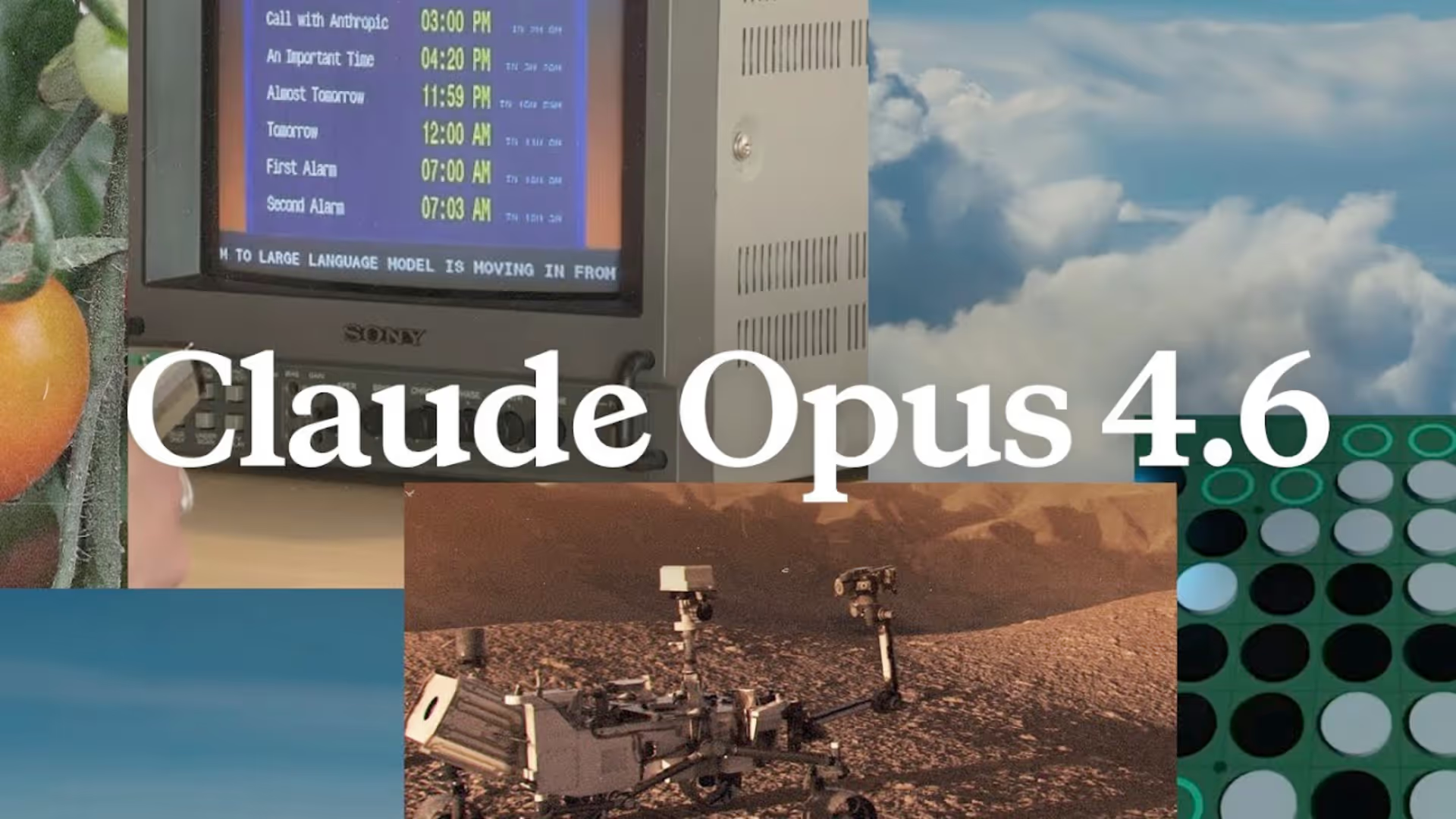
Just hours after OpenAI's announcement, Anthropic released Claude Opus 4.6 on February 5, 2026, featuring significant improvements in coding capabilities and a groundbreaking "agent teams" feature that enables multiple agents to collaborate on complex tasks by segmenting work.
The model now operates with a 1 million token context window (in beta), allowing it to process entire codebases in a single session. Claude Opus 4.6 demonstrates improved code review, debugging skills, and the ability to sustain agentic tasks for longer periods with better planning.
Business Impact: The agent teams capability addresses a critical enterprise need: breaking down large projects into manageable components while maintaining consistency across the entire workflow. For software development teams, the million-token context window means AI can finally understand and work with production-scale codebases rather than isolated code snippets.
Market Reaction: The release triggered significant market volatility, with software stocks experiencing a trillion-dollar selloff as investors reassessed the competitive landscape for traditional software companies facing increasingly capable AI alternatives.
NVIDIA Rubin Platform Enters Production with Microsoft Azure
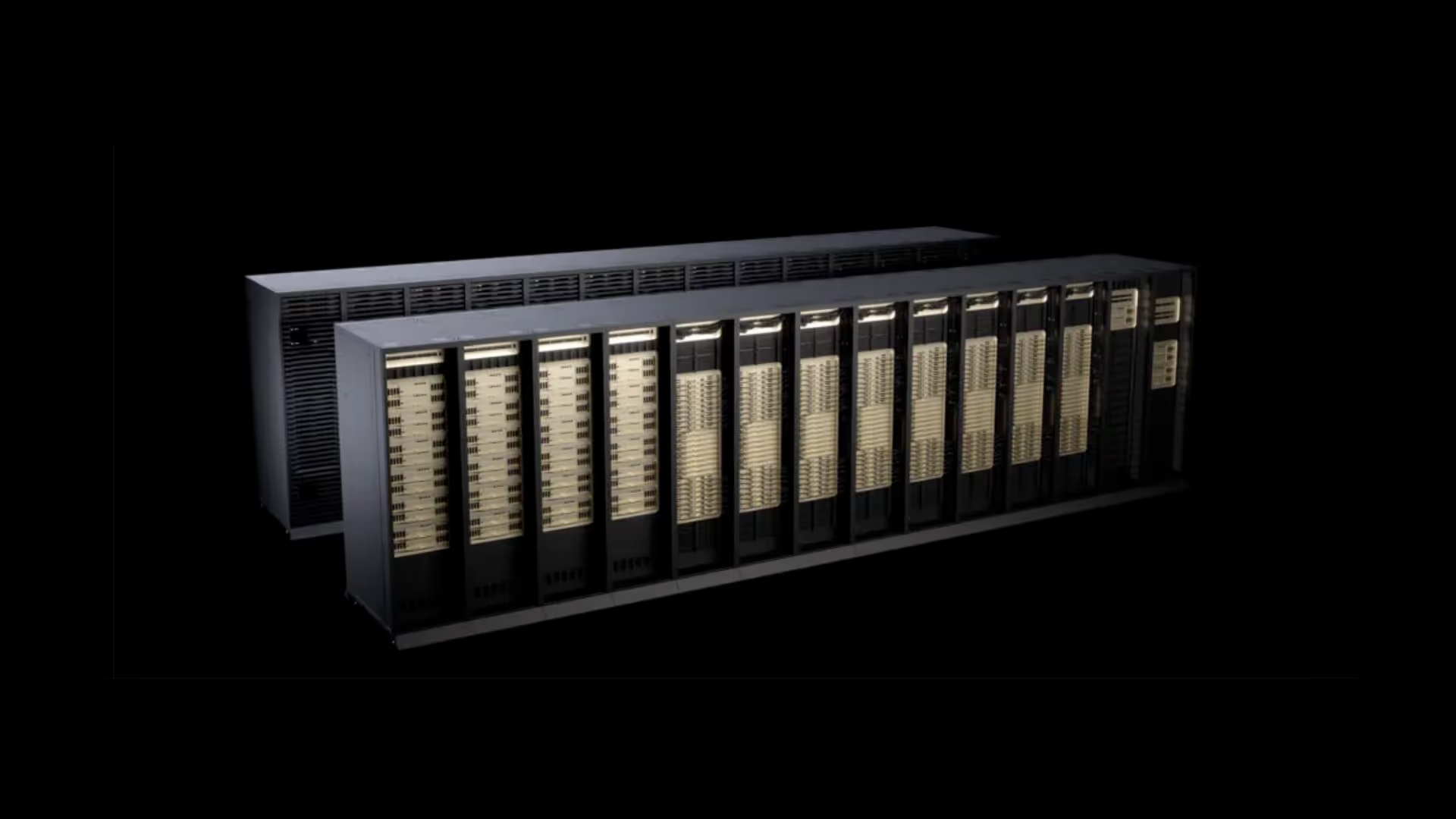
Microsoft announced that its next-generation Fairwater AI superfactories in Wisconsin and Atlanta are ready to deploy NVIDIA Vera Rubin NVL72 rack-scale systems. The Rubin platform delivers 50 PF NVFP4 inference performance per chip—a 5x improvement over current Blackwell systems—while reducing inference costs by 10x.
Microsoft's strategic datacenter planning anticipated Rubin's power, cooling, and networking requirements, enabling seamless integration without major infrastructure overhauls. Azure is expected to offer Rubin-based instances in H2 2026, alongside AWS, Google Cloud, and Oracle Cloud Infrastructure.
Business Impact: The 10x cost reduction for AI inference directly addresses the primary barrier to enterprise AI adoption: computational expense. As inference costs plummet, previously uneconomical AI use cases become viable, potentially accelerating enterprise deployment of AI agents and multimodal applications.
Chinese AI Competition: DeepSeek V4 Targets Coding Dominance
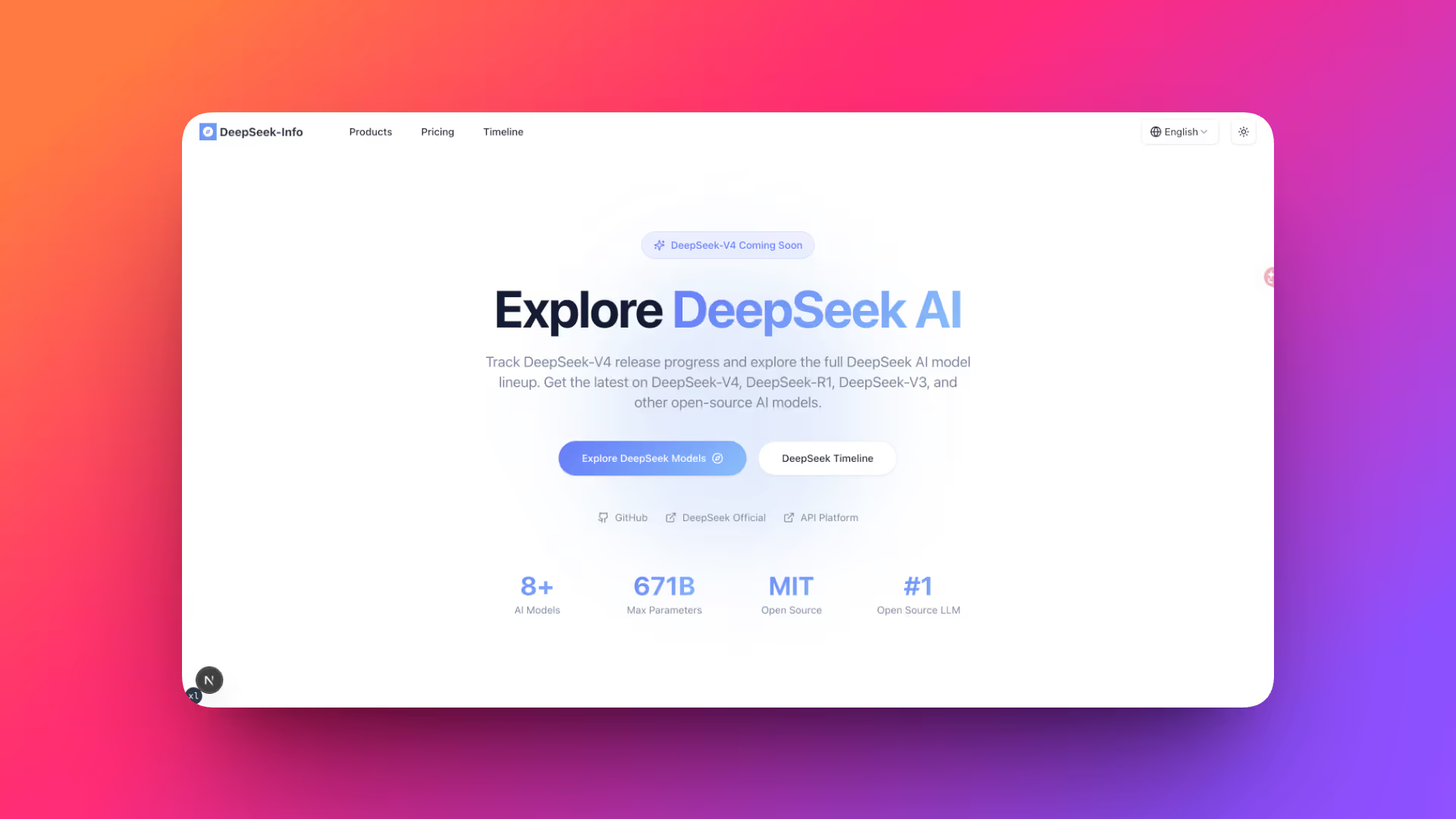
DeepSeek is preparing to release V4 around February 17, 2026, with leaked internal benchmarks suggesting performance that exceeds Claude Opus and GPT-5.3 Codex in long-context code generation. The model features 1M+ token context windows powered by Engram conditional memory technology and is designed to run on consumer-grade hardware (dual RTX 4090s or single RTX 5090).
Business Impact: If DeepSeek V4 delivers on its benchmarks as an open-source model, it could dramatically shift the competitive landscape. Enterprises would gain access to frontier-class coding AI without licensing costs or API dependencies, enabling on-premises deployment for sensitive codebases.
Perplexity Model Council: Multi-Model Answer Synthesis

Perplexity launched Model Council on February 5, 2026, enabling users to run queries across three frontier models simultaneously (Claude Opus 4.6, GPT-5.2, and Gemini 3.0). A synthesizer model reviews all outputs, resolves conflicts, and delivers a unified answer that highlights agreement and differences.
Business Impact: For investment research, legal analysis, and high-stakes decision-making, Model Council addresses the "AI confidence gap" by providing cross-validation from multiple independent models. This approach significantly reduces hallucination risks and improves answer reliability.
Quick Bytes
- Google Gemini 3 Series: Google released gemini-3-pro-preview with enhanced reasoning and agentic capabilities, plus expanded Workspace AI access across Gmail, Docs, and Classroom
- AI Enterprise Adoption: Survey data shows 72% of enterprises have adopted at least one AI capability, but only 8.6% have AI agents deployed in production
- Alphabet Capital Expenditure: Google announced capex will double to $175-185 billion in 2026 to expand AI compute capacity
- Venture Capital Activity: AI startups raised over $25 billion in January 2026 alone, with OpenAI and Anthropic both working on $20B+ funding rounds
Industry Impact Analysis
The convergence of enterprise agent platforms (OpenAI Frontier, Anthropic agent teams), dramatically lower inference costs (NVIDIA Rubin), and multi-model validation tools (Perplexity Model Council) creates the infrastructure necessary for AI to move from experimental pilots to production deployment at scale.
The competitive dynamics are shifting rapidly. Chinese AI labs like DeepSeek are demonstrating that frontier performance no longer requires Western-scale capital expenditure. Open-source models running on consumer hardware challenge the assumption that AI leadership belongs exclusively to companies with billion-dollar training budgets.
For enterprises, the strategic imperative is clear: 2026 is the year to move from AI experimentation to production deployment. The platforms, performance, and cost economics are finally aligned to support genuine business transformation rather than proof-of-concept demos.
Azumo: Your Partner in AI Transformation
As enterprises navigate this rapidly evolving AI landscape, having a strategic partner with deep technical expertise becomes critical. Azumo helps organizations architect, implement, and scale AI solutions that deliver measurable business value—not just impressive demos.
Our teams work across the entire AI stack, from selecting the right models and platforms for your specific use cases to building the custom infrastructure and workflows that transform AI capabilities into competitive advantages. Whether you're deploying your first AI agents or scaling to enterprise-wide automation, Azumo provides the engineering excellence and strategic guidance to accelerate your AI journey.
Learn more about how Azumo can help your organization harness AI for competitive advantage: https://azumo.com/artificial-intelligence
Sources
- Introducing OpenAI Frontier - OpenAI, February 5, 2026
- OpenAI launches a way for enterprises to build and manage AI agents - TechCrunch, February 5, 2026
- Anthropic releases Opus 4.6 with new 'agent teams' - TechCrunch, February 5, 2026
- Introducing Claude Opus 4.6 - Anthropic, February 5, 2026
- Anthropic launches Claude Opus 4.6 as AI moves toward a 'vibe working' era - CNBC, February 5, 2026
- Microsoft's strategic AI datacenter planning enables seamless, large-scale NVIDIA Rubin deployments - Microsoft Azure Blog, 2026
- NVIDIA Kicks Off the Next Generation of AI With Rubin — Six New Chips, One Incredible AI Supercomputer - NVIDIA Newsroom, 2026
- DeepSeek V4 Targets Coding Dominance with Mid-February Launch - Introl Blog, 2026
- DeepSeek V4: Everything We Know About the Upcoming Coding AI Model - WaveSpeedAI Blog, 2026
- Introducing Model Council - Perplexity, February 5, 2026
- Perplexity Launches Model Council for Multi-Model Research - Auto-Post, 2026
- The State of AI Enterprise Adoption in 2026 - Codewave, 2026
- AI Updates Today (February 2026) – Latest AI Model Releases - LLM Stats, February 2026
This newsletter is curated by Azumo's AI Intelligence Scanner to help enterprises stay ahead of critical AI developments that impact business strategy and technology roadmaps.