
.svg)


Year-End AI Briefing: Execution, Infrastructure, and Competition
Executive Summary
The final week of December 2025 delivered transformative developments that will reshape enterprise AI in 2026. Anthropic launched Claude in Chrome, bringing autonomous browser control to AI agents through the Model Context Protocol. Nvidia announced its largest acquisition ever with a $20 billion purchase of AI chip startup Groq, consolidating its infrastructure dominance. Amazon entered negotiations for a $10 billion investment in OpenAI, potentially disrupting Microsoft's exclusive partnership. Meanwhile, AI startups raised over $5 billion in new funding, and Google released Gemini 3 Flash for high-speed developer workflows. These developments signal an industry entering its most competitive and capability-rich phase yet.
Top AI Developments
1. Anthropic's Claude in Chrome: AI Agents Take the Wheel

On December 18, 2025, Anthropic launched Claude in Chrome to all paid users, introducing the first production-ready AI agent capable of autonomous browser control. The integration represents a fundamental shift from AI assistants that suggest actions to agents that execute them.
Claude Code now connects directly to Chrome through a native extension, gaining access to page navigation, form completion, button clicks, console log monitoring, network request inspection, and GIF recording of browser interactions. Users activate the feature by running /chrome in Claude Code, creating a persistent connection that works across any authenticated website.
The architecture leverages the Model Context Protocol, which Anthropic donated to the Linux Foundation's new Agentic AI Foundation on December 9. MCP provides the universal standard enabling Claude to interact with browser DOM elements, APIs, and tools through a unified interface. Since its November 2024 release, the MCP ecosystem has grown to over 75 official connectors and thousands of community-built servers.
Technical Capabilities
Unlike screenshot-based approaches requiring manual image uploads, Claude in Chrome operates through direct API access. The agent can read accessibility trees, find elements using natural language queries, execute JavaScript in page context, scroll elements into view, and upload previously captured screenshots to form inputs or drag-and-drop targets.
For developers, this enables debugging live applications, automating repetitive web tasks, testing cross-browser workflows, and building AI-powered browser automation scripts. Enterprise teams can deploy Claude to handle form-intensive processes, data extraction from legacy web interfaces, and quality assurance testing.
Safety and Security
Anthropic implemented multi-layered protections against prompt injection attacks, reducing success rates from 23.6% to 11.2% through automated intervention systems. The agent blocks interaction with high-risk categories including financial services, adult content, and pirated material. Users must explicitly approve actions involving sensitive data, downloads, or irreversible operations.
The system distinguishes between user instructions and web content attempting to manipulate the agent. When Claude encounters embedded instructions in page content, it stops execution and requests explicit user confirmation before proceeding.
Business Impact
Claude in Chrome eliminates the friction between AI capability and web-based workflows. Organizations can now deploy AI agents to handle browser-dependent tasks that previously required human intervention: legacy system data migration, multi-step web research and compilation, CRM and ERP data entry automation, and cross-platform testing and validation.
The December 18 announcement noted that planning mode is forthcoming, enabling Claude to generate step-by-step execution plans for user approval before taking action. A shortcuts gallery will provide pre-built workflows for common automation tasks.
2. Nvidia's $20 Billion Groq Acquisition: Consolidating AI Infrastructure
On December 24, 2025, Nvidia announced its largest acquisition in company history: the purchase of AI chip startup Groq for approximately $20 billion. The deal consolidates Nvidia's position as the dominant end-to-end AI infrastructure provider.
Groq specialized in Language Processing Units optimized for low-latency inference, achieving speeds up to 10x faster than traditional GPU-based systems for specific workloads. The company raised $750 million at a $6.9 billion valuation just three months before the acquisition, with investors including BlackRock, Samsung, Cisco, and Altimeter.
Nvidia CEO Jensen Huang stated the acquisition will integrate Groq's low-latency processors into Nvidia's AI factory architecture, creating a comprehensive stack spanning training, fine-tuning, and ultra-fast inference. The combination addresses the growing demand for real-time AI applications requiring sub-100-millisecond response times.
For enterprises, the acquisition signals Nvidia's strategy to own the complete AI hardware value chain. Organizations investing in Nvidia infrastructure gain access to optimized pathways from model training to production deployment, reducing integration complexity but increasing vendor lock-in.
3. Amazon's $10 Billion OpenAI Investment: The Microsoft Challenge
In mid-December 2025, reports emerged that Amazon entered negotiations to invest $10 billion in OpenAI, potentially valuing the company above $500 billion. The deal would represent Amazon's most aggressive move yet to challenge Microsoft's AI dominance.
The investment includes OpenAI's adoption of Amazon's Trainium chips for model training, directly competing with Nvidia's GPU monopoly and strengthening Amazon's position in AI hardware. In exchange, Amazon would integrate ChatGPT technologies across AWS enterprise services, creating an alternative to Microsoft's Azure OpenAI Service.
Microsoft currently holds a 27% stake in OpenAI with exclusive rights to commercialize OpenAI models through Azure. The Amazon partnership would introduce dual-platform access, fragmenting OpenAI's distribution and potentially forcing Microsoft to renegotiate terms.
For enterprises, the development promises competitive pricing pressure and reduced dependency on Microsoft's ecosystem. Organizations using AWS infrastructure would gain direct access to GPT models without cross-cloud integration, simplifying architecture and potentially reducing costs.
4. Google's Gemini 3 Flash: Speed-Optimized AI for Developers

On December 10, 2025, Google released Gemini 3 Flash, a lightweight model optimized for high-speed, high-volume applications. The model features the same massive context window as Gemini 3 Pro while delivering responses at significantly reduced latency and operational cost.
Gemini 3 Flash targets real-time use cases including live translation services, rapid coding assistance, high-volume customer support, and data processing pipelines requiring low-latency responses across millions of requests. Google positioned the model as the default for Gemini app and AI Mode in Search, exposing it to global scale immediately.
The release complements Nvidia's December 17 launch of Nemotron 3, a series of open reasoning models in three sizes (Nano 30B, Super 100B, Ultra 500B) optimized for agentic AI systems operating across multiple agents and extended contexts.
5. AI Funding Surge: $5+ Billion in December Deals
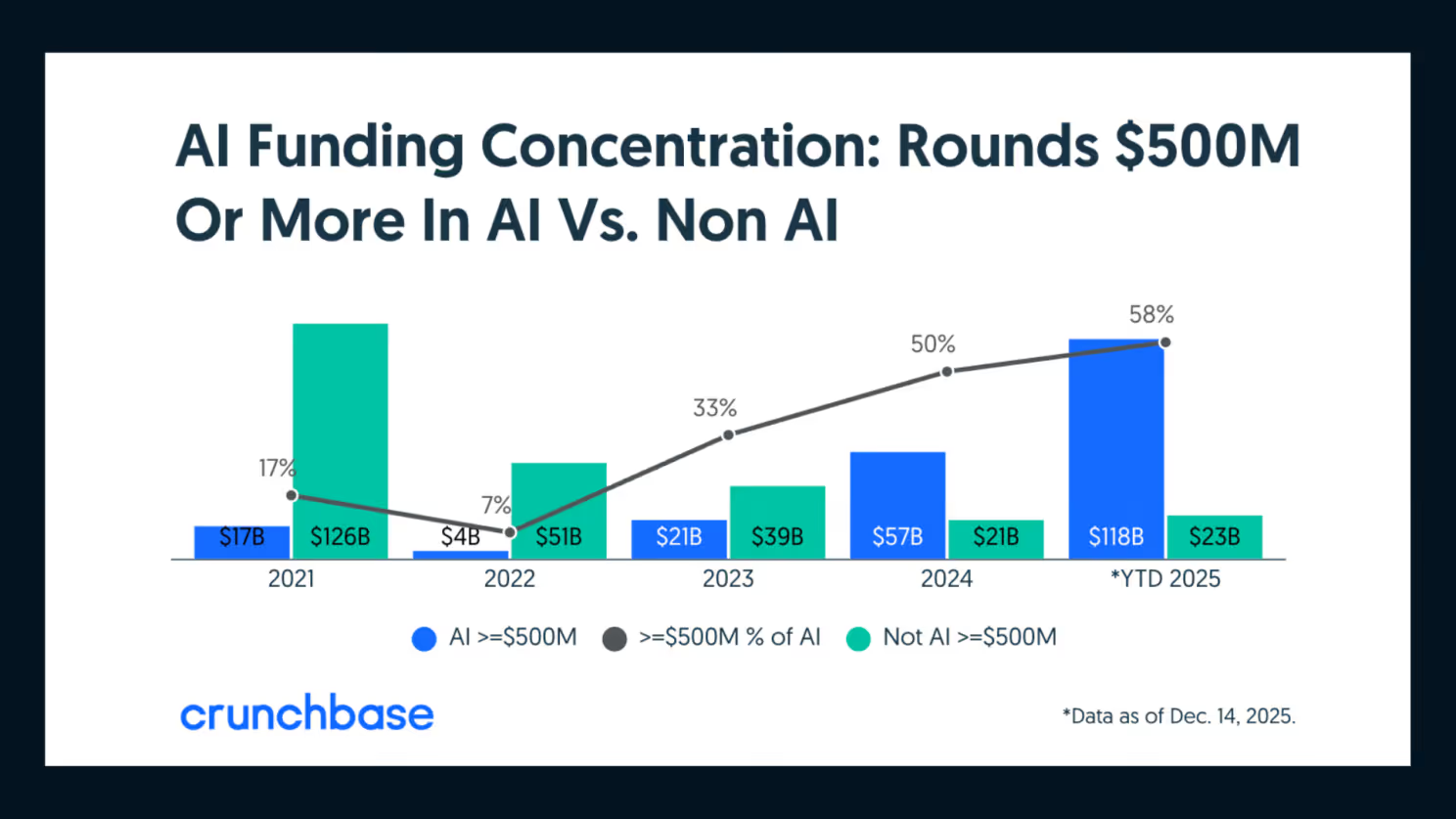
December 2025 saw unprecedented funding activity as AI startups raised over $5 billion across multiple mega-rounds:
- Unconventional AI raised $475 million in seed funding at a $4.5 billion valuation, led by Andreessen Horowitz and Lightspeed Ventures. Founder Naveen Rao, former head of AI at Databricks, targets $1 billion total seed capital.
- Lovable, a Swedish AI development platform, secured $330 million Series B at a $6.6 billion valuation from Google's CapitalG and Menlo Ventures.
- Erebor Bank raised $350 million at a $4.35 billion valuation from Lux Capital, Founders Fund, and 8VC.
- Resolve AI achieved unicorn status with a $1 billion valuation Series A, developing autonomous site reliability engineering systems.
The funding activity reflects investor confidence despite broader economic uncertainty. AI captured nearly 50% of all global funding in 2025, totaling $202.3 billion versus $114 billion in 2024—a 75% year-over-year increase.
Industry Impact Analysis
The week's developments reveal three critical trends shaping 2026:
Agent Infrastructure Maturation - Claude in Chrome represents the first mainstream deployment of autonomous AI agents with real-world access. The shift from suggestion to execution fundamentally changes enterprise AI adoption, moving from productivity enhancement to process automation.
Platform Consolidation - Nvidia's Groq acquisition and Amazon's OpenAI investment demonstrate platform providers racing to control end-to-end AI stacks. Organizations must evaluate vendor strategies carefully as integration advantages increase alongside lock-in risks.
Speed as Differentiation - Google's Gemini 3 Flash and Nvidia's Nemotron 3 focus on latency optimization reflects market maturation. As model capabilities approach parity, competitive advantages shift to operational efficiency, cost structure, and inference speed.
Looking Ahead
As 2025 closes, the AI industry enters 2026 with unprecedented capability, competition, and capital. The technologies deployed this week—autonomous browser agents, consolidated infrastructure, multi-platform model access, and speed-optimized inference—represent the foundation for enterprise AI transformation at scale.
For organizations navigating this landscape, strategic priorities include evaluating agent frameworks for process automation, assessing multi-cloud AI strategies to reduce vendor lock-in, implementing governance frameworks for autonomous AI systems, and optimizing for inference cost and latency in production deployments.
Azumo provides end-to-end AI implementation services that transform cutting-edge capabilities into measurable business outcomes, helping enterprises navigate the complexity of autonomous agents, multi-model architectures, and production-scale AI systems through proven methodologies and deep technical expertise.
Sources
- Piloting Claude in Chrome - Anthropic, August 2025
- I Tested (New) Claude Code Browser Feature - Medium, December 2025
- Anthropic launches Claude for Chrome in limited beta - VentureBeat, August 2025
- Donating the Model Context Protocol - Anthropic, December 9, 2025
- Nvidia buying AI chip startup Groq for about $20 billion - CNBC, December 24, 2025
- OpenAI in talks with Amazon about investment that could exceed $10 billion - CNBC, December 16, 2025
- Amazon Challenges Microsoft with Potential $10B OpenAI Investment - VoIP Review, December 23, 2025
- Google's year in review: 8 areas with research breakthroughs in 2025 - Google Blog, December 2025
- Ex-Splunk execs' startup Resolve AI hits $1B valuation - TechCrunch, December 19, 2025
- Unconventional AI confirms its massive $475M seed round - TechCrunch, December 9, 2025
- 6 Charts That Show The Big AI Funding Trends Of 2025 - Crunchbase News, 2025
This AI Intelligence Brief is generated by Azumo's AI research team to help enterprise leaders stay informed about developments that impact business strategy and technology roadmaps.